Tag Archives: cannon

Geek Related Gunpowder Weapons of Golarion

A while back, I took an initial stab at some firearm rules for Pathfinder 1e. But over the 15 years of the Reavers campaign I’ve been continuing to use and refine them. So now on the Rules You Can Use page is:

Geek Related Gunpowder Weapons of Golarion (7 page pdf)

Now, since I created mine back in 2009, Paizo came out with official firearm rules and then also cannon rules. But I still use mine. Why?

Early Personal Firearms
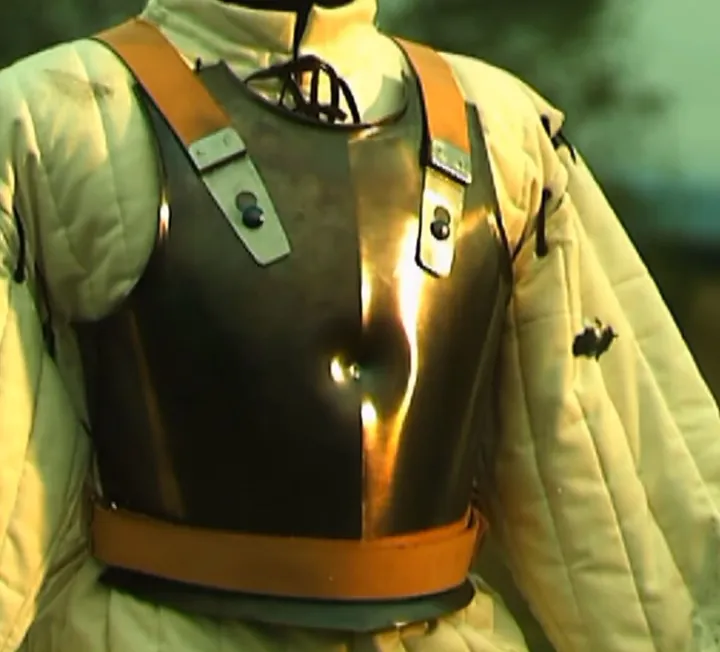
Well, the problem is that to make it easy to balance, Paizo made guns a lot like bows, especially damage wise. Bang, 1d8 damage! People want “consistent damage output” so they made them easy to reload quickly and/or have multiple barrels so you can get your multiple shots in a round. The main thing they added to power them up was to make them hit touch AC within the first range increment. But that’s a problem IMO – so magic plate armor, dragons, etc. are trivial to hit. Sure, “eventually firearms made armor obsolete” but an early flintlock bullet will deflect off a breastplate just fine.

I wanted to approach the topic with two equally important goals.
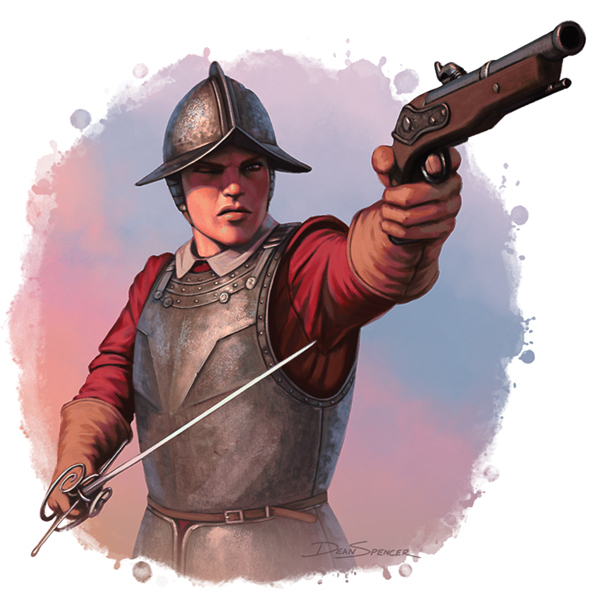
One, historical realism – at least a nod to it. One of the things I have loved about D&D in the 40 years I’ve played it is the exposure to history, technology, real stuff. This means slower reloads, misfires, high crits (the Paizo rules do have misfires and high crits, credit where credit is due), and so on. And related to this, fantasy trope fidelity – firing a pistol while laying about with a sword is a staple of some historical but certainly much fantasy fiction, and if a gun is just a bow then you will only have specialists. And while I do want early firearms in my game, I don’t want someone spewing out 4 shots a round, that’s for a modern game. I don’t really like the feel of a “gunslinger,” maybe a “musketeer” at maximum in a late middle ages/early Renaissance type setting.

Two, make them feel different than other weapon types. If having a gun is just a bow with a special effect, I’ll play Apocalypse World, thanks. If they’re not different texturally, why add them? Just for the fictional impact I guess, but – bah. To me the impact firearms should have is that you can’t fire historical firearms quickly – but if they hit you they will fuck you up. PCs above level 1 treat “a guy with a bow” with impunity unless he is also leveled. “Oh no, I might take about 4.5 points of damage!”

This is easily done – just use a slower reload and put more punch into each hit. Instead of “reload a pistol as a standard action, or move action with a feat, or just all the time if you’re a gunslinger, and then shoot for 1d8 damage” I went with “reloading a pistol takes 2 full rounds, or 1 with a feat, and then shoot for 2d6 damage.”

Suddenly there’s a lot more reason for a melee person to carry a pistol to shoot as they close, or pull and shoot at someone strategic in battle that they can’t get to. And a reason for a gun-wielder to carry a brace of pistols (like, you know, real people did). With these rules combats feel more like fictional early firearm battles (The Patriot… Van Helsing/Solomon Kane era stuff…). It also makes a massed squad of musketeers, for example, something to give PCs pause.

Early Cannon

Same with cannon. Slow but super dangerous – though mostly to ships and buildings and not people, unless loaded with grapeshot.
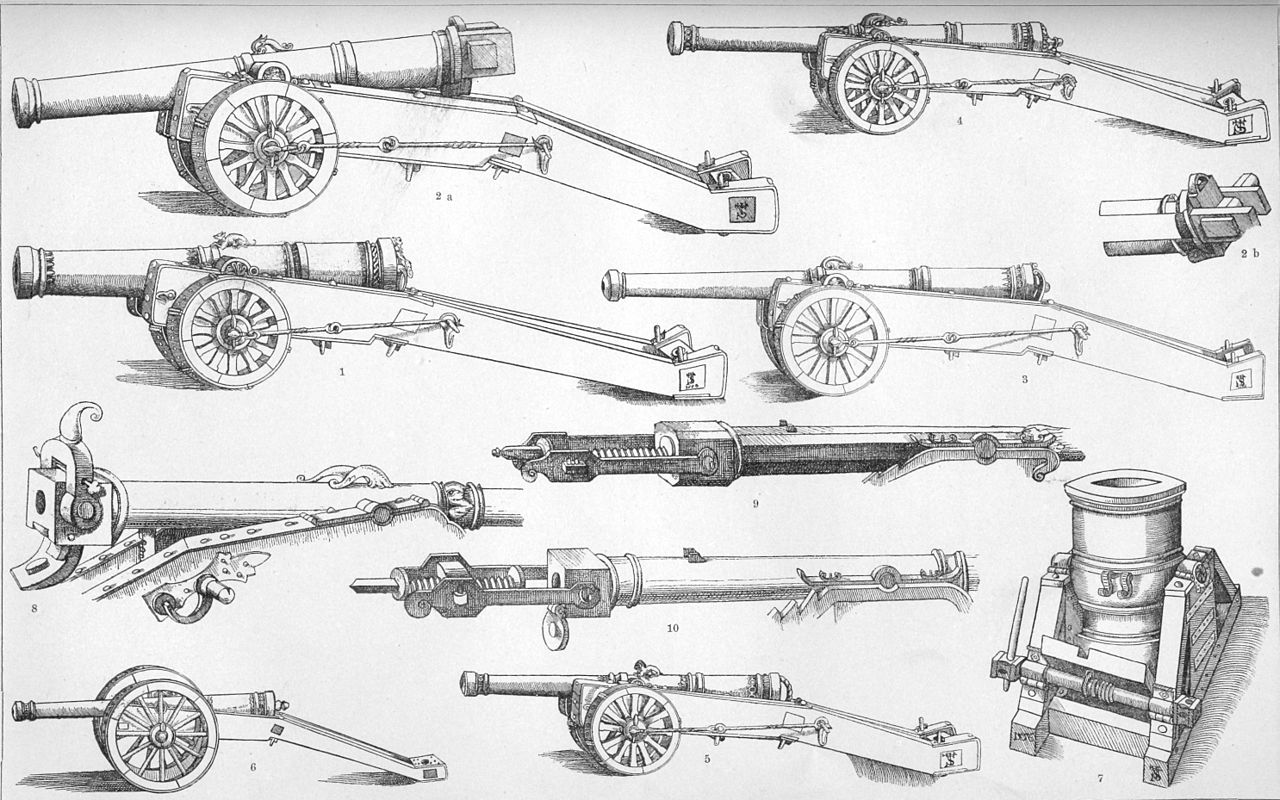
I get some people “don’t want gunpowder in their D&D.” I don’t get that, I just want “historically appropriate for the late medieval era” in my D&D. And Europe had cannon as early as the 1300s (and earlier, in other places), and by the usual late-1400s kind of representative “hybrid medieval/Renaissance” D&D era that most general published settings, including Golarion, trade in, they were definitely in use on the battlefield and on ships. But they are slow and ridiculously expensive.

The Pathfinder cannon rules are actually reasonably similar to what I had come up with, with slow reload and crewing requirements. But they were both way too inexpensive (especially for a world that tries to say “oh they’re only really available in Alkenstar and you know maybe a little in other places”) and don’t pack enough of a punch. “Oh no, I got shot by a cannon and took 6d6 damage.” That’s 21 points of damage, also known as “a melee attack routine from a low level PC” or “the shitty low level fireballs that are why people say playing an evocation mage is a trap.” And their ranges are crazy short (100 ft. range increment).

What I wanted from cannon was to be long range and devastating, but rare due to expense and slow to fire and mostly for structures but still a threat to individuals. So my basic 12-pounder cannon does 7d10 damage every 4 rounds vs 6d6 every 4 rounds for the Paizo version. (Again, they balance it with the touch attack mechanic). It’s actually less expensive than its Paizo equivalent – my 12-pounder is 4000 gp and 120 gp of black powder to fire vs Paizo’s is 6000 gp and 100 gp of black powder to fire, maybe I should adjust that. (A wand of fireballs is 11,250 gp, for comparison.)

And my range increment is 500 feet. I know, all Pathfinder/D&D weapons have pathetic range compared to real life. But the role of cannon should be a super-ranged threat. Can you even get into fireball range before taking a volley? How many shots can your ship take as you close to board? It provides a different strategic element, not just a new skin on an existing strategic element.

Magic and Alchemical Firearms

Now, the other thing I do is to make enhancements to firearms very rare. They are brand new. You can find ancient enchanted swords from wizards over the last millenia but firearms and cannons are from the now, and tech and magic are somewhat opposed (both because wizards like niche protection but also somewhat fundamentally, in my view, built over decades of D&D lore that support that view). I think the “Paizo answer” to firearms and cannon is that you just boost the otherwise sad damage with magic, or with explosive shot and stuff that are, frankly, later tech level.

Conclusion

Now, the Paizo rules aren’t bad – they do most of what I want out of firearm and cannon rules, actually. I just think that it is way more interesting for the role of early firearms to be a slow loading big punch and the role of cannon to be a slow loading big punch at very long ranges. So, feel free and use these if you agree!

Let me know how you use guns and cannon – and especially what the feel of the rules you use adds to your game.

Cannon for Pathfinder

Field Grade Weapons

Most cannon are cast bronze, smooth bore, muzzleloading weapons, although some are breech-loading and older ones are constructed of iron bars welded and bound together. Because they are expensive and rare, many cannons are ornately carved and decorated, and larger ones often have unique names.

Cannon

Name	       Cost	  Damage   Weight      Range        Mount	Crew	Ready
Bombard	       10,000 gp  12d10    8000 lbs.   400 ft.	    -		6	10/4
Cannon          8,000 gp  10d10    6000 lbs.   300 ft.	    Very Heavy	5	6/3
Demi-cannon     6,000 gp   8d10	   4000 lbs.   250 ft.	    Heavy	4	5/2
Culverin        4,000 gp   6d10	   3000 lbs.   200 ft.	    Medium      3	4/2
Small culverin  2,000 gp   4d10	   2000 lbs.   150 ft.	    Light       2	3/2
Swivel-gun      1,000 gp 2d10/4d6   200 lbs.   100 ft./25 ft.	-	1	2/1

Damage: Assuming solid shot, this is the damage done on a direct hit. Cannon (with the exception of swivel-guns) cannot effectively be aimed at a specific person, but instead are aimed at a specific area with the intent of damaging a structure. Monsters that are size Huge or larger can be individually targeted (assuming they stay still for the several rounds needed to aim and fire the weapon). When a cannon hits its target area, it only does its listed damage to that 10x10x10 part of the structure, not any creature there. (On a natural 20, the cannon hits an unlucky person in that area dead on and does full damage to them as well.) However, cannons often do splash damage. If the cannon is using stone shot and firing into a stone environment (like most towns), this damage comes from stone fragments (slashing), or if the cannon is using any solid shot and firing into a wooden environment (like a ship), the damage comes from wooden shivers (piercing). Anyone in the 10×10 target area must make a DC 15 Reflex save or else take ¼ the direct damage inflicted by the shot from the fragments. For example, if a PC is hiding in a 10×10 wooden shack that is hit by a culverin inflicting 35 points of damage on the structure, he may take 8 points of fragment damage if he fails his save.

Crew: All members of the crew must have at least one rank in Profession: siege engineer.

Ready: Cannons all require the listed number of full round actions to reload and then aim with a normal crew. They must be re-aimed every time they are fired because their recoil moves them significantly out of place. If they are operated with a smaller crew than the listed minimum, the time it takes to reload them is proportionately longer.

Proficiency: All cannon require Profession: Siege Engineer (or Artillerist, or Cannoneer, or whatever you want to call it) to operate.

Inaccurate: All cannon have an inherent -4 to hit penalty due to the difficulty of aiming them precisely. This penalty may be reduced by 1 for every 5 points the gunner has in Profession: siege engineer. A gunner uses their base attack bonus, Int bonus, and other modifiers for range, vision, motion, etc. to determine their total attack bonus.

Misfire: Whenever you roll a natural 1 on an attack roll made with a cannon, the cannon might misfire. The crew chief must immediately roll a Profession: siege engineer check at DC 15 (the rest of the crew may assist). A successful check indicates that the wad simply misfired and the cannon must be reloaded. A failure by up to 5 indicates that the cannon is fouled and requires 2 full rounds to clear before it can be reloaded. A failure by up to 10 means that the cannon gains the broken condition and requires repair before further use. A natural 1 on this check means that the cannon has exploded and does its full normal damage to everyone and everything within 10 ft.

Weapon Descriptions

Bombard: Very large caliber front-loading cannon used in sieges. They fire hundred pound stone balls. Bombards are too large for most ships to carry. A variant of bombard that is used for indirect fire is called the mortars.

Cannon: A heavy bronze cannon firing a 36 to 50 pound shot, also known as a basilisk. These usually can only be placed on the bow mount of very large galleys.

Demi-Cannon: Also known as the cannon-perier, it fires a 24 pound shot. This is the heaviest weapon that can be fired from the side of a ship, and a large ship at that.

Culverin: The culverin is a medium cannon firing an 18 lb shot. These are the most common large weapon mounted broadside on sailing ships.

Small Culverin: Also known as the demi-culverin, this weapon fires a 10 lb shot and is suitable for mounting on many ships, including on the top deck.

Swivel-gun: Swivel-guns, which come in varieties also known as falcons, falconets, or robinets, can take a 1-2 pound solid shot or be filled with a dozen pistol shots. They do 2d10 damage with solid shot, but when loaded with pistol shot do 4d6 damage, less 2 points per range increment, in a 10×10 square. A gunner applies their Dexterity bonus to hit instead of their Int bonus with a swivel-gun.

Ammunition: stone or lead solid shot are the most common ordnance in cannon. There is also chain or bar shot which is effective against rigging (normal solid shot passes through rigging doing only minimum damage). Grapeshot or canister shot can also be used; this does not do structural damage but targets the crew, doing half the listed damage to all crew in a 10x10x10 area.

Analysis

Taking the Stormwrack method of doing ship damage, where e.g. a caravel has 24 hull sections with hardness 5 and 80 hp each, and six must be destroyed to sink the ship – it requires 3-4 good hits with a culverin to destroy one 10x10x10 section. Given that the cannon can only fire slightly better than once a minute, that’s a good balance of enough damage with promoting resolution by boarding and melee. A heavily armed small carrack might sport 2 culverins below and 5 demi-culverins on deck per side, which at that rate could sink a ship of its class but only with some work.

Example of cannon fire: A pirate sloop approaches a merchant caravel and decides to soften them up a bit before closing. They aim their two starboard culverins and fire. The base AC to shoot a caravel is -3 because it’s just a big ass object really (value taken from Stormwrack), or AC3 if you want to shoot at a specific section. In this case the pirates just want to hit wherever on it to demoralize the crew. The ships are 200 yards apart, which is three range increments out for the culverin (-6 range). There is a moderate wind (no penalty) and both the firing platform and the target are moving (-5 for each, says Stormwrack, though that seems high ). Total AC to hit is 13. The master gunner (+5 BAB, +2 Int, 10 ranks in Prof: SE) and a crew of three is manning one gun and a bunch of gunner pirate mooks (+2 BAB, +0 Int, 3 ranks in Prof: SE) are manning the other. So the two shots are +5 vs AC 13 (about a sure thing) and -2 vs AC 13 (hit about half the time).