Tag Archives: D&D

Second Curse of the Crimson Throne “Skeletons of Scarwall” Session Summary Posted

We continue to clear Castle Scarwall in Part II of Skeletons of Scarwall (8 page .pdf).  Two more of the four sub-bosses, a devil bat lady (who really reminds me of an enemy from some video game I can’t place) and a shadow dragon, fall to our swords and sorcery, leaving only one sub-boss to go and then the main boss – who we already killed once before, so no worries there.  Our party is only three strong, but we are mighty!

The main challenge is keeping enough spells held back to take care of Shadow Count Sial when he finally decides to turn on us.  He’s acting even twitchier than usual and it’s clearly only a matter of time.  I hope Laori sides with us and not him when it all goes down.  Though Annata’s not quite sold on the hot girl-on-girl Laori proposed last session, she’s been a good friend so far.

We hit level 13 at the end of the session.  For Annata, I’m thinking adding a level of Crusader (a holy martial artist from Tome of Battle: The Book of Nine Swords) to get more combat prowess.  She’s supposed to be a holy warrior but her damage sucks (1d6+2 whether you need it or not!).  She’s finally worked through the feat chains to add one of the Pathfinder beta crit feats, which will help…  She could make her crits fatigue, stagger, sicken, or bleed an opponent, I’m still deciding which.  But with Crusader she’d get all kinds of nice boosts.  Paul’s letting me swap out Stone Dragon school for Desert Wind school to match Sarenrae’s sun focus, though counting the powers as one level higher.  I’m thinking Death Mark, Fan the Flames, Flashing Sun, Foehammer, Divine Surge, and Thicket of Blades stance.  Although Iron Guard’s Glare is also attractive, and if combined with Fire Riposte and Holocaust Cloak, and potentially the various fire shield magics Annata has available to her, could be compelling.

It’s a shame to lose a level of spellcasting, but truth be told, seventh level cleric spells suck.  First of all, there’s not enough of them.  And four of those, really the only good ones, are basically the same spell (dictum/holy word/blasphemy/word of chaos).  Spells like Holy Word and Disrupting Weapon suck because they specify that they only affect creatures of less than your caster level.  So they’re no use on big bads, they are only mook-mowers, and we have plenty of other mook-mowing options. The symbol spells which also take up several spots on the spell list suffer from the same issue.  She’ll miss the level bump to Channel Energy way more.

Hot Girl On Girl Action In Our D&D Campaign?

In our last Curse of the Crimson Throne episode, my character Annata had a surprise sexual proposition from her friend Laori.  I was faced with the decision of whether or not to give in to the frenzied cries of “We want slashfic!” from my fellow party members.  I made my decision, but as I reflected on the thought process I went through to arrive at it, I started to consider the nature of that process.

For some reason, there is very little talk out there about how people actually conduct character immersion in role-playing games.  I suspect it’s the minority that do it at all; many people deliberately reject it and even those who talk about in-character play seem to equate it to things like “using funny voices” or other trivia that reveal that they don’t really understand what immersion, in my opinion, really is.  I wanted to share the method behind how I run “in character” and hopefully get some insights from others out there who do the same.

Here’s some background on the situation in the game to provide a shared context.  My character, Annata, is a priestess of Sarenrae, sun goddess of redemption.  She grew up on the streets as part of a Fagin-style child crime group.  She escaped to the church and grew up there.  She was in the big city of Korvosa and worked as a physician, so she wasn’t cloistered and isn’t ignorant of the world, but her semi-isolation in living arrangements  and total devotion to her duties kept her from “dating” per se.  And long story short, now she’s an adventurer.

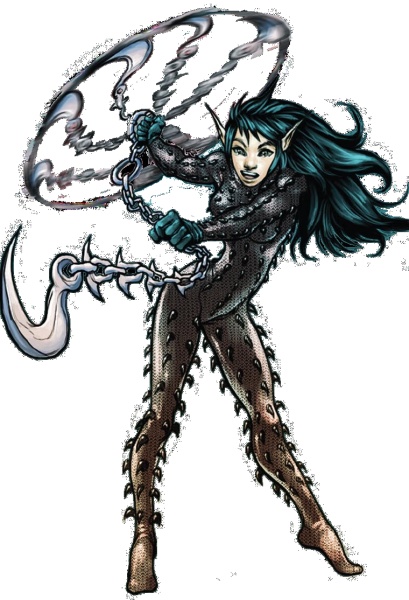
Our group met an odd woman, a “Forsaken” elf (Annata’s not 100% sure what that means) named Laori, and have adventured with her on and off.  She’s a cleric of Zon-Kuthon (think the Cenobites from Hellraiser).  Normally that would be “bad,” but her and her organization’s goals align with our heroes’.  And more than that, she’s likable.  She’s a happy, peppy, and perky (if evil) S&M Gothchick.  Sarenrae’s faith is very ecumenical, and her personality is a lot like Annata’s, so they took to each other quickly and became friends.  All the guys think (from a distance) that she’s hot; here’s the somewhat anime-looking artist’s conception of Laori in her spiked chainmail catsuit:

Laori

Anyway, last session Annata and Laori were chattering away and kinda out of nowhere, she lets me know that she wouldn’t mind getting more intimate with me.  Annata does like Laori; she’s a peppy chirpy cleric too and she definitely saw her as (platonic) girl-friend material, but this was a surprise twist she didn’t see coming.

Interesting! So here’s a peek into how my thought process went. I admit it’s a mix of true immersion and metagame thinking about my character’s personality, but I find that necessary because you seldom have enough information about the fictional world to avoid the “meta” totally.

First, my immediate reaction was intuitive, a quick reaction based on my conceptualization of Annata’s personality. Is it completely out of the question?  No.  Is it a slam dunk? No.  I could see it going either way.

I made a quick roll.   I like to use dice in these kinds of situations. Some people object to this and think any kind of personality mechanic, even an informal appeal to  fate like this one, is “roll-playing” and not immersion.  But in my opinion, the only way to truly simulate real feelings in game is to add some randomization. In the real world, attraction and the like don’t follow any automatic rules. You don’t control who YOU are attracted to.  You may have a “type” but the factors that go into it are too many to be deterministic.  If she had been propositioned by some random person she didn’t know or didn’t like, then I wouldn’t make a roll. If it was some guy she was totally into, then probably I wouldn’t roll either – unless in my opinion the situation was off enough that she might react poorly. In this case, I did what I usually do – a d20 roll, higher means more positive, with vague modifiers applied mentally. Think of it as the other person making a Charisma check. She’s made a handful of checks like this over the course of the campaign, when she’s met someone and I want to know “is chemistry kicking in.” So I made the roll. My gut was “if this isn’t real high, there’s no way.”  I don’t set hard thresholds and results (too much work!  The whole intuition plus roll happens in 5 seconds total), but in this case my gut said 1-5: Disgust, rejection, breaking off friendship; 6-10: Rejection, no explicit breaking off of the friendship but she won’t trust her afterwards; 11-15: Rejection but with friendship not severely affected; 16-20 Maybe, intrigued – not “Yes,” but “She’d think about it.”

Roll result – 18. That’s pretty high. Certainly not high enough for a good girl who has always thought of herself as straight to drop trou on the spot, but enough that after politely extricating herself, she found the idea unexpectedly intriguing and churned over it in her mind afterward in traditional woman-hashing-over-a-relationship fashion.

Here’s the mental path I went through.  Annata has been pretty staunchly straight so far; she was interested in two guys back in Korvosa (Grau, who was a bit of a project for her, and Vencarlo, a sophisticated older gentleman who ended up being the local equivalent of Zorro). Now, she is in love with Vencarlo, or thinks she is (it’s her first time in love). But he hasn’t reciprocated much, and since they both blew town she’s not sure if they’ll ever meet again. And she feels emotionally vulnerable, being away from Korvosa and all.  She’s heard of such things (woman on woman) but never thought about it herself.  What would Sarenrae do?

Meta-thinking comes in here.  I’m not sure if Sarenrae is for or against that kind of thing. One of the problems with fantasy religions is that there’s usually a lot undefined in terms of expected behavior of parishioners.   Is premarital sex OK at all?  Is homosexuality?  This is hard because these should be game “facts” and not subjective, which means I have to engage in metagame thinking. I decide that Sarenrae’s faith is probably not strictly against either, though general societal conservatism that would look down on both would be present.

Back to fully in-character.  Annata has often meditated upon the beauty of the goddess as part of her religion, though (it was the beauty of a statue of the Dawnflower that drew her when she was a street urchin).  Annata has gone through several emotional states in the campaign; when the group left Korvosa for the wilderness she transitioned from her current gig as somewhat strident wound-tight freedom fighter into a bit of a depressed martyr complex, but recently their time with the Shoanti barbarians ended up being kinda “Spring Break”-ey and she got to relax and party and open her mind, so she is in an experimental and confident kind of mood generally.  Laori is clearly a little S&Mey, which isn’t something Annata conceives herself as into, but she is pretty submissive and I can see the dynamics of a top/bottom relationship working there.  And finally, Annata is worried she might be embarrassed if the other guys found out – it might diminish her stature as a spirital leader in the party, generate jealousy, or just get her razzed more.  In the end, a lot of mixed feelings that don’t call for clear action one way or the other.

She thought over it long enough that the sheer weight of the analysis took some of the edge off – she’s not going to act on it (and probably won’t mention it happened). But she took it well enough that it won’t affect her friendship with Laori, and that means she might try again, and if it does it’s got a chance of going farther. I’m pretty comfortable that this is a realistic reaction – I’ve known a couple people over time who have been tempted (sometimes successfully, sometimes unsuccessfully) by a daring and insistent gay friend.

I haven’t gone into my method for how I play female characters; that’s a big topic and only peripherally relevant.  (Nor do I feel like I need to justify it; the people who are “against” crossgender play are wrestling with deep-seated emotional problems IMO.)  But suffice it to say the thinking through the various pros and cons I go through above is my attempt at a female approach to analyzing relationship issues, as opposed to the more… elemental typical male response.  (In this case, I am guessing the other two male PCs’ reaction would be “Hell yeah!” tempered only by explicit or implict fear that Laori would be the “top”.)  I wish I could do it more completely “in character,” but I find myself having to pepper the thought process with little meta-thoughts a lot.

I’m interested in how other people work through in-character issues. (I know some of you don’t, and think this is all weird, and say D&D is just for combat-n-fun… Feel free to not respond then.)  Do you use pure immersion (“I am Annata, and I think this…”), metagame evaluation of your character’s personality (“Annata has this in her background so she’d probably react this way…”) , randomization (“I roll d20 and… Annata likes it!”), something else I haven’t thought of, or a mix of these? And if a mix, in what proportions?

Probably one missing element is metagame group dynamics. “Would the other people at the table feel weird about this?” I almost totally omit that. Either I’m a role-playing purist, or I’m just a narcissist that doesn’t give a good goddamn what other people think, but there it is. Another is the narrativist approach, determining if this would make for a good story or not and deciding on those grounds. I do keep that in the back of my mind a little I guess… If I think it would generate a shit story I’d steer away from it out of fear of “ruining the game for everyone”.   I also try to remove “What I the player think about this” as much as possible.  Do I the player think Annata-on-Laori action would be hot; do I believe homosexuality is right, etc – I deliberately firewall that away (as much as is possible) in favor of my character’s personality and beliefs.  Or worse, what someone else thinks – I have little tolerance for people who interject with “Well, a good character/cleric/woman/etc. would…”  I politely encourage folks like that to close their filthy gobs.  And lastly, “acting.”  Immersion is akin to method acting, but in my mind the more commonly defined RPG actor stance – “using voices” and dramatic turns and flourishes – have jack crap to do with real in character play.

Thus after thinking about it, I’d have to say my pet “in character” thought process mix is:

  • As much immersion as I can (50%)
  • Metagame evaluation to fill in the gaps where I can’t fully immerse (35%)
  • Randomness where I think that human feelings should not be deterministic (10%)
  • A shade of “will this derail the story” in the back of my mind (5%)

I’m really interested in hearing other people’s method for “deep IC” play!

First Curse of the Crimson Throne “Skeletons of Scarwall” Session Summary Posted

We head out to haunted Castle Scarwall in Part I of Skeletons of Scarwall (8 page .pdf), the fifth and penultimate chapter of the Curse of the Crimson Throne adventure path.  Fighting undead is where Annata is a Viking, so we’re kicking bony ass and taking ghoulish names.  We were tickled to be fighting orcs and skeletons, it’s like we’re first level all over again.

I know it’s hard for a DM to run NPCs in a party, but these three Brotherhood of Bones hangers-on we have are worthless with a capital LESS!  Well, except for our favorite, Laori, who is always entertaining.  This session, she let Annata know she’d like to sleep with her!  I’m writing a separate blog post about how she dealt with that.  Will it violate the Paizo fansite license morals clause?  Find out, read the full summary!

At the end, we fought and slew what we think is the “main boss” but it didn’t lift the evil aura around the place; Paul was impressed that I then intuited we’d need to kill all the sub-bosses and then kill the main boss else he’d just respawn.   I’ve been playing RPGs and computer games for 25 years, I know how game designers think.

Let me say again for the record how sweet the Channel Energy power is for clerics in Pathfinder.  For those not familiar with it, Pathfinder replaced turning undead with “channeling energy.”  It heals people in short range and harms AND turns undead.  You can augment it with feats as Annata has – her channeling damages (but doesn’t turn) evil outsiders, she can make it heal only her allies (by default it heals everyone in range), and she’s quickened it to a free action with Quicken Turning.  It means that:

  • If you have a day where you’re not fighting undead, one of your major class powers isn’t worthless.
  • You can heal at range rather than always having to incur attacks of opportunity to go heal a comrade.
  • You can heal multiple party members at once.
  • You have loads of dice of healing that don’t eat up  your spell slots.  Thus you get to use spells for useful proactive things.
  • With the quicken, you aren’t wasting your time every round of combat with only healing.

Face it, as damage dealing has grown, Cure spells have not kept pace.  Even low level characters dish out or take like 20 points of damage a round – at our level, 80 points in a round isn’t uncommon and I’ve seen more than 100.  The usual 1d, 2d, 3d, 4d Cure spells are pretty much worthless in the face of that; I’d need ten minutes and my entire spell loadout to take care of just a couple rounds of combat.  So the channeling steps in to fill the gap and let the cleric do something in a round other than heal.  Neat!

WotC President Explains: “We Are Retarded”

ENWorld scores a interview with WotC president Greg Leeds in which he says nothing we didn’t already know about their recent move to yank all WotC/TSR products from electronic publishing via PDF from all channels without warning.  Except that PDFs are never coming back because of “them pirates.”  Why even do an interview if you’re not going to say anything?  Man, the marketdroids have really raped D&D’s corpse.  Alas.

I don’t know if they realize that before PDFs, enterprising pirates just scanned and OCRed the docs anyway.  This will change nothing in terms of piracy, and will only jack their customers.  But, after all their other moves, it’s clear they don’t really care about that.  They have the attitude that “all you little vermin need our product like it’s your drug, so we can be as exploitative as we want and you’ll still come crawling to us.”  (And frankly from reading ENWorld, there is a good subset of people for whom this is true.)

Wizards of the Coast’s Latest Dick Move

Wanted to buy a PDF of any Wizards of the Coast/TSR product ever?  TOO LATE!!!

It started with an email I got from Paizo:

Date: Mon, 6 Apr 2009 19:28:09 -0700 (PDT)

Dear XXXXXX,

Wizards of the Coast has notified us that we may no longer sell or distribute their PDF products. Accordingly, after April 6 at 11:59 PM Pacific time, Wizards of the Coast PDFs will no longer be available for purchase on paizo.com; after noon on April 7, you will no longer be able to download Wizards of the Coast PDFs that you have already purchased, so please make sure you have downloaded all purchased PDFs by that time.

We thank you for your patronage of paizo.com. Please check out our other downloads at paizo.com/store/downloads.

Sincerely yours,
The Paizo Customer Service Team

But it turns out it’s not just Wizards hating on Paizo, it’s everywhere.  They pulled all their product from DriveThruRPG etc. as well.  With LESS THAN ONE DAY OF NOTICE to download even things you’d already bought.

Read the threads on RPG.net and ENWorld for more.

Wizards chimed in on this with a:

“Hey all. I wanted to step in and shine a mote of light on the subject. First off, this cesation of PDF sales has absolutely nothing to do with the Internet Sales Policy. I know it’s the 6th of April and I can definitely see how the two would appear linked, but the truth is, this is a completely seperate matter.

Unfortunately, due to recent findings of illegal copying and online distribution (piracy) of our products, Wizards of the Coast has decided to cease the sales of online PDFs. We are exploring other options for digitial distribution of our content and as soon as we have any more information I’ll get it to you.”

He’s referring to the new Wizards Internet  Sales Policy they announced today.  Yes, these moves are unrelated.  Surrrrrrrre they are.

So in other words, there are naughty pirates out there!  Don’t sell PDFs!  At the same time, WotC has announced they are suing eight individuals for infringement based on torrenting the PHB2.  You don’t bother announcing stuff like that unless you are trying a “My penis is so big” offensive against the evil forces of teh Intarwebs.

Well you know what?  Fuck you, Wizards.  May I direct everyone who is interested to The Pirate Bay, where the D&D 4e PHB2 is available.  (Not that I’d personally download any of that 4e crap.)

Are they really serious?  What does removing all your PDFs from legitimate outlets do except encourage people to pirate it?  And pulling this with such short notice undermines faith in the entire PDF market – re-downloadability is one of the selling points.

Paizo’s running a “PDF Love” sale on their stuff to try to make it up to their customers (use promo code “PDFLove” for 35% off!).  Of course this sudden yank screws all the companies who were reselling their stuff.  But since when did Wizards give one little damn about any of their supposed parters in the RPG industry?

Second Curse of the Crimson Throne “A History of Ashes” Session Summary Posted

We’re moving quickly, and we finish up the fourth chapter of the Curse of the Crimson Throne Adventure Path this session.

In Part II of A History of Ashes (10 page .pdf), Annata, Malcolm, and Amiri successfully complete our Shoanti ritual as Thorndyke rejoins us.  And then we have to face the biggest Red Mantis hit squad yet.  Amiri and Krojin Eats-What-He-Kills benefit greatly from their barbarian unflankability.  Sadly Malcolm does not, and the fight turns into a WoW-style format of Annata pouring healing as quickly as she can into Malcolm as he hacks at his opponents.  Annata is pretty lucky with striking people blind, her blindness spell succeeds on Cinnabar the Mantis leader.  It’s one of Sarenrae’s prime punishments for infidels so her good luck is dramatically perfect.

Annata respects the Shoanti people a lot more now.  In the beginning she was fearful (as around Korvosa they’re generally considered to be the murder and rape brute squad) and looked down on their “savage” ways.  But living with them, and seeing how they conduct themselves both in battle and in camp, she’s impressed.  They’re certainly brave – Krojin didn’t even bother considering the whole “turn them over to the Red Mantis” spiel from Cinnabar – but they are also surprisingly joyful.  Annata’s never been a big partyer (being largely confined to a temple for most of her post-street urchin life) and their celebrations, even after being attacked, seem much more honest and unabashed than Korvosan life, which appeals to some of her understanding of Sarenrae’s teaching (their worship of the sun also seems symbolic to her).  She gets a bit of a Spring Break experience out of the celebrations and she needed that; being underground resistance in Korvosa had her wound pretty tight.  By the time she has to leave, she is proud to be a Sun Clan Shoanti!

Amiri stays with the clan and Annata works to get her hooked up with Krojin.  Brandie was just temping as a player, and Amiri’s backplot says she was trying to find acceptance with the barbarians so that wraps up neatly.

At the end of Part II, we actually started The Skeletons of Scarwall and did the initial briefing, Harrow readings, etc.  And we get to see Laori again when we go find the Bortherhood of the Bones people!  Shadow Count Sial and Asyra are lame, but Annata really likes Laori.  Except for the evil-god thing they are two peas in a pod and happily chatter away with each other till Malcolm and Thorndyke are driven to distraction.

Something Awful on the 1e Monster Manual

Something Awful has a piece on the freakiest monsters from the AD&D 1e Monster Manual!  My favorite is the Hippocampus, also my daughters’ favorite on merry-go-rounds everywhere.  “They differ from a normal seahorse in that they have a long rear body similar to that of a great fish.”  Think about that for a minute.

Part 2 is coming Friday!

First Curse of the Crimson Throne “A History of Ashes” Session Summary Posted

We continue into the fourth chapter of the Curse of the Crimson Throne Adventure Path from Paizo, using the Pathfinder RPG beta rules.

Part I of A History of Ashes is kinda Part II since we got a lot of the initial plot explication out in the previous session.  We were really short on players, so Chris’ girlfriend decided to dive in as Amiri the barbarian, and she learned the joy of the UltraHack!

It was a short session, we screwed around a lot beforehand.  We went to get devoured by the sandworm, but the noob is the only one who got swallowed!  Then we go to perform some barbarian initiation ritual where we have to keep our poles erect for three days straight.  Has anyone else noticed that this whole adventure path has been pretty homoerotic?  In the art, even in the character descriptions, there’s “a lot for the ladies” in Curse of the Crimson Throne.  Good thing I’m playing a female character.

Speaking of females, we pressure one of our groupies into playing this time, and she outshines her bf easily!  Woot!

Chasing the Dragon – Who’s Down With the New GSL?

With the release of Wizards of the Coast’s new Game System License for Dungeons & Dragons Fourth Edition, they’ve made a bunch of improvements, there’s no doubt.  So how are the third party publishers taking it?

The general summary is that even though the anti-OGL clause is gone and there’s some more favorable termination language, this experience has taught people with large, established businesses that they don’t want to be dependent on Wizards for their sustenance.  The remaining parts of the license, which still allow Wizards to terminate you without the six month sell off at their discretion – especially the hazy “morals clause” – spell out too much risk.  So people with a game of their own are going to go that way.  Which I think is fair.

If people still had trust in WotC that they would “behave well” and probably wouldn’t be in the arbitrary termination business, it might be different.  But everyone’s seen a lot of sadness go down over the last two years and there’s not a reasonable expectation of that.

In fact, reading between the lines, though it would be “safe” for Paizo or GR to just do a couple 4e products  without taking a major line over to it – they generally just don’t want to.  What we’ve heard of 4e sales doesn’t make the $$ too tempting and after spending so much time and effort and love and pain “chasing the dragon” for the last couple years, they’ve just had it.  (My interpretation.)

So the big boys are going to stay away, but it seems like it’s a compelling play for folks who are just starting up and have less to lose.

Pipe up down below if you hear about other folks getting on board or staying away.

Wizards Releases Revised GSL – Is It Better?

So first, a little history.  The first version of the new Wizards of the Coast license to let other people publish products for the Dungeons & Dragons roleplaying game, the Game System License (GSL), was poorly recieved, especially coming after the open and visionary Open Gaming License.  I covered its flaws from when details started to leak last April, in Wizards Declares War On Open Gaming.  They decided to back off of its most controversial “poison pill clause” a little at the time (Wizards Comes Clean On Open Gaming).    But when the final GSL was released, it still wasn’t all that great (The GSL Is Finally Released).   And it wasn’t just me, most of the major players who put out D&D third edition products under the old OGL walked away (How Bad Is the New Wizards D&D 4e Game System License?).  Even Clark Peterson of Necromancer Games, lawyer and big booster of WotC and their license up to that point, had to walk away (Clark Peterson Is A Flip-Flopper).  Wizards tried to ignore the hullabaloo for a while, but finally in August said they’d be revamping the GSL.  Then… time passed.

The New GSL In Depth

But today, they have released a new version of the GSL!  Let’s go through it and see how it is.

Before we start, if you don’t understand all this business about the OGL and d20 STL and GSL and SRD – read my article “Open Gaming for Dummies” which explains the basis of a lot of this.

OK, the license starts by delineating that it’s for D&D Fourth Edition (4e) and lists a bunch of core rulebooks, updated to include newer ones like the PHB2.  It’s nice that they’ll be allowing access to more than just the “core three,” but are they planning on updating the list every time they publish?  Or will subsequent books not be included?   Hard to say.

Starting and Stopping

First, this isn’t a “no-touch” license like the OGL was; you need to send in a document to WotC that they agree to, so it is a real direct entity-to-entity agreement.  Second, they can change the license any way they want at any time, and don’t have to notify their licensees.  This is still a little sucky – if you publish a book, and then they change the GSL to somehow be a problem (like, say, “give us a meeeeelion dollars,”) you automatically accept the changes if you continue to distribute your book after the date it changes.  A bit of an ambush clause, if you ask me.  But, there is now a part of the termination clause that actually lets the licensee terminate the agreement!  That’s new.  And once you terminate, you can sell your stuff off for six months.  Same six month grace period exists if they decide to cancel the GSL wholesale.  The six month period does NOT apply if Wizards decides to terminate your license.

This is a positive change.  Previously, you were pretty much completely at Wizards’ mercy – if they decided to screw you and tell you to set your warehouse on fire tomorrow, they could.  From a  business viewpoint, no one with self-respect (or decent risk management skills) could agree to it previously because of the update and termination (“ambush”) clauses.  Now…  it’s not exactly friendly, but it might be viable, if your products tend to make most of their sales in the first six months.

They still follow it up with the usual legalese about “you can never challenge this license in court, or Wizards’ right to anything it claims as IP under patent, copyright, trademark, trade dress, trade name, trade secret, or anything else we can think of.”  I assume these are largely unenforceable; I see these a good bit in other legal agreements and somehow people still go to court over them.

What Can You Do?

It’s worth mentioning for the newbies that the GSL is a “free” license like the OGL was before it – there are no royalties or payments involved.

The license covers paper game books and pdfs only, or other stuff not excluded in section 5.5, which we’ll get to.  You basically can use any specific term listed in the 4e SRD.  This SRD is a lot more restricted than the old d20 SRD; essentially you can just use some D&D terms and refer back to the core books.  You have to use some logos and disclaimers. You can’t describe character creation or advancement; it still won’t let you create “D&D variants” like Conan, Mutants & Masterminds, True20, or the many other things that came from the time of the OGL.  You can’t change anything from how it’s defined in the core books – the GSL FAQ says that even saying Eladrin are taller in your game world than what the PHB says is off limits.

There’s what I think is a new clause that lets you make new artwork “based on” the art in the D&D books, which is nice – before there was just a clause saying “don’t refer to the art in any way!” which means that drawing an orc too much like the orcs are depicted in the Monster Manual was bad, which was retarded.  Although they specifically list some critters you still can’t create derivative imagery of:  “Balhannoth, Beholder, Carrion Crawler, Displacer Beast, Gauth, Githyanki, Githzerai, Kuo-Toa, Mind Flayer, Illithid, Slaad, Umber Hulk, and Yuan-Ti.”  Why just those?  (Because they’re not in the SRD, says the FAQ, but that begs the question.)  This is a bit of a WTF? clause.

This leads us to Section 5.5, the licensed products clause.  It still omits Web sites, which is sad.  They say fansite guidelines are coming out soon, but it took seven months for their GSL revamp to appear, so who knows when that’ll happen.  It omits software, which is sad because they’ve always produced shit software and it would be nice to have more people working on that, but eh.  No novels, no miniatures, no t-shirts.  The worst part of this is that you can’t include a licensed product in a magazine that isn’t entirely a licensed product.  This means no magazine can print one 4e article – the whole mag has to be all 4e, all the time.  I’ve worked on RPG zines before, and this is a PITA.  We’ll call this the Magazine Killer clause.  Again, this was in the previous rev too, so if not better at least it’s not worse.

Section 6 is the usual morals clause.  No sex, “excessive” violence, or real-world stuff.  Stupid and moralistic, and somewhat counter-productive…  But again, unchanged.

What’s Missing?

Well, the other big change is that they removed the remaining “poison pill” clause.  This clause basically said that “you can’t publish the same stuff under the OGL and GSL.”  In other words, if you want to create a 4e version of an adventure, campaign setting, etc. that is also available via OGL – you have to give up the OGL.   Of course, this meant that everyone with multiple product lines including OGL stuff – Green Ronin’s Freeport, for example – wouldn’t touch 4e with a ten foot pole.

Now, apparently, you could put out a “4e Guide to Freeport,” adapt existing 3.5e adventures to 4e, etc.  You can’t dual-stat; the FAQ states that, say, using Cleric as defined in the OGL inside a GSL-licensed product violates the “don’t redefine things” clause in the GSL.  That’s a little annoying – I fail to see how they have a vested interest in someone not dual-statting an adventure, for example – but it’s a minor restriction in lieu of the previous huge ass one.

Summary

There is no doubt that the two simple changes made in this version – adding a termination clause with *some* protection for the licensee and removing the GSL “poison pill” clause – have hugely improved the license overall.  It has changed from “we hate open gaming and will do everything we can to stomp it out” to “open gaming’s not for us, but no hard feelings.”

It’s still a little wonky (don’t draw a Yuan-Ti!) and has a little of the “You’re all 4e or not” flavor in the no-mixed-magazines and no-dual-statting restrictions.  But whereas the previous GSL was probably rated a 2 out of 10 in terms of desirability for a potential licensee (it really could only have been worse if it incorporated forced sodomy) this version jumps to a 6 out of 10.  It could be more open, but in the end it is a free-use license that lets you publish some things for D&D 4e with only moderate restrictions.  For comparison, the OGL is a 9 out of 10; it could only be improved by making it more future-evil proof, and the old d20 STL is a 7 out of 10, it still had morals clauses and was bossy but at least it didn’t try to tell you what you could do with your other products.

Should I Use It?

If you’re only interested in doing 4e stuff – sure.  You are officially no longer a chump to sign at the dotted line.  Rest easy tonight, for the first night in nine months.

If you do other stuff as well, especially OGL – well, you have to think about a couple things.  One, do you want to fork your R&D to include D&D 4e?  I suspect Paizo, for example, won’t spend much effort publishing 4e adventures because they are now heavily invested in Pathfinder, and as 4e is a very different beast from previous editions of Dungeons & Dragons, it would take a lot of work to dual-purpose.  But maybe Green Ronin would want to put out a “4e Guide To Freeport.”  And certainly outfits like Necromancer that just do adventures and aren’t strongly system-devoted could.  Anyway, don’t glut the stores with 4e stuff because you can now and it might make a quick buck; evaluate it according to your business strategy and focus on your core.

Two, you have to decide if the six month termination deal is okay.  On the one hand, it might be unlikely to happen, and some product types generate a lot of their revenue in the first six months.  On the other hand, this process (and the recent experience for the third party companies of burning all their old d20 books according to the terms of the termination of the old d20 STL) has made a lot of people not trust Wizards so much any more.  And if you lose your GSL licensee status (at your discretion), it’s not just your newest product you lose but anything in the pipeline.  And if your products sell well over time, six months may not be all that great.  Plus, you have to remember that if Wizards terminates your license themselves, you’re boned, no six months.  But it does offer you some legitimate business tradeoffs.

Conclusion

Producing third party supplements for Dungeons & Dragons Fourth Edition is now viable.  It took a long time to get here, but we have to give props to Scott Rouse, the D&D Brand Manager, for listening to the community’s complaints and making positive changes.

Third Curse of the Crimson Throne “Escape From Old Korvosa” Session Summary Posted

Part III of Escape from Old Korvosa is a jumbo session.  It’s actually the end of Escape from Old Korvosa and the beginning of A History of Ashes.  And the hits keep on coming!

First, we find Vencarlo at long last!  Once we escape, he passes on the mantle of Blackjack to one of our heroes.  But that’s not what Annata wants the most from him…  She tries to provoke him into starting up a romance, to little effect.  In reality, the DM admitted that he wasn’t comfortable role-playing the romance.  Which was a little surprising to me, as our DM is gay.  “Between the two of us,  you’re the one who’s uncomfortable with this?  Damn, I guess I need to be hitting the gym!”   The rest of the party was no help; they just suggested I start writing Annata slashfic.

But before we leave the city…  Annata feels obliged to speak out!  Yes, I actually prepared that whole speech (entire text is included in the session summary).  So sue me, I’m a roleplayer.  Educated folks and people with enough of the Old Country in their blood may recognize the bit towards the end that I included as an homage to Irish patriot Michael Collins.

Then we move into A History of Ashes.  I have to say, we were pretty nonplussed by the Byzantine plot laid out before us.  “To find out about the relics in the Queen’s crown, you need Guy#1 to tell you, but to do that you need to perform Heroic Task 1, but to do that you need Guy #2, but to do that you need to perform Heroic Task 2, but for that you need Guy #3, but for that you need to perform Heroic Task 3.”  Michael Kortes, we have our eye on you.  The action setpieces better be spectacular to make up for this lead-us-by-the-nose plot.

Annata is in a weird place right now.  She is starting to see the hand of destiny laid strong upon them.  It had already been impressed upon her that the two men she was fighting alongside were a Korvosan Guard and a Sable Company Marine, which is very symbolic of the founding of Korvosa.  But now with venturing out among the Shoanti, she is starting to wonder if she’s Saint Alika the Martyr in this tale.  As a Korvosan city girl, she has been told since she was young that Shoanti are barbarians, pretty much into arson, rape, and murder in whatever order occurs to them, depending on how much they’re out of their primitive minds on fermented horse urine or whatever.  So mentally she’s hovering between “chosen of Sarenrae” and “martyr complex.”

So now we’re in a weird dungeon with two Brotherhood of Bones weirdos.  Laori was all right, but Annata’s not sure about these two.  They did help kill the latest wave of Red Mantis assassins though.  And did the author really think the tentacle beast was going to be a surprise?  The second we heard “drop down to dark water” we all said “Yep, it’s Helm’s Deep.”  Although apparently the tentacle beast in Lord of the Rings is really at the entrance to the Mines of Moria.  Eh, who can keep all that Tolkien stuff straight.

Game Geeks on D&D 4e – Part 1

Game Geeks has a comprehensive, albeit negative, review of D&D 4e.  He echoes my concerns about back compatibility, role pigeonholing, etc.  There will be a Part 2 next week.