Tag Archives: dungeons and dragons

D&D 5e PHB Readthrough, Chapter 4: Personality and Background

4 personality types farsideTwenty pages of actual roleplaying-related information in a Dungeons & Dragons Player’s Handbook?  What’s the world coming to?

Welcome to the next in the series of my D&D Fifth Edition PHB readthrough and review. We ground through all the classes last time; now, a lighter chapter.

In many earlier editions of D&D, the extent to which personality and background were covered could be described as:

1. A sentence or two telling you to “make one up”

2. The alignment section – “What else do you need?” Maybe religion and height, weight, and hair color, if you consider those “personality.”

I think both 2e (“alignment only”) and 3e (half a page saying “make up a personality and background and maybe have some tattoos or something”) could be fairly described in this way.

Now, don’t get too excited, hardcore immersionists – since this is D&D, we have to hook rules to this stuff, don’t expect 20 pages explaining the actual art of creating a realistic character or anything.

So first we have a page of name, sex, height/weight, distinguishing marks and scars, just like your PC’s eventual rap sheet. In a move towards inclusivity, in the Sex section they mention that you can be something other than simple M or F, and/or be gay or whatever.

This couple sentences has caused a good bit of squabbling online.  I’ll just say:

1. This is a good thing. Back in the 2e days you couldn’t be black or gay in D&D, so this is a pretty big change. (I joke… Kinda.)

2. If you don’t think this is a good thing, STFU. I am not looking to host a comment war from the anti-gay/woman/tranny/whatever contingent (or the “I’m not anti, I just don’t understand why it has to be brought up…” contingent). Comments below in that vein will be deleted, period. Go talk about it somewhere else if you need to.

Alignment is back to the normal alignments from every edition except 4e, with independent law/neutral/chaos and good/neutral/evil axes.  I wish it said out loud “alignment is a [descriptive] tool, not a [prescriptive] straitjacket” like it does in 2e; the best they do is to note that “individuals may vary.” I assume the arguments about “you’re not playing your alignment!” will continue for another decade. That’s a missed opportunity.

Languages!  You can learn them.  Apparently druid language and thieves’ cant are back, but not, blessedly, alignment languages.

Now to personality.  Besides a couple sentences with some guidance about what makes a good personality trait, you choose Ideals (things you believe), Bonds (relationships), and Flaws (personal problems). Well, one of each at least. The Backgrounds that are to come suggest some of each of these.  Borrowed from modern indie games is the concept of Inspiration; basically you can get a free “use this to get advantage on a roll” token (limit one at a time) for acting according to  your ideals, bonds, or flaws. This is a pretty tentative step – you only pick one of each and it’s up to the DM whether it’s really ever going to come up or not – but I think it’s a healthy, positive step to helping people build characters that are more than a collection of kill points.

Next we have backgrounds, which are mainly bundles of proficiencies, languages, equipment, and suggested characteristics. For example, “Acolyte” or “Entertainer” or “Soldier” or “Urchin.” Or you can “Customize” one (kinda like make up your own, but more oddly worded).

An Aside On Proficiencies

Basically “Proficiency” usually just means “you can add your proficiency bonus to the roll” in 5e, so you don’t have to have skills to try something – but having a skill makes you better at it, and a toolkit lets you do something you couldn’t do otherwise. Many things you’d think of as trained skills aren’t actual skills – if you want to be a woodcarver, you don’t get proficiency in woodcarving, you get proficiency in a woodcarving toolset (though  you can use it without the proficiency, you just don’t get to add your bonus).

This is a little confusing because they don’t have a “Skills” or “Proficiencies” chapter – they just mention all this in passing in various other places. The definitive list of 18 skills finally shows up later in Chapter 7. Proficiencies in armor, weapons,  and tools are explained in Chapter 5 (wearing armor you’re not proficient in gets you disadvantage on attacks and STR/DEX checks and you can’t cast spells in it – yes, if your wizard is proficient in plate you can cast in it fine; weapons and tools just lack your proficiency bonus), and saving throws are explained in Chapter 7 as well.

Anyway, for example, the Urchin background grants proficiency in Slight of Hand, Stealth, Disguise kit, Thieves’ tools, and some gear.  You also get a single special “Feature,” in this case ability to move twice as fast while travelling in the city. Suggested personality traits include”I ask a lot of questions” and “I don’t like to bathe,” suggested Ideals include “Respect” and “Retribution,” suggested Bonds include “I’ll fight to defend my home” and “I owe a debt I can never repay,” and suggested Flaws include “I’ll run away if outnumbered” and “I’d rather kill someone in their sleep than fight fair.”

Oddly, the Ideals get tagged with alignment ties – “Respect” is good while “Retribution” is evil – but other things don’t (“Kill someone in their sleep?”) I wish they hadn’t done that, especially because these all are on random tables for if you want to roll.  If you’re LG and roll “Retribution” what do you do?  I’d expect you’d come up with a LG-complaint version of its “eat the rich” concept, but the alignment tag raises unanswered questions of “So can I not take that, or what…?”  My advice is to ignore that alignment tag on the Ideals.

In conclusion, this is a good chapter and really helps raise the bar on roleplaying in D&D.  My only meaningful concern is that they don’t explain clearly enough that all this – alignment, but the rest too – is all helpful description of a real , complex fictional person and not something a character “must do” – there will be an unlimited number of arguments over “You’re not playing your Urchin right/Lawful Good right/retribution right/etc.”, just because that’s how many clueless gamers have done it over the last 40 years. Recently in 4e we saw this with the roles – “You can’t be a Striker and do X!” I think they should have learned from history and couched this a little better, just so people have to put up with 20% fewer twerps in their future. Any noobs reading this – please just treat these as approximate descriptions of someone’s personality and NEVER EVER get into squabbles of “you can’t do that it’s not your alignment…” You make the world dumber when you do.

D&D 5e PHB Readthrough, Chapter 3, Classes

Welcome to the third part of my Dungeons & Dragons Fifth Edition readthrough and review of the Player’s Handbook.  Last time, we got through the race section, and now it’s time for 112 pages of character classes!

LowClassAncientEgyptianStatuettes

Chapter 3: Classes

Well, they sure don’t want to repeat what they did in 4e and make you wait till a later supplement for your favorite class to appear. They pack in twelve of them – barbarian, bard, cleric, druid, fighter, monk, paladin, ranger, rogue, sorcerer, warlock, and wizard. It lacks only the marshal from 4e.

Here’s the general format.  Each class gets saving throw proficiency in two saves (which means you add your proficiency bonus to those but not the third). It gets proficiencies in some armor, weapons, and tools and some number of skills (usually 2-3).  Hit dice and hit points are as in previous editions, though they list the average hit point roll and say you can just take that instead of rolling.

In a manner parallel to the subraces, every class has several paths or specializations under it which are mandatory to take at (usually) level 3. For many classes it’s a couple different paths; for wizards it’s school specializations, etc. This is one of the major expansion-content points in the game. There are 20 levels and you get something at most of them – a core class ability, a path feature, or at every fourth level an ability score improvement (which can be swapped out for a feat, if you’re using the optional feats rules).

Let’s dig into the classes, and I’ll point out interesting approaches as we go.

The barbarian is a raging wild fighter with d12 Ht Dice; their abilities are things like rage, reckless attack, and brutal critical – getting better attacks while taking risks. Rage is really boss – damage bonus but also melee damage resistance. “Resistance” (they wait to define this way later in the book, I’m not sure why they didn’t put it next to advantage) means half damage, period! You get a limited number of 1 minute rounds until you take a short rest. They have the Unarmored Defense feature (you’ll see it more later) that gives you CON bonus to AC when unarmored. At fifth level they get an extra attack, but this doesn’t also go up at 10th and 15th like it did in 3e – you get that one extra, and that’s the dealio. That’ll keep it cleaner at high level.

The barbarian’s paths are Berserker (rage is better) and Totem Warrior (choose a totem spirit, get some related buffs).

The bard is as usual a magical singy person with d8 Hit Dice. They get spells to cast off a custom spell list and have limited spells known. They have Bardic Inspiration, which is a bit of a disappointment from e.g. 3e; they can play at you and then you get a d6 bonus “inspiration die” to use. But instead of being able to buff the whole party, you can only do this a number of times equal to your Charisma mod until a long rest.  So… You get to give out 3-4 d6’s a day? Boo.

The paths are College of Valor (add the sucky inspiration d6’s to damage instead) and College of Lore (subtract an inspiration die from an enemy).  Maybe I’m missing something, but the extreme hobbling of how many times you can use Inspiration make it kinda terrible.  Instead, the bard becomes just a gishy “can fight OK and also has enchantment spells” person. I remember in Second Edition people would always try to give up the musical part of the bard with kits (e.g. gypsy bard) because it was so pointless and awful.

Aside: Spellcasting

Spells in 5e for all classes are “not quite Vancian” – you still have spells known and slots and levels, but you can use a slot to cast any spell you know of that level or lower on the fly instead of having to tightly specify “2 Cure Lights, 2 Bless…” This comes in two flavors; the “limited spells known, but you can cast any of them with those slots” model (the bard, sorcerer) or “you have access to a large set of spells, but for the day you have to choose a (level + stat mod) number you can cast using those slots” (the cleric, druid).  Save DCs are now 8 + proficiency bonus + stat modifier.

The cleric is a warrior healer with d8 Hit Dice. They only get up through Medium armor by default. They have spells off a custom list too. Unlike most other classes you have to pick your variant, in this case a deity, from level 1. You get a domain with powers and spells from that, and your ability to channel divinity to turn undead and/or do other stuff varies based on it. In a very First Edition callback, at 10th level the cleric starts to be able to use Divine Inspiration to call on their god for aid once a week by rolling percentile dice under their level. Make it and sha ZA something good happens. There’s only like 7 domains (Knowledge, Life, Light, Nature, Tempest, Trickery, War) but it almost says “insert splatbook here” under the entry. Hint, Life is what turns your channel into Pathfinder style channeled healing. You can only use the channeling once between short rests though.

The druid is a nature-loving, spell-casting person who can turn into an animal, with d8 Hit Dice. They get spells of the “choose what you can cast today off the full list” type. Wild shaping into an animal starts at level 2 so the fun kicks in early. You can’t cast spells in beast form till like 18th level though. Oddly, there is no animal companion for the druid (despite what both pieces of art would have you believe). They don’t get many specials besides this – the wild shape is kinda cool because it loses its own hp till you turn back to yourself, but overall this still seems like it’s the third “d8 HD, can do a little fight, and casts spells” class in a row.

They have two path choices, Circle of the Land (recover some spell slots with a short rest, some extra spell choices based on terrain) and Circle of the Moon (faster, more violent wild shaping).

The fighter fights. And has d10 Hit Dice. At first level you pick a fighting style (archery/defense/dueling/great weapon/protection/two-weapon). He gets some nice little once-between-rests boosts (1 HD hp regain; 1 extra action). The fighter does extra attacks at levels 5/11/20.

The martial archetypes are Champion, Battle Master, and Eldritch Knight.  Champions get an extra fighting style and better crits and Battle Masters get combat maneuvers (trip, parry, disarm, there’s a page full of them) that use “superiority dice” – 4 of them, replenished at a rest. Eldritch Knights get spellcasting! It’s limited, basically going up a spell level every 6 levels (no fireball till level 13!) but there you go. Armor doesn’t inhibit spellcasting in 5e so no need for powers around that.

The monk is a ki-powered martial artist with d8 Hit Dice. They get a nice Dex+Wis unarmored AC. They can also use Dex for attack and damage, so Strength need not apply. They can make another attack as a bonus action, can make another 2 by spending a ki point (flurry of blows)  and have unarmed damage that goes up some over time (just d4 to d10 at 17th level). They get all the traditional monk stuff – deflect arrows, slow fall. Their stunning fist just uses ki points, only comes at level 5, and stuns for a round if they fail a save.

Their two path options are Way of the Open Hand, Way of Shadow, and Way of the Four Elements.  Way of the Open Hand is pretty hardcore, whenever you hit with a flurry you can trip or push 15′ or deny reactions. Eventually you get Quivering Palm, which no one has ever failed a save against in 30 years at my gaming tables – maybe this’ll break the streak?

One complaint, instead of instant death it does “10d10 necrotic damage.” They kept some of the 4e damage keywords and they sound just as out of place in 5e as they do anywhere.  “Necrotic?” “Radiant?” “Psychic?” What are we, in a CSI lab now? They seem to have worked hard to make most of the rest of the rules non-jarring English, but this bit fails that test.

Way of Shadow is ninja/shadowdancer-ey, spend ki to do darkness or silence or stuff, jump from one shadow to another, eventually become invisible in shadows. Way of the Four Elements gets you a big long list of Dragonball Z/Book of Nine Swords style special moves you can spend your ki on.

The paladin is a holy warrior with d10 Hit Dice and limited-level spellcasting (like the Eldritch Knight). They get spellcasting like the EK, some fighter maneuvers, “divine sense” which is detect evil just for fiends and undead and such, and lay on hands for healing. You can burn spells to add damage as a “divine smite.” It’s pretty similar in concept to earlier paladins.

The paths are Sacred Oaths which come with a code of conduct – Oath of Devotion gives you power to make your weapon holy and turn fiends, Oath of the Ancients is weirdly druidy, and Oath of Vengeance is like Solmon Kane LG murderhobo style.

The ranger is a wilderness fighter with d10 Hit Dice. You get a favored enemy type (dragons, elementals, etc etc), you have advantage on checks against – but not combat, knowledge and survival and stuff. You can choose from a handful of the fighter fighting styles and get limited spellcasting. Senses and movement are a big thing.

The archetypes for the ranger are the Hunter and the Beast Master. The Hunter gets special moves against certain form factors of foes – like Giant Killer is for foes bigger for you. Beast Master gets an animal companion.  It doesn’t get more hit points as you level up which is odd, but it does get your proficiency bonus to attack and damage. Seems like it’s going to die a lot.

This, unfortunately, is where a bad bit of 4e-ism creeps in. Apparently, you have to use your action to command the animal to “take the Attack, Dash, Disengage, Dodge, or Help action.” But, like, every turn.  This is a clear “but we’re worried about the action economy” gamist move – I can see using an action to sic Rover on someone but then he’s damn well going to attack each round without me “spending an action to power him.” House rule time.

The rogue is like a thief and has d8 Hit Dice, but hews to the new post-2e world where of course it has to get sneak attacks all the time. It is limited to once a turn, but can happen basically if the person is in melee with anyone (or you have advantage from any other source). There’s also some skill boosts with a couple skills (double proficiency bonus) and various escape/evasion themed abilities.

Rogue archetypes include the Thief (no really 1e players we love you too!) which has some pocket-picking and second-story work, the Assassin which kills, mildly – advantage in surprise rounds and auto-crit on surprised folks, and the Arcane Trickster, which is mainly just low level spellcasting – there is a “spell thief” feature but it’s not till level 17.

The sorcerer is a self empowered magic machine with d6 Hit Dice. I was interested to read this; given the hybridization of spellcasting there’s not as wide a gap between the “kinda prepared” and “kinda not” spellcasting now – wizard vs sorcerer was frankly a somewhat arguable distinction in 3e and here it becomes quite the same unless they zazz it up somehow. This has the same standard 5e limited-spell-list model as the bard. But they go back and add extra flexibility with some “sorcery points” you can spend for spell slots (cost: level+2) or put metamagic on spells to make them longer, larger, badder, quieter, etc.

The archetypes are Draconic Bloodline and Wild Magic.  Draconic makes you a little tougher and boosts damage for your related element, and eventually sprout dragon wings.  Wild magic has a full page wild magic table.  This is a little weird because the way it’s stated is “Immediately after you cast a sorcerer spell of 1st level or higher, the DM can have you roll a d20. If you roll a 1, roll on the Wild Magic Surge table…” So that’s not “roll it all the time,” I guess the intent is for the DM to dial it back when it would be annoying or force the issue (well, 5% force at least) for critical things?

The warlock is some dark force’s butt puppet (not saying that’s a bad thing), and has d8 Hit Dice. Limited-list Charisma-based spellcasting but super limited, like “here’s 2 spell slots.” And then the star is Eldritch Invocations, which you choose from a big list of supernatural abilities that you can use either at will, or sometimes need to recharge with a rest.  Most are just spells, which is disappointing, but some are cooler.

The splat factor here is your otherworldly patron – the Archfey, the Fiend, the Great Old One. The abilities are themed predictably.

And finally, the wizard, the spell-chucking bookwork with d6 Hit Dice. Lots of Int-based spellcasting, learn spells and put them in a book, traditional 1e-3e flavor. You can recover some spells once used – which seems strangely exactly the same in effect, if different in implementation, than the sorcerer extra-spell-slot thing. They don’t get much in the way of specials, “let the casting do the talking” is the plan.

The paths are arcane traditions, in this case schools – abjuration, evocation, etc. (the full 8 from earlier editions are represented). Each one makes it cheaper and faster to get those spells, and then gives you a couple minor related superpowers.

Analysis

Well, that was quite a slog!  Going through this chapter in depth, I feel a little ambivalent about the overall feel.  The classes are fine, I guess.  Not many of them gave me any wow factor of “OMG I have to play that now!” The barbarian with their damage resistance did tempt me, though. Of course they are specifically trying to not innovate too much but bring back “what you all remember” in the classes, so that might be expected.

At times I felt like they strayed over the line to 4e-style “dang these classes feel all the same a little too much,” but after thinking about it I think that might just be a 1e and 2e thing as well – classes had less variation then (“You leveled?  Have a couple  hit points.  Move along!”), and the more extreme variation in 3e had its own problems (see Some Thoughts On 2e and 3e’s Legacy for more). The special abilities are nice, and often aren’t just a dinky “+1 to something,” so they really matter.

But many of the powers that aren’t just “get a proficiency” are very, very limited in number of uses. That’s very much not 1e/2e – you didn’t get cool new powers with each level, but the abilities you had you could use all day long. With spells it’s one thing, but I don’t like feeling like “sorry, you’ve used all your powers today” when that power seems like something you could do, you know, anytime. “Sorry, you already disarmed someone today, no more for you!”  A couple classes (ahem, bard) really suffer from this badly. And again, one of the problems with 4e was that suddenly it became a resource management game for everyone, instead of the more traditional approach of people that like resource management self-selecting into wizards and people that didn’t self-selecting into fighters.

But, I don’t know.  Am I just too used to 3e/3.5e/PF and so am jumping at shadows? I’ll withhold judgement for now. There’s only a couple things I specifically and acutely found objectionable in the writeups and they’re easily house-ruled; I hear happily that we’re “allowed” to do that again.

D&D 5e PHB Readthrough, Chapter 1-2, Character Creation and Races

Welcome to the second part of my Dungeons & Dragons Fifth Edition readthrough and review of the Player’s Handbook.  Last time, we dispensed with the introduction, and now it’s character generation time!

Chapter 1: Step-by-step Characters

This chapter walks you through the process.  Choose a race, choose a class, determine ability scores, describe your character, choose equipment, come together, you’re ready to rock.

You get proficiencies from your class and other sources, and those proficiencies all share your class proficiency bonus. That’s an interesting streamlining – in 3e, you got a wide array of “your bonus to everything is different.” In 4e you got “+1/2 your level to like, everything.” This threads between those extremes; providing a more simplified general number you add to things you can do while differentiating between things you are skilled at vs not – weapons, nonweapon skills, spellcasting, whatever.  They list the proficiency bonus in each class table but that’s weird because it looks like it’s the same for all of them – it’s +2 and goes up by 1 at levels 5, 9, 13, 17. What is that, ceiling(level/4)+1?

Besides your hit points you actually record your Hit Dice because you’ll use them for healing too. This has confused a lot of 5e newbies online already.  I remember reading Dragon Magazine when I had just started gaming and was playing Star Frontiers, I bought it for the Ares section and would look at the rest with interest – I could figure out what a lot of the D&D part meant except “what the heck is a Hit Dice?!?”

It’s the standard six ability scores – Strength, Dexterity, Constitution, Intelligence, Wisdom, and Charisma, in their new-as-of-3e ordering. Ability modifiers work like 3e and are +1 for every 2 points (=(score/2)-5). I hope their other changes rein in the min-maxing enough; I would have been tempted to take this back to the lower-scaled bonuses and penalties of Red Box Basic (BECMI).

The primary method of generating stats?  ROLLING THEM LIKE A REAL MAN. 4d6 drop lowest, arrange how you like.  Or if you are weak, they do allow for a standard array or point buy (“If your DM approves”!). At least they say rolling is the primary method. A la carte point buy, along with unrestricted magic purchase, is one of the biggest cause of the problems with Third Edition (including 3.5e and Pathfinder) as it allows high precision min-maxing.

Armor Class (AC) is 10 + Dex + armor as it’s been in every version since 3e.

One notable change is that they just simplify and say Strength is + to hit and damage for melee weapons (and thrown weapons) and Dexterity is + to hit and damage for ranged weapons (and finesse weapons). That’s kinda how it worked in 4e, though layered under their arcane power lingo.

And then, there’s a single XP table for all characters.  The fact that there’s just one doesn’t surprise anyone who’s played the game since 3e but FYI if you’re a pure old schooler. The numbers seem scary low – 300 xp for level 2? I haven’t gotten to how they’re awarded, so it may even out, but that’s an order of magnitude reduction from the standard Pathfinder table.

They do define “tiers” of play and tell you what you might expect, but unlike in 4e they refrain from giving them names and note that “the tiers don’t have any rules associated with them,” which is good.

Chapter 2: Races

chuckThey don’t want to leave out anyone’s favorite. There’s nine races, Dwarf, Elf, Halfling, Human, Dragonborn, Gnome, Half-elf, Half-orc, Tiefling, and most have sub-races.  This is a maximal set of races from the various PHBs.

Some of the fiddliness of 3e is removed here. For example, instead of age modifiers to your stats, you are told you could “use your age to explain a particularly” low or high stat.

Each race gets 2-3 pages for a core writeup then a page or so of subraces, representing the various traditional ones – like elves have high elf, wood elf, and dark elf. You tend to get a +2 to a stat from the base race and then a +1 or +2 to another from the subrace (picking a subrace is mandatory). They also go to lengths to point out what these subraces map to in various campaign worlds – “the shield dwarves of northern Faerun are mountain dwarves,” for example.

They mention that races do vary per campaign world, and mention kender and cannibal halflings of Dark Sun as examples.

Dwarves are what it says on the tin. Female dwarves do not have beards (I bet the newbies wonder why I’m saying some of these seemingly totally random things… Suffice to say that any weird statement I make like this is because there’s some major historical debate among gamers on it.) They get +2 to Con, darkvision (low-light and darkvision have been merged), poison resistance plus advantage on poison saves, and some proficiencies.  Hill dwarves get +1 Wis and more hit points; shield dwarves get +2 to Str and armor proficiency.

Elves are the slightly-shorter type, not the slightly-taller Pathfinder type. They get a +2 to Dex, darkvision , proficiency in Perception, and charm/sleep resistance.  I like that they state these abilities directly but without having to resort to too much gamespeak. “You have advantage on saving throws against being charmed, and magic can’t put you to sleep.” High elves get +1 Int, proficiencies, and a cantrip, wood elves get +1 Wis, proficiencies, +5′ move, and can hide in the wild. Drow get +1 Cha, longer darkvision, some magical abilities, and are sensitive to sunlight (plus they dress super sexy). I’m happy that the made-up-sounding “eladrin” has been demoted to a froofy name for a high elf.

Halflings are the Hobbit type not the murder-thief adrenaline junkie type. They get a +2 Dex, -5′ move, are small (which isn’t as big a deal in 5e), are lucky (reroll 1’s!), brave (advantage against being frightened), and nimble (can move through spaces of larger opponents). Lightfoots get +1 Cha and can stealth behind someone and Stouts get +1 Con and advantage/resistance against poison.

Humans are, you know, us.  They can even be black now, which wasn’t OK pre-3e.  (OK, I’m kidding… Mostly…) Humans get +1 on all their ability scores, an interesting interpretation of the “they’re the polymaths of the races” vibe they have. In a sidebar they basically say “or you could play third edition!” and take +2 to two stats, a skill, and a feat. Humans don’t have subraces in the same sense of the other races, but they do list a bunch of Forgotten Realms ethnicities as examples (no abilities or stat changes are tied to them).

Everyone knows these are the “big 4” – in fact, the PHB goes on to say that the other races are “Uncommon” and may not appear in all worlds and even when they do, they are rarer – they even describe what commoners might think of them if they haven’t encountered them before.

Dragonborn are dragon guys of a vaguely Klingon ilk. They get a +2 Str and +1 Cha, resistance to a given damage type linked to their color, and a breath weapon – at will, 2d6 +1d6 every 5 levels after 1!  a 30′ line or a 15′ cone. That’s nothing to sneeze at. (Get it?!?) But you have to rest to recharge it. They don’t have subraces per se, just color bloodlines. (The [rather silly] issue of whether female dragonborn have breasts is not addressed.)

Gnomes are tinkers and adrenaline junkies. And into nature, and illusions.  For most of the races it didn’t hurt too much that they decided to combine up every other edition’s concepts of them into one, but since gnomes have varied so much, it makes this description a little schizophrenic. They get +1 Int, are small, -5′ move, darkvision, and advantage on all Int/Wis/Cha magic saves. Forest gnomes get +1 Dex and illusions and speak with critters; rock gnomes get +1 Con, knowledge, and tinker (make a couple doodads – not very interesting out of the box but I assume the list of possible devices will grow without bound in splatbooks).

Half-elves are diplomatic outcasts (squint real hard and it makes sense) and get +2 Cha, +1 to 2 scores of your choice, darkvision, charm/sleep resist, and a couple skills.

Half-orcs are, you know, half orcy. +2 Str, +1 Con, darkvision, proficiency with Intimidate, one free “pop up to 1 hp when reduced to 0 hp” reimplementation of ferocity, and an extra damage die on crits.

Tieflings are devil people. Well, anywhere less than half devil. Horns, tails, the whole deal. They get +1 Int, +2 Cha (what is this, a Lords of Acid album cover?), darkvision, fire resistance, and some minor spells.

Overall a good spread, and described decently. I don’t disagree with any of the implementations, except that there seems to be a weird lot of charisma boosts for races that could fairly be described in lore as “feared uggos.”

The thing I thought was the most impressive was how the game terms took the background.  They were still there somewhat – Small size, advantage, resistance – but when they could describe something without resorting to sounding like a lawyer, they did, and I think the rules are more robust for it.  “Magic can’t put you to sleep” is way more definitive than “immune to things with the sleep keyword” or whatever – over time you get these things that “are exactly like that but don’t have just the right keyword” – plus it sounds more like natural freaking English.

By this point in 4e I was starting to get pinpricked by weird stuff – movement in squares, super magical racial abilities like eladrin teleporting, rules being keyword-driven to the point of incoherence… But so far, so good here. Part of me wants to gripe about there being no racial stat penalties, as an obvious sop to the helicopter-parented self-entitled kids of today, but… eh. 5e, where all the children are above average.

Next time – 112 pages of classes (gulp)!

D&D 5e PHB Readthrough, The Beginning

Buckle up as we start our review and readthrough of the Fifth Edition PHB!

Design

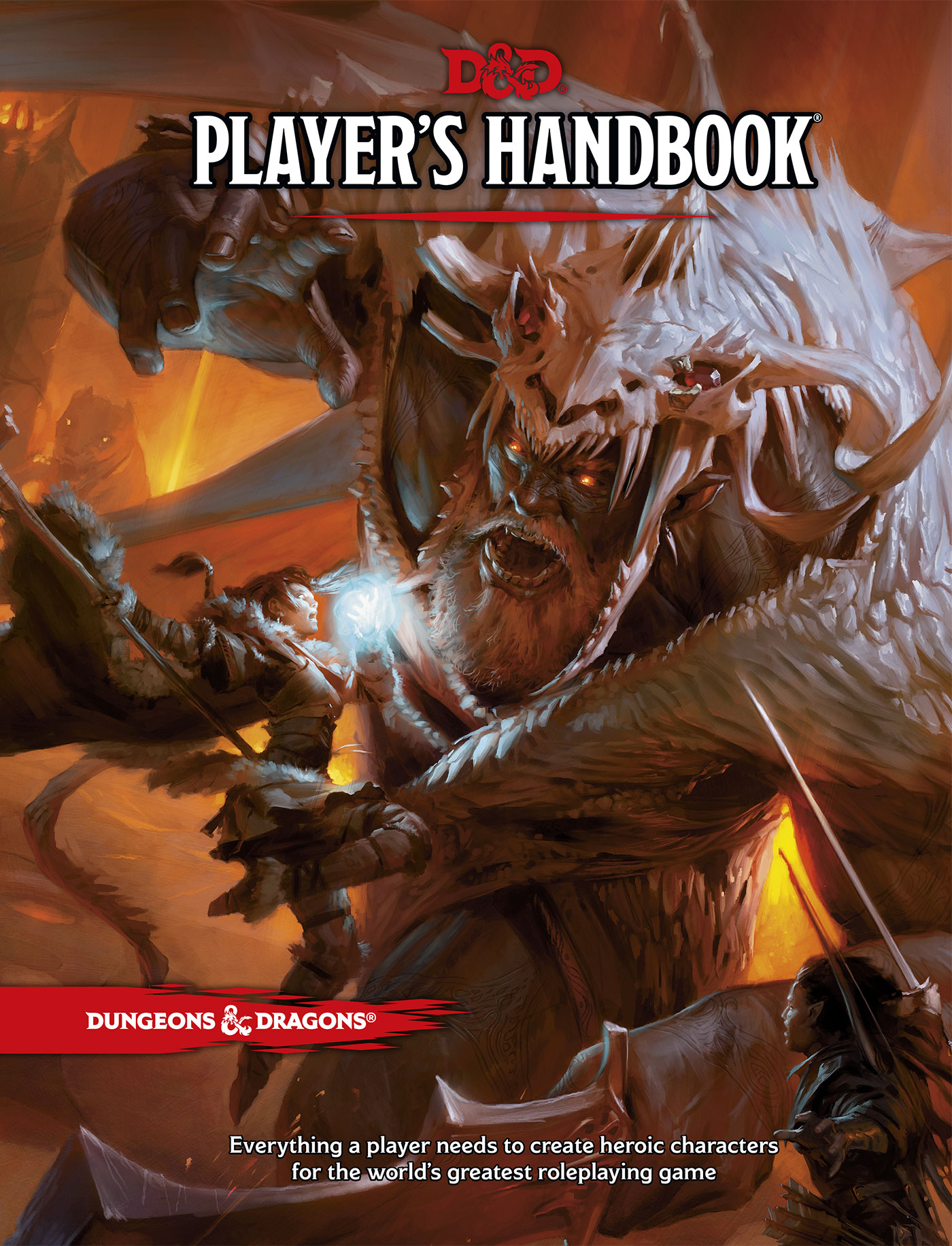
5ephbThe Dungeons & Dragons Player’s Handbook is 350 pages, hardback, and full color. It is clearly noted as “fifth edition” on the rear cover, which is much preferable to the confusing “we’ll just say it’s D&D, for I’m sure this is timeless!” approach that was teased. The vivid cover art depicts fire giant King Snurre fighting some lady. Not as clearly iconic as the Elmore Basic set dragon painting or as arcane as the 1e AD&D PHB “big idol” cover art, but better than the 2e, 3e, and 4e PHB cover art for sure. I’d say it ties with the Pathfinder Core Rulebook at #3 of all-time D&D PHB cover art.

The interior art is varied and attractive – a lot of the pieces really strongly remind me of the aesthetics of the Second Edition PHB interior art. There’s a lot of full page color plates of PCs doing things. It’s definitely not the line art of 1e, the sketch art of 3e, or the “Corporate said these pictures all have to look the same” of 4e.

The two-column graphic design is legible; fonts,  headers, and sidebars are attractive and functional.

Preface

Normally I skim Prefaces and Introductions and that sort of thing, but these were worth it because they try to explain the approach this edition is taking to the game. The preface stresses that this is a game of collaborative creation – you mainly need friends and a lively imagination, and that the players are what makes D&D come to life. All sounds good, nothing terrifyingly groundbreaking. I’ve gamed for too long to put myself properly into the “I am a complete noob what does this do to my fragile little mind” mindset to understand how this’ll start out new players but it seems like a good setting of expectations.

Introduction

The introduction does some introduction of basic terms. They kick off with a super short “what is roleplaying” example, and go on to mention terms  – though a little inconsistently; they bold “campaign” and “multiverse” so you pick them out as meaningful nouns of the game but not “player” or “Dungeon Master” or “adventure?” Odd. Anyway, it gives the basic 411 and notes that having fun and making a memorable story is how you “win.”

They move away from the 4e “points of light” default setting and go back to the “multiverse” concept, and specifically shout-out to the Forgotten Realms, Dragonlance, Greyhawk, Eberron, etc. This section starts a nice theme, which is that they put some of the control back in the DM’s hands – e.g. “Ultimately, the Dungeon Master is the authority on the campaign world and its setting, even if the setting is a published world.” Empowerment of the group to make the game theirs and the DM to rule on the setting, rules, etc. as theirs is echoed many times. This hearkens back to the attitude written into B/X D&D and Second Edition AD&D (see Rule Zero Over The Years for an exploration of the textual attitudes to the relative primacy of rules, players, and DM in various D&D editions).

Then they lay down the basics of how to play.  “The DM describes the environment, the players describe what they want to do, the DM narrates the results of the adventurers’ actions.” Simple explanation of the ‘trad game’ process, though it has some subtle guidance in it (note that players describe what their characters try to do, but the DM decides what happens – yes, no, or what to roll; as opposed to “players make random checks against the stuff on their sheet and tell the DM”).

They explain polyhedral dice, and that usually d20 + modifier vs target number is the core resolution mechanic. Then they mention “advantage and disadvantage,” which is new in this edition – basically rolling 2d20 and taking the best (advantage) or worst (disadvantage). From the designer chatter previous to the release, this is supposed to be used in conjunction with fewer/lower bonuses to provide “bounded accuracy” – if you’re really good, you can hit what you can hit more reliably, but you’re not getting a huge +8 bonus to your rolls that starts to play into the balance, optimization, and encounter tuning issues that plagued Third Edition. They then clarify how specific rules supersede general rules, something that everyone understood but didn’t need spelled out prior to 3e. And, you round down. Simple enough.

Then they describe adventures, and make an important statement – the Three Pillars of Adventure are exploration, social interaction, and combat. This is important to note; especially in 3e/4e, for many people combat had become the sole defining characteristic of the game, reigning in either primacy or solitude, and people would seriously argue that “D&D is only about combat it’s unsuitable for those other things.” A statement explaining the role of all three will hopefully balance expectations of players and DMs of the future.

Magic is described as core to the D&D experience – they do note that “practitioners are rare” and “common people see it on a regular basis, but minor stuff” which helps set some core setting expectations that I’ve seen argued on the Internet far too much.

It’s all good stuff and I don’t have problems with any of it. But the Introduction is a little laundry-listy, though not as bad as 4e’s was. I personally would have pulled the dice and advantage and stuff part back into the rules section and made this a more coherent, punchier statement about adventure and what you could expect D&D play to be like. “You should expect imagination, rounding down, and magic!” isn’t, like, a super coherent message for new players. For grognards like me – OK, got it, on to character generation!

Next time – Chargen and Races!

Dungeons & Dragons 5th Edition Breakdown

D&D on WhiteAs regular readers of this blog know, I’m a long time RPG player and have played every version of D&D since Basic in the 1980s. I was not a big fan of what Fourth Edition did with the game, along with what turned out to be the majority of the market, and have been playing Pathfinder for my D&D fix for the last 6 years. 

I’ve been following the news of the upcoming Fifth Edition with interest.  I read the free Basic rules and shared some initial impressions, but waited until the Player’s Handbook came out to really go into the rules in depth and see what I make of them.

So stand by – you’ll get a PHB readthrough and review (probably in several parts like the 4e one), a Hoard of the Dragon Queen review, and a comparison to all the previous versions of D&D! Will 5e get a passing grade, and will WotC do right by D&D’s deceased creators’ legacy? Stand by to find out!


The Side Effects Of Organized Play

Organized Play – Pathfinder Society for Pathfinder and the RPGA for Dungeons & Dragons – is very popular nowadays, and they’ve all gone to what was originally called the “Living” format, where you have characters that progress as you move from table to table, group to group, GM to GM, made possible by strong standardization.

The benefits of Organized Play include spreading the game through play opportunities at conventions, increased regular play options for those without regular gaming groups, and provides adventure content quickly consumable by GMs. It also provides a sense of community among the participants that make them stickier to Pathfinder and other Paizo products.

There are downsides to Organized Play too however. Let me preface this by saying “yay, Organized Play is good, its adherents should not be drowned in drainage ditches or anything.” This isn’t an argument against it. I’m sure people will trip out, but just because you like something doesn’t mean you shouldn’t be advised of its side effects, just like any other medication 🙂

However, I’ve been involved in organized play for a long time (RPGA, including Living Greyhawk Triad duty), and here’s some issues I see coming from it. It’s mostly an extention of “Walmart/McDonald’s syndrome” (Or now “Netflix syndrome”) – the kind of specific decisions you have to make to create something that works impersonally at scale become predominant and affect even smaller venues because they set specific expectations.

1. Strongly sets a playstyle that disallows GM flexibility/fiat in favor of rules adherence; this is pretty much unavoidable due to the format. This allows a strong focus on character optimization to flourish and become a default way of looking at the game. This isn’t all PFS, but I believe a lot of the rise of RAW/CharOp playstyle from fringe to majority in the last decade has been as a result of the strong 3e/3.5e/PF Organized Play movement. When 3e came out, no one dreamed of using the CR system, or wealth by level, or any of those things as a straitjacket, but now that’s common. Optimization was mentioned only in terms like “min-maxing” or “munchkin” beforehand, now it’s a major part of almost all rules discussion. Of course, if you love RAW rules theory and CharOp this isn’t a downside. But it’s clearly a side effect.

2. Normalization of rules. Authors are loath to put non-legalese rules into products because it’ll be unsuitable for OP use; this means fewer cool experimental rules, fewer rules that depend on GM adjudication, and more fuel on the fire of the expectation that RPG rules should be a legally complete document. Whatever books are allowed by PFS, players feel entitled to use and feel ripped off if a home game doesn’t allow them. Third party publishers, since not allowed in PFS, are marginalized in home games too. Long term, this normalizing pressure ends up leaving us with more Quarter Pounders than home-cooked meals. I’m happy that things like Mythic are still being put out but just not allowed for PFS; it would be easy to be pressured into decisions that don’t let that happen. The more that PFS is tapped for playtests, etc. the more that can happen.

3. Promotes cookie-cutter adventures. To be fair, PFS innovates within the strict time/XP/treasure format a lot more than RPGA Living adventures did, but even so, there is a strong driver towards a very common “4 scenes 2 combats 1 RP 1 puzzle” or similar formula. When I lament the death of Dungeon Mag, James Jacobs says “well use some PFS adventures!” With respect, the PFS modules don’t compare favorably with Dungeon adventures in terms of raw diversity. And they’re not supposed to; like everything else for Organized Play they have to be crafted for large scale, transactional use, with little prep required and change allowed from page to play. And that’s good for PFS but tends to drown out deviations.

Now, I’m not saying OP has killed all third parties or interesting adventures or people that make RP decisions over rules ones. But it has clearly influenced the hobby in specific directions. There’s restaurants other than McDonald’s still, and stores other than Walmart, and movies you can’t see on Netflix. But the existence of a somewhat homogeneous monolith does create downward pressure on other types of gameplay. In our FLGS there’s seriously maybe 40 people a weekend playing PFS that “can’t find a home game.” There’s 40 of you there, sure you can – it’s just not as repeatable as that Quarter Pounder, so we go for the QP.

What’s interesting, besides the arguing over “IT DOES NOT!!!”, is figuring out how to run OP in a way that mitigates these three effects. I think there have been some steps in this regard already; being able to sanction home play of APs and still putting out rules that aren’t PFS-safe are great. And I am sure this isn’t the intent of many of the venture-captains and all, who work hard to provide interesting and customized experiences especially at big cons with interactive events and such. What else can be done to have an OP that doesn’t go “full McDonald’s?”

Rule Zero Over The Years

A recent question on RPG Stack Exchange had me researching the attitudes of Dungeons & Dragons towards rule interpretation over the years and I thought I’d expand it into a post here.

The allowed scope of DM rulings has absolutely changed over time in D&D.  The balance between Dungeon Master’s discretion versus reign of the rules versus player empowerment has always been debated in D&D circles but there’s a clear evolution of thinking across the span of versions.  The attitude towards rulings vs. rules in the game shows up

  •  directly and explicitly in the rules text
  •  implicitly in the text and detectable via textual analysis
  •  in the surrounding publications considered semi-canonical (Dragon magazine, nowadays forums and designer blogs), and
  •  the culture of gamers surrounding it.

Let’s stick mostly to the first two in the interest of space.

Original Dungeons & Dragons (0e, OD&D)

In the origins of the game, Chainmail, there was no concept of straying from the rules – it was a wargame.  You could (and often did) mod the rules prior to play, but the whole thing about wargaming is that, like board gaming, the rules are considered inviolate during an instance of play as a core assumption. Some wargames didn’t have a “referee” role, and those that did, the role was very much like a sports referee – to determine if some violation of the rules had occurred.

But in the very first version of Dungeons & Dragons, Gary Gygax and Dave Arneson open the OD&D Men & Magic book with this admonishment to the “referee”:

These rules are as complete as possible within the limitations imposed by the space of three booklets. That is, they cover the major aspects of fantasy campaigns but still remain flexible. As with any other set of miniatures rules they are guidelines to follow in designing your own fantastic-medieval campaign. They provide the framework around which you will build a game of simplicity or tremendous complexity — your time and imagination are about the only limiting factors, and the fact that you have purchased these rules tends to indicate that there is no lack of imagination — the fascination of the game will tend to make participants find more and more time. We advise, however, that a campaign be begun slowly, following the steps outlined herein, so as to avoid becoming too bogged down with unfamiliar details at first. That way your campaign will build naturally, at the pace best suited to the referee and players, smoothing the way for all concerned. New details can be added and old “laws” altered so as to provide continually new and different situations. In addition, the players themselves will interact in such a way as to make the campaign variable and unique, and this is quite desirable.

– Gary Gygax and Dave Arneson, Dungeons & Dragons Volume 1, Men & Magic (1974), p.4

This is supported by textual analysis as well – the game rules’ intent (medieval people having adventures!) versus the relative paucity of the rules basically required large degrees of interpolation and discretion just to run a game.  The gap between the mode of play and the written rules is so wide that reading the rules as an all-encompassing legal text on how to play is infeasible. Still, the metaphor is of the referee changing the rules as you proceed, with little discussion about ad hoc rulings.

Later supplements continued this theme.  In Swords & Spells, the mass combat add-on, they note:

The second thing to remember is that these rules deal with fantasy. If something is unclear as to how or why it works that way, remember that it is all fantasy.  Fantasy is not bound to rigid rules and rationales.  Fantasy is imaginative. If you feel that your fantasy is better that this in some aspect, that’s fine. After all, it’s your fantasy.  Be warned, however, that unless certain balances are maintained, the game soon becomes very lopsided and very little fun. BALANCE is to be maintained at all times.”

– Tim Kask, Dungeons & Dragons Swords & Spells (1976), Foreword.

In any case fantasy is a growing and flexible form of gaming, and referees must feel at home modifying and expanding upon rules as the situation dictates.

– Gary Gygax, Dungeons & Dragons Swords & Spells (1976), Introduction.

The terminology – “referee,” “modifying the rules,” still hew close to the wargaming metaphor. Also in Kask’s quote, you see the first time balance, or as he states it, “BALANCE“, is mentioned. You’ll see it again…

Basic Dungeons & Dragons – Moldvay/Cook (B/X)

The 1977 version of Dungeons & Dragons births one of three major strains of thought on the issue of DM rulings.

Moldvay p.B2 (Foreword) on changing the rules: “In a sense, the D&D game has no rules, only rule suggestions. No rule is inviolate, particularly if a new or altered rule will encourage creativity and imagination.” Paragraph 3 of the second column p.B3 also discusses how the rules are good as-is but should be changed if desired by the group and with the DM’s permission. Also notable for using the term “rules as written”, but only as normal descriptive English rather than a technical term.

Moldvay also has most of a page (B60) devoted to telling the DM that they’re the boss, not the players or the rules. Notably, it has explicit guidance on making rulings when there aren’t obvious applications of the rules. It also notes that though a good DM will discuss rulings with players after the game, a player who still disagrees is welcome to quit as their only recourse.

As you can see Basic moves well away from D&D’s wargaming roots, gives the players a voice but puts the DM in the predominant place. I would venture to say that regardless of what the text of each game says, this became the predominant model of operation for the vast amount of the history of D&D.

Advanced Dungeons & Dragons (1e)

In first edition AD&D, you see further development of ambivalence between the role of the Dungeon Master and the beauty and balance of the rules, though the DM is still considered the apex. It departs from B/X in that players are pretty much actively denigrated. In the opening pages of the 1e Dungeon Master’s Guide, Gary Gygax rambles on at some length on this exact topic.

What follows herein is strictly for the eyes of you, the campaign referee. As the creator and ultimate authority in your respective game, this work is written as one Dungeon Master equal to another. Pronouncements there may be, but they are not from “on high” as respects your game. Dictums are given for the sake of the game only, for if ADVANCED DUNGEONS & DRAGONS is to survive and grow, it must have some degree of uniformity, a familiarity of method and procedure from campaign to campaign within the whole.[…]  In this lies a great danger, however. The systems and parameters contained in the whole of ADVANCED DUNGEONS & DRAGONS are based on a great deal of knowledge, experience gained through discussion, play, testing, questioning, and (hopefully) personal insight. Limitations, checks, balances, and all the rest are placed into the system in order to assure that what is based thereon will be a superior campaign, a campaign which offers the most interesting play possibilities to the greatest number of participants for the longest period of time possible.[…]  Naturally, everything possible cannot be included in the whole of this work. As a participant in the game, I would not care to have anyone telling me exactly what must go into a campaign and how it must be handled; if so, why not play some game like chess? As the author I also realize that there are limits to my creativity and imagination. Others will think of things I didn’t, and devise things beyond my capability.[…]  The danger of a mutable system is that you or your players will go too far in some undesirable direction and end up with a short-lived campaign. Participants will always be pushing for a game which allows them to become strong and powerful far desire is to issue a death warrant to a campaign.[…] As this book is the exclusive precinct of the DM, you must view any non-DM player possessing it as something less than worthy of honorable death.

– Gary Gygax, Advanced Dungeons & Dragons Dungeon Master’s Guide (1979), Preface pp.6-7.

You can see that player empowerment definitely isn’t on the menu in the seventies, but there is a stronger strain inserted of the wisdom of the rules and how while the DM is still above the rules, they should tread lightly and wisely in changing them. After apparently sucking down some whip-its, he goes on to say:

Know the game systems, and you will know how and when to take upon yourself the ultimate power. To become the final arbiter, rather than the interpreter of the rules, can be a difficult and demanding task, and it cannot be undertaken lightly, for your players expect to play this game, not one made up on the spot. By the same token, they are playing the game the way you, their DM, imagines and creates it. Remembering that the game is greater than its parts, and knowing all of the parts, you will have overcome the greater part of the challenge of being a referee. Being a true DM requires cleverness and imagination which no set of rules books can bestow. Seeing that you were clever enough to buy this volume, and you have enough imagination to desire to become the maker of a fantasy world, you are almost there already! Read and become familiar with the contents of this work and the one written for players, learn your monsters, and spice things up with some pantheons of super-powerful beings. Then put your judging and refereeing ability into the creation of your own personal milieu, and you have donned the mantle of Dungeon Master. Welcome to the exalted ranks of the overworked and harrassed, whose cleverness and imagination are all too often unappreciated by cloddish characters whose only thought in life is to loot, pillage, slay, and who fail to appreciate the hours of preparation which went into the creation of what they aim to destroy as cheaply and quickly as possible. As a DM you must live by the immortal words of the sage who said: “Never give a sucker an even break.” Also, don‘t be a sucker for your players, for you‘d better be sure they follow sage advice too. As the DM, you have to prove in every game that you are still the best. This book is dedicated to helping to assure that you are.

– Gary Gygax, Advanced Dungeons & Dragons Dungeon Master’s Guide (1979), Introduction pp. 9.

This would certainly excite comment if written today in a RPG. And then in closing out the pages of this hallowed tome, Gygax writes:

It is the spirit of the game, not the letter of the rules, which is important. NEVER hold to the letter written, nor allow some barracks room lawyer to force quotations from the rule book upon you, IF it goes against the obvious intent of the game. As you hew the line with respect to conformity to major systems and uniformity of play in general, also be certain the game is mastered by you and not by your players. Within the broad parameters give in the Advanced Dungeons and Dragons Volumes, YOU are creator and final arbiter. By ordering things as they should be, the game as a WHOLE first, your CAMPAIGN next, and your participants thereafter, you will be playing Advanced Dungeons and Dragons as it was meant to be. May you find as much pleasure in so doing as the rest of us do.”

– Gary Gygax, AD&D Dungeon Masters Guide (1979), Afterword.

This marks an interesting change. In Chainmail and OD&D the referee is just there to facilitate play between players. In Advanced D&D the DM has a predominant role and, while he is expected to become a master of the rules, reigns over the rules and players alike and can essentially extrapolate and make rulings according to his sovereign will.

Also notable here is the extensive (if mildly mental) discussion of the subject – many later editions barely spare a couple sentences on it.

Basic Dungeons & Dragons – Mentzer (BECMI)

Ah, my first Dungeons & Dragons – the Red Box. In the Basic Player’s Manual, it briefly describes the DM as “the person who plays the parts of the monsters and runs the game” (p.23). I think it’s so interesting that all the player books over time don’t really expand on the DM role to players beyond one sentence of “this person’s gonna run the game.”

The Dungeon Masters Rulebook makes a dramatic break with all that has come before.

The Most Important Rule
There is one rule which applies to everything you will do as a Dungeon Master. It is the most important of all the rules! It is simply this: BE FAIR. A Dungeon Master must not take sides. You will play the roles of the creatures encountered, but do so fairly, without favoring the monsters or the characters. Play the monsters as they would actually behave, at least as you imagine them. The players are not fighting the DM! The characters may be fighting the monsters, but everyone is playing the game to have fun. The players have fun exploring and earning more powerful characters, and the DM has fun playing the monsters and entertaining players. For example, it’s not fair to change the rules unless everyone agrees to the change. When you add optional rules, apply them evenly to everyone, players and monsters. Do not make exceptions; stick to the rules, and be fair.

– Frank Menzer, Basic Dungeons & Dragons Dungeon Masters Rulebook p. 2 (1983)

The DM’s role as described is exceptionally limited when you compare the parallel AD&D. Heck, the DM can’t even change the rules without group consensus! All the advice in the first section harps on the fairness aspect.  “…so should the DM keep the “monster knowledge” completely separated from the “DM information.”” It tends to assume the rules are complete and impartial application of the rules is all that is required in the game.

There is no explicit discussion of the GM using their judgment or making rulings at all. The rules section just says briefly that if the DM has questions they should 1) read the rules, 2) read some more rules, 3) ask an experienced DM, 4) send mail to TSR to get an answer (no, seriously).  The only other mention is under the “Complaints” section that talks about listening to player complaints and admitting to your mistakes.  The subsequent sets (Expert, Companion…) have exactly zero to say on the topic of the DM’s dilemma of making rulings using their judgment except inasmuch as constructing the adventure and choosing monsters is within the DM’s purview.

As you can see, BECMI takes the ideas from B/X and then apparently reacts against the strong strain of competition and DM entitlement in AD&D and swings way over in the other direction. Basic’s decline came when 2e came out but its concepts get picked up much later by 4e.

Advanced Dungeons & Dragons Second Edition (2e)

The Second Edition DMG kicks in with a significantly different attitude towards rules, picking back up some of the B/X thread. Rulings are discussed explicitly and rules are put in the back seat in terms of primacy.

Choice is what the AD&D game is all about. We’ve tried to offer you what we think are the best choices for your AD&D campaign, but each of us has different likes and dislikes. The game that I enjoy may be quite different from your own campaign. But it is not for me to say what is right or wrong for your game. True, I and everyone working on the AD&D game have had to make fundamental decisions, but we’ve tried to avoid being dogmatic and inflexible. The AD&D game is yours, it’s mine, it’s every player’s game.
So is there an “official” AD&D game? Yes, but only when there needs to be. Although I don’t have a crystal ball, it’s likely that tournaments and other official events will use all of the core rules in these books.[…] Take the time to have fun with the AD&D rules. Add, create, expand, and extrapolate. Don’t just let the game sit there, and don’t become a rules lawyer worrying about each piddly little detail. If you can’t figure out the answer, MAKE IT UP! And whatever you do, don’t fall into the trap of believing these rules are complete. They are not. You cannot sit back and let the rule book do everything for you. Take the time and effort to become not just a good DM, but a brilliant one.
At conventions, in letters, and over the phone I’m often asked for the instant answer to a fine point of the game rules. More often than not, I come back with a question—what do you feel is right? And the people asking the questions discover that not only can they create an answer, but that their answer is as good as anyone else’s. The rules are only guidelines.

– David “Zeb” Cook, Dungeons & Dragons Second Edition Dungeon Master’s Guide, Foreword (1989).

This is very notable – the rules are super flexible, both the rules as written (RAW) and even the rules as intended (RAI) are completely at your discretion, is the messaging. The DMG then talks a lot more about the players’ role in creating the story and in the DM’s role in entertaining them.

A mailing list debate from 2000 highlighting the difference in attitudes – 2e was more about freedom with less specific prescription, and some folks liked that and some didn’t:

1st edition was very personal and idiosyncratic, and not to everyone’s taste.[…] The second edition represents a shift in paradigm from this model (the shift began, of course, right away, as the D&D rules quickly mutated in the hands of individuals, but 2nd Edition was the first time it became evident in the products produced by TSR).  Where once there was a complete game found in a few canonical books, now there is a nebulous web of possibilities spun through any number of sources.

In reply:

There are some good ideas in 2nd edition[…] Other than that, my opinion is that it’s a mish-mash of rules that nobody ever took the time to playtest in conjunction with each other. Put the burden on the DM?  Like I need to have more burdens placed on me!

Some folks are more comfortable with a more constrained and prescriptive ruleset; 2e (along with a lot of the storytelling focus of that decade with Vampire and the like) sets the rules aside for the focus on story and DM discretion.

Dungeons & Dragons Third Edition (3e)

In the Dungeons & Dragons Third Edition Player’s Handbook is the source of the term “Rule Zero” which is often used as shorthand for “DM discretion.”

0. CHECK WITH YOUR DUNGEON MASTER
Your Dungeon Master (DM) may have house rules or campaign standards that vary from the standard rules. You might also want to know what character types the other players are playing so that you can create a character that fits in well with the group.

– Character Creation, Dungeons & Dragons Player’s Handbook (2000).

Since then, Rule Zero has been expanded in the popular mindset to be “The DM Is Always Right/Can Do What He Wants” or, alternately, “Having Fun Is The Most Important Thing.” It caught on as a term to describe judiciously breaking the rules – and the very fact that it emerged as an explicit term shows that there was discussion of the concept going on.

In the 3e PHB, it is pretty matter of fact about “Here’s the rules.  You’ll be using them.” Except for Rule Zero there’s no mention of possible variation and no real discussion of the DM’s role beyond:

One person in the game, the Dungeon Master (DM), controls the monsters and people that live in the fantasy world. You and your friends face the dangers and explore the mysteries your Dungeon Master sets before you.

– Dungeons & Dragons Player’s Handbook, Introduction p.6 (2000).

The 3e DMG starts out with a whole chapter on the Dungeon Master’s role.  This edition talks a lot about the player role – “The players and the DM work together to create the game as a whole” (p.8).  The DM provides the adventure and the world and adjudicates, but the book provides a whole checklist to guide adjudication and creating house rules. For adjudication, check the rules, check similar rules, if you make something up it’s a house rule and you should be consistent with it for the campaign because “Consistency keeps players satisfied and gives them the feeling that they adventure in a stable, predictable universe and not in some random, nonsensical place subject only to the DM’s whims” (p.9). Any ruling made effectively should become a consistent, permanent house rule.

For house ruling, there’s a section discussing it, and the overall gist is to read the rules, understand why the rules exist, be careful about changing the rules – but still do it.  “Given the creativity of gamers, almost every campaign will, in time, develop its own house rules.”

I have extensive RPG mailing list email archives going back to 1997, and as I search for incidences of the phrase “rules as written,” there’s occasional uses of the phrase all the way back but it comes into heavy use as a gaming jargon phrase on D&D lists in 2000-2001 with the advent of Third Edition.

My experience is that since 3e didn’t really explicitly say a lot about the DM’s role, 2e attitudes mostly carried over into 3e until 3.5e, when new players without previous edition experience and the more tactical rules focus enhanced in 3.5e caused a shift in attitudes not strictly prescribed by the difference between 3e and 3.5e text.

Over the course of 3e/3.5e, there was a significant culture change around rules adherence. WotC put a lot of work into their RPGA/Organized Play campaigns, and especially the Living campaigns had to, due to their format, enforce strict “rules as written” adherence (as predicted by Zeb Cook in the 2e preface, you’ll note!). This generated debate, and as time went on, altered more of the default mode of players towards the rules being fixed above the individual DM’s discretion.

A quote from a Living Greyhawk organizer list email in December 1999:

Last I heard, the rule from on high was:  Greyhawk will be the flagship campaign.  It WILL follow core rules, period.  I suspect we both agree this means we will be playing some silly rules, tho not necessarily which ones actually are bad.  However, until we hear otherwise, we had best be prepared to accept Core rules as written in stone.

And an immediate counterpoint:

I would be very…disappointed…if this were true. If this is the case then another Fate of Istus type thing seems inevitable – weird things springing up in the setting just cos they changed the rules again. The mechanics of the game should poke through the skin of the setting as little as possible IMO. Setting over rules – other wise you make things a complete homogeneous sludge.

Dungeons & Dragons Third Edition, Revised (3.5e)

The 3.5e Player’s Handbook still cites Rule Zero (though without the “0,” so it’s just a sentence in the Character Creation section). Its description of the DM role is:

The DM controls the monsters and enemies, narrates the action, referees the game, and sets up the adventures.

– Dungeons & Dragons Player’s Handbook, Introduction p.4 (2003).

The DMG is largely the same as 3e with some slight shading of language couching the DM’s role and authority in more limited terms. “you control the pacing, and the types of adventures and encounters, the whole tenor of the game is in your hands” (p.4).  Collaboration with the players is called out explicitly more. Also, the sheer magnitude of the rules and their attempt to cover all conditions makes the book more inherently readable as a self-contained guide to the game.

Gary Gygax had some harsh words for D&D 3.5 on this topic:

The new D&D is too rule intensive. It’s relegated the Dungeon Master to being an entertainer rather than master of the game. It’s done away with the archetypes, focused on nothing but combat and character power, lost the group cooperative aspect, bastardized the class-based system, and resembles a comic-book superheroes game more than a fantasy RPG where a player can play any alignment desired, not just lawful good.

– Gary Gygax, GameSpy interview, Pt. 2 (16 August 2004)

At the end of 3.5e’s reign, the Rules Compendium had this to say, in departure from what had become the mainstream, about this essential assumption behind the rules:

ADJUDICATION
Essential to the D&D game is the Dungeon Master (DM). The DM is the referee and storyteller for the game, as well as the judge when the rules don’t cover a particular topic.

Let’s face it: No set of rules can cover every possible circumstance in a game meant to mimic life in a fantasy world. The rules clear up as much as possible, assuming the DM can make a judgment in a situation that the rules don’t cover or that they don’t cover adequately. DMs are expected to use knowledge of existing rules, common sense, realworld knowledge, and a sense of fun when dealing with such special cases. Knowledge of the existing rules is key, because the rules often do cover similar cases or combine to make such judgment calls unnecessary. It’s not always true, but you often can do or at least try something the rules fail to directly forbid, as long as the DM thinks doing so is reasonable. For example, the rules don’t come out and say that a Medium creature threatens all squares within 10 feet while wielding a reach weapon and wearing spiked gauntlets. However, it’s appropriate to assume the creature does just that.

The DM is also there to keep the game moving. Doing so might require expedient rulings that later prove troublesome or just plain incorrect. That’s okay. Players and DMs make mistakes, and these mistakes tend to average out over time. It’s better for everyone’s fun if the game just keeps going rather than devolving into a rules argument or going back to revisit the round in which a mistake was made.

– D&D Rules Compendium p.5

This statement, while still backing the rules, tries to cut beleaguered DMs some slack in the rulings department, even saying “let’s not go back and hash it over again” as some of the other advice gives on this subject..  James Wyatt writes a full page essay called “Rules and Fun” in the Rules Compendium (p. 63)  that explains why we have rules and how they are important for balance and for introducing new possibilities, as opposed to their function as limits. He argues that the rules aren’t as restrictive as say a computer game’s, and says the D&D rules “limit your options without too narrowly defining them. The beauty of D&D is that your character can try anything you can imagine. The rules are there as a yardstick to measure your chance of success.”

The problem with this from a textual interpretation standpoint is that it’s hard to not interpret the raft of “possibility” options in the 3e branch of D&D as being restriction of options.  I can try to throw my opponent in a grapple – until a feat comes out that says “In a grapple, you can now throw your opponent.” Thus despite mitigating statements by the designers, their design itself passively promulgates an approach to the rules as written.

Dungeons & Dragons Fourth Edition – 4e

The 4e DMG does a lot of recasting of the role of the DM.  He is described “one of the players,” a turn of phrase never used before in D&D, albeit a player with a special role (p.6) – “The DM is the rules moderator, the narrator, a player of many different characters, and the primary creator of the game’s world, the campaign, and the adventure.” He “stands as a mediator between the rules and the players.” If he makes a rules call during the session, it should be re-discussed later and he should “admit his mistake” and “make it up to the players.” The tenor of this couldn’t be more different from that of Gygax in AD&D, but you can see callbacks to BECMI in the wording.

4e does have a section on house rules (DMG p.189) as something “some DMs” might like to do, and allows that changing the rules is within your rights.

The word “judgment” in reference to the DM using their judgment or making judgment calls is used only 4 times in the 4e DMG, as opposed to 10 in 3e and 15 in 2e. In general it is stressed less in the text as a concept; implying that the rules handle most situations without that being necessary or desirable.

Another significant change here is the formal introduction of dissociated mechanics. In later 3.5e the concept had definitely emerged of “RAW, right or wrong” and that attempting to use game world simulation or physics was undesirable and you should just do what the rules say whether it makes sense or not.  4e codified that and formally dissociated the character powers into “rules first” mechanisms that can be skinned into the world however you want, but that have entirely deterministic effects not beholden to game world simulation. This mode of play places story above world/fiction and thus eliminates a lot of the motivation for rulings calls beyond pure “the rules aren’t clear here” in the game.

Pathfinder

(Yes, Pathfinder is a version of D&D, duh.)  Much of the Pathfinder Core Rulebook‘s GM advice is cribbed from 3e, with slightly stronger statements echoing earlier editions about “All the rulebooks, including this one, are his [the GM’s] tools, but his word is the law” “GM Fiat: The GM is the law of the game.”

When complications involving rules interpretations occur, listen to the player and make the decision as quickly as you can on how to resolve the situation. If the rule in question isn’t one you’re familiar with, you can go with the player’s interpretation but with the knowledge that after the game you’ll read up on the rules and, with the next session, will have an official ruling in play. Alternatively, you can simply rule that something works in a way that helps the story move on, despite the most logical or impassioned arguments from the players. Even then, you owe it to your players to spend time after the game researching the rule to make sure your ruling was fair— and if not, make amends the next game as necessary.

Cheating and Fudging: We all know that cheating is bad. But sometimes, as a GM, you might find yourself in a situation where cheating might improve the game. We prefer to call this “fudging” rather than cheating, and while you should try to avoid it when you can, you are the law in your world, and you shouldn’t feel bound by the dice. […]
Likewise, don’t feel bound to the predetermined plot of an encounter or the rules as written. Feel free to adjust the results or interpret things creatively—especially in cases where you as the GM made a poor assumption to begin with.

So they come out on the side of GM rulings, fiat, and fudging (all forms of primacy over the rules), with a bit of the “make amends if you weren’t fair” flavor.

The Gamemastery Guide has lengthy and detailed advice on running a game including a section called “Winging It,” “GM Subterfuge,” “The Illusion Of Free Choice,” and other related topics. Most of it tiptoes around the topic of ruling in addition to/overriding the rules. It talks about the GM having the final say and not wasting too much time in game with rules disputes but still comes strongly from the rules-fairness viewpoint. It does talk about dealing with “Rules Lawyers,” and says

Even if you follow these rules, you may still have trouble with rules lawyers. Not everyone views rules the same way. The important thing is to stand behind your rulings, and when certain things break the rules—for good reason— don’t feel like you have to reveal world secrets just because the rules lawyer demands answers. GMs work in mysterious ways, and with any luck history will vindicate your choice.

There’s also an “advanced” section on “Customizing Your Game” and it talks about making some non-rules-supported rulings – as long as it’s carefully concealed from the players. “And with some shuffling of notes and hidden dice roles, no player should be the wiser to such an improvised ruling.”

This is an interesting and ambivalent approach – sure, the DM should be ruling, but it’s somewhat shameful and if the players find out then you will be somehow compromised.  It’s like being a closeted 1e DM posing as a 4e GM.

OSR

It’s worth noting the Old School Renaissance movement to bring back older versions of D&D, with its seminal A Quick Primer For Old School Gaming using the phrase “rulings, not rules” to try to describe the spirit of older editions as compared to newer editions. It cites these four pillars:

  • Rulings, Not Rules
  • Player Skill, not Character Abilities
  • Heroic, not Superhero
  • Forget “Game Balance”

Most of the time in old-style gaming, you don’t use a rule; you make a ruling. It’s easy to understand that sentence, but it takes a flash of insight to really “get it.” The players can describe any action, without needing to look at a character sheet to see if they “can” do it. The referee, in turn, uses common sense to decide what happens or rolls a die if he thinks there’s some random element involved, and then the game moves on. This is why characters have so few numbers on the character sheet, and why they have so few specified abilities.

Some, however, consider this to be a bit of a retcon of how old school gaming actually worked. As you can see from this research, it is and it isn’t – the “rulings vs. rules” concept was very strong especially in B/X and 2e, somewhat less so in 0e/1e, and actively militated against in BECMI. Hackmaster and the Knights of the Dinner Table comic prominently parody the not uncommon rules-adherence mode of play in AD&D. As all nostalgia does, the Quick Primer picks certain elements out of the past to bring back and leaves aside some other elements.

Dungeons & Dragons Fifth Edition (5e)

The 5e playtest, when it was called “D&D Next,” had some very retro things to say about the interaction of DM and rules.  “The rules are a tool that you and the players use to have a good time,” “The rules aren’t in charge. You, the DM, are…” “the DM’s power comes with responsibility. Be fair and impartial with the players.” This last quote directly hearkens back to a quote from Zeb Cook’s 2e introduction – “As a Dungeon Master, you have great power, and ‘with great power comes great responsibility.’ Use it wisely.”  It even goes on to discuss ignoring the dice – “The dice don’t run the game. You do.” This sweeps aside a lot of the underlying play assumptions of later 3.5e/4e and brings back a lot of B/X and 2e concepts.

In the final 5e books, it definitely takes a step back from the “rules are God” approach that 3.5e and 4e had been heading towards.  In the Player’s Handbook, it says in the Introduction:

Because there is so much diversity among the worlds of D&D, you should check with your DM about any house rules that will affect your play of the game. Ultimately, the Dungeon Master is the authority on the campaign and itssetting, even if the setting is a published world.

It also appears to take a hint from the OSR’s formulation of “rulings, not rules” as well as the prominent fiction-first modern indie games like Apocalypse World when it describes the basic pattern of play –

  1. The DM describes the environment
  2. The players describe what they want to do (and the DM decides how to resolve those actions – importantly, the PCs don’t decide what rules they use)
  3. The DM narrates the results

In the Dungeon Master’s Guide, the DM is described as the “creative force behind a D&D game,” and it goes into their multiple hats (designer, actor, etc.).  And in its Introduction it’s very clear that

The D&D rules help you and the other players have a good time, but the rules aren’t in charge. You’re the DM, and you are in charge of the game.

Emphasis is in the original. The three parts of the DMG are “Master of Worlds,” “Master of Adventures,” and “Master of Rules”.  As “Master of Rules” the DM is described as the mediator between the players and the rules.

As you read through the 5e DMG, I get a very 2e feel off of it, down to the art direction, and its approach to the game is very similar too.

In Part 3: Master of Rules, it’s very straightforward about presenting the GM with pros and cons of approaches including rolling dice in the open vs rolling behind a screen and fudging (changing rolls) if you want to.   It offers options about the role of dice including using them a lot to mostly ignoring or not using them, OSR style.  In the early stages of 5e development they had some discussions about “5e being compatible with all the versions!” which of course was impossible and left by the wayside, but they’ve tried to preserve some of that in terms of saying  you can take as rigid or loose a playstyle as you want regarding the rules – but in the end, it’s the DM’s call.

And in Chapter 9, you are encouraged to “let your imagination run wild” and use optional rules or make up your own, with pages of advice on how to do that well.

Now, this is how the text reads – but the designers have done a very good job of continuing this.  Games live on past their pages, and now in the age of the Internet, you can reach out to the designers in realtime.  5e designer Jeremy Crawford gives official rulings via Twitter. But the tone of his and Mike Mearls’ responses is usually “here’s how I’d rule”, not saying “this is what’s right you have to do it” like Sage Advice columns of old.

Pathfinder 2e

PF2e starts with fairly usual GM-is-modestly-in-charge advice:

While the other players create and control their characters,
the Game Master (or GM) is in charge of the story
and world. The GM describes all the situations player
characters experience in an adventure, considers how the
actions of player characters affect the story, and interprets
the rules along the way.

This section has a lot of “fun for everyone, change the rules if you want” admonishments. Then in “Chapter 9: Playing the Game” it clearly places the GM’s primacy in rules adjudication:

The GM Has the Final Say
If you’re ever uncertain how to apply a rule, the GM decides.
Of course, Pathfinder is a game, so when adjudicating the
rules, the GM is encouraged to listen to everyone’s point of
view and make a decision that is both fair and fun.

Then in “Chapter 10: Game Mastering,” it talks more about rules adjudication:

As the GM, you are responsible for solving any rules
disputes. Remember that keeping your game moving is
more important than being 100% correct. Looking up
rules at the table can slow the game down, so in many
cases it’s better to make your best guess rather than scour
the book for the exact rule. (It can be instructive to look
those rules up during a break or after the session, though!)

It does add in, however, a big set of design assumptions to help you in your ruling, since PF2e is… very gamey. I don’t like how gamey it is, but since it is, it’s good to say “ok so if you’re ruling, here’s some general guidelines about what to do and what not to do.” What kind of action, bonus, DC, etc. should something take, here’s how we reason about it. That’s cool.

There’s nothing in the core book about house rules or homebrew or anything, but they are trying to get you to somehow consume 640 pages of dense rules so I guess I get it.

Let’s see what the Gamemastery Guide says in this revision. It has a “First Rule” up front that is kinda-almost Rule 0:

REMEMBER THE FIRST RULE
The first rule of Pathfinder is that this game is yours. The
rest of the rules exist for you to use to tell the stories
you want to tell and share exciting adventures with your
friends. There are plenty of rules in this book, but none
of them overrule that first rule. Take the rules that help
you make the game you want, change those that don’t
do quite what you need them to, and leave the ones that
aren’t helping. It’s your game. There’s no right or wrong
way to GM so long as everyone is having fun—and that
includes you!

Though just to pick a nit, the value of Rule 0 was that they told the players that…

Then there is a whole section on “Adjudicating Rules.” It tries to make a reasonable middle path.

CORE PRINCIPLES
These are the most important things to keep
in mind.

  • Remember the basics of the rules.
  • Be consistent with your past rulings.
  • Don’t worry if you don’t have a
    specific rule memorized; it’s OK to
    look it up!
  • Listen to concise opinions from the
    other players.
  • Make a call and get on with play.
  • Review your decision after the
    session is over, if necessary.

And then they talk about house rules – with a little note of warning – “be slow to change the written rules and quick to revert a problematic ruling or house rule.” Which, fair enough, this is such a beast of a ruleset that unexpected interactions are all but guaranteed. It points at a Variant Rules chapter as a place for examples to get started.

What they don’t talk about is a big change from 1e. No fudging, not even a hint at it, just if players are cheating “tell them they are wrong, hmmkay.” No GM subterfuge, no illusion of choice. It’s very much by the book. Which I somewhat expected – PF2e has a “you got a little 4e in my Pathfinder” flavor and has a lot of concern with complicated stat blocks with custom icons and mechanizing everything.

D&D 5.5e (aka 5e 2024)

Coming soon!

Conclusion

Though in each edition you had some elements of each approach, there’s a clear move in philosophy over time from

  • 0e – the referee is an aribter and fills in the gaps
  • 1e – the DM is large and in charge, the rules are pretty good, your players are at both’s behest
  • B/X and 2e – the DM and players are both important, the rules are super mutable
  • 3e/early 3.5e – the rules and players and DM are leveled out in importance, meaning rulings are minimized and a negotiation with players
  • BECMI/late 3.5e/4e – the rules are pretty fixed and players and DM are equal and subject to the rules as law; RAW is an option
  • OSR and Pathfinder – splitting off in their own directions in reaction to 4e, OSR back to a mix of 0e and B/X flavored attitudes and Pathfinder to a hybrid of 1e/2e/3e attitudes
  • 5e – The DM is clearly in charge and can ignore/change rules and rolls as they deem wise, with the goal of everyone having fun (as opposed to the sometimes-stated 1e goal of “keeping the players in their place”.) It reincorporated a lot of the 1e and 2e thinking into the game to an even greater degree than Pathfinder.
  • PF2e – Effectively back to 3e positioning fairly exactly. It stepped back away from where PF1e and 5e were going and got a little less enthusiastic about GM authority, carefully scoping it to interpretation and, sometimes, changes to make things fun. Maybe a *little* more towards 5e than 3e was, but only by a hair.

At the same time, prominent “D&D Offramp” games like 13th Age and Numenera have a large portion of their pitch not just new setting/rules but explicit attitudes towards the running of the game – in Numenera, Monte Cook has a very large section about GM empowerment that, while not written in Grand High Gygaxian, still recalls much of the AD&D 1e and 2e advice about the GM being in charge and doing what they darn well please. 13th Age is a little more 4e-ey but both with rules-crafting and rules advice tries to take D&D in more of a storygaming direction. Dungeon World, a D&D-style game build on the Apocalypse World engine, is interestingly picky about the rules but the rules are kept to a minimum and it’s always the DM’s decision what rule is getting invoked at any time.

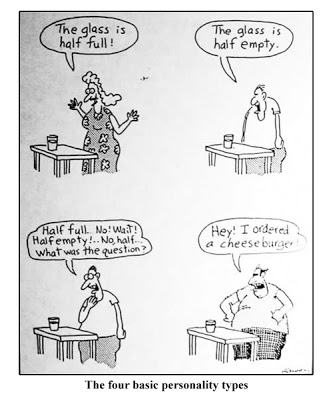
De Ludos Maleficus – On Evil Campaigns

As inspired by an RPG Stack Exchange question on how to run evil campaigns.

I’ve run a variety of tones of campaigns over time and some could be considered “evil”; in fact currently I’m running a three-year long Pathfinder campaign where the PCs are pirates, Reavers on the Seas of Fate.  Not all of them are technically evilly aligned, but murder, torture, rape, slavery, etc. have all come up in the game. Here’s how you make it work.

Why Do It?

Why would you run an “evil campaign?” Sounds like hassle!  And dubious morally, I mean, it has “evil” right there in the title.  There’s a couple reasons to run an evil campaign and the measure of success is different per type.

  1. I want to freak out and kill everyone! Not a real mature campaign type, but often behind more immature groups who want to play an “evil campaign.” Tell your players “go play Call of Duty and teabag noobs if that’s what you want.” There is no meaningful success metric here.
  2. I want freedom! Much of the time people want an ‘evil campaign’ it’s because they feel constrained/manipulated by their GM and/or other players based on an overly restrictive interpretation of alignment (or whatever similar concept your game has). They’re tired of “you can’t do that” and “Your character wouldn’t do that!” and want to cut loose. If that’s the case, consider running an evil campaign once, use it to demonstrate that criminals generally enjoy effectively less freedom than good folks per the above reasons, and then take the hint and run ‘good campaigns’ with more meaningful character choices and letting the PCs be proactive and diverse in their belief. Success is measured by whether you all learn how to do that from the game.
  3. I want to explore the darker side of human nature! This is why I run evil games. I actually have stronger beliefs on goodness than most folks in real life. I like confronting people with the consequences and ramifications of their actions in games to make them think. Is trading off part of your soul or good name or humanity worth it for that goal? How about long after you’ve achieved the goal but you’re still marked by the act? Success here is fuzzier, since games that actually uptake more roleplaying have less clearcut “win conditions” in general. But it’s successful if it’s enjoyable and if it causes people to grapple with moral questions.

But What’s It Really About?

“Evil” is not really a campaign concept (well, not one that passes muster past the 9th grade level). You need a campaign concept and one that will generally keep the PCs acting together instead of being at each others’ throats unless you’re looking for a very short, PvP campaign, which is legitimate. In fact, there’s plenty of short form indie games that facilitate that (Fiasco is probably the most notable). If you are more going fora longer campaign, however, it needs to have as much in teh way of concrete goals as any other campaign. Smart PCs know they need other mighty people to achieve their goals, good or evil.

Heck most “normal” campaign setups work as well or better with evil groups – just because you’re evil, you don’t really want where you live and work taken over by zombies or whatever, that interferes with your cashflow. Often times players want to “play evil” because they feel like the GM has been using “goodness” to manipulate them into being passive and they want to be proactive and smart in confronting threats. Squinting too hard at many campaign concepts passed off as “good” reveals them to be a sequence of home invasion, murder, and robbery anyway.

The main trap you’re trying to avoid is the PCs just self destructing by going nuts on each other and everyone in the world in general – at least, if they’d be unhappy with being hunted down and slain a couple sessions in.

Decide on Limits, Within Limits

Some people, when they say “evil campaign,” just mean “I want to kill lippy villagers like they’re orcs,” not that they want to really delve into the darker aspects of human nature. You may want to establish an agreement on tone/content with your players up front – you are not required to run (and the players aren’t required to participate) in anything they feel like is over their boundaries. I’ve been known to have players vote on approximate levels of sex, violence, etc. in a game ahead of time, and where they want it to “fade to black.”

However, a lot of that will be emergent. In my current pirate campaign, no one really thought about torture until they caught an assassin who was trying to kill the crime-boss they were aligned with. The PC halfling rogue decided he’d torture her extensively to find out who sent her. This definitely put off the other PCs – but not enough that they stopped him. Boundary established (well, lack of one).

Not every “evil” person is 100% evil and on board with everything “evil,” though. The ship took two elven women prisoner and one was claimed as a slave by a vicious half-orc pirate. The PC captain didn’t really like that but felt somewhat constrained by the expectations of the crew (mutiny is always a threat if the crew doesn’t think they’re getting their due) so he allowed it. The PCs and that half-orc were having dinner in the captain’s cabin, and the halfing from the anecdote above suddenly stabbed the half-orc to death on the dinner table (he’s an assassin now – successful death attack). He explained to the shocked command staff that he wouldn’t have any slaves on board or associate with slavers. Boundary established.

If you have real characters really roleplaying and thinking through their motivations, you’ll still have limits, whether it’s “no women, no kids” or the Mafioso that are patriotic and still want neighborhoods to be “family places.” Try to depict other “evil” people as complex in that way as well so that they will understand that evil isn’t just a race to maximum depravity. With that halfling, torture of captives is OK but slavery and rape is a killin’ offense. There’s no “Evil Checklist” you have to adhere to and say every crime ever considered is OK – in fact most evil people really are just into one and consider the others to be as bad as other folks do.  Realistic motivations and roleplaying are what will make the campaign something real and not goofy.

However – some people make too much of setting boundaries for their games. If you came up to me and asked me “Do you want to see some chick saw her cheeks off?” I’d say “No! What are you talking about?” But I just went to see the movie Evil Dead, where that exact thing happened as part of the overall horror movie experience. “Boundary pushing” can be good and desirable and allowed based on initial buyin to the general campaign premise. Sure, there’s a very slight majority of people so traumatized by something that if it comes up in game it’s going to truly trip them out, and there you have outs just like any other kind of media – “press stop,” say “I can’t deal with this” – but most gaming groups don’t really need to do more than establish the general MPAA-rating (e.g. “Hey guys I’m active in my church and I don’t really want to go past PG-13 with this game”) and then mess around in that area. Worrying too much about what exact things might disturb your players is overthinking it IMO. If you go see Evil Dead, you’d better expect that if you have a fear of/complex about anything, there’s a nonzero chance it’s going to come up in lurid color. All the buyin we required for the pirates game was “people can be evil if they want, and expect HBO Original Series level depravity, the pirate world is not a gentle one.”

Actions Have Consequences

Review How do I get my PCs to not be a bunch of murderous cretins? – there are a lot of reasons people don’t perform unrestrained evil deeds all the time, from “I don’t want to” to “I will get in trouble for it.” Sometimes my players complain that the pirate-friendly port city they frequent is “too lawful” just because they can’t get away with any heinous crime or breach of the peace they can come up with – but all societies need some kind of stability and will crack down on those affecting that too much. On the other hand, they have become used to not going out into the city alone; traveling in groups is mandatory to not be victimized themselves.

Many evil societies are like this – see how lawful Drow society looks from the outside. Our pirate PCs have to fear their pirates mutinying, the law/navy hunting them down, the bigger pirates in port deciding they’re too big for their britches or have so much loot that they’re a tempting target in turn. Criminals “hide out” for a reason – they are not free to operate within larger society, and therefore end up having less freedom than good people (something good to play up as the GM). The law, higher level “good” adventurers, etc. are always looking to wipe you out with a clear conscience.

A mechanical option here is keeping track of “infamy points” – I have my own homebrew system I use, but there’s a lot of extant reputation-tracking mechanics in the world. People have heard of the big bad people and will react like people do – avoid, confront, narc them out, victimize them, etc. Remember that many victims of crime are doing something bad themselves – criminals, or at least the dishonest, make the best marks for cons and crimes because they have little legal recourse. The pirate PCs can’t go just anywhere as their infamy becomes known; honest ports reject them, and other evil folks are generally not the best allies because they like to turn on you when you blink.

So that’s my take on evil campaigns.  Our current one is turning out very well, with complex characters. Sindawe the captain is reluctant to do much “really bad” stuff himself except the occasional act of violence – but he’s happy to let/order others to do them. Serpent is concerned with getting married and having a kid, and even surreptitiously tried to let some of the elven women escape, but he’s even more murder happy than the more measured and Lawful Sindawe. Wogan tries to not do much evil himself but he doesn’t speak against it either. Tommy tortures and worships lust demons, but will do anything to free some slaves. HBO Original Series achieved!

D&D Gen Con 2012 Keynote

Here’s the full video of the D&D keynote from Gen Con.  Sounds largely positive. They are taking the Domino’s route of owning up to screwing up.  Mike Mearls says that D&D R&D went astray and started to prescribe certain playstyles and they want to move back to empowering all styles and making it “your” game.  And that it’s not the rules that are important, made to be broken, a minor part of the shared gaming experience, there’s freedom to do whatever you imagine, etc.  They’ve put the rules and designers first lately and that makes in “their” game not our game. It’s nice to hear it said out loud, but they have to put their money where their mouth is.

The one thing they did do to back it up was to announce all the D&D backlist will be made available electronically!  They didn’t say “PDF,” it may end up being some crappy device-tied DRM in an unusable format, but it’s a start.

On the bad side, they’re doing yet another major Forgotten Realms shakeup, “The Sundering.” This is why I hate the Realms, its continuity is almost as bad as the comic Earth’s (DC or Marvel,  your choice). When challenged on this Mearls says “Oh sure but AFTER the sundering it’ll all become normal and the stories are yours.”  Of course this new era only lasts until they decide to do a shakeup or have a D&D After Next, says the cynic in me. They’re also going to have people send in results from published adventures with majority results to decide “what happens to the game world,” which has always been gimmicky when done before. This is less “you shape the Realms” and more “dance for me my little monkeys” IMO.

Dark Documentaries

Check out this trailer for a new in-progress documentary about D&D, courtesy Topless Robot.  I am ambivalent, since we’ve already progressed from documentaries to satire documentaries as the main mode of discourse on gaming, but good luck to them…

Another Bad Dungeons & Dragons Movie

Why is the preeminent  fantasy franchise, Dungeons & Dragons, doomed to horrible movies?  The first one with the Wayans brother and Ewok village was godawful and I didn’t see the second.  This trailer for the third, which allegedly even Syfy won’t air because it’s unwatchable. Just the trailer makes my colon spasm. Awful dialogue, acting, CGI…

Morale in D&D

The D&D 5e design team is talking about morale in D&D. I miss morale.  For those not familiar with morale, it was a mechanic that told you when foes were likely to break and run or give up instead of just fighting to the death like killbots. (Yes, I know, hard to believe.) It was in Basic and 2e if I recall correctly, and you’d roll 2d6 against it and apply penalties in various circumstances. For examples from my 2e MM, Kobolds were unsteady (7) and Kuo-toa were Elite (13).

To forestall the inevitable poorly thought through complaints, you can ignore it just like you can any other piece of a stat block or monster writeup as a DM, you don’t have to be beholden to it.  (“It says they appear in mountainous terrain and it’s not mountains!  NOOOOOO!”)  But it helps define more specifically how vicious/cowardly a monster or NPC (or PC ally) is. I have this problem right now in our Reavers campaign – the PCs have a bunch of pirate allies, and I’m continually having to make 6 judgment calls a round as to which keep fighting and which fall back; I’d rather have a mechanic for it.

In fact, I think morale can be improved. Back in my Animals in D&D article I proposed to split morale into two factors – one which determines how likely something is to attack in the first place, an aggression value – and one which determines how likely something is to keep fighting. This is especially great for animals – unlike in computer games, animals usually don’t just attack for grins.  And some will flee if they get hit once, while others won’t.  Heck, it’s good for NPCs too – I remember as a new GM back in AD&D 1e days being confused in T1 the Village of Hommlett as to whether the berserkers in the gatehouse were just going to attack anyone they saw, or what? They’re berserkers, but on the other hand they seem to just be chilling in a building with other kinds of creature around…

Sure, if you plan out every single encounter and what is “supposed” to happen you might not need the aggression. But many of us use random encounters, and also have just stuff out there people can wander across – is that owlbear feeling very irate, or just standoffish today?

So I’m definitely in favor of morale coming back.  Let’s say convert it to a d20 roll as is more traditional now. First value, roll over to attack, second value, roll over to keep attacking. And you get a bunch of more interesting behaviors quickly defined…

  • Morale DC 20/10: isn’t going to attack unprovoked, will bail about half the time if it’s in a fight that’s not going well (most animals might fit in here.)
  • Morale DC 10/0: Somewhat likely to attack you, but once the fight starts there’s no going back! Maybe a good value for those berserkers in T1.
  • Morale DC 20/20: Not gonna fight, always gonna run, like a peasant or small herbivore or my dog.
  • Morale DC 10/0: Going to attack half the time, will never flee or surrender
  • Morale DC 7/15: Likely to attack, but not likely to stick with it (many ambush predator types fit into this category, like my cat)
  • Morale DC 5/5: Aggressive and elite critter
  • Morale DC 0/0: Stone golem, crush them!

Etc.  Thoughts?