Tag Archives: RPG

Reavers on the Seas of Fate – Eighth Session Summary

Eighth Session (14 page pdf), “Death in Riddleport, Part II” – The PCs find a hidden temple under an abandoned house and engage in vicious combat with serpent men!  “Sorry, Vincenz, but that’s too tough!” they conclude after a couple runs at it.

The adventure was a beefed up version of Green Ronin’s “Death in Freeport.”  (Spoilers for that adventure ensue).  Did I beef it up too much?  The weakest part of the Freeport Trilogy, I thought, was that the great legendary serpent men were 1 HD (and 3.0 HD are like worth 1/2 a Pathfinder HD) pieces of crap.  Paizo printed some more “real” serpentfolk in their 3.5e Into the Darklands supplement.  I had to do the degenerate-statting and conversion to Pathfinder myself, but was left with some nice CR4 brute types.  I didn’t think that would be a horrible problem – these PCs are Pathfinder and pretty optimized, and have pretty much happily rolled over all the other fights so far.

Well, they got tromped by two of them.  There were a couple reasons why.  One, they were down a PC because Blacktoes wasn’t here, which means they were only four men against an unknown foe.

But shouldn’t a party of 4 second level PCs be able to take (though have it be tough) 2 CR4s?  Well, secondly, they’re pretty tough even for CR4s, I think, and I made a mistake in not nerfing their poison more (I converted from 3.5e to Pathfinder poison on the fly and the latter procs each round for 6 rounds, so needs a much lower penalty value).

But also some of it, the third part, was the PCs I think.  I’m trying to get them to think more tactically as part of a “gritter” campaign, but I’m afraid they still default to “screw it, let’s run around like butt monkeys.”  The villa assault in Three Days to Kill was a good example; they started in decent SpecOps style but then all started running round solo (and still did well – I tried to scare them some but I guess they may have gotten the lesson that that’s OK…).

Although maybe it worked out kinda decently in the end.  Samaritha went with them and they fought ten skeletons and three serpentfolk at once!  (You don’t hit a dungeon, leave, and return after two days without them getting a good reaction plan in place.  Sorry.)  And once the players got scared into really thinking hard, they did a good fighting withdrawl that they converted to a hasty ambush and took the enemy all out (albeit with using all their remaining action and Infamy points).  Which would have been fine, but that fight demoralized them enough that they bailed – not even to come back after healing, but just “bah, maybe after we level.”  I made it crystal clear that they were leaving Vincenz to his death, but that didn’t impress them.  They figured any more of those serpentfolk and they were meat.

Ironically, they had killed all of them off and just had the boss to fight – he’s tough but not as tough CR-wise as e.g. two serpentfolk.  But they didn’t know that and I don’t like giving metagame info; courage isn’t real courage if you are told the risk was low, so they walked away and I didn’t do much to stop them (except having the voice of an NPC speak as a conscience.  “You’re gonna leave your friend to die?”).   They pushed me to get a level at the end of the session.  Perhaps I’m cussed, but I didn’t want to reward failure with a level (and have them think on some level that I gave it to them so they can go back and succeed).  Not like they’re going to hang around awaiting the PCs’ leisure; I’m not big on static dungeons or villains that don’t respond to stuff like that.

They got some of the disappointment out of their system by going and beating the crap out of Braddikar Faje.  Second Darkness has some badly balanced encounters; as if a third level NPC fighter with some goons is going to be a credible threat to a whole party of PCs.  I had built up his street cred enough that they took him seriously, at least, but he couldn’t damage them worth a darn.

Now I have to figure out what’ll happen next.  I pretty much run things from a simulationist point of view during a session (what would logically happen next) but from a story point of view during sesssion prep (it might be interesting if person X goes and does Y…).  I reckon trouble will start coming to them; my hope is that they snap and become the ruthless pirates they are destined to be…

This group of players is a little of a challenge as I found out when they hated my Mutants & Masterminds campaign.  They really don’t like being bested, even if it’s nonfatal or dramatically good.  I guess we’ll see if this demoralizes them or what.

Outlaw Press Thieving Update

As a followup to my article “Outlaw Press, aka Jim Shipman, Is a Big Crook“, I have an comprehensive update provided by one of the artists Shipman ripped off.  The story thus far:

A small RPG Publisher (Outlaw Press, Inc. run by James L. Shipman II) that exclusively publishes Tunnels & Trolls RPG materials was accused of extensively using and publishing unlicensed art and text for profit by several artist and writers who own the copyright to the art and content in question. Some of the images used by this publisher are work-for-hire art copyrighted by big-name companies like Dreamworks SKG. Games Workshop, Upper Deck/Blizzard, and Wizards of the Coast.

The discussion about the whole matter of this publisher using unlicensed art started on this thread at RPGNet (which is now 101 pages long, and has been closed). The thread started when it was brought to the attention of an artist, Kevin Bracey, that he was wrongfully credited with the cover art of a product that had actually been created by Mauricio Herrera and used without permission. Kevin Bracey was, however, the creator of the original cover for the product, which was changed when the work was made available in PDF format by Outlaw Press, Inc.

After repeated unanswered communications sent to the publisher by the growing number of artists who recognized their work as being used without a license, mainly as covers for his products, his Lulu and DriveThruRPG stores were taken down with all the questionable products removed. The products were also removed from his own website for a while, but soon afterward were re-listed without showing the cover art–the most readily recognized and easily identifiable circumstance of copyright infringement. Moreover, Outlaw Press, Inc. removed their e-mail address from their main site, although the publisher’s actual contact details can still be found here and here.

After many more unanswered communications to the publisher, some from past contributors requesting the removal of their freely contributed material from his publications (Tori Bergquist, Simon Lee Tranter, Ken St. Andre, Gianmatteo Tonci, and M. E. Volmar included) as a result of their outrage and in solidarity to the affected artists, the matter was still unresolved and being ignored by the publisher who continued to sell – through his own website, Lulu’s Amazon Markeplace and Amazon’s CreateSpace – products that were no longer just suspect (on a grand scale) of copyright infringement, but whose permission by the contributing artists and writers to sell their materials had been rescinded.

Some artists, prompted by a lack of answer from Shipman, resorted to leaving notes of art theft on the Reviews section of the products listed on Amazon.com. And eventually, all but 5 of the roughly 130 listed items were removed from the Amazon.com and Lulu’s Amazon Marketplace stores at the request of the art’s copyright owners who were left no choice but to contact Lulu and Amazon.com directly.  Of the 5 remaining products (which can still be found here), 2 still present covers with verified unlicensed art – “Troll’s Blood & Old Delvers: Tunnels & Trolls Anthology” with Jon Hodgson’s art, and “Lizardmen In Red Water Bay: A Tunnels & Trolls Fanpostal Novel” with Allen Palmer’s art.

So far, the list of artists that have confirmed the use of their unlicensed art featured on the covers of Outlaw Press, Inc. products (without counting the 10+ contributors who have so far rescinded Shipman’s permission to use their materials) is overwhelming and growing (with around 20 or so other artists who are being contacted to confirm if indeed their art has been used without permission). These 30+ artists, some whose 70+ pieces of unlicensed artwork is featured on several of the publisher’s products (see attached PDF file), include:

  • J. P. Targete
  • Sylvain Despretz
  • Simon Dominic
  • Mauricio Herrera
  • Jon Hodgson
  • Daniel Horne
  • Michal Ivan
  • John Shannon
  • Bill Corbett
  • Martin McKeown
  • Mats Minnhagen
  • Ursula Vernon
  • Jeff Lee Johnson
  • Henning Janssen
  • Zoltan Boros and Gabor Szikszai
  • Jhoneil Centeno
  • Johann Valentin Andree
  • Bera Karoly
  • Alan Lathwell
  • Ken Jeremiassen
  • Jan Patrik Kresny
  • Fredrik Rahmqvist
  • David Lightfoot
  • Allen Palmer
  • Alejandro Guitierrez
  • Daniel Falck
  • Storn A. Cook
  • Norbert Vakulya
  • Thom Scott
  • Darrenn E. Canton
  • Tibor Szendrei
  • Goran Josic
  • Per Eriksson
  • Kory K.

One of the artists, Daniel Falck, wrote about the situation in his own blog.

Others have also written about the matter at:

The publisher was also accused of reprinting and selling without the author’s permission a magazine called “Mazes & Minotaurs,” which is offered for free on the author’s website. The details of this accusation can be found here.

Moreover, most of the art identified by the artists as used without a license is art featured on the covers of this publisher’s products, meaning that a thorough examination of the interior art used on his publications is yet to be undertaken, and that more artwork could have been used without a license by this publisher and more artists may be in reality affected by his practices.

The requests to remove freely contributed art and content, and the cancellation of the license to publish Tunnels & Trolls materials made by the makers of the Tunnels & Trolls game, Ken St. Andre and Flying Buffalo, Inc., have so far been completely ignored, and nothing close to an apology or explanation has been offered by the publisher to anyone – although he has appeared as Shipy (also his nickname on http://www.trollhalla.com – Ken St. Andre’s Tunnels & Trolls website) in this thread (post 162 and 168) mocking the requests and comments about his practices made by the RPG community.

At this point, the publisher claimed that his art was bought from an art broker called David Levine (or David Levin) from the United Kingdom, of whom no record exists anywhere on the Web and to whom Shipman claims to have paid around $2000 for all the art used in his publications. Still, after having been repeatedly informed of his use of unlicensed art, the publisher tried to sell the infringing print products through his own website and made no effort to recall or remove the publications from any of his other still active sales outlets.

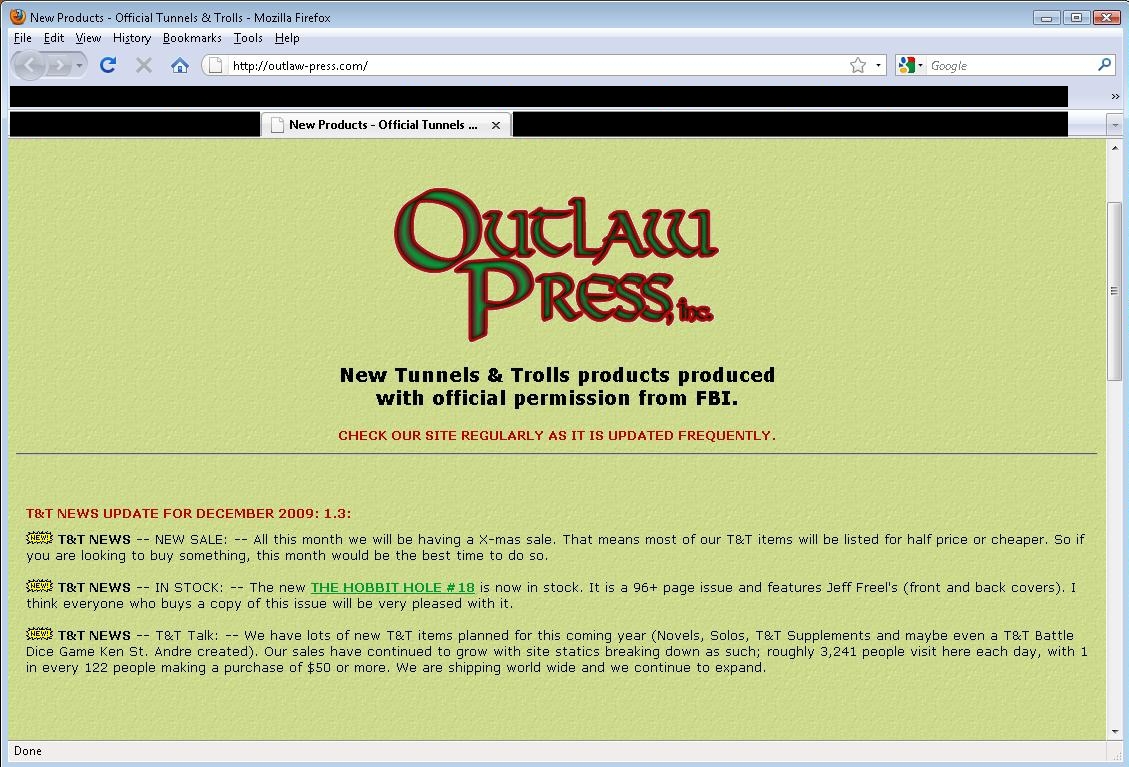
Subsequently, after the posts were made by Shipy on the Trollbridge, the publisher’s website announced on its homepage:

“All this month we will be having a X-mas sale. That means most of our T&T prices will be listed for half price or cheaper. So if you are looking to buy something, this month will be the best time to do so.”

And went on to boast about the money he was making off products that still featured all the unlicensed art in question.

“We have lots of new T&T items planned for the coming year (Novels, Solos, T&T Supplements and even a T&T Battle Dice Game Ken St. Andre created). Our sales have continued to grow with the site statics breaking down as such; roughly 3,241 people visit here each day, with 1 in 122 people making a purchase of $50 or more. We are shipping world wide and we continue to expand.”

It is also of note that the publisher sells a magazine called “The Hobbit Hole,” although the word Hobbit and its use is trademarked to the Tolkien Estate, and highly unlikely to have been licensed to an obscure independent publisher such as Outlaw Press, Inc. and/or James Shipman.

This week, and after having been contacted through e-mail by Shipman (who cited bogus publication rights and falsely claimed owning the copyrights to freely contributed materials whose copyright was never given to him by the rightful copyright owners), Ken St. Andre terminated James Shipman membership at Trollhalla–St. Andre’s own Tunnels & Trolls fan club–after issuing the following statement:

“Because James Shipman has shown himself to be neither truthful nor courageous nor ethical, I declare that he cannot remain a member of Trollhalla any longer.”

Although the publisher’s website has now been down for a few days, he continues to sell his products on E-Bay under various user names including: jimship1, Hobbit_King, actionseller99 and selling4u2, using the hobbit_king@yahoo.com PayPal account.

Still, a storefront for this publisher and most of his products (which still feature the unlicensed art) can be found by following the product links at the Noble Knights game store here, probably selling old stock.

Not only have the actions by James Shipman been damaging and disrespectful to many, including his contributors and the Tunnels & Trolls community, but his practices have muddied reputations, impacted artists and fans alike, and cast a bad shadow on the whole RPG community and on legitimate independent publishers. This situation needs to be exposed, if only in the hope of helping the affected artists and contributors who have been wrong by Shipman, and the RPG community and independent publishers alike.

Please help support the artists and legitimate RPG publishers by not patronizing this ripoff artist, even at discount prices.  If you are an artist or writer, do not compromise your own professional reputation by working with him.

Life In The Big City – Crowds and Mobs

In a city campaign, there’s many times where you need to reflect enough bystanders that representing them individually just doesn’t work – a pain with minis, but also it loses the crowd effect of slowing down runners, etc.

Luckily, The Alexandrian has some crowd and mob rules I found!  I’ll try these in an upcoming crowd scene and see if I want to mod them or not.

Reavers on the Seas of Fate – Seventh Session Summary

Our heroes (?) continue in their shenanigans in Riddleport in Reavers on the Seas of Fate: Death in Riddleport, Part I.  I’ve been borrowing from Green Ronin’s excellent Freeport setting to flesh out the pirate haven of Riddleport and here’s where we kick into their classic adventure, Death in Freeport, but adapted to Riddleport and generally getting beefed up.

Seventh Session (14 page pdf), “Death in Riddleport, Part I” – Crimelord Avery Slyeg makes the PCs an offer they can’t refuse, so they hunt down the Splithog Pauper (the leader of the criminal gang from “St. Casperian’s Salvation”).  And they look for their kidnapped friend Vincenz – rubbing elbows with Cyphermages requires them to clean up a bit.  The practical and moral dilemmas get harder as they work to rescue their friend.

I was pretty happy with this session.  The trick to a good campaign is having interesting NPCs that the PCs believe in enough to deal with realistically, and this session was all about that.  Man, the Splithog Pauper has gone from a side sub-boss with no real personality – less backstory than the average Paizo NPC, really – to a major player.  The first time he escaped, the PCs found his disguise kit and decided he was a master of disguise – to the point that as they were walking out right after the fight, they interrogated a legless homeless guy to ensure he wasn’t the Pauper in disguise.  This time, he lived up to their expectations by being disguised as a peg-legged pirate captain.  Once they caught him and took him back for interrogation, he managed to talk his way out by trading the location of his hidden treasure for his life, and after they let him go, he told them the treasure was in the artificial leg from his disguise they already had in hand.  They were all impressed and like “Damn, he totally conned us!  That took balls of steel!”  Now they’re convinced he’s Golarion’s answer to James Bond.  DM pro tip: every time the PCs decide an NPC is really bad ass, give them a level.  Ding!

And besides the Pauper, the interactions with Avery Slyeg, Samaritha, and Iesha are all going well.  When the PCs are taking NPCs as or more seriously than fights or loot then you can get some real stories going.

Other things I was proud of – I don’t like when NPCs know things they shouldn’t; I hate the “hivemind complex.”  So the Pauper had a signal arranged – if he started singing “What Shall We Do With A Drunken Sailor,” that meant trouble, and his new rent-a-goons should come downstairs shooting.  Well, the PCs were spread all over the bar doing various things and the goons had never seen them before, so they just started drive-by style random shooting at anyone that looked dangerous.  And in turn, that galvanized the PCs much more to immediate action than a standard thug attack.

During this session I made use of two of my custom rulesets – the gather information/random encounter/rumor combo I discussed in Life in the Big City – Gather Information, and the chase rules I laid out in Life In The Big City – Chase Rules.  Both chases (the Pauper and Enzo) went well; I think after another use or two the chase rules will be nice and solid.  The trick is to not make them too much of a “separate minigame” that causes problems with interactions with all the skills/feats/spells/etc of 3.5e play.

Next session – some shockingly brutal fights!

Alternity “The Lighthouse” Session Summaries 11 and 12 Posted

Welcome back to our tales of the Lighthouse, the wandering space station operated by the Galactic Concord to keep peace in the delicate frontier of the Verge in the Alternity Star*Drive universe!

Eleventh Session – Subplots are visited upon us en masse as we starfall towards Hammer’s Star.  Crazed cyborgs rampage and the station populace begins rutting like crazed weasels.  And we have the first real combat for like three sessions.  Not that there’s anything wrong with that.

On the one hand, I like that our custom subplots help drive the campaign.  On the other hand, this game session was just chaos.  People weren’t listening, interrupting, yelling off topic stories about whatever damn TV show they watched last night…  I don’t mean “not behaving optimally for people to roleplay” or “enjoying socializing with friends,” I mean “acting in a distressingly impolite way.”  At one point I seriously considered punching another player in the head if he interrupted me again.    Then I considered just packing up and leaving.  Then I decided to just quietly ride it out.  Sigh.

Twelfth Session – The Lighthouse starfalls to the Hammer’s Star system.  The normal shenanigans and subplots ensue until an entire klick fleet appears and Captain Takashi gets to yell “FIRE ZE MISSILES!!!” again and again until they stop moving.

I think we’ve discovered the best way to use the Alternity space combat mechanics…   Ranges vary widely on normal weapons, from 1 to 12 hexes.  The Lighthouse itself can’t really move in combat and has short range beam weapons, so if anyone gets through our screen of defending ships we’re in trouble.  But missiles move like 6 hexes a round, and thus can get .  So really you  just want to fire all missile tubes at once before the other ship(s) are even anywhere on the tactical map; the chance of any significant weapon hit taking out major systems is very high.  We lost one of our two destroyers because we “played nice” and didn’t insist on engagement at very long range.

The Ghost of Gaming Past

I was at the local mall today doing some Christmas shopping, and was in a combination calendar/board game store (some kind of weird residue left after a Waldenbooks died) and saw the latest D&D boxed starter set there, next to the Apples to Apples, Dirty Mind, and Carcassone.

This brought back fond memories.  I bought my first RPG, Star Frontiers, in a board game store in a mall back in the ’80’s.  I had gone in and bought a little tactical dice-and-chit game called “Attack Force” (I still have it!) made by TSR, where one player is a Death Star-like space station and the other is a squadron of space fighters.  I liked it and its science fiction theme, but it was only diverting for a while, and so was back looking for other stuff along those lines.  There was a bigger box, also with “TSR” on it, also SF themed.  I didn’t know what a “roleplaying game” was, but it said you’d play a human or alien who would become part of the “Galactic Task Force” and “defend the galaxy against ruthless adversaries.”  Deal!

For some reason current RPG industry doctrine says this doesn’t happen.  “People have to be introduced to RPGs by other people, it’s all word of mouth.”  “Boxed sets are bad, mmmkay.”  “Retail distribution blah blah blah.”  But in the end, it’s possible and it works.  Certainly if you’re Hasbro you can have a D&D set next to Monopoly in every single Target if you gave a crap enough to, but even smaller players should be able to get to more venues as well.  A lot of these companies behind the other “boxed sets,” aka board games, in those stores are pretty small.    The RPG guys just need to figure out how to leverage that channel, I guess.  (Ironically, I see Munchkin, a game that is a parody of D&D, in way more book and board game stores than I see D&D in.)   RPGs are pretty “sticky,” so if you can get someone introduced with a basic set that’s going through a more mass market channel you can probably pull them to the more specialized stuff later.

Green Ronin is trying the “D&D basic set” pattern again with their Dragon Age game.  If it’s going to sit in some “RPG/comic” store that only the weirdos go into in the first place, I’m not sure that’ll work, but if it gets to computer game stores, bookstores, big box stores – I think it will.

P.S.  Star Frontiers rules and adventures are available for free and legal download here and has a “remastered” version and thriving fanzine here!

PC on PC Violence

There is always a lot of advice about how you never want PCs to actually come into physical conflict with other PCs, how that will ruin your game and you should take any meta-game action necessary to prevent it.

Well, that’s complete and utter crap. Here’s a gaming anecdote about some awesome PC-on-PC violence from an old AD&D 2e Forgotten Realms game I ran.

Bad Neighbors

SPOILER WARNING – this is full of spoilers for the 2e Forgotten Realms adventure “Bad Neighbor Policy” from “Four From Cormyr.”

In general I prefer gritty, low magic campaigns like Greyhawk or even Warhammer Fantasy. But for a change, our group said “Let’s play a high level high magic game!”  This clearly meant the Forgotten Realms, and since I was a crazed D&D DM I had every product put out in the 1e/2e days, so the PCs munchkinned themselves out with high level (10 or 12 or something) powerz and magic items and everything and I prepped a Realms game, which though it went off track, ended up a thing of beauty.

We ran something else forgettable first, but soon began “Bad Neighbor Policy,” in which the PCs are travelling to the Orvaskyte Ruins out in the swamp for one reason or another.  But first, there’s a random interesting location on the way – the “Inn of the Undead,” an inn run by two hot women.  The first, the scenario claims, is “a voluptuous blonde” and the other is a “tall, attractive woman with a luxurious, tousled mane of fiery red hair.”  They are also vampires, as it turns out, and there’s a 12th level necromancer who hangs out with them.

One of the PCs decides, true to form, that he’d “seduce that hot blonde chick who owns the place!”  She says, “Okay…  Come upstairs after closing  and we’ll take a bath together.”  “Well that was easy,” he thinks.  The PC comes upstairs with her, doffs all his armor and weapons and gear and gets in the bath.  Then the other woman, the redhead, comes in too, and the blonde says “I thought I’d ask my sister to join us, if that’s all right.”  The player, nursing a woody by this point no doubt, is all like “Woo, threesome, I win!!!”  They disrobe, get into the bath with him, and and then the fangs come out and ENERGY DRAIN ENERGY DRAIN ENERGY DRAIN ENERGY DRAIN the poor bastard is a vampire himself.  I laughed and laughed and laughed.  It’s scenes like that which make all the BS you have to deal with for being a DM worthwhile.

But it gets better. The necromancer’s there for no stated reason except an “alliance” with the vampires.  So I decide they’re doing some experimentation trying to make the ever-popular vampire that can walk during the day.  There was some spell they published around that time, I think it might have been in the Spell Compendium, where if cast on a vampire, their powers wax and wane over the course of the day but the sun doesn’t kill them.  So the dead PC gets that spell permanenced on them by the necromancer as part of his undead rebirth.  I also decide that the PC has to rest in water not in earth because of the circumstances of his death.  Success, a new weird variety of vampire!

Anyway, the PC wake up as a daywalking water-sleeping vampire and doesn’t let on that anything’s wrong.  “I’m evil now right?  I’m gonna turn them all into vampires!”   The party, upon hearing that he looks “pale and drained” the next morning, just responds “Yeah, I bet.  Let’s get going.”  The PCs travel out through a day or two of swampland to the Orvaskyte Ruins, where they really have a hard time of it what with dragons and cornugons and whatnot.  Half of the PCs are unconscious or otherwise disabled after the final fight – so of course the vampire PC picks that time to strike, paralyzes one PC and drags another off into the swamp for vampirification. The frozen PC gets free and drags the other PCs into the convenient shrine that undead can’t enter in the ruined keep.  (That shrine is actually in the adventure; I didn’t plan any of this.)

So then what unfolds is pure beauty. No hold barred combat between the vampire PCs and the living PCs. For three weeks the players come over and eagerly take seats in separate rooms, and I scuttle back and forth as they try to outsmart and overcome each other.

The living PCs didn’t understand how things were working exactly with the vampires being active in the day – even without their vampire powers, they were still 10+th level Forgotten Realms characters and put down quite a whupping!  The PCs try to hole up in the shrine, but the vampires snipe at them and summon critters to go in and disrupt their sleep, so they’re not getting spells back.  They try to escape through the swamp, but the vampires catch up and attack and they have to retreat back into the shrine.

My favorite part was when the living PCs ventured out during the day and used spells to track down the dead PC the vampires had carted off and stuck under some roots in an icky swamp pond to turn.  One of the vampires is lurking nearby in a tree and summons a bunch of giant crocodiles into the pond.  The PCs come up and one, thinking for some reason that they’re safe during the day, dives right into the muck without a second glance.  All those crocs latched right on and started spinnin’.  “OH JESUS NO!!!” he was screaming as his hit points disappeared.  I had to devise a quick hit location chart to determine what part of him a given croc was attached to.  The rest of the PCs panicked and Lightning Bolted the entire pond killing everything; all the crocs and the PC floated to the top and they pulled him out to see if they were in time to heal him but he was gone below the torso.   Everyone screams.  Retreat to shrine, cast Raise Dead.  The living PCs had one Raise Dead a day which was very helpful.  Sometimes the vampires would catch a living guy and turn them; sometimes the living guys would catch a vampire and Raise Dead them.   They kept this up for hour after hour, session after session.

Finally after a couple sessions of this the remaining living PCs made a successful break for it, but the vampires were faster and got back to that inn first.  One of the PCs, a monk, was suspicious of the inn as “That’s where all the trouble started!” and stayed outside, clinging to the roof to peer into windows.  Another was disgusted by the whole thing and just marched in to get a room.  When he went upstairs and closed the door to his room, the initial vampire PC was standing behind it with bared broadsword.  The monk peeped down just in time to see the inside of the room’s window suddenly become completely coated with blood.  More screams.  In the end, a couple living PCs retreated under cover of magically created fog while the vampires plotted a daywalking vampire apocalypse to take over Sembia.

The campaign ended there (it was supposed to be short anyway), but everyone had a grand time.  People fight hard against DM-run monsters.  But they fight HARD against other PCs.  It was a very meaningful test of abilities for everyone – the DM couldn’t pull a punch if he wanted to, and each opponent wasn’t one of many faceless critters being multitasked by the DM, each one was backed by a clever and bloodthirsty player’s undivided attention.  Each session, I kept asking “Do ya’ll want me to wrap this up?”  But each time, they were excited to get there and continue one of the most exhilarating fights for their lives they had seen in a game.  I was surprised with how long it went, I would have expected one side to get a numerical advantage and then just roll over the other.  But each side could safely retreat and when things started getting bad they fought harder – using one-use magic items, desperate tactics, and more to avoid being wiped out.  I was really proud at some of the stuff “my players” came up with when the chips were down, I saw balls to the wall crazy kickass things happen I hadn’t seen before or since.  It was really a memorable experience for everyone.

Lesson Learned

After that, I would often bring in a “guest star” – some other gamer not in a given campaign – to run a major villain at the climax of an adventure.  “Here, you’re this guy, here’s what you know, you have free rein to defeat them any way you can.”   You could tell by the “Oh, shit” looks on the PCs’ faces that they realized they needed to step their game way up when that happened.  The villains were always extra clever and brutal and self-preserving (and therefore realistic) when they had a dedicated brain behind them.

And sure, the simple “PCs shouldn’t hit each other” advice is all well and good for the 13-year-olds and emotionally maladjusted out there, where people are just acting disruptively or whatnot.  But in a game for grownups, it has its place.

On Immersion

I firmly believe that immersion should be the primary artistic goal of a roleplaying game.  It is an eminently achievable goal which creates a rich experience that one that can rightfully claim to be more than “just a game.”  Sadly, few people even understand what immersion is, let alone try to reproduce it in their RPGs.

What Is Immersion?

Well, that’s a good question.  There’s a recent really good RPG.net column entry, “On The Nature Of Immersion,” which got me started down this train of thought, that talks about five different things one might mean by “immersion.” For purposes of this discussion, I will define immersion as the process of trying, to the degree it’s really possible of course, to holistically take on your character’s mindset, and to try to experience the game world and events through that mindset.  Metagame factors should be eliminated ruthlessly.  Back in the day (the early ’90’s) we just called this “in-character roleplay.”

Theory and History

Though I’ve seen people play “in character” since the early days of the hobby, Immersion ™ was strongly promulgated as a concept by the “Turku School” of Finnish larpers and their humorously boldly worded Manifesto, in which they delineate four types of gaming – gamist, simulationist, dramatist, and “eläytyjist”, which I will call “immersivist” from here on out because I’m on a low reindeer-meat diet. They say the point of an RPG is to immerse yourself into your character’s consciousness and interact with its surroundings, and that furthermore this is how RPGing can become art.  And this is 100% correct in my opinion.

It’s instructive to see the difference between immersion and other styles.  Some other theorists confuse immersion with “acting,” but this is actually one of the major anathematic stances to them.  The Turku School’s “Larper’s Vow of Chastity” starts with: “1. When playing a character and immersing myself in it, my foremost goal shall be to simulate what happens inside the character’s head, and how it affects his behavior. Hollow pretence I leave for the actors.”  Good stuff in general, though there’s an off undercurrent of “I lick the gamemaster’s boots!” running through it.

The Nordic LARPers later came out with an interesting clarifying paper, Autonomous Identities, which is good reading if you understand words like “diegesis” and don’t mind people quoting Aristotle.  It clarifies how in some ways simulation can be an immersion substitute – “The theory is that the immersionist experiences what the character experiences, while the simulationist only pretends to, logically deducing what the character would do next.”  Eventually  the Nordic scene stepped back from immersion a little in favor of a story/dramatist approach, as you can see in the new loosely-defined but Diana Jones award-winning Jeepform style of LARPing.

Unfortunately, all this stayed largely confined to the Nordic LARPer community, even though immersive concepts are equally (if not more) applicable to tabletop play.

In the American/British mainstream RPG theorist tradition, they pretty much ignore immersion.  The GNS/Forge “indie games” tradition recognizes only the three non-immersive types, and in general the Ron Edwards-driven FORGE group of indie RPG makers have moved from their historically more dramatist/narrativist approach to strongly favor a strange gamist/dramatist mix (We’re telling a story, but with more and more tokens and cards and miniatures and crap!)  that even the more mainstream games like D&D 4e and WFRP 3e have started to adopt in part.  Most of the indie RPG community’s theory work has become ghettoized into being dependent on Edwards and therefore has been pretty much sitting unchanged for a while.  The “Big Model,” his newest approach, might theoretically allow for immersion as part of “character exploration” but its very weakly represented, if at all, in his description of creative agendas.

Outside the FORGE, the earliest RPG “theory” book I know of, Gary Gygax’s “Role Playing Mastery,” (yes, I have a copy, I’m a freak) is unabashedly about tactical (gamist) mastery, even though it does begin by noting that role-playing is half born of the historical minis wargamers and half of “clinical and academic role assumption and role-playing exercises “.

Robin Laws’ “Robin’s Laws of Good Game Mastering” mentions a variety of player types including the “method actor.”  Its definition is reasonably immersivist – “The method actor bases his decisions on his understanding of his character’s psychology” – but in name and in some of the turns of phrase threatens to confuse immersive with the dramatist’s surface “actor” stance which is in reality totally opposed to real immersion.  But if one has an accurate understanding of what pure method acting is supposed to be, it’s a good term.  Immersion and method acting can use some of the same techniques, like affective memory and substitution, but immersion is arguably purer because there is no external audience to please which requires classical acting techniques to be admixed.  Many “method actors” really mix traditional acting with the more immersive method acting techniques, so for RP theory purposes I don’t like using “actor” anywhere near “immersion” because it causes confusion.

Greg Stolze’s “How To Play Roleplaying Games” at least promulgates “setting logic” (aka simulationism) and notes that role-playing “can go deeper and have a more profound impact” by confronting characters with challenging issues.  But then it goes more to the basics like “show up to the game, pay attention, and don’t be a disruptive prick.”  Sadly, and I’m not saying it’s not needed, most “how to” RPG documents tend to turn into a list of stuff you should have learned in elementary school.  I’m not criticizing Stolze on this point; my interaction with the larger RPG community through the RPGA indicates that a lot of people need that.

Anyway, clearly game theory outside the ice-bearing countries doesn’t get into immersion much, but then again it’s largely either mired in basics or enslaved to Ron Edwards.

Why Immersion Via Tabletop And Not LARP?

Some of the folks reading this may be Nordic LARPer types.  I had a discussion with a couple after the inciting RPG.net column, and they tend to feel that immersion is easier in or more relevant to LARPing than tabletop.  I actually disagree pretty strongly with that.  Let me start with a pretty brutally worded analogy.

Q: Which is more immersive, a book or a movie?

A: A movie if you’re stupid, or a book if you’re smart.

After saying “Oh, snap,” think about that for a minute and we’ll proceed.

I would say that LARPing can probably be more immersive that tabletop when:

a) It is very well done, with realistic scenery and props

b) The characters are very close to the players in physical makeup

But that’s a big “if.”  It creates a lot more jarring things that block immersion in many other cases.  Some guy carrying an orange “please don’t shoot me, cops” gun is frankly less convincing than just being at a table imagining a guy with a gun.  And if all my characters are out of shape thirtysomethings that’s great, but wandering around the Dragon*Con hotel or campsite needing to take a dump doesn’t make me feel more like a robotic killing machine from Mars.

Even if one could get to the ideal “holodeck” type solution to address a), you would still have trouble until you got “Avatar” type solutions for b)…  At the current tech level and the current level of sophistication of LARPs I personally have seen around, I strongly prefer a completely imagination-based field to promote immersion.

It’s the same reason I find books to be more immersive in many cases than movies.  Haven’t we all been disappointed with a movie adaptation of a book because “that’s not how I imagined that would look?”  Or where one really crappy CGI shot breaks you right out of the suspension of disbelief?

Furthermore, In a LARP with props, there is the promulgation of one “objective” truth of how things behave.  But there is little value to that and more value to each player’s separate subjective diegesis.  And the more you force the subjective diegeses to collide, the more likely you are to shake someone out of their immersion.  It reminds me of the GM advice in Robin Laws’ excellent game Feng Shui, to not use tactical maps.  “Revealing your map locks you into a precise conception of the area…”

Anyway, I’m not saying you can’t LARP immersively, but I am saying that there is little reason to believe immersion as a concept is inherently LARP-focused (except for the historical accident that the only folks that seem to be really into immersion are also Scandinavians who are really into LARP) and that there are good reasons to even prefer tabletop for immersion in many circumstances.

The Immersive Tabletop Game

All this isn’t just theory.  I’ve run and played in immersive games, and those groups have found them to be immensely rewarding.  I had one game that had the explicit goal of character immersion run for five years in the mid-1990s.  I’ll ping my players from that game for insights from their point of view, but for me at least it really hit the heart of what it is I wanted out of role-playing.  For many years I’d had fitful stabs at it with “normal”
casual RP games but I knew it could be so much more than that.

And it’s not really all that hard.  Though there are helpful techniques, 80% of the work is just getting a group of people to sit down and say “Yes.  In this game I am going to try to get into my character’s brain and look at the world through their eyes.”  Mainly you just need everyone to agree with that goal and for the GM to be trying to facilitate it (like any style, when different players are heading for different agendas, you end up with the least common denominator).  The players have to be emotionally unstunted enough to emote a little bit and the GM needs to keep his “in world” viewpoint going strong so that he can allow the PCs to get along with0ut making metagame decisions.  With a little practice, that’s really not very hard.  You can start out as simulationist and let things develop from there, and sim is a good fallback point that doesn’t “ruin things for everyone else” at times you can’t immerse well.

Give it a try!  I don’t have a lot of sympathy with people that have the “one way” they like to roleplay.  Maybe it’s a well kept secret, but you can play one game sim, the next gamist, the next focus on story, and the next try immersion.  Broaden your horizons.  I don’t like certain games or styles, but I play them when my gaming group wants to.

Future Topics

If anyone’s interested, I can go into:

  • How to run an immersive tabletop game
  • How to play in an immersive tabletop game
  • Simulation as a gateway to immersion
  • Isn’t immersion bad?  Aka Bleed, or “Isn’t that how that Egbert guy went nuts?  And that Elfstar bitch?”
  • But immersion makes me “uncomfortable,” aka George McFly syndrome

Life in the Wide World – Random Encounters

Last time, I explained why I like random encounter tables and feel like they add to both the “realism/simulation” factor but also add to the story by being bellwethers of the players’ interest.  Now, I’ll talk about how I create and use them.

Scope

The Pathfinder Bestiary has some generic random encounter tables in the back, but obviously in most cases you’ll want something tailored to the place you are.  The Paizo APs do a pretty good job of providing basic random encounter tables for the various cities and regions in which they take place.  You’ll want to put work into these tables proportionally to how long the PCs will be there.

More specific is always better, it’s just a matter of how much work you want to put into it.  The good part is, if you do this right the work you put into it is heavily reusable from campaign to campaign.

  1. City Random Encounter Table Template – consider putting some meta-thought into this so you can use it to build other charts easily.  “01-05, Wimpy Local Monster 1”, for example.
  2. Generic City Random Encounter Table – to use anywhere when you don’t have anything more specific on hand.  Some are provided in the Pathfinder Bestiary.
  3. Chelaxian-type City Random Encounter Table  – you can use this in a broad swath of locations – Cheliax, Magnimar, Korvosa, etc.   If you have a couple of these ready to cover the most likely sectors, you are ready for a lot.  “Port City Random Encounter Chart,” with maybe some entries that say “City Guard (lawful city)/Pirate Press Gang (pirate city)”  would cover a lot too.
  4. City of Korvosa Random Encounter Table – use in Korvosa.  Often there’ll be one of these provided in an adventure or AP you can modify for use.
  5. City of Korvosa Sewers Random Encounter Table – use in the sewers.  You might have a Generic City Sewer Random Encounter Chart that this inherits from too.   Sometimes an AP will publish tables down to this level of detail.
  6. City of Korvosa Midland District Random Encounter Table, During the Troubles – you can vary the charts by time as well.  If the city is under martial law, you’d expect the encounters to be pretty different.
  7. Gold Goblin Gaming Hall Random Encounter Table – don’t be shy about making charts that are very very specific to a small location, as long as the PCs are spending a lot of time there.  In the Second Darkness AP, it’s likely the PCs will end up running a gambling establishment and will be working in it a lot.  That might merit a very specific “who wanders in and/or causes trouble on a given night” chart just for that one building.

Scaling

There are two philosophies of encounters in D&D.  The first is to always scale encounters to the PCs.  The other is to allow for the entire range of realistically possible encounters without regard for the PCs’ abilities.  The latter, though nice from a realism/sandbox play point of view, can be a little dangerous.

I thought the Scarred Lands products from Sword & Sorcery had an elegant solution to that problem that well served both realism and scaling needs.  They assigned CRs to actual locations that reflected the average CR of encounters there.  Then PCs should, with a modicum of care, be able to find out how dangerous a region is.

  • “Foundling’s Green?  A naked virgin with a sack of gold could wander the cornfields safely there.  Someone thought they saw a goblin 5 years ago and the Count sent troops; turns out it was just a real ugly sheep.”  CR1/2.
  • “The Schwartzwald?  Well, you wouldn’t want to wander around in it alone, there’s some dangerous things in there, but groups of loggers work those woods.  One group like that went missing six months back, though.”  CR3.
  • “The Forest of Screaming Skulls?  No one has ever entered it and returned.  The Hellknight Order of the Dragon sent in a hundred knights to pacify it; none came back out, but their mothers all died of heart attacks that very day.”  CR 16.

You can vary CRs by smaller scale, of course – the Bowery has a higher CR than the Merchant District.  Of course in most normal human cities, even “rough” areas aren’t going to have super high CRs, or else people’d get wiped out.  The crime-riddled streets of Riddleport only have an average CR of 1 on their encounter table.  This advice mostly applies to hostile/monster encounters; there may be EL5 bands of city guards about, of course, or by crossing the street and going into the Collegium you can probably toss a rock and hit a CR8 wizard, but they are not (usually) eating peasants.

I’d like to give a shout out to “Wilderness & Wasteland – Scarred Lands Encounters,” a Sword & Sorcery supplement all about building encounter tables.  It’s worth picking up.

Anyway, once areas have average CRs, PCs know where they can go safely and what’s risky, and  your campaign flavor is backed by the rules.  It allows scaling by self-selection, in the same way that World of Warcraft does with its zones.

Type

Similarly, there are two philosophies on random encounter tables.  One, the “hostile encounter” theory, holds that they are only for monsters or people likely to provoke random encounters.  These consist solely of entries like “Bandits, bulette, owlbear, King’s Guards, orc warband.”

The other holds that they should also include “friendly” encounters, events, and other stuff. “Crying orphan, dead soldier, abandoned shrine, loose horse…”  These can be used as hooks or just to provide flavor – this example list communicates “war-torn countryside”, for example.

I personally prefer the latter, though the former require less work, as they’re a subset of the larger, more inclusive ones.

The main thing to keep in mind is that you want the frequency of encounters to be lower if you’re using an all-hostile encounter table; you can ramp up the frequency the more other stuff is on them.

Populating the Table

What, besides monsters, can go on a random encounter table?

  • Normal animals or plants – threatening, tasty, valuable, or entertaining
  • Natural phenomena or events like sandstorms, stampedes, marching strikers, or an overturned dung collection cart
  • Traps like bear traps or pungi stakes
  • Diseases like malaria or yellow fever
  • Largely friendly people like traveling merchants, con men, pilgrims, or prostitutes
  • Largely unfriendly people like city guards, roving berserkers, or bloodthirsty natives
  • Local features like totem poles or caves
  • Happy treats like ivory, an outcropping that contains valuable metals, or a dropped coin purse
  • Specific people the PCs know
  • Pretty much whatever else you could think of

Now, I will say that more isn’t always better.  Especially if you evolve your tables over time, you can easily get 100 different things on a given table.  But this runs the risk of cognitive sprawl – it’s hard to work up 100 encounters ahead of time and so they are more off the cuff, and it’s less likely to have anything recur – and from both a story and a game point of view, you want some recurrence.  Recurring threats help show theme more strongly than totally different ones every time and may become a plot element, and also PCs like to get better at fighting things.  The first time your party encounters a yellow musk creeper, it may take them a while to figure out there’s a plant behind all the zombie business.  So the second time, they can know what’s going on, target the plant, and feel proud in showing off what they’ve learned.

It’s easy enough to have a big long list of random encounters and cross ones off.  So if you have your big jungle encounter table, for a given trek through the Mwangi you might cross off a bunch of it and use a subset, just so  you can prep some of them a little, allow for recurrence, or even just not have to carry ten different books with monster stats in them to the game.  And if you’ve added a cool new monster or NPC it’s more likely to come up, and if there’s just monsters you feel more like running this week and ones you don’t…  If you have your table stored in Excel then it’s easy to cut, paste, and remove/alter entries to taste in very short order.

Chance of Encounter

Historically in D&D this has been a fixed rate; “x% per hour” or other time increment.  (Bizarrely, in Pathfinder they seem to not have addressed chance of encounter at all.)  I kinda prefer to make it dependent on the PCs’ skills.  Someone with a good Survival check (or, in the city, Diplomacy/Gather Information) should be able to avoid a lot of encounters with their knowledge of the ways of the wild/city.  In addition, the chance should probably be lower if the party’s staying still and higher if they’re romping through the underbrush.  It’d also be nice to take into account the scenario where the PCs want to provoke random encounters, for whatever demented reason happens to be at hand.  (You could argue PCs acting as a highly motivated city guard and looking to enforce the law could be simulated by provoking random encounters.)

Cautious: If you’re staying in one place or otherwise trying to avoid encounters, you check once every twelve hours.  You can travel overland  cautiously by moving at half speed.

Normal: If you’re moving about normally, you check once every six hours.

Aggressive: If you are looking for trouble deliberately, or otherwise moving about in an intrusive manner (searching the wilderness for a dungeon entrance, foraging, checking every inn in town for someone) you check once every three hours.

The DM may also modify the frequency of checks based on what’s going on – if there’s an active battle in the vicinity, it’s reasonable to say that the area is hot enough that there’s random encounter checks every hour.

Use skill checks to determine random encounters.  In the wilderness, use Survival, and in the city, use Diplomacy.  The DC to avoid an encounter is 10+the CR of the location.  So for example, in a CR3 location, a Survival check of 13+ avoids an encounter during that time period.  Feel free and combine this with other rolls of this skill; for example overland travel usually provokes Survival checks.  If someone’s rolling their Survival check to avoid getting lost, you can just compare that roll against the encounter DC and have it serve double duty.  You can always deliberately “pull” this check if you’re looking for trouble and “take zero,” so to speak.

Optionally, you can do a little more granular work and roll on the encounter table first and then check against the CR of the specific random encounter rolled.  Then you can let Knowledge checks be used to assist – if the encounter rolled is a bear, then PCs with Knowledge: Nature could roll to assist the Survival roll to avoid (or provoke) the encounter.    This rewards domain specific knowledge, which is always a plus.  It also allows for some discretion in “looking for trouble”.

Example

Let’s say the PCs are out looking for magical beasts to capture for some dude in town that’s paying well for them, but would like to otherwise avoid pointless fights.  The PCs decide they’re looking aggressively during the day (one check every 3 hours) but taking it easy at night (one check every 12 hours).  During the day, they decide to “take zero” and provoke an encounter on a d20 roll under 10+ the encounter EL.  If you roll an encounter with orcs, for example, which they don’t want to deal with, let them make Knowledge: Nature checks to “assist” the Survival roll in the direction they want.   Let’s say two of them have Knowledge: Nature and make their DC10 assist rolls, meaning a total d20+4 on their check to avoid the encounter.  If they might encounter an owlbear according to the chart, the same Knowledge: Nature assist rolls would let them subtract two from their roll, so if both make their assist they would roll d20-4 versus the same encounter.

Bringing It All Together

Here’s what an encounter table might look like.  Let’s say it’s this party’s first trek into the Mwangi Expanse, Golarion’s equivalent to Africa.  I have a giant jungle encounter table including all the entries in the table in the back of the Bestiary.  I decide that I want to stress the more “mundane” threats that the jungle has to offer for this first outing, so I focus on the inhabitants, animals, and diseases of the Mwangi more than supernatural or monstrous threats; on later journeys I’ll crank up those and have the mundane stuff stay there but become a  smaller piece of the pie.

They’re going to be inland only three days or so, therefore probably a dozen or so entries will allow for enough variation with some chance of recurrence.

Kaava Lands, Mwangi Expanse Random Encounter Table (CR 5)

  1. Bonecrusher Fever Fort DC 12 (CR1)
  2. Sleeping Sickness Fort DC 14 (CR2)
  3. Javelin Trap (CR2)
  4. Enteric Fever Fort DC 15 (CR3)
  5. 2d6 Mwangi Tribesmen Warrior L1 (CR3)
  6. 2d6 Jungle Elves Warrior L1 (CR3)
  7. 2d10 Aspis Consortium slavers (CR4)
  8. 1 army ant swarm (CR 5)
  9. 2d4 gorillas (CR6)
  10. 1 dire tiger (CR8)
  11. Location (roll d6):
    1-3: Mwangi village – 10 warriors, about 30 souls total, starting attitude of indifferent
    4-5: Mwangi village – burned to the ground, no survivors
    6: Mwangi sacred site – any Mwangi with the party will refuse to enter the area, causing two hours of lost time maneuvering around it, and any PC taking any of the fierce little carved masks hanging from trees in the place will get a hostile reaction from any Mwangi seeing them later on.
  12. Person (roll d4):
    1-2:  That crazy explorer they met in Bloodcove
    3-4: That hottie that works for the Aspis Consortium they’re all trying to impress

This table carries out my theme for the adventure – it’s more about discovering the area than hacking on wildlife.

Other things to put in your table besides the encounter name and CR – I would have done it above but WordPress is awful at tables, sadly – put the source and page reference, like Paizo does.  A lot of their cooler new monsters are from articles in the APs, and even now I have a dickens of a time hunting down where a monster is.  Writing it down in the table once will save you much flipping later.  Also, consider putting in starting attitudes (friendly, indifferent, hostile), especially useful for people-heavy tables.  There’s a big difference between a friendly “come join us!” merchant caravan and a “don’t come within 200 feet or we fire these crossbows” merchant caravan.

Here’s a more city-focused encounter chart that I might use in my current campaign.  It uses the Riddleport Random Encounters Table from Second Darkness: Shadow in the Sky p.79 as a base, but I’ve added specifics.  The AP says  “con artist,” I’ve come up with some specific hustles and also have some specific con men added in from random places, like Mungo and his Amazing Monkeys from a Freeport supplement.   And the table completely omits certain things that seem obvious, like Riddleport Gendarmes.   Plus, as their intrigue among the city’s inhabitants heats up, I’m adding more specific people and/or spies for specific people.  CR is less meaningful as more of these aren’t (necessarily) combat encounters.

Riddleport Wharf District Random Encounter Table (CR 1)

  • 1 monkey (Avg CR 1/6, MM p.276)
  • Con artist pretending to be a shanghaied princess (CR 1/2, see notes)
  • Con artist – Mungo and his Amazing Monkeys (CR 7, Denizens of Freeport p. 65)
  • 1 leper (Avg CR 1/2, SitS p.79)
  • 1d4+1 Gendarmes, reasonably honest (Avg CR 2, use Riddleport Thug stats)
  • 1d4+1 Gendarmes, looking for trouble and/or bribes (Avg CR 2, use Riddleport Thug stats)
  • Harlot, quickwife (CR 1/2)
  • Harlot, easyboy (CR 1/2)
  • Harlot, Selene (CR 2, Maiden Voyage p.XX)
  • Harlot, Lavender Lil in disguise (CR 7)
  • Drug dealer, connected to Avery Slyeg (CR 1/2)
  • Drug dealer, unaffiliated (CR 1/2)
  • Drug dealer, the one Sindawe likes to beat up and take drugs from (CR 1/2)
  • Homeless person from St. Casperian’s (CR 1/4)
  • 1d8 Drunken pirates Ftr1/Rog1 (Avg CR 3, see notes)
  • Street vendor, spy for Clegg Zincher (CR 1/2, see notes)
  • Splithog Pauper, in disguise (CR classified, SitS p.66)
  • 1 goblin snake (CR1, Pathfinder #1)
  • 1d4 Small monstrous centipedes (CR 1, MM p.276)

Conclusion

Random encounters can be fun and useful, and are for way more that just monsters.  Customization is your friend, and it can be done without requiring a lot of work all the time – some upfront work to make some basic tables then lets you do minimal per-session work to customize them.

Life In The Big City – Follow The PCs

In my last Life In The Big City installment, I was asked about my random encounter tables.  In that article I describe one way in which I use random encounter tables, which is that PCs going out into the city to gather information or perform other tasks can provoke them.

I am a believer in random encounters.  Some people aren’t, and only run pre-selected, or “scripted,” encounters.  While that’s fine, I have learned over some 20 years of gaming to “trust the dice”.  As a DM, you can get predictable.  Much of the time, the things that players really get into are things you didn’t intend.  That’s worth a brief aside.  So NEXT time, I’ll get to random encounters.  This time, I’m going to talk about the philosophy of mixing simulation with player interest.

Cue Off Your Players

One of the best ways to make sure your players enjoy your game is to cue off the things they like.  Throw stuff out there and see what sticks.  Sometimes, players will be proactive enough to let  you know what they like; you as the DM can also do some things to elicit that feedback.  But analysis fades before experience.

Here’s an example.  I was running a low level game where the PCs were wandering around some loosely settled farmland.  It started to rain (I also use random weather generation, because if I don’t I frankly forget to make the weather vary, unless it’s important to the plot, in which case players start to see weather as a sign of an impending screwjob…) and the PCs took cover in a nearby abandoned barn.  “Is there anywhere we can get out of the rain?”  “Uh, there’s an abandoned barn about a half mile off…”  Being PCs, they decided to search it.  Rather than say “Come on man, I’m just making this up as I go along,” I tossed out some details.  “There’s moldy hay, the ladder up to the loft is ruined, there’s a frayed rope hanging over the center beam…”  The busybodies start rooting through the hay, looking for stuff.  Thinking “You can just say we wait till the rain stops and get back underway, you know,” I said “You find an… old human skull under the hay.” Just to make something up besides “dirt, you goons!”

Well you would have thought I tasered them all in the nutsacks.  An episode of CSI: Greyhawk broke out as they frantically tried to unravel the mystery.  They determined the person must have hung themselves over the center beam.  One PC clambered up and went all over the ruined hayloft, finding an old rusty dagger stuck into the frame of the hayloft door.  I looked around at all of them and realized they were really, really into this.  Slightly creeped out, highly engaged.

When something comes up in your game, you can pretty easily determine what your reaction as a DM should be.

1.  Players not interested- worthless color, forget it.

2.  Players moderately interested – build it up into a one off.

3.  Players fascinated – it’s totally related to the overall plot, or will be once you figure out how yourself.

In this case, I led this into a mini-horror adventure I largely made up off the cuff that I ended up making central to the overall core plot of the campaign.

Random encounters, random NPCs, etc. all work this way.   If – and this is a big if – you are making your game world somewhat realistic.  If PCs believe that there may be a legitimate reason behind the way things are, then they’ll react to it as if it were, and look for the “why” behind events.  If the “why” is that the dice or the story say so, they lose interest.  Of course, it could be that the dice or story did say so, but your job as a DM is to build out behind that.

There’s a random encounter of an owlbear.  Maybe the PCs kill it and move on without a second thought.  Maybe they take an interest instead.  “Hey, we’re mighty close to that village for a roving owlbear to be attacking people, maybe we should go check in with them.”  Maybe it’s the second owlbear encounter and they go nuts.  “The evil wizard must be creating them to destabilize the region!  I take favored enemy: magical beasts with my next ranger level!”  That doesn’t have to be the actual explanation, but it is a cue to you to make the owlbears more than just two random rolls in a row.

Same deal with NPCs, or locations.  I like random NPC generators, for sure.  But the same principle holds if things aren’t randomly generated.

In my current campaign, the PCs are on the mean streets of Riddleport.  There are some NPCs the Paizo Second Darkness Adventure Path I’m using say are important, others it just mentions, and some that I’ve made up or brought in from other random adventures I’m weaving in.  There’s some that they have really taken to, and others that have been inflicted on them against their will.  You can’t turn every beggar they take an interest in into a ninja in the employ of the BBEG (Big Bad Evil Guy), but you can definitely add some depth to them and consider how they might play a part on the larger story.

Rumors are great for this too.  I give out bunches of them, some false.  The PCs fell in love with a false one – that there was treasure hidden below a local homeless shelter.  They went all over that place with a fine toothed comb and flushed out and killed the criminal gang hiding there before  I had actually planned on incorporating them.  Though I’m not going to put in a hidden treasure just because they went there, the PCs themselves started brainstorming.  “That’s a good rumor to plant if you want some rubes to go wipe out a rival gang!”  Hmmm… Yes.  Yes, it is.

Paizo APG Playtest Continues

In true open gaming form, Paizo has put out all six new classes that are going into their Pathfinder RPG Advanced Player’s Guide for comment.  You can download them for free:

In my opinion, Paizo has knocked another one out of the park.  I was prepared to be underwhelmed – most new non-core classes in D&D 3.5e were clearly just there to be weird collections of rules and not represent meaningful iconic archetypes.  “Ooo ooo, I’ve always wanted to be a Hulking Hurler!”  “And I always wanted to be a Master of the Unseen Hand!  Or maybe a Spellwarp Sniper!”  It feels like you may as well just say “DURRRR” out loud after announcing your chosen class.

The Cavalier is the prototypical knight.  He belongs to a specific knightly order, takes oaths, challenges enemies, and has a mighty mount.  Trap avoided: making the class *too* dependent on mounted combat. Remaining weak point: the oaths are kinda lame in implementation and the knightly orders fall into that weird “made kinda generic but still hard to fit into your campaign world” area.

The Oracle is filled with divine force, but less from a specific deity and more of a powerful archetype.  Besides clerical spells, the oracle gets powers appropriate to their divine focus, and suffer from a curse like being haunted, blind, or lame – but the curse turns into powers of its own with level!  Trap avoided: when I read the class name I thought, “Ah, a lame diviner class suitable for NPCs.”  Remaining weak point: the curses are the main thing that seems different about the Oracle and her foci from a normal cleric and her domains; a focus feels just kinda like a “double strength domain.”

The Summoner is what we call a “pet class.”  He has a persistent customizable critter called an eidolon; plus he can summon monsters pretty well and toss other conjurations and enchantments off a custom spell list.  It’s the first time D&D has really been able to do the “Pokemon Master” or “WoW Warlock” thing effectively.  Trap avoided: this class already got nerfed from the playtest doc where he could cast a large number of 1 minute/level Summon Monster SLAs and could easily boost his eidolon’s AC to the 50s without breaking a sweat.  Remaining weak point: The eidolon rules are complicated and probably open to a lot of exploits.  And why the hell does he have d8 HD and decent BAB?

The Witch is the most witchy witch class in the history of D&D witch classes.  It’s brilliant.  It can cast hexes, have a cauldron, join a coven, cackle, lay the evil eye on you…  And she learns spells (off a custom spell list that has enchants, conjures, and even heals)  from her familiar.   Trap avoided: being lame.  Remaining weak point: the covens are weak and should be more interesting, but that’s a minor nit in an otherwise very nicely designed class.

The Alchemist makes potion-like extracts made from formulae, bombs, and self-transforming mutagens.  Very flavorful – taking some of the alchemist schtick (like the bomb throwing) from WoW and other computer games.  They had to cop out a little to explain the limited number of uses in a day – the concoctions are powered by the alchemist’s “magical aura,” so if you’re looking for the scientific angle here you’re out of luck.  Trap avoided: being godawful complicated like the Artificer from Eberron.  Remaining weak point: They don’t get many bombs per day and their extracts and mutagens are pretty weak otherwise – I think they’ll have trouble being useful over the adventuring day.  The mutagens do physical boosts, but it’s not going to sufficiently make up for the BAB/HD discrepancy and turn them into a useful fighter even for the limited duration.

The Inquisitor brings to mind Warhammer 40k, but upon reading it…  This class is an odd mishmash.  It has a cleric’s HD and BAB and invokes judgements upon the naughty; it has a little ranger to it in the “vampire hunter” kind of vein.  But then it gets tactical/teamwork feats.  I’m not really sure what it is trying to be – a paladin of any alignment?  A Buffy?  A marshal?  Mostly a Buffy I think.  Trap avoided:  none.  Remaining weak point: falling too close to what other classes are or can do.  I’d think you could build something like this as a cleric/ranger or pally/ranger.

Anyway, I think they’ve done a great job of taking truly iconic mythical archetypes and making them solid playable classes.  Check them out yourself!

Life In The Big City – Gather Information

Once you start running an urban campaign, you start seeing the gaps in the existing rules on a lot of points.  In our case, we had a good number of times where PCs needed to go out into the city and hunt down some piece of information or person.  When we started working through it, I realized there were a lot of gaps that needed filling to make a satisfying play experience.

The rules components you have to work with from the Pathfinder core book and the APs are:

1.  A random encounter table for a given city (with no instruction as to when to roll a random encounter). Maybe I’ve missed it in poring over the Pathfinder RPG and Bestiary, but despite there being random encounter tables, I can find no place where they assign a chance of a random encounter happening.

2.  The Diplomacy skill has replaced Gather Information from 3.5e.  Information on using the skill in this way is light, just saying it’s a variable DC to find out something about a “topic or individual.”  As is traditional, there’s an unclear overlap between this skill and Knowledge: Local when it comes to the practical work of finding a nearby fence for your stolen goods.  Furthermore, there’s no accounting for a check being opposed by someone trying to hide or conceal information.

3.  The “Urban Adventures” part of Chapter 13: Environment in the Pathfinder RPG (p.433) has some other details that may be helpful – kinda.  But not really in this case.

4.  Rumors.  Every AP has a load and every DM loves having a bunch of rumors to pass out, but their incorporation is always an adventure-specific hack.

These are the ingredients, but a recipe is lacking, especially once you hit the intrigue-laden bits of any city campaign.  I wanted to bring all these things – gathering information, random encounters, rumors – into one easy to use system.  Here’s how I put them together.

Goals

When the PCs hit the streets, they may have a variety of different goals in mind.  Sometimes they are looking for a specific fact or person.  Sometimes they just want the “word on the street” about what’s going on.  In certain cases they want something else specific to happen – to spread the word about a particular rumor themselves, maybe to provoke or mislead someone.

As a result, someone seeking a specific goal will use a different skill check depending on what they’re trying to find.  Diplomacy/Gather Information is the clear choice for traditional finding stuff out, for example, but you could use Bluff instead to spread a false rumor.  Or Perform to get the peasants all singing a catchy yet treasonous little ditty.  There’s a lot of possibilities here.  Consider rewarding relevant Craft and Profession skills by letting them be used instead when relevant; if you’re looking for someone you hear is a blacksmith, then a relevant Craft or Profession check would be a great way of tracking them down by talking to other smiths, checking at places smiths would tend to buy supplies, etc.  If you are trying to find out when the Midnight Mermaid is setting sail, Profession: Sailor would be appropriate.

In many cases you’ll want to call for a complex skill check for tasks taking more than a cursory amount of time.  Each attempt would usually reflect a half day of asking around, staking out places, fending off streetwalkers and beggars, etc.  You can reflect each success with some kind of in-game description of how they’re getting closer.  “You find someone who says they’ve seen two guys with mustaches like that hanging out around the Wharf District – you can focus your search there.”  If there’s an extenuating factor like “find them before they leave town” or “figure out the cult’s leader before they sacrifice that victim” then the check should be of the “X successes before Y failures” model.

If the goal being sought is simple – a fact or public personality – then the DM simply sets the DC, with perhaps more knowledge available at higher DCs.

“I’m looking for a high quality weaponsmith!”

  • Natural 1 – “Your mother’s a weaponsmith!  She can bang on my sword anytime!”
  • DC 5 – A random blacksmith’s name, probably makes simple weapons only.
  • DC 10 -A decent weaponsmith’s name who has a selection of martial weapons.
  • DC 15 – Otto the retired adventurer reliably makes masterwork blades.
  • DC 20 – Otto hates elves, don’t take your buddy with you if you’re going there, he’ll refuse to help you.
  • Natural 20 – “Oh, I know Otto, tell him Grey sent you and he’ll cut you a deal.”

Sometimes, however, the PCs are trying to track someone down who’s actively trying to conceal themselves.  Or, they need to lay low and thwart other people’s attempts to track them down using these rules!

If someone is just trying passively to stay hidden or hide an item, place, or bit of information, they make a check using a plausible skill to set the seekers’ DC.  If you’re hiding out, you can try Stealth or even Disguise.  If you are in a friendly ethnic enclave, you can try Diplomacy to convince people not to help snoopers.  If you’re going by a fake name, use Bluff.  The DM should see fit to add on bonuses or penalties based on the circumstances.

Keep in mind the quarry may not know specifically that anyone’s looking for them.  Many criminals or other underground figures will routinely be trying to stay somewhat off the public’s radar as part of their daily routine.

Stay flexible and use common sense.  If the PCs are trying to place a false rumor to flush someone out of hiding, their seeker checks might be opposed by the target’s Sense Motive, for example.

Random Encounters

Let’s get an important distinction out of the way first.  There are several different kinds of random encounter charts, derived from different unspoken philosophies of what an encounter should consist of.

The first, which I’ll call the “normal” encounter table, includes a bunch of stuff a PC might come across in a locale, whether it’s a “hostile monster” or not.  These kinds of charts contain everything from peasants to hookers to “Event: someone empties their chamberpot out of a second floor window as you walk by” to real threats.  The first edition AD&D DMG was a great example of this theory of random encounter design, what with the random harlot table.

The second, the “hostile” encounter table, limits itself only to likely combat situations.  A city encounter chart with only “Muggers, press gangs, stirges, and vampires” is a hostile encounter chart.  This kind of chart has become more popular over time as D&D groups who “just want to kill something” don’t want to bother with chatting up some “rich panderer”.

It should be obvious why you need to understand what kind of chart you have in hand – if it’s the former, the chance of encounter should be higher, but if it’s the latter, it should be much lower.

Traditionally in D&D, there’s a flat random chance of having a random encounter.  But there’s a reason native New Yorkers run afoul of trouble less than visiting tourists; an innate knowledge for an area leads to instinctively safer behavior.  You avoid “that street,” know to ignore certain voices calling “Hey Mister!”, et cetera.  Therefore it would seem to me that Knowledge: Local is perhaps a relevant factor. It feels about right to say the chance of encounter in a normal city is when you roll a DC 5 or less for a “hostile” table and DC 10 or less for a “normal” table.  You’d manipulate these chances for special places or times – if the city is wracked by revolution or martial law reigns, crank the DCs up.  (Consider using Survival in the same way in the wilderness.)

Pro tip – consider customizing your encounter table over time.  Have 91-100 be “someone who the party knows” and keep a list of likely people.  PCs love running across people they know, it adds to their sense of belonging in the game world.

Rumors

Rumors.  The lifeblood of any campaign.  You can always rely on the PCs to spend a bunch of time interacting with your lovingly crafted setting and NPCs if you feed them random information that they think might be amusing to follow up on.  It turns setting information from something you inflict on them using boxed text to something more akin to “treasure I found!” which is innately more motivating.

As with random encounters, there are a couple schools of thought on rumor creation, largely depending on how much work the DM wants to put into it.  Some create a small number of mostly valid and/or important rumors, or even customize them to individual PCs.  Some create a vast host of rumors of varying importance and accuracy.  In this case you want to divvy them up by DC (crappy false rumors=DC 5, etc.).

As the PCs roll their seeker checks, you can give them rumors according to your chosen DCs.  I usually do the “small number of good rumors” approach and give one out on a DC 15, plus an additional rumor for every 5 points of success.  You’d select DC 10 or DC 5 if you had a lot more rumors of varying provenance.

Make sure and hand out rumors you really want them to have first and then hand out the random stuff.

Keeping It Quiet

In some cases, the PCs want to track someone or something down without other people getting wind of it.

If you’re actively seeking but want to keep it quiet, you need choose a skill designed for misdirection to use as you ferret out information.  This could be Bluff (I tell people I’m a merchant from some other city who owes the guy money) to Stealth (I try to overhear conversations more than actually precipitate them) to whatever’s plausible given the circumstance.  Seeking “quietly” doubles the time required to make each seeker check.  The DC for the quarry to detect the seekers’ activity is set at 10+the selected skill bonus.  The seekers can deliberately take a penalty on their seeker checks and add that as a bonus to their keeping quiet check.

The quarry (or other interested third parties) can make seeker checks of their own to determine if someone’s looking for something or someone.

For example, the PCs are looking for a jumpy guy who owes them money.  They decide to take it easy and send a seeker group that has a good Bluff skill of +10 out to find him.  The seeker group searches at the rate of one check per day, and the jumpy guy asks around every other day to see if anyone’s after him – a DC 20 on his Diplomacy check would indicate yes, there’s some guys asking around after him.

Hitting the Streets

All of this boils down to a reasonably simple system for urban information warfare.  The various participants break up into teams as they desire.

1.  Setup

The DM sets the random encounter DC and chooses a random encounter chart, and decides the success DC, how many successes are required, and what those successes mean.

2.  Hide

If there’s an active opposition, the “hiders” roll their check first to set the DC for the “seekers” (if the hider’s an NPC it’s easiest to just take 10 on this check).  If there isn’t, the DM sets the DC based on the availability of the knowledge or whatever is being sought.

3. Seek

Each seeker team makes a DC 10 Knowledge: Local check, the team member with the best score leading and any others assisting.  Rolling below the random encounter DC  indicates a random encounter.  Success indicates that the seeker team has used their knowledge of the city to find a good audience or locale for whatever it is they’re trying to do.  Success gives a +2 bonus to subsequent checks, with an additional +2 for each 5 points by which the team beats the DC.  Each seeker team decides whether they are keeping the search quiet or not, and makes a relevant skill check to seek out their goal.  Time spent and successes are noted and rumors are handed out.

4.  Cover Up

The hider can take time to do their own seeker check against the DC of the seekers’ chosen mode of sneakiness if they want to know if anyone’s looking for them.

Repeat steps 3-4 as necessary.

Playtest: Guerilla Marketing

In this case, the PCs were looking to go out on the mean streets to promote an upcoming animal fight they were arranging; they weren’t specifically looking for information in the traditional sense.  No problem, these rules handle that.  They divided up into solo teams of one to cover the most ground and were not trying to be subtle in any way, confident that the crooked town guard would not care one bit about all this.  I gave them their choice of social skill to use – Diplomacy (“Come see the awesome matchup!”),  Bluff (“You’ll win big if you bet on the bear!”), or Intimidate (“You punks can’t handle carnage like you’re gonna see at this fight!”).  They disperse throughout the city and promote their fight.

Since this was a fairly diffuse goal, it doesn’t have a clear success or failure criteria.  The locals are, in general, all about a semi-legal animal fight.  Therefore I set the base DC at 10, with each increment of 5 above that indicating that more people would hear about the match and come. Each attempt would reflect a half day of work.  They could do as many checks as they wanted to spend the time on until fight night.

The encounter table I was using has both “normal” encounters and “hostile” encounters so I set the encounter DC level to 10.  If any PC rolled below the base DC of 10 while conducting their marketing, it would generate an encounter.

I had prepared a small number (7) of fairly juicy rumors, so set a base DC of 15 to get a rumor, with an extra for every 5 points above.

All the DCs were set, so each PC made their skill check.  1-9 indicated an encounter, 10-14 indicated limited success, 15-19 indicated moderate success and a rumor, 20-24 was good success and two rumors, and so on.

Because most of this group lacks meaningful social skills, they started provoking random encounters, and since they were alone, those encounters didn’t go well.  One PC, trying to drum up business outside the competition’s gambling halls, got beaten insensible by some goons and had his cash stolen.    One got bitten by a monstrous centipede as he sat down to rest outside an alley.  One had a nice chat with a friendly lady who owns a fruit stand (later destroyed by the PCs in the commission of a chase, that’ll show her).  After a day of that they decided to leave off; they got an OK crowd in at the fight night.

Playtest: Manhunt

In this scenario, the PCs had killed off a criminal gang but the leader, the Splithog Pauper, got away.  They decided to hunt him down (and by decided, I mean another crime lord made them an offer they couldn’t refuse and told them to).

The goal was pretty concrete – find him!   He was very much trying not to be found.  His main skill is Disguise at +11, which would normally mean a pretty hardcore DC of 21 for the seekers.  However, when they raided his gang’s headquarters the PCs got an encoded list of various IOUs to various petty criminals and business associates.  Since the Pauper was staying in town and trying to rebuild, this was an extremely relevant leverage point and I gave them a huge +5 bonus for having it in hand.  Also, they got a description of two thugs that may or may not have been affiliated with the Pauper (turns out they were).

The PCs learned their lesson about running around the streets solo.  They split into two teams, one of which was following up on the list of associates and the other of which was talking to various prostitutes and homeless people they associated with to track down the thugs.

They were rolling well, and since each team had several assists they stayed well out of random encounter DC territory, sad to say.  It took them a day and a half to get the five successes I figured were needed to track him down.  They had not been subtle in their inquiries, however, and he knew someone was looking for him, so when they went to the inn he was laying low in, he was disguised and had a bunch of thugs nearby ready to ambush intruders.