Tag Archives: tactical

Geek Related Mass Combat Rules

I’ve just done a pretty big update to the Rules You Can Use page with a variety of revised rules for Pathfinder 1e (but easily adaptable to other adjacent D&D-ish rulesets). In this case, check out:

Geek Related Mass Combat Rules (6 page pdf)

I originally published them as a janky blog post but since we’ve been using them for years now (like… 15!) I put together a more polished version.

Mass combat? Oh, boo! you say? Well, I get it. Most mass combat rules are not great. Usually they’re not synergestic with the PCs and their abilities. The official Pathfinder Mass Combat ruleset originates with Kingmaker, and while it’s fine, it’s a minigame abstracted almost completely away from adventuring. The same goes for more thoughtful approaches like this one on Erin Palette’s blog and the one it links to by Sarah Wilson. Which is fine for its use case, but in my experience the problem that comes up much more frequently is small unit combat, when the PCs have gathered groups of people that are just big enough to be unwieldy but not large enough that “just have the PCs make some kind of Command” checks is remotely appropriate.
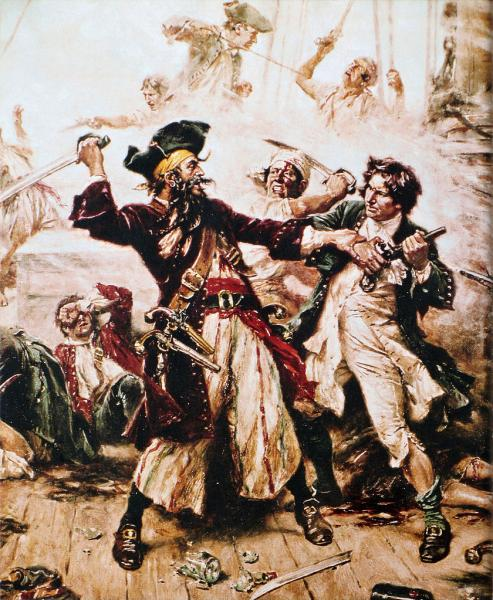
This came up very early in our Reavers pirate campaign. The PCs started to gather a crew on their pirate ship. A crew composed of clumps of similar folks – a couple fistfuls of War3s from when they took out an opposing ship in one adventure, a bunch of Fighter 2/Thief 1’s from another… And they are not faceless hordes; the PCs know each one’s name. But now how to run a combat with 4 PCs and 30+ pirates against some other ship or force that has some named commanders but also “30 sailors (see NPC Codex)” or similar? You either spend an hour between PC actions rolling infinite dice or “just abstract it out.” And just abstracting it out doesn’t respect PC investments in their own abilities or their NPCs’. If they buy all their pirates a masterwork weapon – should that not affect outcomes in a way they would expect? Should you “just have the PCs fight the bosses and let the mooks slug it out?” Well, one of the joys of being a PC is not always fighting “level appropriate” foes (You are level 60! Now the map is full of demon boars! That’s World of Warcraft shit.) – it’s fun to mow down mooks.

Another challenge is that the level system is a little wonky in that it makes, say, 20 L3 pirates basically no threat in any way to a L7 character. It turns into rolling 20d20 (or 8d20 if it’s melee and they can surround the PC) and hoping for 20s, and then doing a little damage. Therefore you want to be able to put those mooks into wads, to use a concept and terminology from the Feng Shui RPG, and make them some kind of a credible threat when massed. In my rules, when you make a unit, it gets +1/2 to attack and +1 to damage for every unit member, so for example 10 pirates that would normally have “cutlass +3, 1d6+3 damage” as a unit have one attack that is “cutlass +8, 1d6+13 damage.” Not overwhelming, but suddenly not nothing for a PC a couple levels above them.

Paizo did come out with troop rules (a solid 8 years after mine, ahem) that somewhat addresses this – turns a group of NPCs into something like a swarm – but has the fatal flaw of being only for crowds of faceless unknowns, not a group of people you know, and depend on special abilities that have nothing to do with actual individual level class special abilities, feats, etc.

Hence these mass combat rules. You can form like groups of NPCs into units, they get boosted attack/damage as a unit, have a combined pool of hit points broken into single-individual chunks, but otherwise use their normal Pathfinder 1e rules. If the members of the unit have Point Blank Shot and masterwork crossbows, then guess what, the unit has Point Blank Shot and has masterwork crossbows, easy peasy. And they attack and are attacked by PCs, NPCs, monsters, and other units normally using all the customary Pathfinder rules. As they take damage, a member of the unit goes down for each chunk of hit point damage they take. For example, 10 pirates with 22 hp each – the unit has 220 hp but someone falls for each 22 it is damaged. A PC that does 40-ish points of damage with a full attack routine can chew through a couple members of an opposing unit a round.

And as members of the troop start to fall, you can easily figure out who it is with a quick e.g. d10 roll. “Oh no, Billy Breadbasket went down! He’s our cook!”

The result – exciting, personal larger group combats that don’t bog down and the PCs feel an integral part of. Tactical enough that you get the feel of battlefield command without dragging you into an external minigame.

A core design tenet that people don’t seem to understand is that minigames that are sufficiently divorced from the PCs and their primary governing ruleset harm character immersion. I was forced to make these rules because I have never come across anything that maintains the identity of participants and supports the core ruleset that they normally operate under.

So give them a try, I hope you like them! I’d love to hear feedback – these do rely on frequent rulings to operate in the thick sludge of PF rules, and I generally trust DMs to set things up well so I don’t have guidance on e.g. “only make units of a size equal to the PCs’ level plus something” or the like. And I could see some of the more detailed factors in some of the other mass combat rulesets being usefully ported over (Morale, most specifically, I haven’t found a morale system I’m totally happy with yet.)

Theater of the Mind

With D&D Next coming out soon, I’ve seen some questions from newer gamers who only have experience with 4e and maybe 3.5e about how to make combat work without using a tactical map or grid and miniatures, sometimes referred to as “Theater of the Mind” combat because all the description and positioning is happening in the participants’ imagination and not on a game board.  So I thought I’d take a moment to explain Theater of the Mind combat and how to make it a successful technique.

 I run theater of the mind combat preferentially. I can’t always get away with it in 3.5/Pathfinder, but in Basic and 2e days I did this exclusively, and most other RPGs assume it as the default and only option. We are even doing this more in Pathfinder nowadays as we grow increasingly bored with tactical tabletop combat and how long it takes. D&D Next/5e is fairly similar to 2e in metaphor so I believe most of these techniques will port well.

Theater of the mind provides quicker and, frankly, more interesting combat scenes – but the primary risk that comes with it is players feeling hosed, that too much of the power is in the GM’s hands, and that they keep getting told “No” arbitrarily when they want to reach someone in combat or whatever. This is why D&D had been moving more and more to minis and defined rules in the name of “player empowerment.” And of course with more feats and powers that have ranges on them, it’s unclear how to adjudicate flanking, range, etc. without a tactical map to rely on. Here’s how to do theater of the mind combat without reducing player agency.

Put information in your players’ hands.

Be clear with your descriptions. For this to work, you have to be clear and the players have to pay attention, or else you get a lot of “Well I wouldn’t have charged if I had heard there was a chasm between us and then…” Describe the most important elements (obstacles, opponents, how those opponents are armed) and don’t be afraid to reiterate it each round. Similarly, players should be detailed and repeat themselves – “And then I use my move action to move 30′ away from the rest of the group so that if they decide to area effect us I’m farther away, right, you heard me right GM?”

Even if not using a tactical map, putting a quickie room sketch on a whiteboard or whatever can help a lot – in our Pathfinder games nowadays, “mapping” is just the GM continuing to draw the map on the whiteboard, and rather than use a tactical map we just refer to that and say “I run over near that altar thing…” If pressed we add some X’s and O’s, football play board style, to show relative force dispositions.

In general, give the players the benefit of the doubt. Be generous in your interpretations; they are badass adventurers and you can fairly assume they’re making badass decisions. You’ll want to be fair and have a clear “take-back” policy for the table in case of mishearing – but it’s OK to not be too generous there, as it will encourage people to pay attention.

Put decisions in your players’ hands.

Firstly, let the players have some discretionary input into the narration. I learned my lesson on this playing Feng Shui, where I learned if the PCs are fighting in a pizza parlor and someone wants to pick up a pizza cutter and slash someone, getting out of the way of that as the GM and letting them declare there’s a pizza cutter nearby and use it without getting all up in their business has a lot of upsides – players who add to the environment are invested in the environment. After playing Feng Shui I was so much better as a D&D DM. Let them riff off the environment, only vetoing clear abuse.

You also want to encourage players to explain both what they want to do and “why” – their intent and stakes. “I want to move 15 feet” tells no one anything. “I want to get into flanking around the orc leader with Jethro, and I’m willing to risk an AoO to get there,” for example. Similarly, you as the GM want to state options and stakes to them – “You can do that, but there’s a chance that you’ll fall in that pit.” Some quick negotiation and being very specific help here. “I want to swing on the chandelier, and I’m willing to risk a fall,” says the player, envisioning a max of 2d6 damage based on the room description they heard, but the GM is thinking 10d6… If you wait till after the slip and fall to have that discussion the player gets irate; if you set the stakes up front everyone’s on the same page.

Put outcomes in your players’ hands.

Put the outcome in the PC’s hands, ideally via a die roll from some attribute of their character. So if they want to know how many creatures they can catch in their Burning Hands spell, you could respond “Two, but you can roll Spellcraft (or Int, or whatever) to try to get three, with the downside that if you fumble you’ll burn one of your buddies in melee with them.” I use this in naval combat in our current Pathfinder game – when a PC fireballs the other ship, how the heck do I know where every one of the 30 enemy crewmen are? I say “Roll Spellcraft,” and based on the result is how many pirates got fried. We have generalized the assist mechanic to be “success at 10, and then +1 for every 5 above that,” and it’s easy to quickly map effects onto success margins in that manner.

Same thing with movement. I have all my players convert their movement into an actual “Move bonus”, +2 per 5′ of movement, so a 30′ move is a +12, for example. (Side rant, the conception of movement as fixed when everything else in the system is a variable is one of the greatest missed opportunities in D&D design and all the other games that blindly inherit their metaphor from it.) “I want to get around that orc and flank him with Billy!” “OK, roll Move. You’re not even inside the door yet and there’s a bunch of other orcs, so I’ll call that DC 20, fail means you get to melee but not in flank, fail by 5 means someone AoOs you on the way.”

I also used a house ruled Luck stat in 2e to help determine other elements like “Who’s standing on the trapdoor?” Because if a player is rolling for it and/or making risk/reward decisions, then they feel that the outcome is in their hands and not yours.

One last thought – make character options that a PC has paid for worth it. Some options are hard to quantify if not on a battlemat (like the Lunge feat from Pathfinder). As the GM, you basically want to keep stuff like that in mind and give them a benefit for it from time to time. If, for example, you’re telling people they can’t reach opponents a good bit in battle, and someone has the Lunge feat, turn it into “you reached them!” automatically once every combat when they plead “but… Lunge!” Basically whatever the option is allegedly for, let it do that.