Category Archives: reviews

Pathfinder Tales – Plague of Shadows and Prince of Wolves

In the second in my series of book reports from my vacation in Bulgaria, I thought I’d review the two Pathfinder Tales novels I managed to lay my hands on.  These things must be popular because I’ve been waiting for them to show up at Half Price Books and it’s taken a long time.  (I don’t buy paperbacks at full price…)

I’m a big Pathfinder and world of Golarion fan, so I wanted to see how the novels treat it. I enjoyed them both.  Neither is going to become part of the Western canon or anything, but they were better than, say, every Greyhawk novel ever. (Rose Estes is the worst RPG novel author ever, and Gary Gygax, God love him, isn’t as bad as she is but he isn’t the best either.)

Prince of Wolves, by Dave Gross, covers the adventures of Pathfinder and Chelish nobleman Varian Jeggare and his erstwhile tiefling companion Radovan wandering about in Ustalav.

Plague of Shadows, by Howard Andrew Jones, details the attept by elf-raised-by-humans Elyana to save her old adventuring buddy/lover, the now-married and now-Lord Stefan.

The Good

Prince of Wolves had an interesting conceit, where the chapters alternated being from the perspective of Jeggare and Radovan respectively. They get separated early (well, the book jumps back and forth in timeline a little) and then go about their own solo adventures till they join back up about 2/3 of the way through. In general the action progressed nicely, though there were some repetitive parts. It was well written and engaging in general.

Plague of Shadows was a little weaker in the writing department. I was feeling “meh” about halfway through but then there were some big twists and I was interested through the end. I liked the initial setup where it was an adventuring group that had grown apart and was coming together much later, and not all as friends. I had a 2e campaign that was like that, and it gives a feeling of a lot of rich history.

Both novels used Golarion to good effect.  Plague of Shadows did a lot with Galt and the French Terror-esque revolution there, and Prince of Wolves used the gothic nation of Ustalav and the gypsy-like Sczarni. They illuminated the world nicely.

The Bad

Both of the novels suffered from D&D.  Or from Pathfinder.  Mainly the magic system.  They use the game system’s rules too obviously in their fiction. “Time to rest to regain my spells!” “I don’t have that memorized today!” Suck. And they kinda went that way with the magic items too, though Shadows was a little more clumsy about that than Wolves. The mechanical wonkiness of D&D spells do not good storytelling make – Jack Vance used it but these guys are no Jack Vance. At least these authors don’t do like Gygax does in his Greyhawk novels where his storytelling is dictated by the combat rules too (seriously, Gord got 3 attacks every 2 rounds, and he let you know it), but the D&D magic system – for all its in-game merits – invariably comes off as lame in fiction.

And a small nit – I didn’t like the big Golarion glossary in the back. If your writing doesn’t stand on its own, definitions aren’t going to help you. I think it’s much more interesting to wonder about parenthetical references than have them defined for you – hell, that’s how Lovecraft and Howard and those guys’ prose captured the imagination. I am sure they’re trying to help, but cut that out of future novels please.

Conclusion

Both were better than most gaming fiction. I’d give Wolves 4/5 and Shadows 3/5, maybe. Fans of Golarion will enjoy them because of how they showcase the world, and normal fantasy fans should find them diverting enough. I definitely plan to hunt down the rest (though am not inspired enough to start paying full price for them).
Myth & Magic Playtest Underway

Myth & Magic is a 2e retroclone under development and it’s looking good!

In retrospect, the much maligned 2e was probably, in my opinion, close to the best version of D&D. Shocking claim, I know.  But a lot of the stuff in 0e (race as class?) certainly deserved to die, and 1e was pretty Byzantine. 2e cleaned it up but was still light enough that people could house-rule and “ruling, not rules” reliably. I was really sold on 3e when it came out, and it definitely had some nice bits, but over the years it led to some mighty undesirable things (CharOp, Christmas Tree Syndrome, etc.).  A cleaned-up 2e might just do it for me!

You can download the Myth & Magic Player’s Starter Guide and GameMaster’s Starter Guide for free (forum registration required) now, they’re a playtest covering levels 1-10.

Player’s Starter Guide

It’s not just a slavish reprint of 2e, which is good. They’ve adopted the to-hit bonus and AC ascending from 10 from d20 instead of the less intuitive THAC0.  And they’ve added a seventh stat, Perception.  I think this is just wonderful; I ran with a Perception (and sometimes Luck) stat for most of 2e’s run. In general it’s 2e but cleaned up.

They also add “class talents” which are kinda like feats but scoped down a lot and limited to specific classes. You can spend proficiencies on them. I like some things about that approach, though I worry that powergamers will just take those and not actual NWPs.

There are still some wonky bits I’d like sanded off, like different XP tables per class – that’s just complexity that adds no value.  I don’t require classes be “balanced” but let’s avoid those different-for-the-sake-of-it bits that littered early D&D. If you want thieves to advance X% faster, give them the same XP table and just give them X% more thief skill points a level. Voila, same effect, less complexity.

On the other end, the only modernization I’d remove is the point buy character creation.  That is the gateway to optimized character builds, which in turn are the root of all evil. Yeah, it was an option back then, it was still bad.

GameMaster’s Starter Guide

The GMSG kicks off with the usual but keeps it short instead of meandering in for hundreds of pages, and even includes the first raft of monsters, which is good. It goes bad, however, when it incorporates the 3e approach to balanced encounters – ELs and XP budget.  “The XP budget tells you the maximum amount of XPs you can tally to an encounter.” That’s some 4e bullshit right there and needs to go.

On the monsters, they have a “CAM” (Combat Ability Modifier) which seems overly simplistic – it’s a single modifier for all skills and attacks and physical attribute checks in combat. It replaces all the stats but Int and Per. I’m about streamlining but that’s a little much, it makes monsters too homogeneous. Everything’s as strong as it is dextrous as it makes Will saves. And it’s always equal to the monster’s HD, which begs the question of why it needs to be an additional separate stat with an oblique acronym in every listing.

It does have random treasure determination tables; I get pissed off every time I run Pathfinder and want one, so props there.

Both

The art is sparse but good,the graphic design is simple but good, and it’s copyedited better than many pro products I’ve bought.

The game is definitely a good innovation on and return to 2e; with some more work I could see it being competitive with e.g. Pathfinder which I really like. And I like it better than the 0e clones, I never got that, 1e is the first real edition, and even in a cleaned up version like Castles & Crusades there’s still a little bit too much “Oh I’m a first level cleric and have… no spells.  I suck.”

13 Assassins

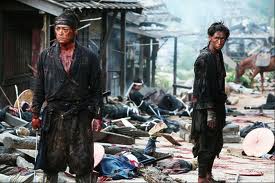
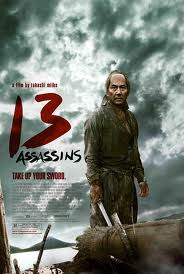
Here’s a movie you don’t want to miss.  I saw 13 Assassins back at Fantastic Fest last year and now it’s in limited release in the US; here in Austin it’s showing at the Alamo Drafthouse South Lamar. I went to see it again last night and again was blown away at the brilliance of the film.

13 Assassins is directed by Takashi Miike (Ichi the Killer, Sukiyaki Western Django) and stars Koji Yakusho (Memoirs of a Geisha). It’s a traditional samurai movie in many respects, the kind there used to be scads of but isn’t really made much any more (technically, jidaigeki).

The general setup is that there’s a noble who is a degenerate Caligula style freak who is committing all kinds of atrocities, but he’s the Shogun’s half-brother so can’t be held to account. In fact, he gets nominated to be the Shogun’s chief advisor and once he travels back home from Edo, will take office and be untouchable. Finally the Chief Justice has to do something, and he approaches a samurai, Shinzaemon Shimada, and asks him to take care of this problem. Shinzaemon recruits 11 other samurai willing to risk their lives for the sake of taking out the sadistic noble and they plan an in-route hit, culminating in them taking a small village and turning it into a prepared kill zone. In an unfortunate turn for them the noble’s head samurai, who knows Shinzaemon, is forewarned and gets more troops, so the opposing force is 200+ clan samurai. This does not of course dissuade the samurai, who just hold up a banner stained with the bloody tears of one of the noble’s victims that reads “TOTAL MASSACRE” and then proceed to kick a legendary amount of ass.

The film is very, very well done. It has an economy of motion about it very fitting for a samurai movie.  There aren’t wasted scenes or movement; the momentum of the film builds strongly even through the early recruitment and planning scenes and doesn’t spin out or go over the top even in the end fight scene that’s an hour long(!). The violence is not done in a “cheap” way like in many, where the super-protagonist just kills an unlimited number of people because, hey, it’s a movie and they’re the star.  And it’s not turned into a big epic costume drama either. It is a very personal movie.  I was impressed that the 13 protagonists (they are joined by a hunter they find tied up in the forest, though he is a lot more than he seems) were all distinct characters without being broad stereotypes – that’s hard to do even with smaller ensemble casts.

It is refreshing after a diet of Hollywood movies where all you can really say is “Well, I’m glad it wasn’t awful” – like Thor and everything else I’ve seen this year really – to see something skillfully done, a movie made like a movie can be, with drama and violence and some humor and executed completely faithfully to its theme.

And also – you get to see an unparalleled samurai bloodbath.  Woot! Go see it.

RPG Review: Coliseum Morpheuon

My newest review is up on RPG.net! Here it is for your viewing pleasure.

Coliseum Morpheuon is, in its own words, “an Extraplaner [sic] plug-and-play mini-setting and adventure for 16th-20th level characters, wholly compatible with the Pathfinder Roleplaying Game.” It’s a patronage project by Rite Publishing, and the primary designers are Clinton J. Boomer (of D&D PSA and RPG Superstar fame) and Jonathan McAnulty. It’s a 128 page PDF and my review copy came with a number of separate PDFs with terrain and paper minis specifically for the adventure, which was a really nice touch.

Look and Feel

The front and back cover art is very nice, though the back cover text has a startling number of misspellings and grammatical errors. I found that a bit off-putting. Luckily the rest of the book doesn’t have that high a rate of editorial flaws. Inside, the layout is nice if not brilliant (I especially like the border art, but am dubious about the font choices especially within boxed text) and the interior art is good if not super frequent.

Contents

Chapter One is about the Plane of Dreams, where all this takes place, from the Shores of Sleep to the Slumbering Sea. It owes a lot to H.P. Lovecraft’s Dreamlands. It explains it briefly in both fanciful and technical game terms.

Chapter Two explains the art of “Dreamburning,” which is an interesting mechanic. A character’s hopes, aspirations, and dreams are turned into actual game effects in the lands of Dream, and can be used up by the character, or even destroyed or stolen. It’s a good mechanic – you have a limited number, so those who don’t roleplay at all have a resource management mechanic to play with, and also burning or gaining Dreams is reflective of actual changes to the character’s psyche, so if you are into the roleplaying it can be extremely interesting. And especially for a high level game, it adds some additional strangeness and risk that can add a new dimension to the usual grind.

Chapter 3 describes four denizens of the Dream. These range from the “chittering dream eater” to the iconic denizens of Leng.

Chapter 4 gets into the Island of the Coliseum Morpheuon itself, a land of coherent dream afloat in the Slumbering Sea, and its demented and depraved ruler, the Khan of Nightmares. It hosts a large bazaar-city whose most salient feature is the Great Coliseum where the Games go on endlessly, which contains charming locales like the Pagoda of Patricide. As a cosmopolitan city, it serves as the Waterdeep/Sigil/Sharn/Absalom of the setting. It’s pretty cool, but described only very briefly.

Chapter 5 narrows down to focus on 16 major denizens of the Coliseum itself and provides full writeps and stats for each. This is where a lot of meat is generated, and that’s good, because you can always make up more weird dream locations but NPCs for a 16-20th level campaign are hellishly hard and a lot of the work for an GM. This one chapter is as large as all four that came before put together.

Anyway, these NPCs aren’t your usual cast of characters. They are as weird as you’d expect high level denizens of a dream realm to be. The Dragon of the Ghostdance meets Jack of Diamonds, a “Lifespark Psion-Killer” who looks like an anime robot critter out of Neon Genesis Evangelion. There’s Kahnzadeh Sukhbataa, an “Advanced Transforming Shield Guardian Clay Golem Fighter 3,” the Solstice King, and the Pasha of Swirling Ashes. None are stock high level goons, they are all lovingly crafted in their complexity. There’s a lot of high level goodness packed into this chapter, and it’s worth looting for high level extraplanar NPCs or opponents on its own.

In Chapter 6, we move towards the adventure part of the program, with an overview of the Damnation Epoch, a specific tournament with the Cup of Desires as its prize, that is the primary adventure hook. Since they assume you have complex 16th level characters with huge backstories of their own coming into this, the authors take a toolkit approach and let you piece together a plot with chunks they provide instead of laying out a linear adventure path. The PCs, as a team in the tournament, are given a benefactor (one of the heavy hitters from Chapter 5).

Chapter 7, An Invitation to Damnation, is the first part of the adventure proper. It introduces the PCs to the realms of Dream, the Coliseum, and the games. It’s a lot more linear than the rest of the product, but I suppose that’s somewhat inevitable.

Chapter 8, The Tests of the Coliseum Morpheuon, is a set of adventure seeds for PCs once they’re established in the place. Then Chapter 9, The Tests of the Damnation Epoch, is about what actually happens in the arena – a set of 10 specific trials that the tournament consists of. Many teams participate, but few make it out. Chapter 10, Secrets of the Coliseum Morpheuon, is about larger plots to weave into the campaign. You could just run the Tests of the Epoch in Chapter 9 and have a straightforward “kill and kill again” campaign, or sprinkle in the Tests of the Coliseum in Chapter 8 to mix it up more, but it’s the Secrets of the Coliseum that proposes more high level goals the PCs may be trying to accomplish the and milestones towards them.

Then we have three appendices. The first two describe a couple opposing teams in detail, the Dirges and the Gray Feathers, one evil and one good, but both worthy opponents. They are fully statted up and have intriguing backstories. The third has four pregen characters, also complex and weird – no “Hi I’m Bob the 16th level fighter” guys here. If you don’t need pregens, you could use them as another opposing force. My only complaint here is that they don’t cite their references, making it hard to go find more information. Like one PC is a “Wyrd” and another is an “ironborn.” Are those from some other book? (Probably so, the OGL declaration in the back mentions a bunch of other works). But which? Having some codes that show where the various bizarre race, class, feat, and other power options are from would be invaluable.

Conclusion

I found myself wishing Coliseum Morpheuon was about three times longer than it is. It takes on an extremely ambitious scope in 128 pages, and as a result you often get very terse coverage of its contents. The text is very evocative, however, and provides a great framework for you to create a fantasia upon. And the hardest part, the high level opponents, are done up in detail, so the work you have to do is more the fun stuff than the soul crushing detail work of high level builds.

It’s just the bare bones of a setting, but more than enough to get started, and at that level tossing in a weird location and so many interesting and detailed NPCs means the adventures write themselves.

Coliseum Morpheuon is a rarity – a viable campaign for very high level PCs. It’s innovative and very well written. I give it a full 5 for substance. I have to dock it one point for style because of the lack of referencing and awful rear cover typos. I hope they fix those before they go to print; it sets an unfairly bad impression to see that on the outside of a work. But overall, it’s excellent and I would definitely run it for my gaming group.

Pathfinder RPG GM Screen

I’m not a big one for GM screens.  I like having one, but mainly just to obscure my notes and dice; having useful info on it is a “nice to have.”  I had a custom one I made of black posterboard I used throughout Second Edition.  I’ve been using a 3.5 one for my Pathfinder campaign.  I don’t get screens for most game systems; I have a couple others, inevitably, as part of my 1000-item RPG collection but don’t seek them out.

But then today I saw the Pathfinder GM Screen in my local gaming store.  “Eh…” I thought.  “Is it worth spending money on a screen?”  Then I picked it up and thought, “This is a fat package, does it have something else in it I want?”  Then I realized the screen itself is super duper well made and the whole centimeter of thickness of the product was just the screen itself.  It’s four panels, not of the usual cardstock, but of like hardcover textbook cover stock!  It’s not going to fall over, need other items chocking it into place, or the like.  I dropped the $15 without compunction.  It’s the best made GM screen I’ve ever seen.

They also did a good job of choosing what to put on it; not the “super easy to remember” or “supposed to be used during chargen” stuff, but all the fiddly skill check DCs, attack/AC modifiers, conditions, and object hardness/hit points.

Only one slipup – they have XP awards and treasure values on the screen for some bizarre reason (for those “I’m generating a random dungeon as I go” moments I guess).  Could have been used for hampered movement, light sources, combat feats summary, action types/AoOs, something.  But despite that, it’s definitely a great buy, and that’s from someone who generally considers screens a rip-off, one step above selling a bundle of blank character sheets.

Fantastic Fest – District 13: Ultimatum

District 13: Ultimatum is the sequel to the French parkour-and-martial-arts movie District B-13 (or “Banlieue 13” in Surrender Monkey), both by Luc Besson.  It pretty much follows the same formula – the French government’s gone all wrong and it takes two scrappy hunks from the wrong side of the tracks to flex some sense into it.

David Bell (Leto) is a miscreant who engages in minor vandalism and major free running, and his buddy Cyril Raffaelli (Damien) is a cop who loves him some martial arts.  As usual, the government/elite cops have a plan to kill all the poor people in District 13 by killing some cops, and putting them in gangland, and provoking a mass riot, and then getting the prime minister to bomb B-13 back into the Stone Age.  Damien and Leto have to evade and/or beat the snot out of 200 riot police and unite the five quite colorful gang leaders of the district to show the video of the shooting to the prime minister and stop the scheme.

The main problem is how unrealistic the plot is.  I mean, since when does having cops killing innocent people, even on video, result in anything other than “the officers were later cleared in the shooting…“?  Must be a European thing.  No, the plot is just an excuse to have cool stunts and fights.  And they’re pretty cool.  This movie focuses more on Damien and his martial arts then Leto and his parkour.  The fight scenes are nice and brutal, and like the previous movie they eschew CGI and wires for good old fashioned muscle-and-sinew work.  I wish there was a little more variety in the fights though, they are almost exclusively against faceless uniformed cops who stream out of everywhere like ants.  A couple mook fights are good in a martial arts movie, but I felt like the boss fights were lacking.  The pace is pretty good and it’s not allowed to lag too much before the next explosive action scene.

Like most Besson franchises, there’s a little bit of diminishing returns at work here; the action isn’t as novel and the fact that the plot is so much the same as the first movie erodes a little of the “dumb, but WOW” calculus of the original.  It is still fun, though, and listening to the French prime minister wax poetic about “liberte, egalite, fraternite” is inspiring.  In the end, I’m glad I saw it, though it’s not revolutionary it’s solid.

Fantastic Fest – Movie Summary

I will endeavor to write a review for each one of these fine films.  But here’s a cheat sheet!  I’ve stack ranked all the movies I saw here, from the ones I liked best to the ones I liked least.  There are really only two movies I disliked enough that I regretted seeing them, and only one of those intensely.

Must See

These are all instant classics I’d like to own the DVD of.  You should see them – alternately,  some don’t have distribution, so if you’re in “the biz” you should get a piece of them and distribute them!

  • Fish Story, a Japanese movie about a punk song that saves the world.  It is beautiful.  10/10.
  • Dirty Mind, a Belgian drama about a stuntman who gets a frontal lobe injury and turns from zero into Rico Suave.  Funny and thought-provoking.  9/10.
  • Stingray Sam, a sci-fi Western musical and one of the most hilarious things I saw at the festival.  9/10.
  • Mandrill, a South American version of James Bond.  Just enough camp.  9/10.
  • Zombieland, the big star-studded zombie comedy.  Nut up or shut up!  9/10.
  • The Revenant, a very well done movie of modern undead life.  9/10.
  • Doghouse, British zombie survival horror comedy.  Like Shawn of the Dead but with a touch of Return of the Living Dead.  8/10.
  • Rampage, by infamous director Uwe Boll.  Columbine meets Die Hard.  8/10.
  • Merantau – Indonesian martial arts, but transcends the genre.  8/10.

Should See

When you go to see one of these in the theater, you come out feeling your money was well spent.  Much better than the stuff playing on “SyFy”.

  • Sweet Karma, a chick-revenge killing movie with great gratuitous nudity and good twist.  7/10.
  • Salvage, a British horror/thriller.  7/10, higher with a better editing job.
  • Metropia, a dystopian uniquely animated movie.  7/10.
  • Crazy Racer, an over the top Chinese version of a Guy Richie movie.  7/10.
  • Kamogawa Horumo aka “Battle League in Kyoto”, a Japanese movie with a funny supernatural twist.  7/10.
  • REC 2 – The first REC was the movie Quarantine was based on.  This is the sequel, which kicks off immediately after the events in the first one, Halloween 2 style.  7/10.
  • Krabat, a German movie based on a young adult novel called “The Satanic Mill” (yeah, that’s how the Germans roll).  6/10.
  • Hard Revenge Milly, a bloody Japanese chick-revenge actioner.  6/10.
  • Ninja Assassin – Rain is a ninja killing ninja!  An over the top ninja actioner.  Ninja!  6/10.
  • Buratino, Son of Pinnochio, a weird Estonian film that’s like a light-hearted and musical version of Clockwork Orange.  6/10.
  • House of the Devil, a movie trying to replicate in every detail the typical late ’70s/early ’80s horror movie.  6/10.
  • District 13: Ultimatum, a sequel to the first French parkour-and-martial-arts dystopian actioner.  Dumb but fun.  6/10.
  • First Squad – Russian anime.  Pretty good if not exceptional.  6/10.
  • House (Hausu), an older Japanese film I describe as “John Waters does Evil Dead.”  5/10.

Could See

About what you’d expect from a good day on SyFy/Chiller.

  • Survival of the Dead, George Romero’s newest zombie movie, somewhat disappointing.  5/10.
  • Vampire Girl vs Frankenstein Girl, Japanese splatter comedy.  5/10.
  • Under the Mountain, a young adult movie from New Zealand; apparently based on some famous book/TV series and bearing some similarity to Escape to Witch Mountain.  5/10, higher if you’re a kid.
  • Yesterday, good old fashioned zombie survival horror on a super low budget.  4/10.
  • Cropsey, a documentary about an alleged child murderer from Staten Island named Andre Rand that just doesn’t deliver much.  4/10.

Bah

These movies made me sad.

Stuff I Didn’t See

All this is complete hearsay.  But I heard from many people about many movies, and here’s my summary of the buzz.

The Good

Love Exposure, a 4 hour long Japanese movie about upskirt photography (among other things) was rave reviewed by everyone I talked to who saw it. I just couldn’t fit in a 4 hour movie in my schedule.

Down Terrace was also very well reviewed, but I missed it.

The Mixed

Clive Barker’s Dread – very mixed.  Some people hated it and walked out, bored.  Others say if you stay for the end it’s a big twist and gory demented.

I did not hear good things about Paranormal Activity, a new major release that’s like Blair Witch in your bedroom.  Same with Antichrist, the Lars von Trier horror vehicle.

The Human Centipede, about a surgeon who nabs three people and sews them together ass to mouth  into a big human centipede.  It won an award, but I didn’t talk to a single person that liked it.

Random Thoughts

Shorts.  Shorts are good.  I wonder why genre channels like Chiller and SyFy don’t run more shorts just interspersed with their programs; there are a lot of good ones, they’re cheap…

This was a “genre” festival.  That’s code for “good stuff Hollywood doesn’t like”  It’s an odd mix – zombie movies, horror movies, martial arts movies, foreign movies, R rated movies, non-G rated animated movies…  In today’s studio system, films like Sweet Karma, a solid thriller that’s a solid R but not a “horror ghetto” movie like Saw, don’t have a place, sadly.  I was actually surprised at how many movies weren’t traditional horror/sci-fi/martial arts genre movies.

Fantastic Fest – House of the Devil

The House of the Devil, by Ti West (Cabin Fever 2, The Wicked), is a homage to late ’70’s/early ’80’s horror movies and does a great job of slavishly reproducing the look and feel of movies from that time, from the lead actress’ feathered hair to the cinematography, title and credits, everything.

The lead, Samantha (Jocelyn Donahue) is a poor college student trying to make enough money to get a place of her own, and takes a babysitting job at a big house out of the city to that end and OH GOD SATANISTS!  The plot is the usual chick chased around a big house thing.  Donahue does a good job and the movie is suspenseful, it gets you with a couple good scares.   It resembles a film made in 1982 in just about every respect – story, effects, score, characters.  (With the welcome exception that the lighting work didn’t suck as bad as it did in the older movies, always a pet peeve of mine.)

That’s a cool and interesting accomplishment, and I enjoyed my time watching House of the Devil enough, but I didn’t think it was all that interesting once you got past the ’80’s reproduction thing.  It was a little bit too much Halloween meets Rosemary’s Baby; I liked the ’80’s tone but wanted the plot to be a little more than a retread.  It was gripping, though, and would be somewhere in the top 30% of 1980s horror movies.  Which, come to think of it, puts it above about 90% of the crap put out in the last year or so, thus I guess in the end analysis House of the Devil is pretty good.

Fantastic Fest – Dirty Mind

Belgian director Pieter Van Hees brings us his new film, Dirty Mind, about a shy stunt effects guy, Diego (played by Wim Helsen), who suffers some brain trauma and suddenly develops a totally uninhibited personality (a real syndrome called frontal lobe disorder).  He starts calling himself “Tony T, as in TNT, boom baby!” and becomes a devil-may-care stuntman.  A doctor, Janna (Kristine Van Pellicom) tries to get him to get treatment for his disorder, but Diego/Tony hated his loser life and is enjoying being a stuntman and chick magnet.  So he tries ceaselessly to seduce Janna instead.

The interesting part of the film is the debate over whether Diego/Tony really needs treatment or not.  He was an unhappy loser living with his mother, also a pathetic depressive, always overshadowed by his stuntman brother Cisse (Robbie Cleiren).  Now, sure he’s a little inappropriate at times but is generally acting like his brother or any number of non-brain-damaged overenthusiastic assholes we all know and semi-love.  The film slowly ups the ante as his syndrome progresses – in the beginning, his brother and family are very enthusiastic about the new personality.  But then Tony starts to eclipse his brother in the stunt world and cuts him out of deals; he has sexual contact with people he shouldn’t; he gets very narcissistic and loses the ability to empathize with people or determine what is inappropriate and the progresses to very risky behavior.  But even with that the people in  his life vacillate over whether Diego or Tony is the best guy (also an interesting theme, about how other people help determine who we are).

Helsen’s performance is great.  The film’s serious but funny at times; Tony has these little pseudo-raps he does about how great he is that are hilarious.  The best takeaway points are:

  • There’s a fine line between mental disorder and the normal range of human behavior
  • Women love the bad boys – even (especially) the buttoned up professional women; when it comes down to it they’ll throw it all away for the deep dicking
  • Sometimes your mother just needs a good punch in the uterus for lippin’ off to you

I thought this movie was awesome.  Very thought-provoking.  The one thing I didn’t like was the ending; they throw in a little “action” at the end when the operate-or-not decision is at stake and I thought that was a misstep, trying to do things the “Hollywood friendly” way or something.  But besides that, this was one of my favorite movies of the festival, and definitely the most thought-provoking.

Fantastic Fest – Buratino, Son of Pinnochio

Buratino, Son of Pinnochio is a very odd but good-hearted Estonian musical.  Buratino’s mother wishes upon a star for a son and is suddenly impregnated by a…  Fairy rape splinter from heaven, I guess?  Anyway, she comes to full term immediately and has a wooden boy as a son, who as soon as he loses his bark looks normal (as normal as anyone looks hereabouts).  Flash forward to the teen years, and Buratino and his friends in “Badville” go over to roust the citizens of “Goodville” for spare cash and outrun/terrorize their police force.  The bizarrely costumed youth gang brings to mind images from A Clockwork Orange (though the tone is diametrically opposite). Eventually some bad guy from Goodville (that’s a good name for a band!) named Karabas Barabas sends his thugs after Buratino to kidnap him to get some kind of “seeds” from inside him.  And he has a hot blue-haired daughter, Malvina, who Buratino naturally falls in love with at first sight.

I thought Buratino was charming and upbeat, if not very polished.  Characters frequently burst into song so you get a bit of rock opera thing going on.  The twists and turns are humorously bizarre (Pinnochio himself, who no one knew was Buratino’s father prior to this, turns up later on) and there’s all kinds of over the top cartoon style silliness (to see for long distances, people just make their hands into binoculars; people get exploded and tossed a quarter mile and only end up disheveled).  Sure, it’s goofy, but has a real heart.  It was Rasmus Merivoo’s first film done while he was in school on a shoestring budget and a very short timeline, and shot in Russia to boot.

Buratino, Son of Pinnochio was fun, weird, and happy.  The musical bits are surprisingly good.  The rest is obviously low budget but solidly done.  I enjoyed its off-beat humor.

Fantastic Fest – Survival of the Dead

George Romero, the grandfather of modern zombie cinema, was in attendance to show off his new movie Survival of the Dead.  It’s a spinoff of the recent “Diary of the Dead” and, like it, is completely independent.  He says he envisions doing a four movie series like the first “of the Dead” linked series (Night, Dawn, Day) but along this new, different storyline.

I am always of two minds about Romero.  He’s of course a seminal figure in the field, his first zombie movie especially was brilliant, and has spawned an entire genre.  But…  His ideas aren’t aging well, and it often seems to be more of the same, without the additional polish you would tend to hope would come to pass over a career spanning so many decades.  I’d use a geek analogy to Gary Gygax, co-creator and main popularizer of the Dungeons & Dragons game – yay, he created a lasting cultural icon, but then over the next three decades he kept regurgitating the same ideas without, really, much evolution and became less and less relevant.  (It’s a step better than the Linus Pauling syndrome, where someone who was brilliant in a given field picks up crackpot theories in another – Pauling was a brilliant chemist who gave us several important theories, especially on the nature of atoms, but later in life hooked in to the idea that megadoses of Vitamin C would cure anyone of anything and went onto the quack circuit.)

Anyway, Survival of the Dead, as I feared, has its good points but also has many weaknesses and inconsistencies.  It follows some ex-National Guardsmen gone wrong (and a sassy kid they pick up) as they go to an island rumored to be free of the undead, but instead run afoul of a family feud.  Romero said he was going for a Western feel with this one, but it felt like he briefed one set of actors (the islanders) on that and neglected to brief the other (the Guard) and it yielded an extremely inconsistent tone.  Furthermore, though generally “serious,” there are moments of camp, like one zombie kill where the cap of its skull spins around before coming to a rest on its neck-stump like something out of Army of Darkness.  Similarly, at times it seems like life is going on OK in the U.S. despite the zombie plagues – late night hosts joke about “deadheads” and the Internet is still working – but then it seems like every single location is infested with undead and completely unlivable.  The movie couldn’t figure out what it wanted to be and veered wildly between several different tones.

The nominal addition to the Living Dead mythos here is that one of the islander families doesn’t want to kill the zombies, but keep them around as revered ancestors; rationalizing it as maybe someone will find a cure one day.  This could be an interesting premise, but it ends up being incoherent – the family is “zombie ranching” on their farm but carelessly kills them plenty themselves.  Then they change their story to “trying to teach them to eat something besides people!”  But no matter how you look at it, that’s stupid and pointless.  First, teaching zombies to eat livestock would just denude the world of animals as well as humans.  Second, zombies don’t need to eat – they just kill and “eat” out of their bizarre undead natures.  It’s not like they can “fill up” on something – they’ll eat your dog and then eat you;  you’re not being used as food per se, it’s not like they get nutrition out of it.

In the end, the failure of this movie and the other more recent Dead movies can’t be blamed on budget – it’s the script, and an inability to craft a coherent narrative.

Fantastic Fest – Metropia

Metropia is an animated feature set in a European dystopian future (is there any other kind?).  People still live on the surface but apparently never travel there, instead using the huge interconnected subway system controlled by the Trexx corporation.  Roger has an indifferent life – working as a drone, his relationship on the rocks, etc.  His only step away from “normalcy” is enjoying bicycling instead of using the metro.  But apparently that’s enough – the voice in his head that tells him to buy Viagra and conform becomes jarring to him.  He thinks he’s going crazy until he sees the cover girl from the shampoo everyone uses, and starts to follow her around instead of going to work – this spirals him into a web of intrigue.  The movie recalls themes from Brazil and A Scanner Darkly.

The animation style is unique and weird.  People’s heads are large and facial features very realistic, but the rest of their bodies and the world are more stylized.  It fits the Kafkaesque feel they’re going for and allows for maximal expressiveness and acting on the part of the characters, a double win.

The plot is pretty interesting – turns out the ubiquitous Trexx Corp. has graduated from just putting cameras in everyone’s TV set to mind – if not control, influence – via their ubiquitous shampoo; they have a bank of call center type employees who can see through people’s eyes and speak into their minds.  Roger is never sure who to trust – his girlfriend, the shampoo cover girl he’s obsessed with, his “control” who talks into his head and looks disturbingly like him…  It’s a conspiracy thriller about control and perception.  I liked it quite a bit, as I did the somewhat similarly themed (and also weirdly animated, though in a completely different style) A Scanner Darkly.  It’s director Tarik Saleh’s first movie and as a freshman outing I think it’s amazing.