Category Archives: talk

Fantastic Fest 2025 – 20th Anniversary Edition!

I took a week off and went to my favorite Austin film festival, Fantastic Fest! It’s the 20th year of this genre (fantasy, horror, science fiction, action, and cult) film festival started back in 2005. The movies range from the ultra weird obscure foreign films to the breakthrough hits (Zombieland, John Wick, The Babadook, and Smile for example). I started going in 2009 with fellow gamer Chris and have attended on and off since (2009, 2010, 2011, 2015, the online-only 2020, 2023, 2024, and 2025). It’s always a good time – you see some complete trash and you see some movies better than anything that would normally hit the theater in your city that become your favorites of all time.

You can check out my writeups of previous years (of varying length and detail). The TL;DR is my top 10 movies I enjoyed the most from prior years are:

  1. Fish Story, a Japanese movie about a punk song that saves the world.  It is beautiful. 
  2. 13 Assassins, the best modern day samurai movie by a wide margin. TOTAL MASSACRE!!!
  3. Sound of Noise, a Swedish film about guerrilla musicians and the tone deaf cop from a famously musical family who’s after them
  4. Green Room, where a punk band runs afoul of Nazis, as they do (with Patrick Stewart as lead Nazi!)
  5. Kill, an Indian (Sikh) movie that is “Die Hard on a Train” with super impressive action
  6. Animalia, a Moroccan arthouse movie that is beautiful and deep
  7. Riddle of Fire – like a 1970s live action Disney movie, and absolutely hilarious
  8. Planet B – a frighteningly realistic “VR Guantanamo” scenario in a French near future sci-fi thriller
  9. Daniela Forever – Nacho Vigalondo’s take on an Eternal Sunshine of the Spotless Mind type situation
  10. Sister Midnight – a newly married bride in Mumbai’s life goes from trying to boring to weird

If you watch those you’ll have a good time and also get a taste of the breadth of offerings at the fest.

Here’s a letterboxd list of the 2024 features as a bonus.

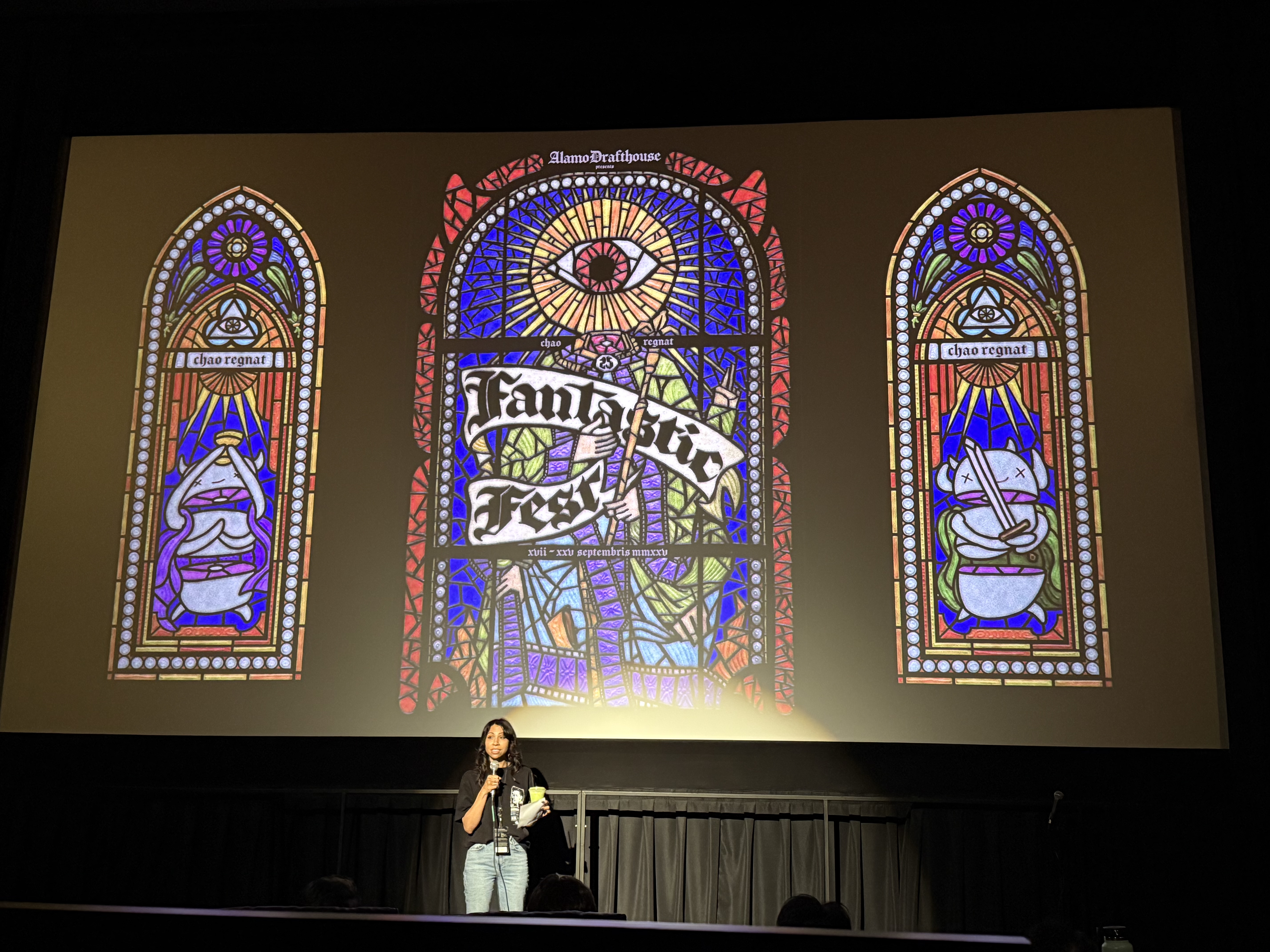
I’ll cover the fest day by day! Here’s the cool stained glass “Saint Chingu” theme this year:

WWII RPG Kickstarter

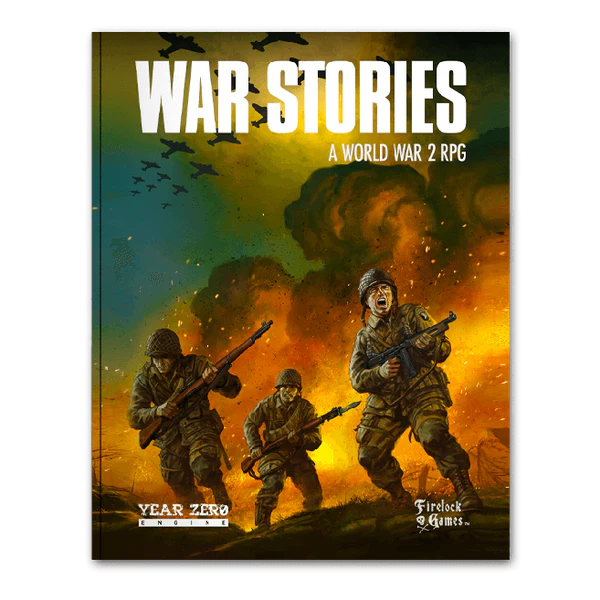
I don’t usually pass on Kickstarter news but I ran across this one from this Limithron blog post and while this company, Firelock Games, does lots of pirate-era mini games they have a Year Zero engine WWII RPG called War Stories, there’s a kickstarter for the Pacific books right now, and here’s an actual play and a RPG.net review.

WWII RPGs are oddly rare, I have copies of old ones like Behind Enemy Lines, and of course GURPS has everything, and then you get your weird combos like Weird Wars, Achting! Cthulhu, or Godlike – but except for very focused indie games like Night Witches and Grey Ranks you don’t see it much any more, so it’s cool to see a squad focused modern RPG system in the genre!

So if you obsessively watch Band of Brothers, The Pacific, Saving Private Ryan, etc., here’s a great way to roleplay in that setting!

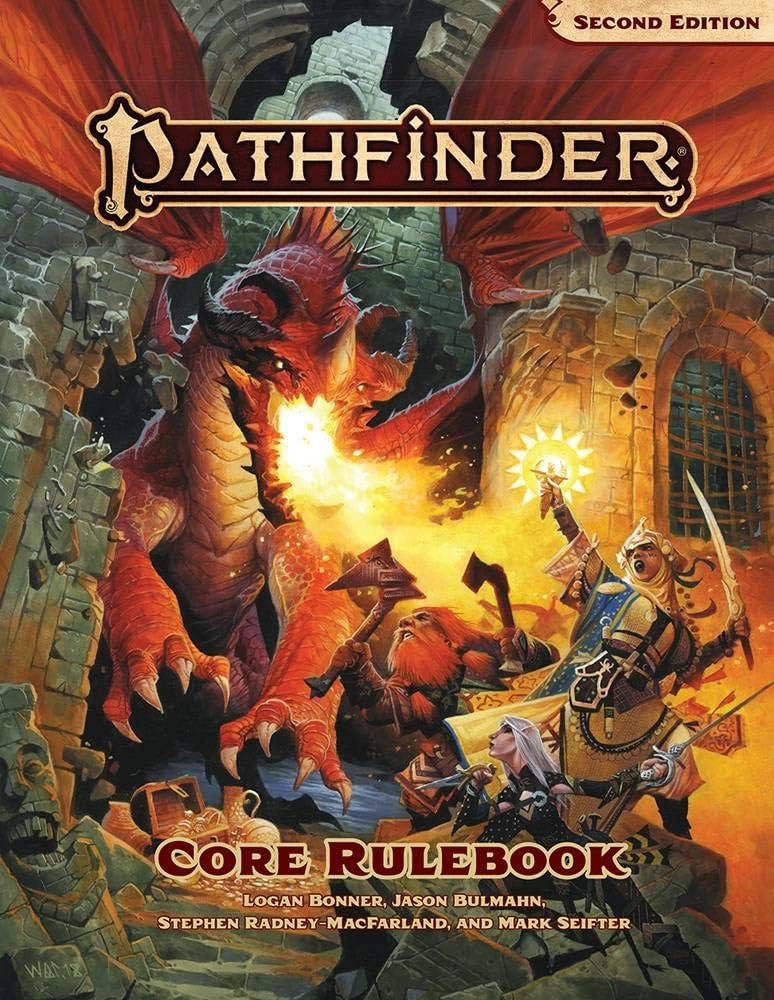
Why I Don’t Like Pathfinder 2E

I got it when it came out, I tried it… I didn’t like it. Or at least, I didn’t see any improvement that would cause me to re-buy my thousands of dollars in PF1e gear (I was a superscriber from day 1). “The same, but different” didn’t keep my wallet opened up.

I tried picking it up again lately. I still like their adventures and Golarion content and would use the newer stuff if I could (lore books – kinda can, APs – kinda can’t, at least without 6 man-months of conversion time for each one). I ran across pathbuilder2e and wanderersguide and thought “well hey let me try it with a character generator” and I liked it even less, but I think I understand why now.

It reminded me of the experience I had with the Spycraft game from the 3e era. Spycraft was fun! D&D rules for James Bond stuff! Spycraft 2e came out! I hated it!

The newer version wasn’t even that different – it was that the new implementation of the rules was just… charmless. Everything was a technical term that was a reference to 3 other technical terms and so on.

And that’s my problem with PF2e. No hate if it speaks to you. But when I read through it and it’s all keywords and jargon – and sure, any RPG has some of that, but there are many levels of fiddly – it leaves me completely cold. It’s the difference between a book that teaches you physics in an accessible way (Hi, Isaac Asimov!) and a textbook.

And if the “keyword” approach actually brought brevity to the rules, turned the PHB into 96 pages… ok maybe… But no, just like Spycraft 2e, PF2e is giant. Those ‘simple’ keyword bones actually become more complex when there’s too many of them.

I prefer having a tool to run high level PF1e… But I can’t imagine running any level PF2e without it.

Want a character with these 3 skills? Oh sorry you can’t just choose skills, you have to pick an ancestry that gives you one and a background or whatever they call it that gives you another and then a class and a heritage and and…

Stats? Can’t just roll or buy them, no no, you need to cobble together ancestry boosts and background boosts and class boosts and free boosts…

I stuck through it until I tried to get equipment and then the keyword slush just overwhelmed me. Then “special action icons” time came and I was out, I hated that in D&D 4e and I hate it now.

Every Archives of Nethys page gives me a headache. Everything is so goddamn long. Picking a random monster… Chimera! 3.5e: 391 words. PF1e on Nethys: 537 words. PF2e on Nethys: 1192 words. Fuuuuck me. I mean, I get it has more options and stuff. But… do I need that? Do I need 1000 words on every single one of 1000 monsters? This is why people are giving up and training LLMs instead of trying to keep up with the diarrhea of content in every field.

I am sure I could figure it out if I stuck to it. But it’s just not… Fun. I’m not sure why I should.

Most of the arguments I see about why to (besides “3 actions in a round, woo”) are “well if your friends do” or “well if the only tables around are” or “if you want to buy stuff now you have to” but these are all just like the reasons to go cow tipping and get pregnant early from my youth.

It makes me sad, because with PF2.5e (whatever they call it- “Remastered?”) out, I feel like I’ve lost my chance to get back on board. By all accounts it’s even more “like that” than 2e and now bunches of 2e things are incompatible. I like the sound of their new Azlanti islands AP coming out but I fear trying to convert it back to 1e. “You missed that there were TWO DOTS next to the person’s name that means they have SOMETHING SOMETHING!!!” Without being an expert in it, it’s inaccessible.

I’m playing DCC now, and most of the OSR stuff has too *little* rules texture and options for me compared to 2e/3e times. But if my only other options are BehemothLand, what’s someone who wants moderate crunch to do?!?

In The Shadow of Giants

I ran across this blog post describing a campaign concept called “The Book of Giants”, of Nephilim and witch-wives and a world populated with dangerous giants. I like it; I once wrote a Living Greyhawk scenario called “Giants In The Earth” so I am familiar with the source myth.

I had actually been mulling over a new campaign with giants as the primary opponent and predominant/ruling populace. My concept has a little less angel witch sex but I think it still has legs. I like constraining campaigns to focus on a set of concepts – sure, PCs can’t play any crazy option they can think of, but they also have a much better idea of what’s going to come up so they can pick options that would have a guaranteed chance to shine. Let’s see what you think!

Campaign Concept

All civilized lands are ruled by the titans, who style themselves the gods that walk the earth. (They were the children of the gods, and rebelled against them and they are all now destroyed or hidden away or forgotten.) Their empires are inhabited by all sorts of giants as the primary populace. Humans are simply a slave race to the giants and are lesser beings that live in their shadow. They are used for labor, crafts, entertainment, and so on; not taken seriously as a threat. The tech level and society is most analogous to ancient Greece with the titans considering themselves the Olympians.

The first plot arc is to survive servitude and get free. Naturally the giants delegate down tasks like slave wrangling to the smaller giants, but even a hill giant for a group of first level humans is an intractable opponent. They have to build up arms caches, make plans, and take advantage of the giants’ complacency and hubris to make their escape.

Then the second plot arc is to go find places to hide and allies. There’s a couple major factions to join up with that lurk in places inaccessible to the giants. First, escapees living in the thick forests. There’s a cabal of mages here that consider themselves in charge, and of course a bunch of druids and rangers and fae. They focus on rediscovering ancient magic as the way to gain enough power to survive and thrive and try to teach as many people magic as possible. Second, underground caves with dwarves and artificers where there’s a lot of building golems and automatons to be able to fight for you. Most humans haven’t seen a dwarf up till now; they refuse to live as slaves and either fight or just sit down and die so they’re not seen in giant lands.

The third plot arc, of course, is to take the fight to the giants and free humanity – at first guerilla style and then as levels rise and armies assemble, direct action.

There’s no other humanoids – humans *are* the humanoids and giants are the humans, effectively. Every giant animal and insect in the books are the primary threat; they’re everywhere as the ecology is scaled to giant size. While there are umber hulks and some other aberrations underground the focus is really on giant animals/magical beasts, there’s no outsiders or undead (except for some run by a hag coven with three nightspawn that operate in the mountains). This allows PCs to not have to worry about a large number of opponent types to focus on the campaign thematic ones. It won’t get boring, there are 30+ types of true giants in Pathfinder and so, so many animals that are either giant or dire already or can be quickly made so. (This has the bonus of some real live zoology learning for everyone.)

Religion is banned by the giants, but a priestess has rediscovered a lost god of the humans, a couatl type deity, making PC worship effectively monotheistic. There’s no “churches,” it’s more of a hidden and evangelistic enterprise among the humans, focusing a bit on the liberation theology angle.

While you can make heavy armor in the later game, the nature of the world strongly prefers light, mobile, ranged, and hit-and-run type combat against an inevitably larger and stronger foe. While some folks can learn and steal wizard type magic from the giants, sorcerers are more common at lower levels, and then as levels increase people can learn magic from the wizard cabal or the fae.

Now, I’m torn as to whether this is enough – I also have the idea for a larger destabilizing force, an ethereal invasion of xill that is converting some of the landscape to wasteland. This would distract the giants with a larger threat to allow the alliance of human rebel groups to grow. Living plants and certain metals would be proof against ethereal travel so the humans could protect themselves to some degree, though once they venture forth, the terrifying sudden appearance of an ethereal murder machine would become a common threat. This would add a weirder layer to the campaign so it’s not just giants and animals and rebels.

Thoughts welcome – does it sound fun as a player? I know PCs don’t like being captives, but I am hoping that if starting as a slave is clearly part of the premise and getting free is the whole point, it could be a cool vibe people could get into…

The Monsters Know What They’re Doing

I ran across this cool blog that talks about various monsters and their tactics, in context of who and what they are. Monsters aren’t deliberately dumb (though based on their Int they may be more or less sophisticated) and “blindly charge PCs till dead”, while popular among too many DMs, isn’t a really interesting or realistic set of tactics. So check it out and consider how everything from a razorvine to cosmic horrors would react to a threat.

Geek Related Naval Combat Rules

I’ve covered guns and cannon, chases, mass combat – but what would a pirate game be without ship-to-ship combat? Now on the Rules You Can Use page is:

Naval Combat Rules (14 page pdf)

A navy ship and a pirate ship engaging each other on the open seas

For Pathfinder 1e, but easily adaptable to many others I think. It works in concert with the Geek Related cannon and mass combat rules and adds ship design and combat at sea.

I wrote an early version of this for Frog God Games and it got partially incorporated into Razor Coast: Fire As She Bears! But that work turned out pretty long and complicated, though very good, and for our game my players wanted naval combat but weren’t going to put up with 96 pages worth of it. Do get Fire As She Bears, though, it’s quite good, especially if you want to invest more in the naval combat ruleset part of your game. If you like these rules, they are directionally similar; I’ve been evolving mine over the intervening 10 years as we’ve used them to maximize flavor of our base case – small numbers of ships chasing, fleeing, and fighting with small numbers of cannon and the usual Pathfinder magic-and-monsters thrown in.

Pathfinder published some ship combat rules eventually for their Skull & Shackles adventure path but they suffer from the core problem of ships having one pool of 1600-ish hit points, which makes it either pointless to do the ship-to-ship combat and everyone just boards or, once you get high level, you swing the barbarian over there on a rope and sink it in a round. They did this because their adventure path quickly becomes PCs running squadrons of ships, not the feel I was going for.

The solution (from my rules, and in Fire As She Bears) is to break larger craft up into 10x10x10 squares and have each of those have hit points, with the added benefit of you can correlate crewmen (and PCs) to those areas. I used much lower hit points than even Fire As She Bears did – 50 hp per hull section instead of 150. In my campaign this was better suited to fast naval combats. PCs get impatient and always want to fly to the other ship; this made the PCs focus on keeping their ship safe and manning repair crews instead of just saying “it’ll be fine, we can just go melee kill.” But it’s still enough hit points (and enough hull sections) that they don’t just get blasted to flinders in a round. (Unless they go bother a ship of the line.) I also have fewer cannon per ship because they are newer, rarer, and more expensive in Golarion – FasB lets you pack like 4 9-pounders into a single hull section so “28-gun” and “49-gun” ships exist – in my game it’s more like 4 cannon a side is a well armed craft. (And also not hours of dice rolling for a single round of combat).

Anyway, once you have your ship and cannon, you gain the weather gage, maneuver trying to get closer or farther away; conduct maneuvers while trying to line up cannon shot, and so on. These are similar to these other naval rulesets.

Part of the real magic, however, is the range bands and speed checks. This is what makes the battles feel naval and not like sitting slugfests. The Skull and Shackles rules just make this “2 out of 3 sailing checks and you catch ’em”. But I bring in some ideas from my chase rules that make the positioning important, and not just a preface to a static combat. Your ship’s speed turns into a bonus to a Profession: Sailor check and if you can beat the other ship by 5, you can close (or increase) the range by a band.

We’ve been using these rules a lot over years and it’s very dynamic. You pull a little closer – now you’re in Medium range and can bring those 12-pounders (and fireballs) to bear! Oh no, they pulled away to Long range, try to hit their sails with the long nine chase gun! It hits the magic ratio of 2/3 of the combat is naval before finally 1/3 devolves into normal Pathfinder combat, and a full on naval battle beween fully armed ships with similarly-leveled crew is a showcase event that can take most of a game session. And it’s not a completely abstract minigame; you’re throwing your usual spells and shooting your usual bow or musket at the other ships.

Enjoy, and let me know how you find them!

Rule Zero In Pathfinder 2e

One of the most popular evergreen posts here on Geek Related is Rule Zero Over The Years, which compares the positioning of the GM’s authority relevant to the game rules and to the players in the different editions of D&D including Pathfinder. Well, I just updated it to include Pathfinder 2e, so check it out!

The TL;DR (and it is indeed too long) is that Pathfinder 2e steps a little back from the Pathfinder 1e/D&D 5e flavor of kinder, gentler GM authority, where it’s “for everyone’s fun” not “to put those little peckerheads in their place” as Gygax would say in AD&D, but the GM can make rulings and house rules and cheat/fudge die rolls and use tricks. It still adheres to the 3e concept of “Rule Zero: The GM is the final rules authority”, and doesn’t fully go the D&D 4e/3.5e direction of “you will adhere to the rules young man, if you know what’s good for you,” but… it does a little bit. In PF1e they explicitly discussed GM fudging and illusion of choice and similar – all that is gone in 2e, the GM is in charge but much more by-the-book.

I find this interesting but not surprising, PF2e did ‘get a little 4e in it’ in my opinion, and it is such a huge beast of a ruleset they can’t help but say “maybe you should steer away from modding this.”

Anyway, more detailed analysis and textual support from the books added to the original post!

Geek Related Gunpowder Weapons of Golarion

A while back, I took an initial stab at some firearm rules for Pathfinder 1e. But over the 15 years of the Reavers campaign I’ve been continuing to use and refine them. So now on the Rules You Can Use page is:

Geek Related Gunpowder Weapons of Golarion (7 page pdf)

Now, since I created mine back in 2009, Paizo came out with official firearm rules and then also cannon rules. But I still use mine. Why?

Early Personal Firearms

Well, the problem is that to make it easy to balance, Paizo made guns a lot like bows, especially damage wise. Bang, 1d8 damage! People want “consistent damage output” so they made them easy to reload quickly and/or have multiple barrels so you can get your multiple shots in a round. The main thing they added to power them up was to make them hit touch AC within the first range increment. But that’s a problem IMO – so magic plate armor, dragons, etc. are trivial to hit. Sure, “eventually firearms made armor obsolete” but an early flintlock bullet will deflect off a breastplate just fine.

I wanted to approach the topic with two equally important goals.

One, historical realism – at least a nod to it. One of the things I have loved about D&D in the 40 years I’ve played it is the exposure to history, technology, real stuff. This means slower reloads, misfires, high crits (the Paizo rules do have misfires and high crits, credit where credit is due), and so on. And related to this, fantasy trope fidelity – firing a pistol while laying about with a sword is a staple of some historical but certainly much fantasy fiction, and if a gun is just a bow then you will only have specialists. And while I do want early firearms in my game, I don’t want someone spewing out 4 shots a round, that’s for a modern game. I don’t really like the feel of a “gunslinger,” maybe a “musketeer” at maximum in a late middle ages/early Renaissance type setting.

Two, make them feel different than other weapon types. If having a gun is just a bow with a special effect, I’ll play Apocalypse World, thanks. If they’re not different texturally, why add them? Just for the fictional impact I guess, but – bah. To me the impact firearms should have is that you can’t fire historical firearms quickly – but if they hit you they will fuck you up. PCs above level 1 treat “a guy with a bow” with impunity unless he is also leveled. “Oh no, I might take about 4.5 points of damage!”

This is easily done – just use a slower reload and put more punch into each hit. Instead of “reload a pistol as a standard action, or move action with a feat, or just all the time if you’re a gunslinger, and then shoot for 1d8 damage” I went with “reloading a pistol takes 2 full rounds, or 1 with a feat, and then shoot for 2d6 damage.”

Suddenly there’s a lot more reason for a melee person to carry a pistol to shoot as they close, or pull and shoot at someone strategic in battle that they can’t get to. And a reason for a gun-wielder to carry a brace of pistols (like, you know, real people did). With these rules combats feel more like fictional early firearm battles (The Patriot… Van Helsing/Solomon Kane era stuff…). It also makes a massed squad of musketeers, for example, something to give PCs pause.

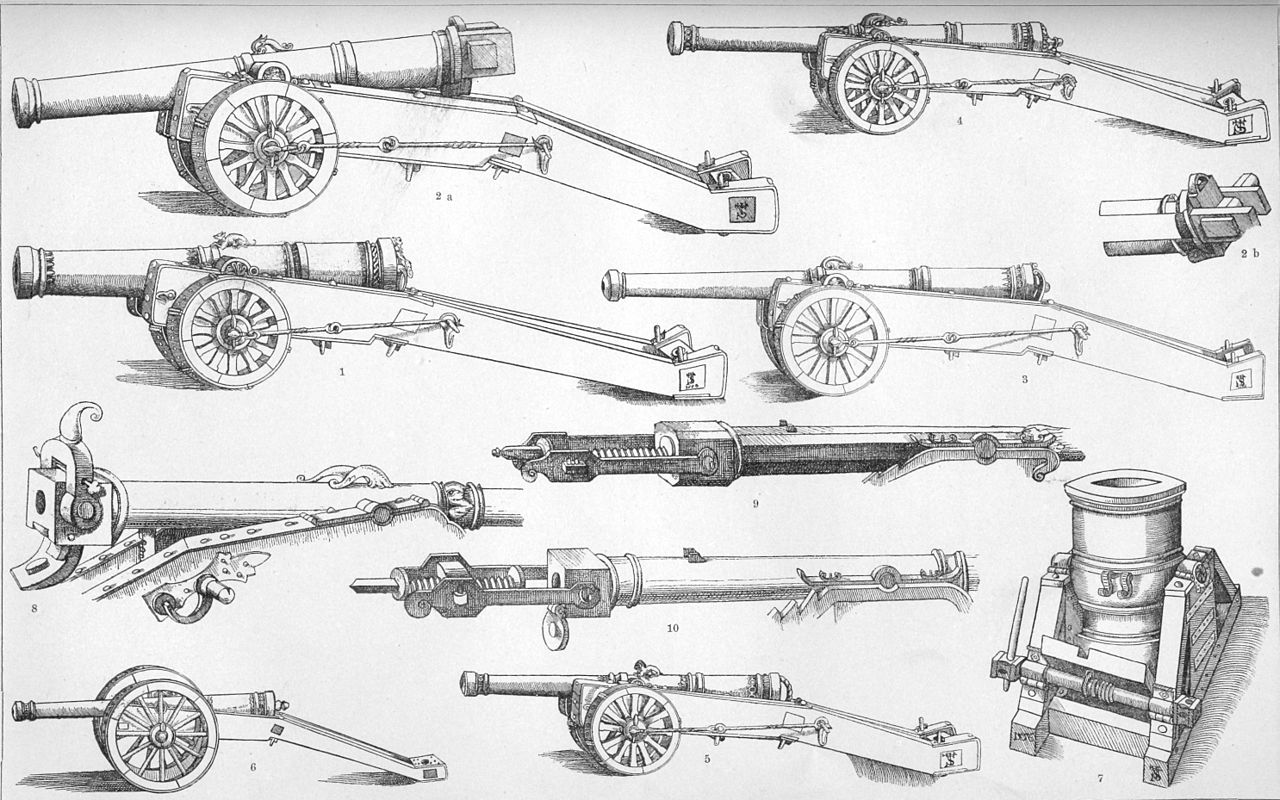
Early Cannon

Same with cannon. Slow but super dangerous – though mostly to ships and buildings and not people, unless loaded with grapeshot.

I get some people “don’t want gunpowder in their D&D.” I don’t get that, I just want “historically appropriate for the late medieval era” in my D&D. And Europe had cannon as early as the 1300s (and earlier, in other places), and by the usual late-1400s kind of representative “hybrid medieval/Renaissance” D&D era that most general published settings, including Golarion, trade in, they were definitely in use on the battlefield and on ships. But they are slow and ridiculously expensive.

The Pathfinder cannon rules are actually reasonably similar to what I had come up with, with slow reload and crewing requirements. But they were both way too inexpensive (especially for a world that tries to say “oh they’re only really available in Alkenstar and you know maybe a little in other places”) and don’t pack enough of a punch. “Oh no, I got shot by a cannon and took 6d6 damage.” That’s 21 points of damage, also known as “a melee attack routine from a low level PC” or “the shitty low level fireballs that are why people say playing an evocation mage is a trap.” And their ranges are crazy short (100 ft. range increment).

What I wanted from cannon was to be long range and devastating, but rare due to expense and slow to fire and mostly for structures but still a threat to individuals. So my basic 12-pounder cannon does 7d10 damage every 4 rounds vs 6d6 every 4 rounds for the Paizo version. (Again, they balance it with the touch attack mechanic). It’s actually less expensive than its Paizo equivalent – my 12-pounder is 4000 gp and 120 gp of black powder to fire vs Paizo’s is 6000 gp and 100 gp of black powder to fire, maybe I should adjust that. (A wand of fireballs is 11,250 gp, for comparison.)

And my range increment is 500 feet. I know, all Pathfinder/D&D weapons have pathetic range compared to real life. But the role of cannon should be a super-ranged threat. Can you even get into fireball range before taking a volley? How many shots can your ship take as you close to board? It provides a different strategic element, not just a new skin on an existing strategic element.

Magic and Alchemical Firearms

Now, the other thing I do is to make enhancements to firearms very rare. They are brand new. You can find ancient enchanted swords from wizards over the last millenia but firearms and cannons are from the now, and tech and magic are somewhat opposed (both because wizards like niche protection but also somewhat fundamentally, in my view, built over decades of D&D lore that support that view). I think the “Paizo answer” to firearms and cannon is that you just boost the otherwise sad damage with magic, or with explosive shot and stuff that are, frankly, later tech level.

Conclusion

Now, the Paizo rules aren’t bad – they do most of what I want out of firearm and cannon rules, actually. I just think that it is way more interesting for the role of early firearms to be a slow loading big punch and the role of cannon to be a slow loading big punch at very long ranges. So, feel free and use these if you agree!

Let me know how you use guns and cannon – and especially what the feel of the rules you use adds to your game.

Geek Related Mass Combat Rules

I’ve just done a pretty big update to the Rules You Can Use page with a variety of revised rules for Pathfinder 1e (but easily adaptable to other adjacent D&D-ish rulesets). In this case, check out:

Geek Related Mass Combat Rules (6 page pdf)

I originally published them as a janky blog post but since we’ve been using them for years now (like… 15!) I put together a more polished version.

Mass combat? Oh, boo! you say? Well, I get it. Most mass combat rules are not great. Usually they’re not synergestic with the PCs and their abilities. The official Pathfinder Mass Combat ruleset originates with Kingmaker, and while it’s fine, it’s a minigame abstracted almost completely away from adventuring. The same goes for more thoughtful approaches like this one on Erin Palette’s blog and the one it links to by Sarah Wilson. Which is fine for its use case, but in my experience the problem that comes up much more frequently is small unit combat, when the PCs have gathered groups of people that are just big enough to be unwieldy but not large enough that “just have the PCs make some kind of Command” checks is remotely appropriate.

This came up very early in our Reavers pirate campaign. The PCs started to gather a crew on their pirate ship. A crew composed of clumps of similar folks – a couple fistfuls of War3s from when they took out an opposing ship in one adventure, a bunch of Fighter 2/Thief 1’s from another… And they are not faceless hordes; the PCs know each one’s name. But now how to run a combat with 4 PCs and 30+ pirates against some other ship or force that has some named commanders but also “30 sailors (see NPC Codex)” or similar? You either spend an hour between PC actions rolling infinite dice or “just abstract it out.” And just abstracting it out doesn’t respect PC investments in their own abilities or their NPCs’. If they buy all their pirates a masterwork weapon – should that not affect outcomes in a way they would expect? Should you “just have the PCs fight the bosses and let the mooks slug it out?” Well, one of the joys of being a PC is not always fighting “level appropriate” foes (You are level 60! Now the map is full of demon boars! That’s World of Warcraft shit.) – it’s fun to mow down mooks.

Another challenge is that the level system is a little wonky in that it makes, say, 20 L3 pirates basically no threat in any way to a L7 character. It turns into rolling 20d20 (or 8d20 if it’s melee and they can surround the PC) and hoping for 20s, and then doing a little damage. Therefore you want to be able to put those mooks into wads, to use a concept and terminology from the Feng Shui RPG, and make them some kind of a credible threat when massed. In my rules, when you make a unit, it gets +1/2 to attack and +1 to damage for every unit member, so for example 10 pirates that would normally have “cutlass +3, 1d6+3 damage” as a unit have one attack that is “cutlass +8, 1d6+13 damage.” Not overwhelming, but suddenly not nothing for a PC a couple levels above them.

Paizo did come out with troop rules (a solid 8 years after mine, ahem) that somewhat addresses this – turns a group of NPCs into something like a swarm – but has the fatal flaw of being only for crowds of faceless unknowns, not a group of people you know, and depend on special abilities that have nothing to do with actual individual level class special abilities, feats, etc.

Hence these mass combat rules. You can form like groups of NPCs into units, they get boosted attack/damage as a unit, have a combined pool of hit points broken into single-individual chunks, but otherwise use their normal Pathfinder 1e rules. If the members of the unit have Point Blank Shot and masterwork crossbows, then guess what, the unit has Point Blank Shot and has masterwork crossbows, easy peasy. And they attack and are attacked by PCs, NPCs, monsters, and other units normally using all the customary Pathfinder rules. As they take damage, a member of the unit goes down for each chunk of hit point damage they take. For example, 10 pirates with 22 hp each – the unit has 220 hp but someone falls for each 22 it is damaged. A PC that does 40-ish points of damage with a full attack routine can chew through a couple members of an opposing unit a round.

And as members of the troop start to fall, you can easily figure out who it is with a quick e.g. d10 roll. “Oh no, Billy Breadbasket went down! He’s our cook!”

The result – exciting, personal larger group combats that don’t bog down and the PCs feel an integral part of. Tactical enough that you get the feel of battlefield command without dragging you into an external minigame.

A core design tenet that people don’t seem to understand is that minigames that are sufficiently divorced from the PCs and their primary governing ruleset harm character immersion. I was forced to make these rules because I have never come across anything that maintains the identity of participants and supports the core ruleset that they normally operate under.

So give them a try, I hope you like them! I’d love to hear feedback – these do rely on frequent rulings to operate in the thick sludge of PF rules, and I generally trust DMs to set things up well so I don’t have guidance on e.g. “only make units of a size equal to the PCs’ level plus something” or the like. And I could see some of the more detailed factors in some of the other mass combat rulesets being usefully ported over (Morale, most specifically, I haven’t found a morale system I’m totally happy with yet.)

Reavers on the Seas of Fate, Season Five Retrospective – “Sailing to the Edge of the World”

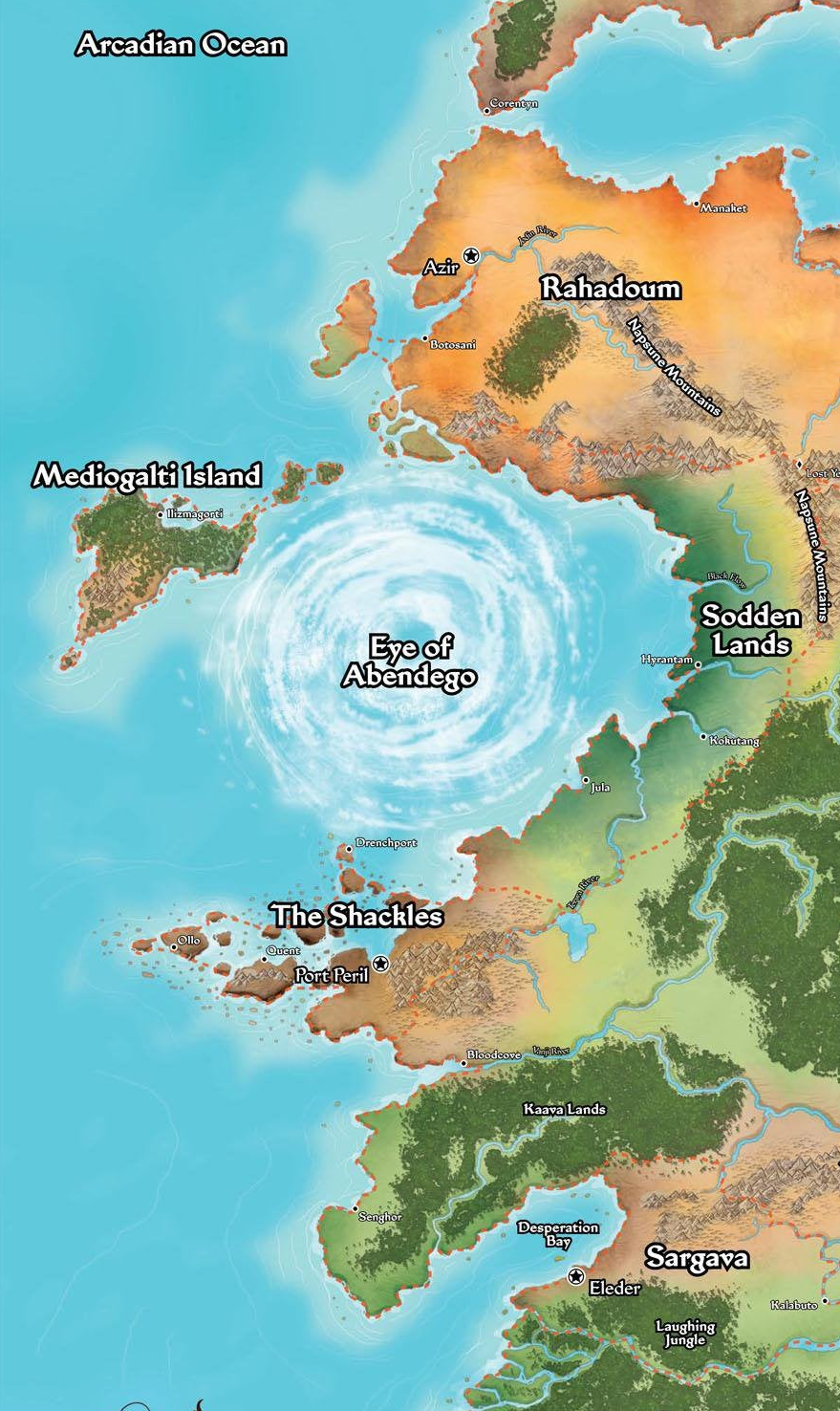
Fever Sea Map

Well THAT was a long season. 40 sessions, which is early 2015 to early 2017. (As of 2024 we’re coming towards campaign end!) Season Four was all the stuff with Staufendorf Island (adding the three aasimar sisters to the crew) and Deepmar Prison (from which they got Klangin). Heck Samaritha laid her egg back in the first part of S4 and we just got around to it hatching in S5!

This season I dubbed “Sailing to the Edge of the World” because in it they go from Riddleport down past Avistan to Garund and then south and further south through the Fever Sea, past Rahadoum, Ilizmagorti, the Eye of Abendego, the Sodden Lands Devil’s Arches, the Shackles, the equator, Bloodcove, and now beyond, preparing to go off the edge of officially published Golarion maps.

I used a few Pathfinder adventure modules as part of this season – Treasure of Chimera Cove, River of Darkness, Crucible of Chaos – and some smaller ones like King Xeros of Old Azlant the Pathfinder Society scenario and Tarin’s Crown from Legendary Games, but most of it was just smaller encounters and a lot of setting lore content from all the Golarion world content I could scrape together (which is a lot, I subscribed to all Paizo’s content during Pathfinder 1e so I have a bookcase full). Plus, since these places have real-world analogues, I did loads of research on the African coast from Morocco on to the Bissagos Islands off Guinea-Bissau to add fun details. Talk about exploring Golarion! Too often the setting is just a place for a little color before going off on a generic dungeon crawl. I don’t like that, I mean, travel is fun in the real world and the “work we do while we’re there” is not the draw, is it? They spent four seasons up around Cheliax and now they get to travel the world.

On the one hand, this entire season could be seen as a “between.” Their origin is up north and they need to get to Port Shaw on the Razor Coast down south for the campaign endgame. But if you’re a pirate, the journey is the real adventure! None of these adventures were “mandatory” for the plot but were things that made sense for our pirates to do to get power/money/booty/allies/etc.! To sum up our S5 arc:

  • Can we get a planar ship? Nope, didn’t work out.
  • Woo, Morocco (Rahadoum) parties!
  • Woo, Mediogalti Island parties! The players tell me Mediogalti Island parties are the best in Golarion. Cities of Golarion has a whole section on Ilizmagorti including specialty alcoholic drinks there. And the PCs had money, didn’t have anyone immediately after them, and the risk of Red Mantis Assassins being irritated at large scale disruption let everyone focus on the partying and not get friskier.
  • Can we get a giant undead dragon turtle murder machine? Uh, maybe we don’t want that after all.
  • Let’s fight off some native elves in the heart of darkness! We hate elves. I mean, I’m sure some of them are fine people!
  • Can we make our ship fly? Yes we can!
  • Woo, Bloodcove parties!

Don’t worry, S6 is shorter, basically the journey to the Razor Coast where I start the foreshadowing harder (we get a little with the phantom inhabited guy at the end of S5). If you are too antsy to wait for these blog posts, the summaries are posted up through S9 on the session summary page.

Infamy Points

One of the key rules we use in the Reavers on the Seas of Fate campaign is Infamy Points, colloquially called “gold coins” because I hand out actual replica pirate coins to represent them.

I asked for feedback on hero point mechanics prior to the campaign starting, and then I had posted them quietly on one of the Reavers pages but never really talked about them. Recently, Paizo has started to unveil their “new take” on Mythic rules in Pathfinder 2e and it seems like a step in the right direction, but still a little fiddlier than it should be.

Infamy Points (2 page pdf) in my piracy-oriented Pathfinder game are gained rarely, by performing significant acts of derring-do that get the populace’s attention. They don’t have to be “evil”, but do have to be “dangerous and badass” (a paladin who killed an apartment building full of criminals is as scary as someone who just mass murdered; no one wants to hang out with Judge Dredd). You get one a level, and one each time you do something super notorious – not every game session, not tied to “completing an adventure”, you have to do something really badass. Maybe that’s once every 4 sessions, maybe less if you don’t have a local populace to impress.

I have a list of things they can be used for but over time it’s basically boiled down to “anything.” Spend a coin, tell me what you want to happen. This is a big level up from the usual “Inspiration” type mechanics you see in D&D and D&D clones. “Oh you can add a couple points to your roll!” “Oh, you can reroll it, but before you know the result!” A bunch of fiddly crap if you ask me – kinda OK if you get a fistful per game session but if you only get it once in a while (like 5e inspiration) – why are you so afraid of making it powerful?

Get out of death? Sure. (Proactively you get off scot free, if you do it reactively after you already took the death blow I give some kind of drawback – like Sindawe lost an eye after being critted through the head with a rapier). Save someone else from death? Sure. (It’s a pirate campaign so this is a great source of people needing peglegs, hooks, and eyepatches.) Just take out some goon? Sure. I don’t let them take out a major villain with it but “they cackle and run off” or something is fine. Change the narrative somehow? Super! Oh the guy that runs this bar is your old buddy? Why not.

This is a place where I feel like D&D/Pathfinder has been too conservative – there are plenty of games out there that let you use actual narrative control but here everyone argues about “oh but if you can decide to roll inspiration afterwards it’s so powerful“…

Because, you see, here’s the secret. It’s not a tool for the players, it’s a tool for the GM. Whoops, you unleashed something too hard on the PCs and their ship is about to get eaten by a shoggoth? Well, they spend an infamy point and look there’s another nearby ship they can speed by and have the shoggoth eat them instead. The PCs are finding a plot thread boring? They short-circuit it. In Reavers, Sindawe had set up in his background a whole thing about his family so later I have his long-lost brother show up to fight him in a shark cult temple – “I kill him. Here’s an Infamy Point.” Uh, OK – I was surprised, I thought that was something he wanted, but this gave him a way to say “nope” that has his character come out well in the fiction, so fine!

Also, getting them is based on interacting with society ™, and it’s always good to promote that. Heck, my PCs use these rare and valuable things on saving their favorite NPCs fairly commonly!

So don’t be afraid of letting your PCs thwart death and accomplish things. A limited powerful narrative currency is IMO much better than fiddly ass shit like action points (add a 1d6 to a roll if you declare it before you roll! You get 1d8 of them a level! Please.)

Sentinel Comics RPG – Kaiju Hunters, Collection 6 – “A Place To Call Home”

Welcome to the sixth and final collection of us playing the Sentinel Comics RPG with our Aussie family of Kaiju hunters. This collection revolves around finally finding our wayward relative The Umbral and stopping his villainy one way or the other – and The Yowie’s love life!

Follow along with our exploits!

Thirty-first Session – “Dark Side of the Moon”
Kaiju Defenders International (KDI) is doing well. Our sidekick team the Bondi Beach Brawlers are doing well, El Genio has an evil infiltrator girlfriend, and Golden Key, Overwatch, and Dynamo Joe have upgraded themselves. The Yowie is torn by his love for both social media maven Dr. Broussard and the giant queen of the Endlings, Jansa Vi Dero. However it is marred by our missing family member Haskell Marston, aka The Abyssal, aka The Umbral who has turned to evil and is lurking in some dimension or another. Sure enough, The Harpy shows up to tell us he’s abducted the Argent Adept. We have to go to the Moon to save him and then back to the Harpy’s manor to try to save a MacGuffin, but the Umbral is ahead of us at every turn.

Thirty-second Session – “Don’t Cry For Me, Argentina”
We save the Sydney Harbor Bridge from “The Kookaburra” but then all our love lives go nuclear. The Yowie’s love triangle with Dr. Broussard and Jansa Vi Dero… El Genio’s torrid affair with an evil infiltrator… Golden Key’s dalliance with a chick who likes to cosplay as his ex-wife.. Dynamo Joe and the secretary based on “Roz” from Monsters Inc… Overwatch and Feral Juggernaut from the Brawlers… But evil does not rest and we have to to back to Argentina and deal with Guarani demigods to fend off Ivana Romanat, aka Baroness Blade, and her goon squad.

Thirty-third Session – “Around The World In About Eight Hours”
We are drawn too far into the land of the telenovela and go back to our home in Australia to decompress. Except for The Yowie, whose layover in El Salvador is interrupted by a summons from Jansa Vi Dero for a DTR talk. Meanwhile Sulimar the Magnificent is abducted from his magic shop leading the KDI crew to Hesse, Germany to fight some Aryan villains. “But no one who speaks German could be evil,” we lament!

Thirty-fourth Session – “They Snowblinded Me With Science”
After more love triangle drama we are off to Longyearbyen, Svalbard (home of the Global Seed Vault!) in Norway, which is having dinosaur attack problems. No one bothers to mention that cats are banned there, which is good because we’d probably leave them to their Eurotrash fate if we heard. We fend off the dinos and go to the EISCAT scatter radar station (it’s not Ikeas up there, they got lots of science). The Umbral is behind it but his plot is foiled by Yan-Gannoth the Nadir King and we have to pound on him and some rando villains. Then at the end a troll(?) appears from somewhere(?) to be seduced by El Genio(?). Your guess is as good as mine.

Thirty-fifth Session – “Neighbors”
Our grand opening of the Singapore branch of KDI is full of conflict – everyone’s women (including both Dr. Broussard and Jansa Vi Dero, which is a problem) but then also the Bondi Beach Brawlers don’t want to just be sidekicks any more. We set up a giant fight in the simulator with Yowie as a kaiju that needs subduing against the Brawlers and the other Marsden clan as sub-villans. We pound the Brawlers but they learn a valuable lesson. Then we go to the Dreamtime and fight the most dangerous enemy – Australian wildlife!

Thirty-sixth Session – “Wake in Fright”
The grand finale of our Sentinels campaign! We go to our final showdown with wayward family member The Umbral. Some are willing to kill him to end the threat! To others, blood is thicker than water! Atlantis! Cthulhu! Time travel! Dimensional travel! And most importantly, which woman (and personal fate) will The Yowie choose? Read on, true believers!!!