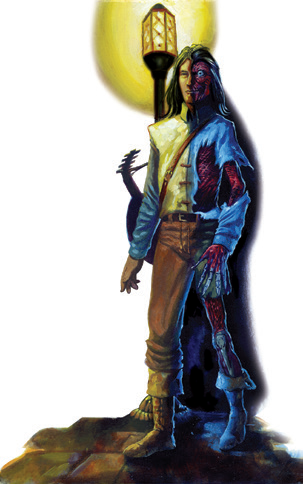
Tag Archives: golarion

Reavers on the Seas of Fate, Season Seven, Ninth Session

Ninth Session (6 page pdf) – “The Gnoll Cartel” – To get proof of their crewman’s innocence, the crew pursues drug dealers back to the lair of their boss and his menagerie.

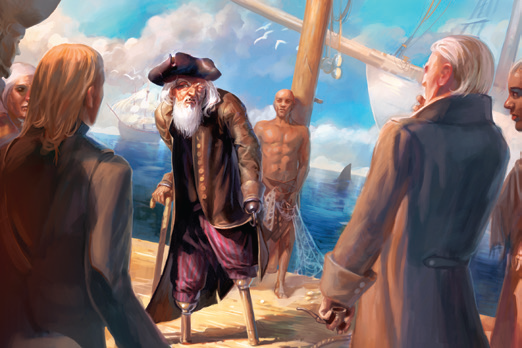
This is a pretty focused session – the PCs ambush some drug smugglers who also have a captive – who turns out to be the famous pirate Falken Drango, who busts loose and helps them! Entertainingly, the session almost completely omits his sad story to them about how his crew and ship, the Nightslink, are missing and he needs help to reclaim them. But, they like him and partner up with him, which is good.

The drug smugglers were an encounter from the Razor Coast book (The Midnight Deal) but I added Drango so the PCs would have another chance to meet him.

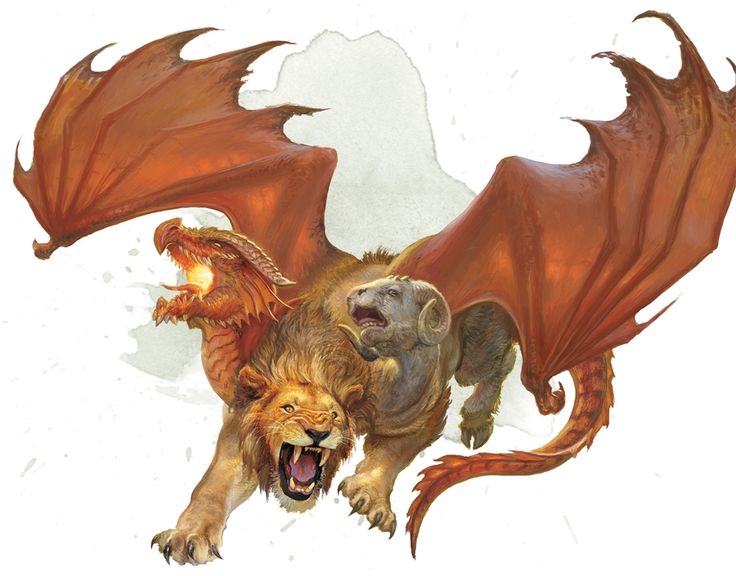
They track back to the gnoll smuggler Bonegnaw’s cove where his ship, the Dragon’s Tail, berths. He smuggles in both drugs and exotic monsters. That makes for a lively and very dangerous fight full of chimeras and cockatrices and chuuls and girallons. And many of the monsters don’t differentiate between smugglers and PCs in terms of murder opportunities.

After an orgy of violence, they capture Bonegnaw!

Reavers on the Seas of Fate, Season Seven, Eighth Session

Eighth Session (13 page pdf) – “Back To The Sewers” – Among other shenanigans, the crew heads back down into Port Shaw’s sewers to find a bard’s corpse at his postmortem request.

The plot threads come quickly. Dragonsmoke pushers are working for Bonegnaw who is also the chimera smuggler that burned down the warehouse! They need to go back into the sewers to set a bard’s corpse to rest to find Garr Bloodbane’s treasure! More Salty Dog dock gang issues! New NPCs a’poppin’!

The love of treasure wins out and they go back to the sewers with Cap’n Lester, where they make friendly contact with a crab-man and unfriendly contact with gator-men. Oh, fantasy RPG racism, when will you let us live in peace?!?

Anyway, they find the dead bard and emerge from the sewers with a bunch of skulls from people the gator-men have killed. The locals and Dragoons are just happy it’s not all child corpses this time.

Reavers on the Seas of Fate, Season Seven, Seventh Session

Seventh Session (7 page pdf) – “Arson, She Wrote” – As usual, while our PCs have been off adventuring, their crew has gotten into various forms of trouble. Their Nidalese fisherwoman Arsonee has been arrested for being close to the scene of an arson, and… Her name is “Arsonee.”  Open and shut case!

One of the fun parts of the PCs having an entire crew of pirates is that when they leave them alone, they don’t just peaceably swab decks on the ship, they go ashore and get into pirate style trouble. I put entire charts together to randomly determine it.

There’s some other minor problems but the biggest one is that Arsonee, the fisherwoman they picked up from Nidal (the shadow torture country), got arrested for arson, largely based on being near a burning warehouse and having the name “Arsony.” “I mean, we’d get busted down to private for *not* arresting her,” reasoned the Dragoon responders.

Naturally, they immediately take her to the torturer to elicit a confession, in standard fantasy (?) cop procedure. Being from Nidal where recreational torture is an art form, it’s getting them nowhere. The PCs are on good terms with the Dragoons mainly via making friends with Sergeant Darenar, so they go get them to chill out on the torture while they investigate, and as a bonus take crazed fisherman Harok McFarrow who saw his family eaten by weresharks and was then blamed for the crime to Father Zalen to see if he can cure his insanity, but he’s “only” a ninth level cleric.

Zalen explains he doesn’t have the magics personally to heal peoples’ minds. And the local asylums have been closed down by the city council.

Some discussion ensued about “Oh, just like Ronald Reagan!” which should have been a tip to them about who the bad guy is…

But anyway, Arsonee tells them a weird story about a chimera inside the warehouse and the prostitutes starting to set up the new brothel they’re establishing provide some leads as well. The PC crime wave in Port Shaw is well underway!

Reavers on the Seas of Fate, Season Seven, Sixth Session

Sixth Session (8 page pdf) – “The Roach King” – Disappearing children lead the crew down into the sewers of Port Shaw, where they make various disgusting and gruesome discoveries.

Trigger warning – violence against children. Well, and bugs and slime and stuff but mainly the kids.

There’s a whole section in Razor Coast about Port Shaw’s sewers, which is are a little weirdly sophisticated for a little colonial town, but whatever. They go in with the halfing sewer pirate captain and poke around. I don’t want to spend too much time in the sewers so get them to fun encounter locations quickly. They fight sahuagin! They fight skum! They find the Jawbone of Kaho Ali’i, which is a scrimshaw relic super important to the local Tulita tribe, which they don’t know will be super important later, but it will be.

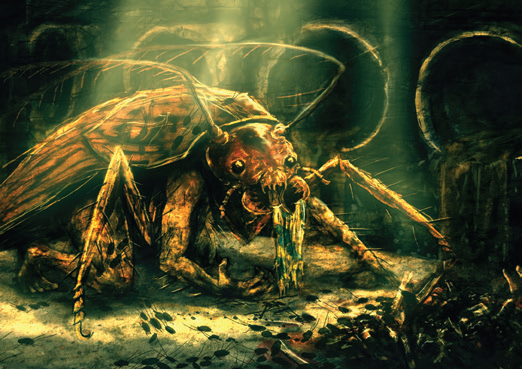
They fight a quasit and dretches! They need to retreat… But then hear a crying child. They go save her from the Roach King! Which is a big ass (9′ tall, >100hp) roach mutated from an ogre by toxic magical runoff that controls roach swarms. And every Pathfinder player knows that swarms are the most dangerous thing in the game.

After a hard fight they kill it and find, unfortunately, a large number of child corpses from local kids it’s been snatching and bringing down here, “Stephen King’s It” style. The PCs are pirates but not monsters, they want to retrieve the bodies – but the problem is, they’re down here illegally. There being no Erin Brockovich in fantasy Golarion to address the legal side of fatal toxic runoff related problems, this instead generates a side quest to go get a forged set of papers, which all goes well and lets them meet more local power players. Bodies recovered and turned over to authorities and grieving families. Not really a victory to feel all that good about, but… something.

Then Sindawe finds out their crewmember and suspected serial killer Slasher Jim is at it again.

Sindawe is also shown by Serpent that one of the “head” barrels contains the corpse of an attractive young woman that he hears was put there by Slasher Jim. Sindawe concludes this is like the twentieth most pressing thing in his life.

On the one hand, serial killer. On the other hand, it is right next to the barrels they keep the pickled heads of their enemies in (for speak with dead and light entertainment purposes, mainly), and he’s a solid crewmember, and it’s been a long day. Sindawe just tucks it down into his feelings lockbox and goes about his business.

Reavers on the Seas of Fate, Season Seven, Fifth Session

Fifth Session (12 page pdf) – “Shadow Conspiracy” – The night gets longer as they have to dispose of a body. Finally they check in at their ship and split time between planning to fund a brothel and searching down leads related to their phantom attacker, which sends them from the church to a bar to a sewer.

And then guess what the fourth shark took?!?

The party struggles on, having been awake for several days at this point. Every time they think about turning in some new demented entertainment is offered up by Port Shaw. They go to dispose of the phantom/businessman’s mortal remains at a local inn that offers that as a value add service, And, of course, drink and gamble some more. Even when they get back to the ship, they take some reports before finally turning in…

But Serpent’s family has moved out (he forgot that this was the plan, to be honest) and Sindawe’s captain’s quarters are occupied by Lefty and a local girl. A rough night on an improvised pallet for both of them then!

They then split their time between investigating phantom sightings and arranging to own a proper brothel that their four new prostitute besties can set up in. Since Lavender Lil was a proper (?) brothel prostitute back in Riddleport they put her in charge, which is a great idea except for the fact she and all the other women immediately decided they hated each other on sight.

I generally roll informal reaction checks whenever people meet each other to see how well they get along. Years ago the group was entertained by Samaritha and Ameiko Kaijutsu of Sandpoint (the latter eventually travelling to Tian Xia and being the empress apparent in the Jade Regent adventure path) both rolling nat 1’s when meeting each other, causing them to fall into that inexplicable state of implacably cold hate that only women just meeting each other can immediately muster. Well, many years later it happened again, so the rowdy whores are quite a handful and it’ll take a while to get to some equilibrium on that (more to come!).

And finally, they find a sad native girl who indicates that the “Roach King” took one of her friends into the sewers to be eaten. The sewers are suspiciously locked and guarded by Dragoons. This is their cue to find Capt’n Lester Farrows, a swamp pirate (no really) and his raft to venture therein!

Reavers on the Seas of Fate, Season Seven, Fourth Session

Fourth Session (9 page pdf) – “Fight Club Raids and Noose Races” – The crew isn’t done with having fun yet, so they continue to cut a swath across Port Shaw. A Dragoon raid and an infamous pirate cause an early end to the fight club for the evening, so they go find the “Noose Races” they have heard so much about.  But after a Conan-esque night of debauchery, an old threat appears.

Anyone who refers to time an adventuring party spends in a city as “downtime”, give yourself a big ol’ wedgie and then read on.

Last session went great so I took a chance. In the Razor Coast book there’s a very “Captain Jack Sparrow” type of infamous pirate named Falken Drango. However, I know that Chris (Sindawe’s player) hates Captain Jack Sparrow.

So how do I introduce him without triggering that? I mean, he’s not plot critical, but I wanted to use him as a recurring NPC to introduce them to the local piracy scene, so I wanted to do something where they wouldn’t kill him/avoid him. So instead I had him be in disguise and be Sindawe’s first foe in the Broken Skull fight club ring!

Some background – Sindawe decided he really, really hated a Riddleport NPC called the Splithog Pauper who was always in disguise. They were “frenemies” sometimes on the same side, sometimes opposing, like every character in Sons of Anarchy. The last time they saw him was in 2011 and left it like this:

“Our heroes fail to lure the Splithog Pauper to his death behind the building; he makes a “I am keeping my eyes on you” gesture which is reciprocated with “I am going to kill you” gestures.”

For whatever reason he has become Sindawe’s greatest nemesis (in Sindawe’s mind) and so when the fighter was in disguise he was convinced it must be the Splithog Pauper. When it wasn’t, he was so relieved – and then the Dragoons went after him – and the relief plus their normal “fuck the police” sentiment meant they helped him escape!

As they wandered the active night streets of the Bawd District after that, eating lizards on a stick or whatever, they are clearly ready for more hijinks so it’s time for the noose races!!!

What’s a noose race? Beats the shit out of me, but it’s mentioned in the Bawd District writeup in the Razor Coast book and then never after:

The low-burning, smoky tar lanterns of Bawd call sailors and other visitors to her dark twisting alleys and dock-ways, luring them to experiment with exotic and far-ranging narcotics, to lose their shirts (and occasionally their teeth) at gambling dens, to enjoy Port Shaw’s infamous houses of ill repute and to attend her myriad entertainments: performances from the Speckled Eyes snake charmer’s guild, baboon fights, gourd-gazing seers, legendary scorpion baths, noose races and other wild spectacles.

I had read this to the players at some point and the noose races captured their fancy, so I worked them up as a minigame. They give you a swig of arsenic, tighten a noose around your neck so you can’t breathe, and then loose a greased naked Keleshite you have to catch. As there are no other rules, violence between the runners is encouraged. Used our custom chase rules plus the normal Pathfinder “holding breath” rules and losing 1 “breath” per action.

As this is a pirate campaign, they were way into it, and emerge victorious after a hilarious action sequence romp through the nighttime crowds of the Bawd District.

And then they meet up with their new favorite quartet of hookers from last time, Ophelia, Molly, Feather, and Joy. They had them set up a meeting with a local businessman and john of Joy’s that was looking to join the Lodge, the local ruling council. You need their approval to buy businesses and stuff, so from an organized crime point of view they figure he’s a good guy to talk to.

So they meet their friends in the bar, in comes Joy and the businessman – and cyper glyphs burn. He’s a phantom!!! A sudden, brutal fight breaks out.

This was sobering (in and out of game), they hadn’t come across phantoms in Port Shaw yet. So after all the hilarity it was like throwing a bucket of cold water on them at the end of the session! I love GMing. Definitely wound them up for the next game.

Reavers on the Seas of Fate, Season Seven, Third Session

Third Session (7 page pdf) – “Drinking, Whoring, Gambling, and Brawling” – Our crew is in the mood for some shore leave.  They meet a quartet of hookers that they take a shine to and gamble with. Then they go fight at a fight club.  Good clean fun!

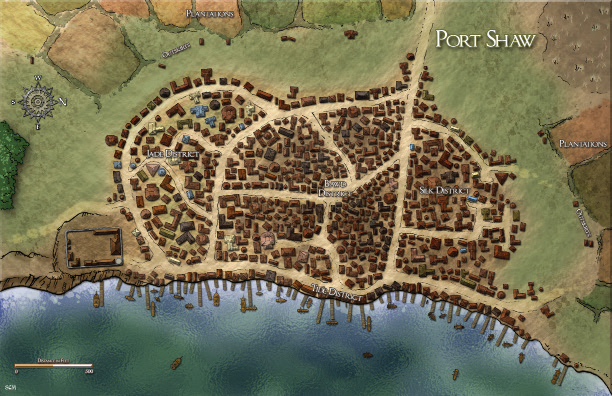
Port Shaw is a city of 20,000 people. Sindawe is originally from this area but it’s pretty different from when he left as a youth. Whaling and overfishing and plantations have driven off much of the wildlife. Native practices are considered an entertaining diversion in the city, and something to be whipped out in the plantations. It has four proper districts – Tide, Bawd, Silk, and Jade, plus the plantations and outskirts. In the words of the city’s stat block, Here’s a little interlude that sums the place up pretty well:

  • Silk: Home to Port Shaw’s artisans and artists.
  • Jade: The lair of Port Shaw’s wealthiest upper crust.
  • Bawd: Entertainments abound–narcotics, gambling, prostitution, pugilism and more.
  • Tide: The mercantile heart of Port Shaw encompassing trade, fishing and whaling.
  • Plantation: Slave estates growing pineapples, taro, sugar cane and mangos.
  • Outskirts: Tulita ghetto struggling against disease, famine and aggressive predators.

They got into town and went right into wandering around to fight weresharks, and they want a break. Now it’s time for a slice of life on the mean streets of Port Shaw’s Bawd district. I had a boy (Tanga) offer himself as a guide, it’s helpful to the PCs but also for me to plausibly infodump about local places and practices.

He leads them deeper into the district, past ale houses, houses of ill repute, drug dens, apartments, nice walled compounds, and the general chaos of its denizens going about their business. Dragoons keep the peace by watching and doing little, including a halfling robbing an elder gnome openly on the street. Sindawe intervenes by kicking the halfling robber away. Olgum the gnome leaves with his wallet intact. He sobs and clings to Wogan a moment; the group invites him to lunch with them later. He begs off given a prior engagement, and scuttles off with Wogan’s coin-purse (unbeknownst to them).

They wanted to go to a random inn to eat, so I used this random inn generator to create one on the fly, the Cursed Spear. Then, I can’t even remember what I was using for random encounter tables, might have been “Lawless Port City” from d20PFSRD (576 pages and no random encounter tables for Port Shaw, boo), but they ran across four local hookers in robes and togas, and for some reason they really took to them! Even though none of them had prurient interest, because Sindawe knows Mama Watanna is a jealous loa-lover, Serpent knows his wife Samaritha is a jealous serpentfolk wizard-lover, and Wogan knows his god is jealous of his weiner (or whatever Gozreh’s motivation is).

I pulled up this random brothel generator to generate them but I lost the initial pdf – my notes simply record quick descriptions and who they were hitting up. “Molly (Wogan, impressive, nice, varisian neck tattoo, hood piercing, knows business guy), Ophelia (Sindawe, clean, dragon face tattoo, potter’s apprentice), Feather (Serpent, greedy, dextrous, tiny, long hair, hottest), Joy (30, left out, matching Molly tattoo).”

The PCs and prostitutes (P&P, the exciting new OSR variant) hit it off and gamble, drink, and chat the afternoon away. In a followthrough from the previous quote…

Wogan discovers all his money is missing when the call to ante up comes and has to borrow money to get started. Molly asks him if “He’d like to make 14 gold the hard way,” which he declines to the amusement of the other pirates.

Sometimes, players are really in the mood to role-play and the GM is firing on all cylinders role-playing as well, and you get magic moments that end up being more lasting than the actual locations/NPCs in the source material and session prep. Eventually the PCs leave to go to the Broken Skull and get back on plotline, but expect to see the girls again soon! Spoiler alert, they become long term NPCs.

At the Broken Skull, they discover that Sindawe’s long-lost brother Ochiba (well… technically Sindawe is the long-lost one, since he’s from here and went up north to whitey-land for a decade or so) is currently the champion of the bare knuckle brawler fights the place features. They bet on the fights and Sindawe signs up to fight as well!

Reavers on the Seas of Fate, Season Seven, Second Session

Mokoli Ali’i

Second Session (6 page pdf) – “Wereshark Conspiracy” – The crew tracks down tales of wereshark attacks on the Razor Coast.

First they meet Mokoli Ali’i, the leader of the local Tulita who are trying to maintain their traditional ways instead of living as plantation slaves or servants in the city. They are told about the evil shark god Dajobas and that weresharks herald his return. They get some poultices to fix the wereshark bites, since they are a more dangerous form of lycanthropy, “fel lycanthropy.”

Now, what exactly does that mean? This is one of the real problems with the Razor Coast book. Information is spread all over and called different things. (fel lycanthropy? Kiss of Dajobas?) And they have all these summaries (multiple kinds, and very long) in an attempt to be helpful with campaign planning, but instead they thwart searching the PDF quite effectively because it guarantees that encounters, NPCs, etc. are mentioned in literally hundreds of places. You’d think they’d summarize everything about it in one place, but once you finally find the “fel lycanthrope” (not wereshark, that’d be too easy) template it doesn’t mention lycanthropy or spreading the Kiss at all. The Tulita poultices to cure it are mentioned just in equipment in Milliauka’s stat block.

I love Razor Coast but man… I know organizing such a huge amount of content is difficult, but I have spent a lot of my life control-F’ing over the last several years.

Anyway, then they go fight some weresharks. Choppity chop!

Reavers on the Seas of Fate, Season Seven, First Session

Port Shaw

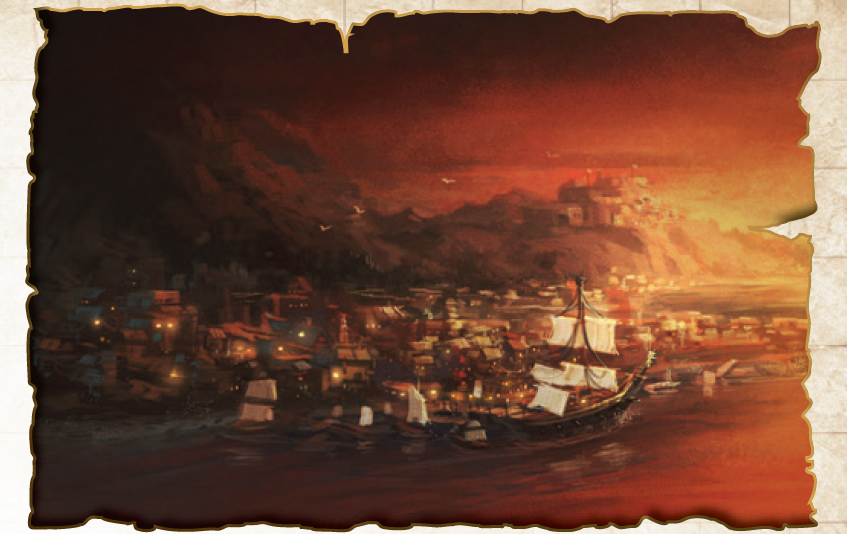
First Session (6 page pdf) – “Port Shaw” – The Chainbreaker reaches Port Shaw, on the Razor Coast, in search of its long-awaited prey! New friends and enemies are made in the southernmost outpost of civilization (by which of course we mean white colonizer civilization).

Ah, the first day in a new city! Buying! Selling! Meeting the new crop of NPCs! Collecting quest leads!

They make friends with Fr. Zalen Trafalgar, the priest of the local chapterhouse of Gozreh, and then try to make friends with both the Dragoons and the native shaman Milliauka they’ve arrested, and both hear about recent unfortunate shark attacks and go to meet the local would-be native leader, Mokoli Ali’i.

This session’s pretty self explanatory. It took a lot of prep – one of the most difficult kind of sessions to prep for is when a) there’s a whole bunch of pregenerated content and b) the PCs are free to go wherever and interact with any bit of it. As the DM you can try to lure them into specific things but I really had to bone up on several full chapters of the Razor Coast book to keep it rolling!

Reavers on the Seas of Fate, Season Seven – “The Edge of the World”

The Reavers on the Seas of Fate keep on goin’! In Season Seven, we investigate Port Shaw on the Razor Coast, from the Frog God Games Razor Coast setting/campaign. (It was started by infamous Pathfinder author Nick Logue, but abandoned and picked up by Frog God, I actually helped proof it and have a credit in the book!)

The Story Thus Far

Our PCs are pirates from the Riddleport area, plying the seas in their ship the Chainbreaker.

  • Captain Sindawe is a Bonuwat Mwangi monk. His patron is the voudou wendo Mama Watanna (a fantasy version of RL African goddess Mami Wata). He is lawful and violent.
  • Quartermaster “Serpent” (real name: Ref Jorenson) is an Ulfen barbarian/ranger/druid. He has a large serpent pet (Saluthra), a serpentfolk wife (Samaritha), and can turn into a serpent. He is chaotic and violent.
  • Master gunner Wogan is a Chelaxian gun-wielding cleric of Gozreh, the god of wind and wave. He guards his chastity carefully and is less violent than the other two, but a hefty dose of rum covers over the differences.

Back in Riddleport, they got embroiled in a plot by an ancient serpentfolk wizard who took over the identity of Elias Tammerhawk, head of the Cyphermages, a group dedicated to unraveling the secrets of the massive arch known as the Cyphergate. He of course tried to use it to loose a shadow army upon Golarion. The PCs thwarted him, though the opening of the gate did cause problems including a tsunami that trashed Riddleport, and various phantom enemies to deal with that can only be harmed by an ultra-rate metal, orichalcum.

Now, with cypherglyphs embedded in their bodies from that event that burn in proximity to phantom foes, they are hunting the serpent man known as Elias Tammerhawk to the ends of the globe to finish him off. They have tracked him to Port Shaw on the coast of the Mwangi Expanse (fantasy-Africa), which is the southernmost outpost of fantasy-European civilization. With, of course, some detours for random acts of piracy, navigating the remains of the sunken continent of Azlant, and a variety of hair-raising encounters as they made their way south of the equator.

Port Shaw in Golarion

Part of the challenge of GMing this is weaving this large setting into the Pathfinder world of Golarion. Here’s how I did it.

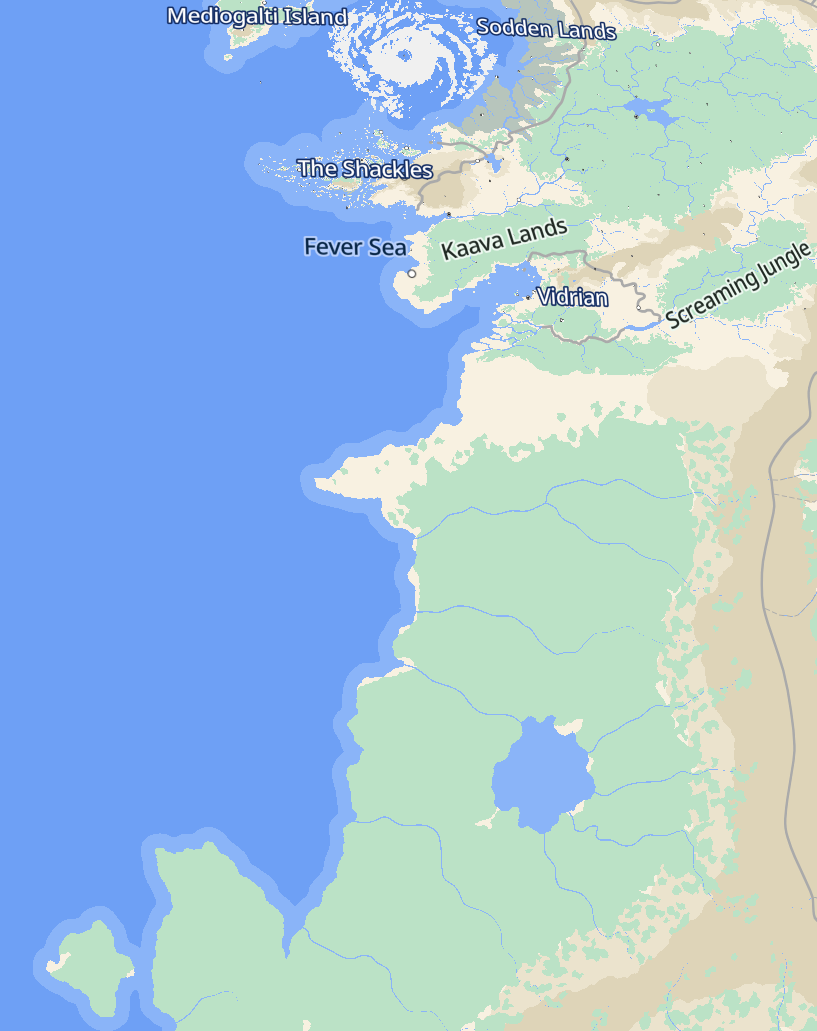
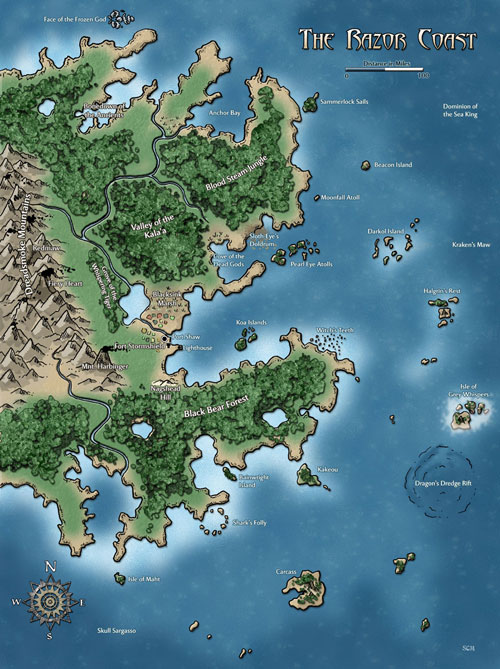
First, the map. I’m looking for the Razor Coast to be part of the western Mwangi coast south of the Shackles, Sargava, and Bloodcove – right off the edge of the published maps and south of the Equator!

Right about here in the big empty region on this interactive map of Golarion.

I basically took the map of the Razor Coast and flipped it both north/south and east/west to fit.

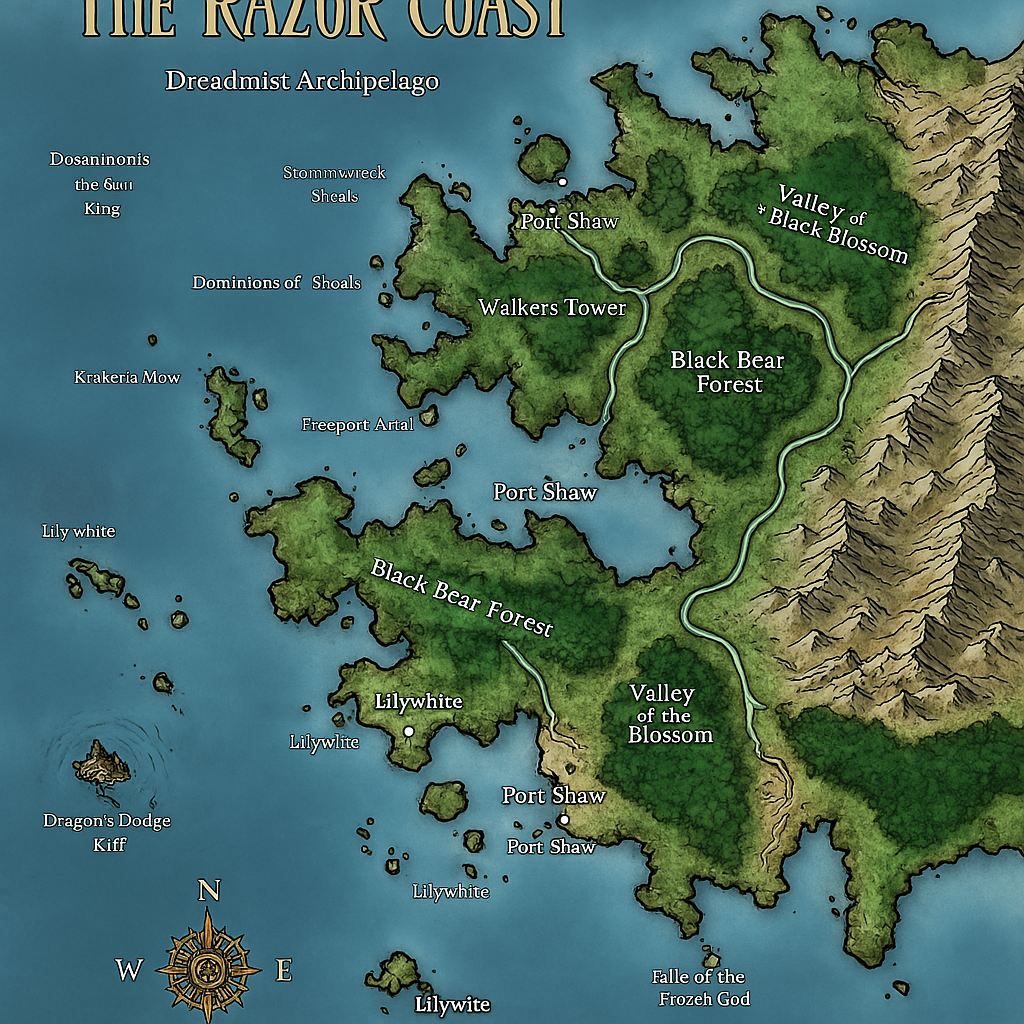
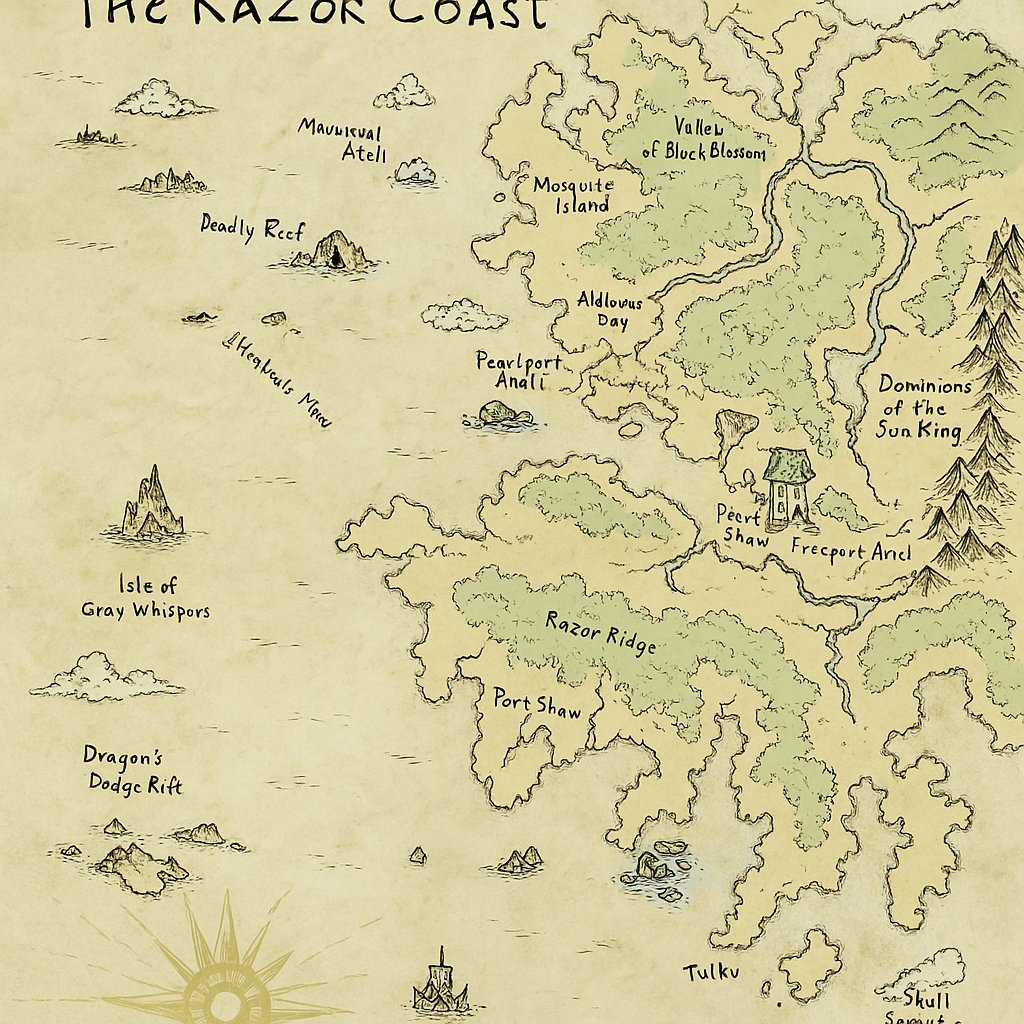
In fact, I had to just eyeball it, but now we’re in the age of AI, let’s see what it can do… Here’s what ChatGPT did! OK, not perfect, but pretty good; Gemini and Claude boofed it pretty hard. And I must say that “Freeport Anal” is pretty on point as a place name.

I also decided on a real-world location analog to pull weather, culture, and other elements from.

One of the things that always appealed to me about D&D is that it was a good prompt to do real world research – all of Gygax’s fiddly polearms in AD&D, understanding what medieval life was like (I have copies of Life In A Medieval City and Life In A Medieval Village whose purchase was prompted by D&D; I even took a medieval history course in college to learn more). In my opinion the “made up fantasy lands” people do nowadays are weak, tepid, lacking in the texture and realism of – real world stuff! So I embrace Golarion lands being “fantasy <wherever>” and then it makes me go learn something real.

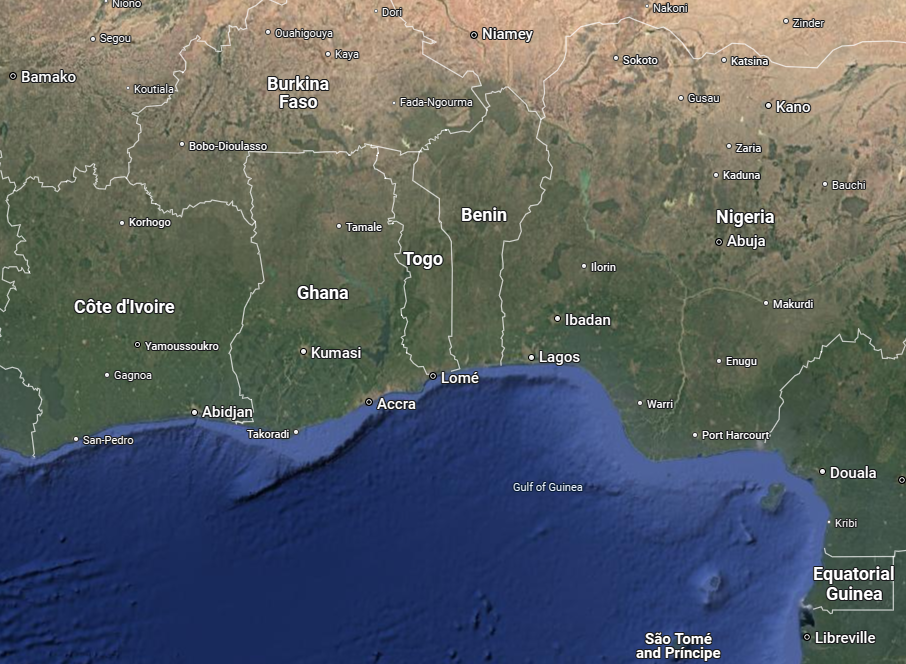
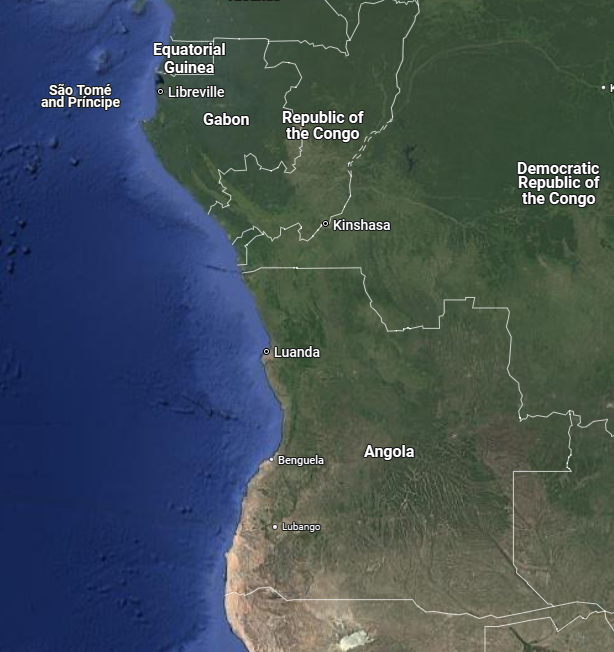
I declided that the Razor Coast would be equivalent to the Gulf of Guinea, from Ghana in the north to the end of Nigeria, rotated 90 degrees to the right.

Really the part of the coast from Gabon to Angola is a better geographic analog to the Golarion map; I could have used the Fang people as a guide and made Angola more of an analog to Port Shaw, which would also be a solid choice – but I wanted more a “medieval” feel (when Elmina was colonized) than an “early modern” feel (when Libreville was colonized). Ghana’s later colonized by the British and called the Gold Coast in this later period. And Sargava to the north, when it throws off its chains, will be kinda like the Mali Empire.

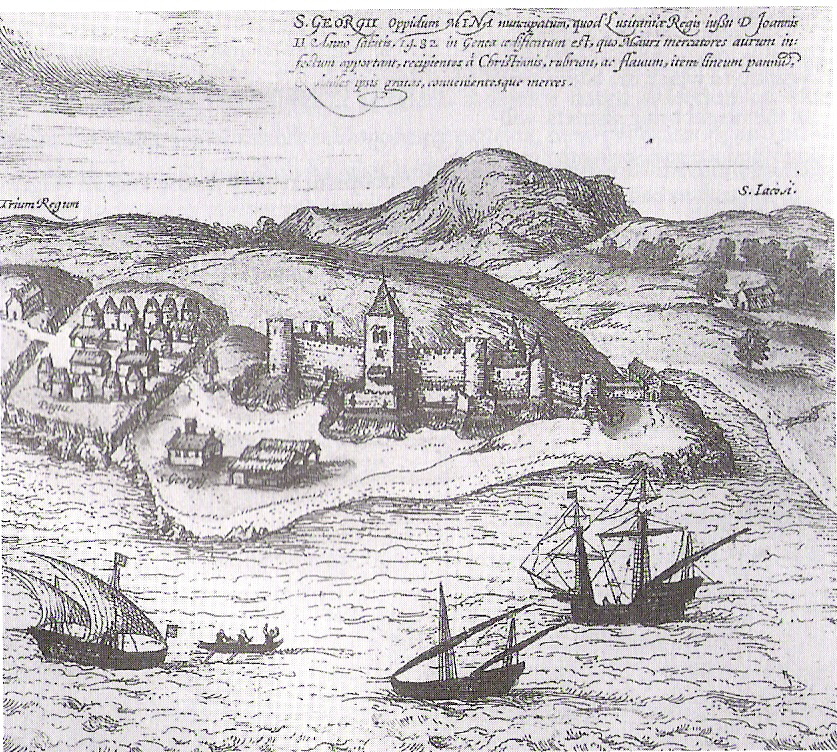
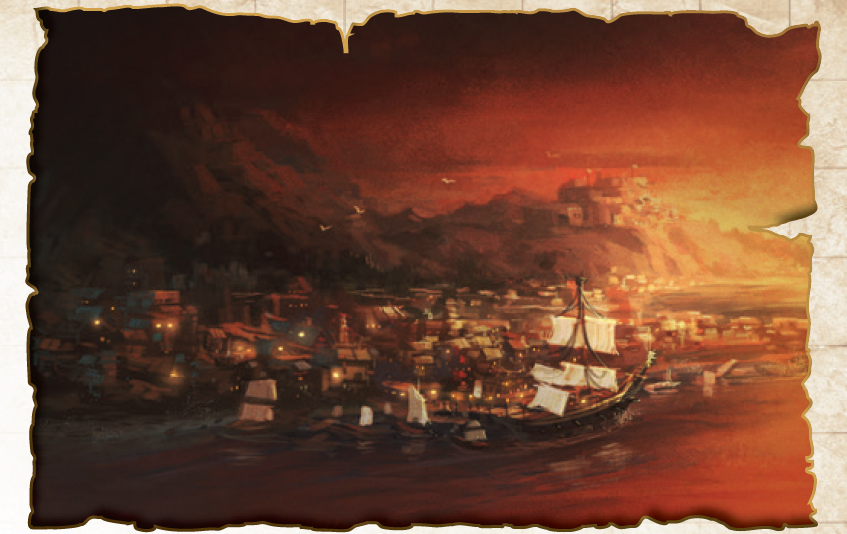
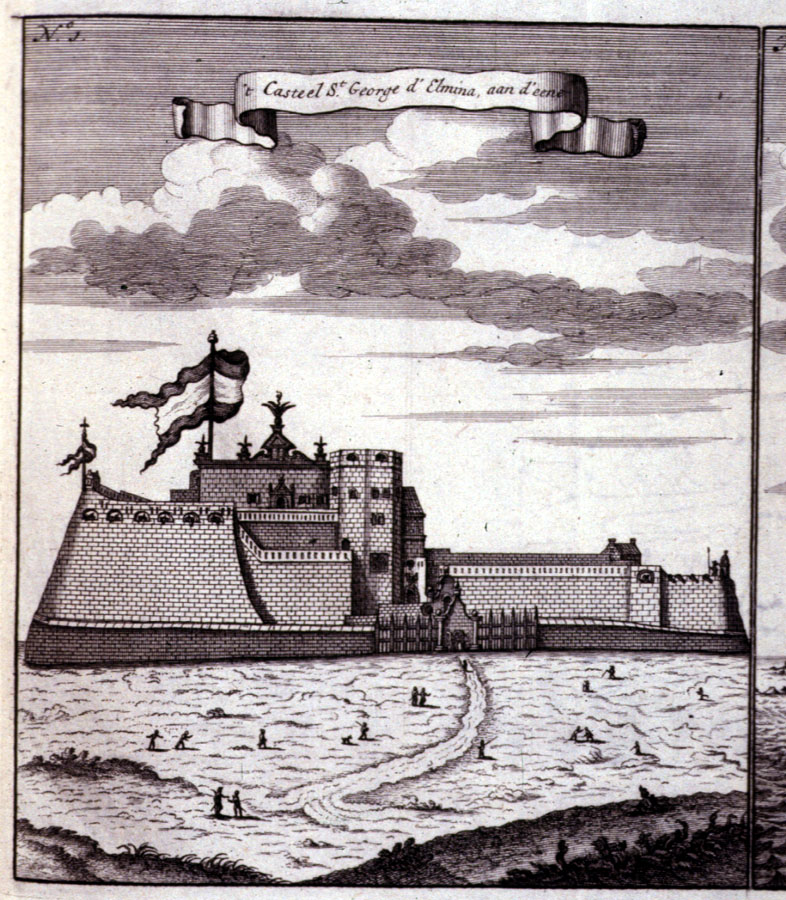
I used the RL Ghanian city of Elmina as the Port Shaw reference point, it was colonized by the Portugese in 1482. Tell me this Port Shaw art and this Elmina art don’t look the same!!!

And thus Fort Stormshield is represented by Elmina Castle (originally St. George Castle):

Here’s a concrete example of how having real world places to draw from pays off… So there’s some whaling ships in Port Shaw in the Razor Coast book. That seems like a less tropical and more arctic thing, I wasn’t sure what to do with it – change it, but to what… Insert research… Oh look a whole fucking Wikipedia article on “Whales in Ghanian Waters.” Turns out “Ghana’s coast forms part of the distribution range of a ‘Gulf of Guinea’ humpback whale breeding stock with estimated population at over 10,000 individuals.” Sperm whales wash up from time to time. Well consider me educated and I have enough info now to add realistic details when the PCs engage with it.

Converting the people groups over was easy, the colonists are Chelaxians like in Sargava, the natives are Mwangi, and the local Tulita tribe is just a specific tribe of Bonuwat.

Converting the religions was also easy. The only real church mentioned is the church of Quell which is a sea god, so that maps directly to Gozreh, who’s the deity of all the party as well so they’ll have affinity with those plot threads – there’s a plot to blow up the church of Quell/Gozreh, and Bethany Razor’s ship, the Quell’s Whore, becomes the Gozreh’s Whore.

What about when they start poking deeper into the natives’ beliefs? Real world research to the rescue again – I used these Wikipedia entries as starting points, West African Vodun and Yoruba Religion. We often get a bit of a “New Orleans” view of voodoo from films and stuff. I went more to the original Orisha for details and insipration.

Frank Mentzer’s add-on Razor Coast adventure has voodoo loa based on the same sources (Oggun is even in there by name). In the adventure, PCs go find mystical trinkets for Aizan, the loa of water and the seas (Yemaya, in the Yoruba religion). Sindawe is already hooked up with her under the name Mama Watanna, so we have PC linkage! (OK so technically Mami Wata and Yemaya are different in RL African mythology, but it’s better for my game to combo them… And Mami Wata has a relation to serpents which plays into our party and themes… And again, I have learned something about the real world while figuring this out!)

I mean, I can’t say the tie-ins were all completely accidental as I had a good knowledge of Razor Coast and knew it was the capstone of the campaign from the beginning, but with just a little stage-setting the incorporation of this monster (546 pages in Razor Coast, plus more in Heart of the Razor) into Golarion, and fleshing it out with real world details, was pretty seamless.

Now on to adventures in Port Shaw!

RPG Review: Pathfinder Lost Omens Travel Guide

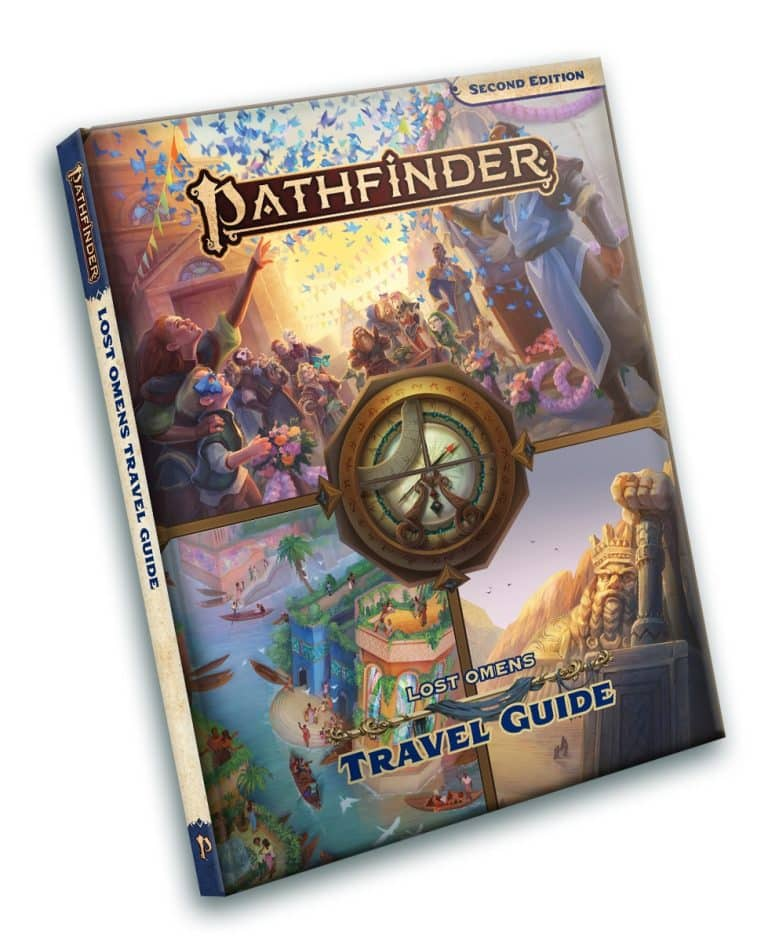
Pathfinder Lost Omens Travel Guide

I love the world of Golarion, Paizo’s default game world for the Pathfinder RPG. I was a subscriber to basically everything that came out for Pathfinder first edition and have been running a Pathfinder campaign for some 15 years now (and played in many of their Adventure Paths myself). PF2e wasn’t different enough to convince me I should spend thousands more dollars on the same content again, but the Lost Omens line is about Golarion world content, and I buy those from time to time.

And since my current game is about pirates traveling from place to place, the idea of the Pathfinder Lost Omens Travel Guide, which “presents the highlights of the Inner Sea region to help any and all curous travelers plan where to go and what to see,” was super intriguing. I got it recently and read it cover to cover! I assumed what I’d get would be like a travel guide – here’s what to expect of the sights and sounds, but also practical details, of going to various places in Golarion.

Bottom line up front – it’s OK. There is some great content and some complete misses. And that’s a challenge – as a hardback with 124 pages of actual content for $40, I’m paying a buck for every three pages so each three pages should be worth a buck to me in content. Some groups of pages met that burden and some did not. It’s very uneven. There were some chunks of great Golarion content and then there are chunks of content that I can only call “generic medieval fantasy for dummies.” Let’s get into it.

I got in a bad mood early reading this book but it picks up later. We start with a two-page “introduction” spread containing zero content written by, not a Pathfinder whose name we know from somewhere, but some rando fake fantasy editor.

Time & The Calendar

The book starts with a six page section on “Time & The Calendar”. It names the days and months – something we already know from the world guide – and adds a little bit of helpful flavor, like which day is usually a market day. It confusingly adds “common names” for the months. “Abadius, alternately called Prima.” Alternately by… Who? Why? Where? We’ve been using the primary names for decades in Pathfinder world now, so this a weird add that doesn’t expand our direct usability of the world. Do they use these different names in… Garund? Are they formal “Latin Church” type names the educated would use vs. peasant terms? Who knows. Then a quick justification for the laziness of using the same calendar across the world (There was a war! People agreed!) and then, super frustratingly, some alternate calendars like the Tian Xia Imperial calendar that date from a different year. OK that’s cool. What year? Who cares, apparently.

This is a gripe I’m going to come back to. World content that is actually *useful to players, in play* has some very specific requirements. If we’re going to say “Ah the guy from Tian Xia says back in IC 123”, we should be able to say “oh and that’s equivalent to AR 2500.” But this book just doesn’t bother with that. GURPS was the game that really got this right. I didn’t play a lot of GURPS but I own 20-30 of their sourcebooks because they mastered the art of taking fictional content and boiling it down to what you needed in play. GURPS Conan tells you how much a broadsword costs in Scythia and what differences you, a person wandering in the world, are going to see and encounter. I would get GURPS supplements when planning to run a game in that setting in another game system because their value was distilling the fiction down to usable, tangible specifics relevant to PCs exploring a world.

Then we have a quick historical timeline – again, from other sources, without any kind of effort to make it “what today’s peasant understands” or the like, and then time constructs broken down by race. (We’re supposed to call “races” “ancestries” now but bah to that.) More than 50% of the pages have big graphical sidebars that are not super useful.

Everyday Life

Next, a sizable 12-page section on “Everyday Life.” Here’s where we get into some trouble. Much of this is “Life in a Medieval Village Lite” generalities about what some abstract generic Golarion medieval European does in their life, but less focused on historical realism and more what a fantasy anime village does. “Get up early to tend the livestock!” “People on the water fish!” “Nomads travel!” is the level of detail here. No Golarion insight, like “here’s what a peasant in Andoren’s day is like vs a Bonuwat fisherman vs a Varisian nomad” – nope. Next is a long section on languages, which has the helpful point “Common/Taldane and Tien are trade languages commonly spoken, but not well, because people tend to speak their actual local language.” I said that in one sentence but they took half a page. Then a bit on ancient languages, which I’m not sure how it’s relevant to the alleged travel guide format. Next we have some more generic fantasy content – a full page spread on a “rural home” and an “urban home.” You know, a generic one that is certainly identical across an entire world. These helpfully explain what a “Yard” and a “Bedroom” are. Next, a couple pages on what “Rural Life” is like (is that not “Everyday Life” in Golarion?). This has some dross like “did you know there’s not as many restaurants out in the sticks” but some actual value, just padded. “Out in the sticks people tend to trade in barter instead of paying each other coins, but they’ll take yours” is another sentence you can replace a half page with, and “people tend to not be monotheistic, but revere the various gods in charge of whatever they’re doing at the time; farming, hunting, dying, sailing, etc.” same thing. Like, great clarification, just padded to all hell. And then we have an actual useful little bit saying what a house costs.

Then we have a two page spread on “Rural fashion” indicating that our generic rural peasant might wear a “Hat” and a “Work Apron” and if they fish, perhaps “Fishing Galoshes.” This is where I started to get angry and fear that I’d dumped $40 on one of those shitty big-board books you find in the discount section of bookstores that are like “a castle, for kids!” kind of things.

We run through the same lengthy content for Urban Life, which has more restaurants and more monotheism, and a fashion spread, which indicates more of a love for parasols and pouches than the dirt people. But make sure and ethically source your hat feathers because “the collection of feathers can do a lot of damage to bird populations, and activist groups have begun to protest them.” No I am not kidding. I mean, I guess since slavery and racism and all the other evils have been solved we may as well. (In the interest of PC-ness, everyone including the most evil of evil realms all outlawed slavery in the last couple years between Pathfinder 1e and 2e.)

Festivals & Holidays

I assume it’s because of assigning out sections to different authors and not a lot of time spent editing, but we had some festivals in the calendar section and now we have another semi-redundant 8 page festival section. This one’s OK – it notes a bunch of holidays and festivals with actual locations/deities/context on them, which is great, but with no information on any of them that would be useful to someone traveling there.

There’s no excuse for that. I went to Japan last summer and the travel guide packed in 5x as much information (these 8 hardback pages equal 16 real travel guide pages, which manage to give you a little about what a given festival may actually entail and look like and be about). They do add a little flavor in the 6 pages they use to show some dress for a couple of the festivals, but the density and focus is a problem. In a full page spread on the Cayden Cailean festival of Merrymead, we have a random super dark piece of art that indicates a reveler may well have a “handkerchief.”

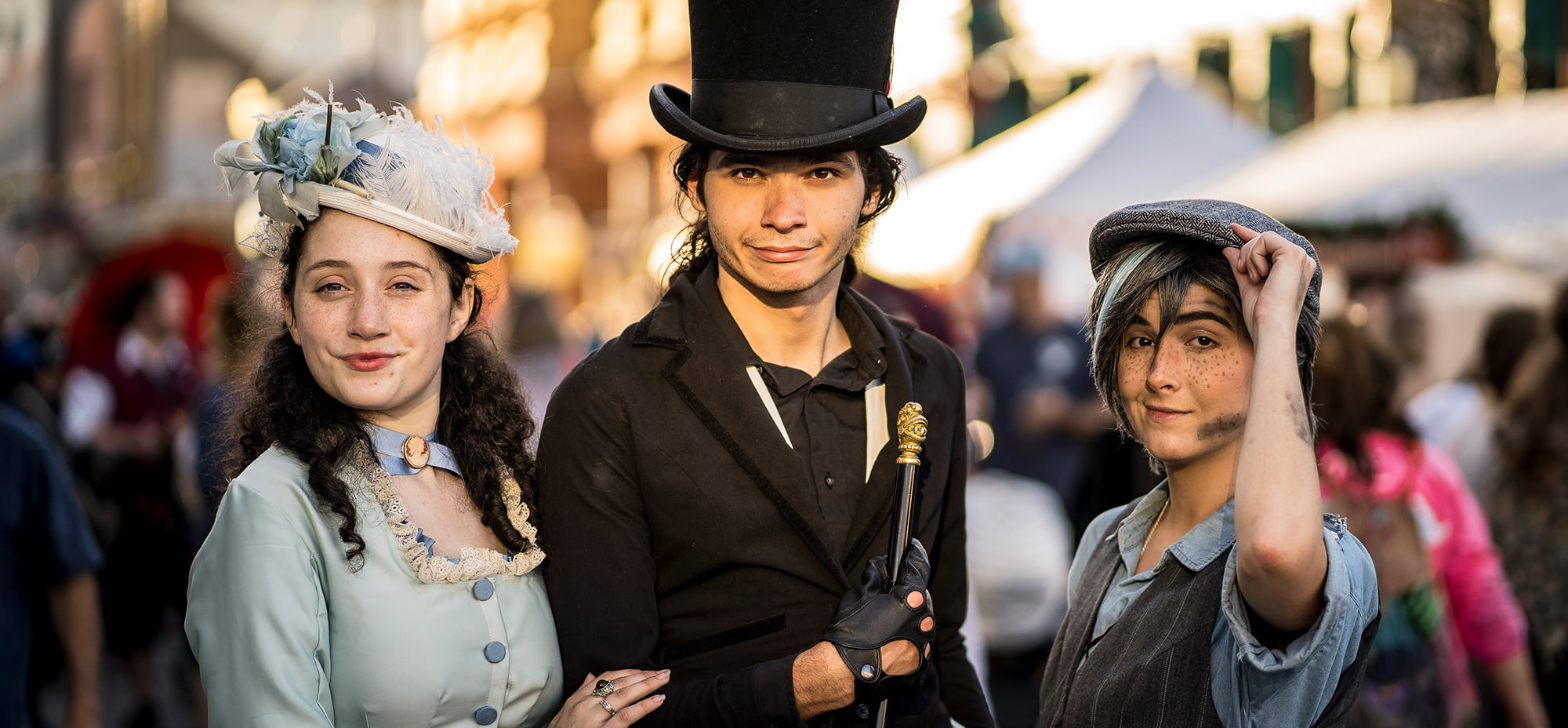
But how would you do this better, you ask? OK so near me in Galveston, TX, they have a Christmastime “Dickens on the Strand” festival:

Dickens on The Strand is Galveston’s annual winter holiday street festival bursting with live entertainment on multiple streets, including strolling carolers, roving musicians, bagpipers, jugglers, and a crowd of entertainers and costumed revelers, all dressed in period formal Victorian garb like formal dresses and stovepipe hats and eating cold-weather treats like roasted chestnuts and drinking mulled wine.

Bam. Concise but focuses on what you’ll actually do, what it’ll feel and look like (cold! festive! music in the air! fake old-timey formality!). And you could fit 5 of those (easily) per page so you get more coverage – the problem with a book like this is if your campaign is set in place X and focuses on deities Y and so on, the chance that one of the 4 padded out holidays they cover is going to be relevant is low. Do 30 in that format, and you’re good to go. Or dig more into each one, but dang the content per dollar is low in this section. I get art is expensive, but blowing up a drawing of a copper piece to take a full 1/8 page spread just makes me spend more of my money on it too.

Trade

And that segues us into the Trade section. The church of Abadar works to validate contracts and balance interest rates across the Inner Sea. Some of this is great, some of it gets into weird “fantasy modern”. (They have things to detect if goods have been teleported somewhere to try to profit! No one would want to buy teleported goods! I’m glad we have a super high magic solution to all those level 10 wizards trying to profit off teleporting lingonberries to the Mwangi Expanse!).

They have a full page spread with 4 coins – which is nice, it’s nice to have an example, oh look here’s what an Absalom platinum piece looks like and is called. But again, it’d be better with then a list of 10 other things they’re called in other places and maybe a “and they are all little bars instead of coins in Druma” or something.

A two page spread, one page of which is a map, has trade routes of the Inner Sea. Now we have the first truly useful worldbuilding. (I knew most of this from extensive research I did planning my pirate game, but it wasn’t all in one place previously.) So trade tends to flow in these routes, which has transport implications, pirate implications, and so on. The main drawback here is they don’t really get into what kinds of things are traded. “Goods! You know… Goods from Casmaron!” Cool story bro.

It’s followed by a 2 page spread on trade goods but again we’re back to generic anime fantasy content not Golarion content. Did you know people might trade in metals, fish, wine, leather, cloth? Who exactly? Eh, who cares. This is 2 full pages of “No shit Sherlock” with extensive spending of the art budget on 20 illustrations of “A pile of bricks. A pile of lumber. An ingot of gold.” I pray they reused these off some item deck somewhere or something.

Cuisine

There’s some gems in here but a lot of it is that generic fantasy-ish content again. “People like to eat pork! And stew!” There’s blah fantasy bits (behir caviar is tasty) but also some actual Golarion content in places, but I think it sometimes is harmed by a common problem. Technically Golarion is the entire world, then Avistan and Garund the two most prominent continents in products, and then “the Inner Sea” is technically the Mediterranean that’s between the two. So “One unique aspect of Inner Sea cooking is the prevalence of olive oil.” Fair enough. But because all the world products are called “Inner Sea,” and cover places obviously not in the Inner Sea (Fantasy Norway! Fantasy Kenya!), it’s not clear where they’re saying that’s narrowly vs tightly scoped and it harms diversity. “The northern shore of the Inner Sea uses olive oil in its cooking, while the southern shore predominantly uses palm oils” would add some diversity and some clarity as to range in the same space.

Same deal with spices, you get an actual useful bit about pepper from Varisia’s Mushfens being popular, but then just a laundry list of other spices that I guess are everywhere because we have Fantasy Kroger’s. “Basil, dill, rosemary, coriander,…” makes it sound like everyone in the world of Golarion has easy access to the store brand of all 20 common spices.

A bit on drinks, a 2 page graphical layout of “A Noble’s Feast” (no location) is again discount bookstore fare. Just even make it an example Taldan noble’s feast or something; the world of Golarion basically has “all real world areas and cultures” represented.

Drinks of Ilizmagorti

Then we have 2 recipes which are just excuses to stick recipes in a book because people like that nowadays and 4 cocktail recipes. They have a lot of ice in Northern Garund (think Morocco) do they? I wish they didn’t do the full recipes but just gave some rundowns.

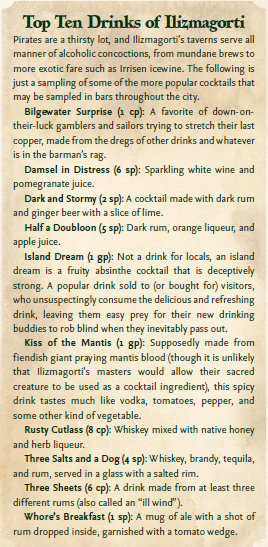
Some of the most useful content I’ve pulled from other sources is like in Cities of Golarion that covered Ilizmagorti, it said it’s a bit of a foodie town and pub crawls are big and here’s a list of representative cocktails. My PCs still say Ilizmagorti was “the best place to party” in my long term pirate campaign mainly because I used this. Notice the conciseness and richness of detail. This entire sidebar takes the space they used for one cocktail recipe in the Travel Guide. “That drink that was just the squeezin’s!” still gets mentioned time to time years later.

Fashion

I mean… So maybe I misunderstand the point of this book. Maybe it’s for 12 year olds who have never done any basic learning about the world or history, and it’s very helpful for them to understand “Silk is an animal fiber like wool.” But it’s billed as a Golarion travel guide God damn it!!! “You can have a beautician do your nails.” The first page is annoying but the second is actually good, it’s fashion trends from Queen Anastasia of Irrisen and Queen Edasseril of Kyonin – sure, Queen fashion trends will travel, that makes sense, it gives me some actual details to put into a real game. “As you look around the high end salon, you see many of the women have real or tailored flowers and leaves adorning the ends of their sleeves and the lower parts of their skirts.” They ask, and “Oh, it’s all the fashion because the Queen of Kyonin a couple countries over is wearing that.” Bam, world immersion.

They keep it up for a while – garb of a student in the Magaambya (fantasy Africa) vs Ustalav (fantasy Transylvania), some New Thassilon driven fashion, some modern anarchist fashion. But we edge back into generic with Accessories. “Handbags! Aprons!” Some are ok though and add world flavor- “Shoanti Tattoos! Varisian Scarves!” The latter help me, the former – I guess it reminds me some people carry purses?

Art & Architecture

I’m going to spare you belaboring the details of this chapter, it’s a mix of generic claptrap with occassional useful examples of some real artists in Golarion, including at least one, Ailson Kindler, that is actually from Golarion lore and not just net new made up, which is great.

Some architectural styles are covered which is good – and finally a bit that is what you would expect in an actual fricking travel guide, famous structures! Go to Riddleport and see the Cyphergate! Go to Osirion and see the pyramids! Each with an illustration.

Pastimes

This is where the generic claptrap to useful world content ratio starts to get a little better. On the one hand, “people collect flowers and shit to entertain themselves.” On the other, we have log rolling popular on the Sellen, people around Lake Encarthan love whittling little big-eyed stylized animals… That I can use to make PCs feel more like they’re in a distinct location.

And then they have extensive rules for “Golem”, which is basically normal poker except there’s a “best hand” made from the discards that can win, and “Basilisk,” a popular sport (though again, popular *where*??? Across Fantasy Tunisia to Fantasy Colombia to Fantasy France? Come on man.).

It ends with a sample Basilisk team, the Riddleport Rollers. OK great! My campaign started in Riddleport! Here’s the goaltender, Mujaika the Wall, who looks like a Mualijae elven woman. Perfect! Ok that’s real PC-interactable world content. Meet them on a ship going to <nearby place>. Party with them. Get pulled into a skirmish game on a beach somewhere, learn the game. That’s a whole game session driven off world content. More please.

Crime & Law

Generic. “Wherever you are… Robbery gets you 20 lashes and 1 to 5 years hard labor.” It makes the content wasted. Call it an example legal code from the Isle of Kortos, have a half page of “well in place X they have wandering judges, in place Y they don’t punish violence much because they victim blame, in place Z conviction is based on a vote from all the citizens that can be bothered to show up in the town square…” and you’re making world content.

Then a two page spread of wanted posters. I “wanted” to like them but they immediately showed the confusion between the “generic objective set of laws” and the practice, since some of the wanted are for doing good acts somewhere that didn’t appreciate them. And no location on most of them.

Now two pages on “headquarters”, with an example furniture shop hiding a thieves’ guild and an Irrisen cop precinct. You really have to squint to see this as Travel Guide material, though I guess you could say the chance a traveller in Irrisen will end up in a lot of cop precinct houses is fair.

What People Know

This is one of the things I have specific expectations around. Too often fantasy worlds are portrayed as people know everything in the setting book. What happened 5000 years ago? Of course a random bog farmer knows about it. Luckily I found this section strong. People have different creation myths, their knowledge of history is generally that “well Aroden started the age of man like, a long time ago, and he died recently and things suck.” What’s the Shining Crusade? “I don’t know but I heard of it.” Realistic, I like it. Introduces the concept of “microregions” where knowledge tends to locally pool – three countries fighting each other have a general shared knowledge, but one country over they may not know much about them. In the Mwangi Expanse, most people know about the Magaambya and welcome traveling scholars from there, and know to be wary of Nagisa and Usaro. This is good info to help show things from ‘the locals’ perspective’ without the locals knowing everything because, you know, they’re primitive savages mostly.

Magic

While this should have more local flavor incorporated besides the obvious “Rahadoum doesn’t allow divine magic,” it’s a good look into what the common man understands. They know magic exists though may not have experienced it; wizards are probably upper class; priests are a little more special because, you know, gods… It also says that many people have some kind of inherent magical knack that they have never trained to the level of “spells” but maybe some of the random superstitious crap they do actually has some effect (folk magic). Good.

Then we have a REAL weird section. I don’t know why it’s in this book and it seems like a pretty major thing to introduce. It turns out whenever you cast a spell you have a bunch of CGI runes that appear around the caster with some specific meanings to them and their colors and fonts and stuff. I mean, this is how it kinda worked in the Pathfinder comics, but this is a strange place to make a canon introduction of what spellcasting looks like in Pathfinder. It definitely means casting every single spell is super obvious, which is a problem for the more stealth casters and enchantments, illusions, and so forth, but eh. Anyway, I don’t know why it’s in this book.

Same deal with a two page spread on spellcaster lairs. This is a travel book man.

Folklore & Mythology

This is cool. Creation myths and differences from place to place. Some example fables and fairy tales. Some ghost stories, some legendary figures. A little more formal than a travel guide would bear but still, good Golarion world content. A bunch of local superstitions, this is totally what I wanted out of this book. In place X a given color or animal or number is lucky/unlucky for a random reason so the locals do something colorful time to time.

Then a full two page tale of a Garundi hero. Nice, though pushing the page count to usability in game ratio.

Religion

More good stuff. Common religious practices, specific things to note per region, religious events & observances, religious iconography. “Gozreh’s worshippers among the Ulfen see the deity’s duality as fire and ice, rather than the wind and the waves… [they] carry iron ice picks…” This is “good” worldbuilding.

Then we have a section with some pantheons. This is “bad” worldbuilding and let me explain why. The concept of a pantheon is great. Normal people don’t pick one god in this kind of polytheistic world, they generally have a set that makes sense in their area and life. Out in farm country in Andoren that’s more like the US Midwest, most folks worship the “Hearth and Harvest” pantheon of X, Y, and Z. That’s cool. These specific ones, however, fall into the min-maxers’ trap of putting together anything from any source with no in-game reason. These pantheons are not local but are often “across the Inner Sea,” and have deities from all kinds of places – Mazludeh, the ruling angel of Holomog, which basically no one has been to and whose worshipers are just described as “Holomog” – suddenly part of a pantheon for people 1000 miles away to use because their “domain” fits into an arbitrary list. Asian gods? European gods? African gods? Native American gods? Nonhuman gods? Sure, mix ’em all together with no justification.

I will never use any of these. And it’s a missed opportunity. Make them hyperlocal and have deities that make fricking sense in them. It’s OK if one is foreign if there’s a reason! I could buy an Asian (Tien) god in a Viking (Ulfen) pantheon because the trade route to fantasy Asia goes through fantasy Norway and there was a whole Adventure Path about it, so maybe one imported deity filled a spot that was kinda missing with the locals so it’s all Thor Loki Odin and samurai lady, fine. But you can’t just say “I’ll pull all the gods from all the regions that have academics in their list of domains and call that a pantheon.”

Nature & Animals

A section on what wildlife, not just monsters, you’ll find as you travel around, like the bowing deer of Nara!

No, I’m kidding, it’s 2 pages of basic PETA propaganda about coexisting with bears and not polluting and stuff. What the absolute fuck. I mean, I agree with it, I was a Boy Scout, but “stuff I personally agree with” is NOT GOOD GAME CONTENT, something that both Paizo and WotC have completely forgotten.

But then we get a page spread of 10 illustrated flora and 10 illustrated fauna, with actual Golarion locations they live in. This is good.

And then two pages of random new herbalist concoctions. Which would be fine in some random Complete Guide to Herbalists but this is a TRAVEL GUIDE. Not “a herbal concoction you can only find in Hermea,” it’s just generic rules content.

And then 2 pages of pets you can buy, including some actual unique and location-dependent ones. Arcadian opossums tolerate being dressed up in little outfits well so they’re popular pets among the white trash of ancient America. OK that’s great!

Finally a 2 page spread of monster locations with a map – reefclaws are abundant south of the Eye and manticores are endemic to the Mindspin Mountains. This is good content but there should be 10x the amount of it, cut some of the flavor text and you could have instad of 6 small blobs on a big world map, more coverage to where whereever your campaign is set, there’s a place renowned for a given kind of monster nearby.

Like, I can’t get over that for every 2 pages of useful content I’m paying for 2 additional pages of dross, and at this hardback cost that’s a buck per three pages.

Weather & Climate

Some good information on the climate in many microregions, with a big but very hard to read map of climactic areas (the legend is miniature and relies on some pretty complicated patterns not just colors). Now if this had a random weather table per region, it would be good game content. As it is, it just tells me that in Fantasy North Africa it’s desert like I would expect from having been through the 7th grade. I don’t hate it but I don’t love it.

Then we have a 2-page spread on natural disasters (normal style) and a 4-page spread on weird supernatural specific weather events that if you, like, vibe with you can get some kind of effect. If you stay outside for a day in the Blood Rains of Ustalav you can make a DC 24 check to maybe get a benefit for a week, or if you f that roll up maybe you get tuberculosis. That’s fun specific world content and Travel Guide worthy. “Travel to Droskar’s Crag, and if you’re lucky enough that it’s spewing ash at the time, rumor is you’ll be protected from the cold when you go back home!”

The Stars

This section talks about the moon, the stars, the constellations (Fantasy Zodiac), moon phases… It’s ok almanac content but does “Moon Phases” need to be an entire 2 page spread? This is one of those “completionist” things that can exhaust PCs. If one or two moons a year are important that’s great, if every single full moon of the year has a special name and meaning and stuff, it becomes hard to care and it’s hard to believe most of the populace does either. At most you’re in an inn in a small town and someone’s grandma is nattering on about how this is the “sweet moon” because it’s around when the berries ripen. Thanks, boomer.

Then we have some astrological backgrounds rules because of course you have to have character options even in a travel book because it’s Pathfinder.

Then they have a 4-page glossary and index, which is actually great because they just toss off random names from all across Golarion and I read the book in one hand while I looked up random deities and stuff with an iPad in the other. (I wish I had known the glossary was there before I got to it, lol, though really hitting PathfinderWiki is better.)

Conclusion

I know I griped a lot. I expected a Travel Guide that does what it says on the back cover, and I think that’s a fair fricking expectation. Fodor’s Guide/Lonely Planet Guide to Golarion would be a great book. If they hired someone from Lonely Planet and had them read 100 lbs. of Golarion lore and said “make a travel guide and make up stuff that’s not in the infodump” I’d pay $100 for it and buy copies for my players. This isn’t that book. But it does have some good Golarion content. There’s animals and stories and art and fashion movements to mine to include in actual Pathfinder games set in the world to add versimilitude.

The “bad” content – most of it isn’t bad per se, just in the wrong book or full of padding. Some is weirdly basic (Did you know in really cold climates people wear winter coats? Here’s a picture of a random winter coat that looks suspiciously like the one Bespoke Post tried to sell me today) and some is weirdly in depth wonkiness (The third full moon of the year is…). The only part I said “no this is wrong and bad for Golarion” is the random-deity pantheons.

If it was a $30 softback I would say it’s a clear buy. As a $40 hardback of 124 pages of which maybe 60 will ever see use… That’s tough. If you’re fairly well off, I guess. I don’t regret buying it but I have plenty of disposable income. If I bought this at age 23 during my first job out of school I’d try to return it.

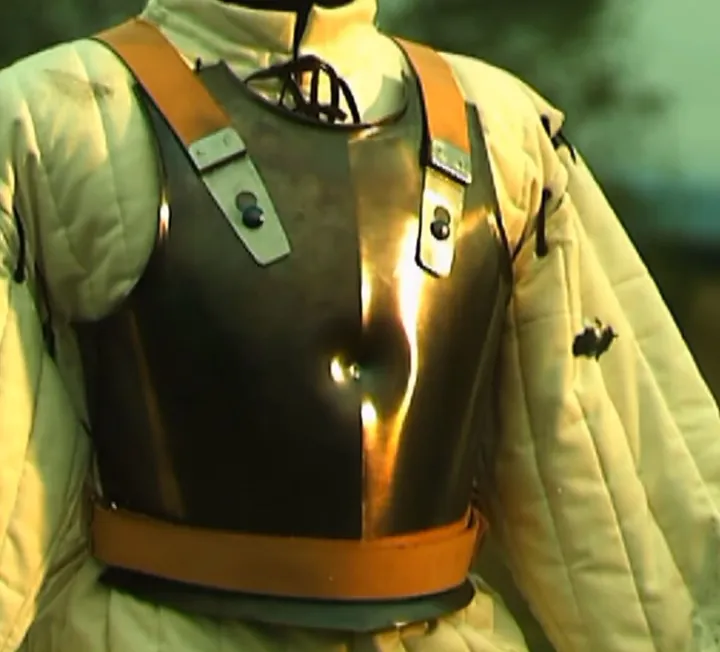
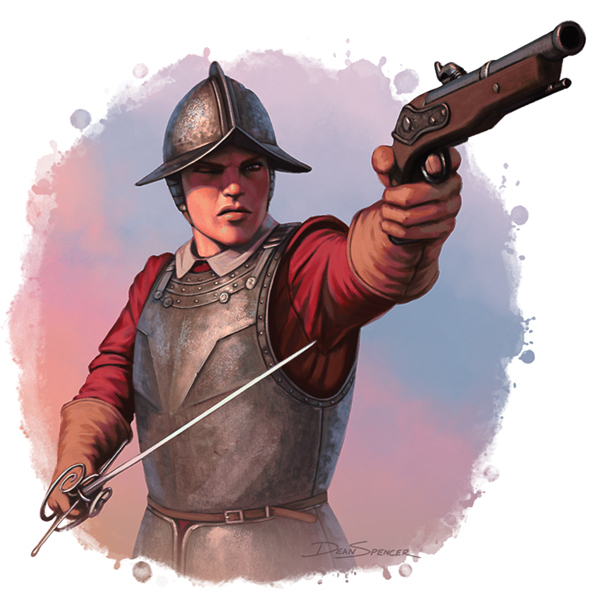
Geek Related Gunpowder Weapons of Golarion

A while back, I took an initial stab at some firearm rules for Pathfinder 1e. But over the 15 years of the Reavers campaign I’ve been continuing to use and refine them. So now on the Rules You Can Use page is:

Geek Related Gunpowder Weapons of Golarion (7 page pdf)

Now, since I created mine back in 2009, Paizo came out with official firearm rules and then also cannon rules. But I still use mine. Why?

Early Personal Firearms

Well, the problem is that to make it easy to balance, Paizo made guns a lot like bows, especially damage wise. Bang, 1d8 damage! People want “consistent damage output” so they made them easy to reload quickly and/or have multiple barrels so you can get your multiple shots in a round. The main thing they added to power them up was to make them hit touch AC within the first range increment. But that’s a problem IMO – so magic plate armor, dragons, etc. are trivial to hit. Sure, “eventually firearms made armor obsolete” but an early flintlock bullet will deflect off a breastplate just fine.

I wanted to approach the topic with two equally important goals.

One, historical realism – at least a nod to it. One of the things I have loved about D&D in the 40 years I’ve played it is the exposure to history, technology, real stuff. This means slower reloads, misfires, high crits (the Paizo rules do have misfires and high crits, credit where credit is due), and so on. And related to this, fantasy trope fidelity – firing a pistol while laying about with a sword is a staple of some historical but certainly much fantasy fiction, and if a gun is just a bow then you will only have specialists. And while I do want early firearms in my game, I don’t want someone spewing out 4 shots a round, that’s for a modern game. I don’t really like the feel of a “gunslinger,” maybe a “musketeer” at maximum in a late middle ages/early Renaissance type setting.

Two, make them feel different than other weapon types. If having a gun is just a bow with a special effect, I’ll play Apocalypse World, thanks. If they’re not different texturally, why add them? Just for the fictional impact I guess, but – bah. To me the impact firearms should have is that you can’t fire historical firearms quickly – but if they hit you they will fuck you up. PCs above level 1 treat “a guy with a bow” with impunity unless he is also leveled. “Oh no, I might take about 4.5 points of damage!”

This is easily done – just use a slower reload and put more punch into each hit. Instead of “reload a pistol as a standard action, or move action with a feat, or just all the time if you’re a gunslinger, and then shoot for 1d8 damage” I went with “reloading a pistol takes 2 full rounds, or 1 with a feat, and then shoot for 2d6 damage.”

Suddenly there’s a lot more reason for a melee person to carry a pistol to shoot as they close, or pull and shoot at someone strategic in battle that they can’t get to. And a reason for a gun-wielder to carry a brace of pistols (like, you know, real people did). With these rules combats feel more like fictional early firearm battles (The Patriot… Van Helsing/Solomon Kane era stuff…). It also makes a massed squad of musketeers, for example, something to give PCs pause.

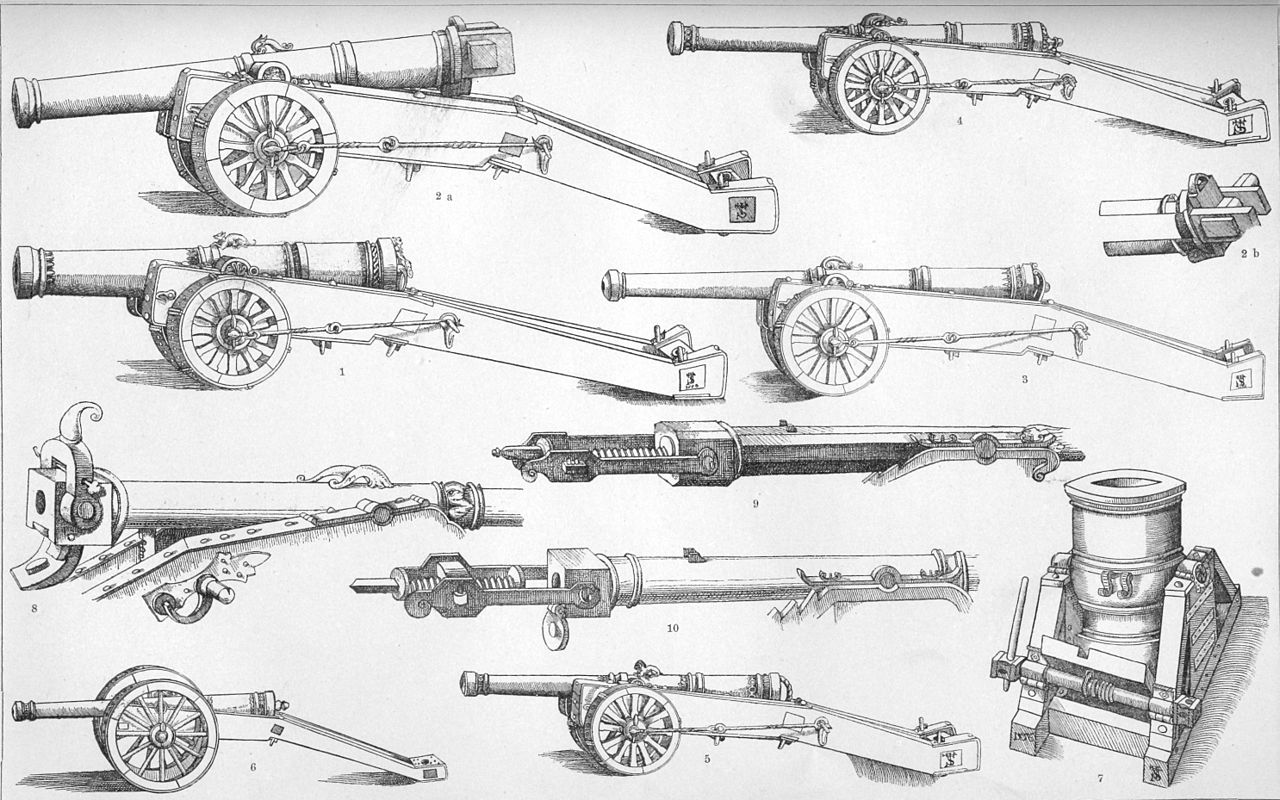
Early Cannon

Same with cannon. Slow but super dangerous – though mostly to ships and buildings and not people, unless loaded with grapeshot.

I get some people “don’t want gunpowder in their D&D.” I don’t get that, I just want “historically appropriate for the late medieval era” in my D&D. And Europe had cannon as early as the 1300s (and earlier, in other places), and by the usual late-1400s kind of representative “hybrid medieval/Renaissance” D&D era that most general published settings, including Golarion, trade in, they were definitely in use on the battlefield and on ships. But they are slow and ridiculously expensive.

The Pathfinder cannon rules are actually reasonably similar to what I had come up with, with slow reload and crewing requirements. But they were both way too inexpensive (especially for a world that tries to say “oh they’re only really available in Alkenstar and you know maybe a little in other places”) and don’t pack enough of a punch. “Oh no, I got shot by a cannon and took 6d6 damage.” That’s 21 points of damage, also known as “a melee attack routine from a low level PC” or “the shitty low level fireballs that are why people say playing an evocation mage is a trap.” And their ranges are crazy short (100 ft. range increment).

What I wanted from cannon was to be long range and devastating, but rare due to expense and slow to fire and mostly for structures but still a threat to individuals. So my basic 12-pounder cannon does 7d10 damage every 4 rounds vs 6d6 every 4 rounds for the Paizo version. (Again, they balance it with the touch attack mechanic). It’s actually less expensive than its Paizo equivalent – my 12-pounder is 4000 gp and 120 gp of black powder to fire vs Paizo’s is 6000 gp and 100 gp of black powder to fire, maybe I should adjust that. (A wand of fireballs is 11,250 gp, for comparison.)

And my range increment is 500 feet. I know, all Pathfinder/D&D weapons have pathetic range compared to real life. But the role of cannon should be a super-ranged threat. Can you even get into fireball range before taking a volley? How many shots can your ship take as you close to board? It provides a different strategic element, not just a new skin on an existing strategic element.

Magic and Alchemical Firearms

Now, the other thing I do is to make enhancements to firearms very rare. They are brand new. You can find ancient enchanted swords from wizards over the last millenia but firearms and cannons are from the now, and tech and magic are somewhat opposed (both because wizards like niche protection but also somewhat fundamentally, in my view, built over decades of D&D lore that support that view). I think the “Paizo answer” to firearms and cannon is that you just boost the otherwise sad damage with magic, or with explosive shot and stuff that are, frankly, later tech level.

Conclusion

Now, the Paizo rules aren’t bad – they do most of what I want out of firearm and cannon rules, actually. I just think that it is way more interesting for the role of early firearms to be a slow loading big punch and the role of cannon to be a slow loading big punch at very long ranges. So, feel free and use these if you agree!

Let me know how you use guns and cannon – and especially what the feel of the rules you use adds to your game.