Tag Archives: RPG

Paizo Playtest of New Pathfinder Classes Starts Today

Paizo is working on an “Advanced Player’s Guide” for the Pathfinder RPG.  It will have six new character classes in it.  In their usual open and enlightened manner, they are going to be opening those classes up for playtest and comment by the gaming community before going to print.

Here’s the schedule – the Cavalier and Oracle should be up sometime right around now for you to check out!

  • Group 1 (11/13–11/29): Cavalier and Oracle
  • Group 2 (11/30–12/13): Summoner and Witch
  • Group 3 (12/14–12/27): Alchemist and Inquisitor

Enjoy!  Our group is loving the Pathfinder RPG, also known as “the real new edition of D&D,” and I’m looking forward to seeing what these have to offer.

FreeMarket (aka Project Donut) In Free Beta

It’s been a long time, but the new game by Jared Sorenson (octaNe, InSpectres) and Luke Crane (Burning Wheel) is out in public beta.  The game, which was referred to as “Project Donut” for some time, is now called FreeMarket.  It’s a colorful game of transhumanist life aboard a 80,000+ person space station.  It’s a more lighthearted take on the other new game in that genre that’s on my radar, Eclipse Phase (and what came before: Underground, GURPS Transhuman Space…).

Anyway, if you go register you can d/l the beta (if you’re one of the first 1000, they’re at 288 now).  It looks interesting – it’s definitely an “indie RPG.”  Character generation has a lot of “tagging” (in the Web 2.0/Spirit of the Century sense) and the mechanics are part board game, part RPG.

I’ll post more once I’ve had time to digest the mechanics, but here’s the basics.  In general, on the station everyone’s basic needs are taken care of and you’re trying to get “flow” – think of it as in-world “rep” or “karma” like on a forum.  Even death is pretty much always reversible in this super high tech world, mainly you kill someone just so they lose some short term memories.  Combat is not distinct in the rules from other conflicts (from memetic hacking to agriculture) which are commoditized into “Challenges”; a special card deck and tokens are used to resolve those.  Your and your group’s flow is raised or lowered thereby.

Your character is in a group called a MRCZ (pronounced “mercy”) which is a voluntary birds-of-a-feather organization like an online clan or guild.  You are good at things like “wetwork,” “ephemera,” and “thin slicing” – yes, there’s a big glossary included.  It seems fun and not as complex and heavy as Eclipse Phase or GURPS: Transhuman Space.

If I have one major concern, it’s the same concern shared with a lot of indie games – they come up with an interesting setup, new way to conceive a character, an innovative mechanic – and then leave coming up with scenarios totally up to you.  Some of this is in the name of being player driven, but I’ve seen groups have a hard time with just “here’s a cool character and cool setting, go…”  More adventure seeds and “things that could happen” are needed – they really only tangentially brush on that in 2 pages of the 150 in the rulebook.  I would recommend sitting down and generating at LEAST 5 pages of that kind of thing, and more setting detail too.  There’s some basics but for such a complex location it’s quite bare bones.  You don’t have to go “full trad” and have a keyed map of the station, but an example street (if that’s what they have there) with interesting locations/people/etc. would be a huge boost to not just reading the game, thinking “clever!” and playing it once, but actually trying to use it for real ongoing gameplay.

White Wolf – Dead Yet?

For those of you not “up” on White Wolf, news is bad for the company that brought a lot of vampiness to the RP scene – some love it, some hate it, but none can deny it changed the RPG landscape profoundly.

They made a pretty big step – and many would say mis-step – in recently rebooting all their monster lines, forming the “new” World of Darkness.  Then they got bought a while back by CCP, a computer game company.  How does this bode for their RPG lines?  Well, in a Gamasutra interview, none other than Ryan Dancey, former Great White Hope of D&D/OGL and now CCP Chief Marketing Officer, disses them pretty hard:

“Q: Can you fill me in on the status of White Wolf, the physical game company CCP acquired in Atlanta?

A: It’s just an imprint… White Wolf used to have a fairly large staff. It doesn’t anymore. It’s focusing primarily on the World of Darkness RPG products. It’s not doing some of the things it used to do; board games and other card games and things. The focus of the company [CCP] is on making MMOs and our legacy table top business is a legacy business.”

Legacy business, ow.  That’s business speak for “we’re not killing them, but those bitches are going on an iron lung and there will be no reinvestment in them.”

Meanwhile, White Wolf is making some announcements of their own.  They seem to be twisting in the wind a little and stepping back from their RPG business too.  They want you to “explore the deepest shadows of the World of Darkness,” but specifically cite “our board games and card games and the Machiavellian surprise behind the latest Mind’s Eye power struggle.”  RPGs notably absent.  Which is funny because Dancey says they’re cutting the board and card games.

They’re also planning to lighten up their terrifically restrictive fan site policy, which is welcome news.  And go for a digitial initiative-esque thing for you to “manage your Chronicles online,” which sounds as thrilling as everyone else’s digital initiative (which is to say, it gives me diarrhea).  And a new “content management system” for their Web site, which hopefully will address how bad it is.  And I don’t understand all their Camarilla stuff (it’s their fan club, like the RPGS but you have to pay) but it is clear they’re saying “OK, OK, you can play the old World of Darkness again, we get that many of you hate the new one.”

My translation: “Screw it, we’re getting old and have cashed in with this CCP deal, just leave us alone to LARP.  You can’t see me!  <crosses arms>”

Dragon Age – Really Something?

I have to admit, when Green Ronin was all abuzz about their new RPG, Dragon Age, I was unimpressed.  “Oh yay, some CRPG license, who cares,” I mused to myself, even though I generally trust them (I love Freeport and Mutants & Masterminds). CRPGs are a dime a dozen, and WoW has been the only one to get any real market share for a long time.

But they seem to have beaten the odds and Dragon Age: Origins is going to be actually good.  The trailers out for it are bad ass and the reviews are top notch.  Check it out:

As a bonus, they have a downloadable character creator you can use to make your characters even without owning the game.

And again!

Sanity Rules for Pathfinder from KQ

Kobold Quarterly has published some bonus material for their eleventh issue that has madness and sanity rules for Pathfinder/3.x!  Check them out.  [Edit: Part 2 is out too.]

I’ve used Sanity in D&D before.  I think these rules are OK, but there are three problems I have with them.

1.  A minor gripe – the Mind stat being the “best of Wis/Int/Cha.”  That’s a holdover from this being a conversion from a 4e article, you never do that “best of” stuff in 3.5.  I always used Wisdom exclusively.

2. They try to hew just a little too close to the Call of Cthulhu Sanity rules.  I like those rules, in fact when I do sanity I do it “largely” that way – 5xWIS.  But then they carry over some things I feel like don’t make sense in the average D&D game.  Penalizing starting WIS because of Knowledge skills is an example of “too much rules” and it’s even going overboard from Cthulhu- in CoC you only get this penalty for Mythos Knowledge, not just any occult knowledge.

3.  And then they put a lot of SAN loss – too much – for only mildly horrific creatures.  1d8 for dragons, outsiders, and undead and 1d12 for aberrations…  Even Mythos creatures generally did less. In CoC, undead are d4 to d8, byakees and Deep Ones are only d6…  It’s the Old Ones etc. themselves that have big SAN losses.  I think this approach makes it too much like “mental hit points” and doesn’t get the feel you get from CoC, where little stuff gets you a little, basically softening you up for the big horrid outer god.  I know it’s hard to do in an article but they need to vary it more, a musteval guardinal is going to hit you for way less SAN than some gnarly daemon thing.  The default SAN losses by creature type are way too high. Jesus, in d20 CoC the Dark Young of Shub-Niggurath are only d10, less than a carrion crawler apparently.

It’s not their fault, it’s just that the types are used too gratuitously in D&D.  There’s these Medium lobster critters in Golarion called reefclaws.  Dangerous, sure.  But they are aberrations instead of being magical beasts or whatnot.  Screws the rangers and now they are supposed to be super sanity blasting?  Maybe  if you don’t have any melted butter…

I do think the atrocity level of SAN loss is appropriate.  I’d like to see the list expanded; in my experience this is the best place from a storytelling point of view to deal with Sanity.  The list seems to “wuss out” and eliminate bad things characters can do.  Witnessing a murder or being tortured gets a SAN loss, but what about murdering or torturing?  One of the main points of using SAN is to show the consequences from being a big ass evil freak.

Six Great Places To Use In Your Game

As usual, courtesy of Cracked Magazine, The 6 Best Towns To Live In (If You Have A Death Wish).  You don’t need magic or “gateways to the elemental plane of fire!” to have a twisted Hellscape.  Dallol, Ethiopia is my favorite.  Acid lakes right below the surface!  148 degree heat! Although the place in Chile where it never rains and the little ground water is poison but the natives are immune is neat too.

These places will definitely have you breaking out the hostile environment modifiers from Sandstorm, Stormwrack, Spires of Xin-Shalast, and the like.

Preparing Image Visual Aids For Your Game

Last time, we talked about using character standees as visual aids in your game.  Well, I found out to my horror that it’s not all that easy to extract and prepare them, which is a pain.  Even images that are supposedly “player handouts” are often mixed in with text, rendered very small, or otherwise not very suitable (and though most of us have color printers now, who the heck has a color printer or even a scanner?).  And naturally, even if you’re rich and have the full Adobe Acrobat, most of the PDFs are password protected so you can’t just edit them and get stuff out (lame!).

Here’s the combination of free software and prep steps I use.  Don’t worry, I’m worthless when it comes to graphics stuff, I can’t make a good looking image to save my life.  But the manipulation you need to do here is extremely basic.

First, extract the images from the PDF.  I use the free program Some PDF Image Extractor.  It extracts everything, which is annoying – mixed in with the real images you’d like are a hundred images that are little bits of page decoration and whatnot.  But, it’s easy enough to delete them all.  Use Thumbnail view in Windows Explorer.

Now in many cases the extracted images will mostly be JPGs but there will be more annoying formats like PPM/PBM that Explorer thumbnail view, Picasa, etc. don’t understand.  Especially for player handouts, it seems.  I use the free program ImageMagick (available on Windows and Linux) to do bulk conversions.  “convert *.ppm pic-%d.jpg” converts all the ppms to sequentially numbered jpgs (I haven’t figured out how to do what should be the base case, which is just bulk convert every name.ppm into the same name.jpg without writing a loop in a script or something).

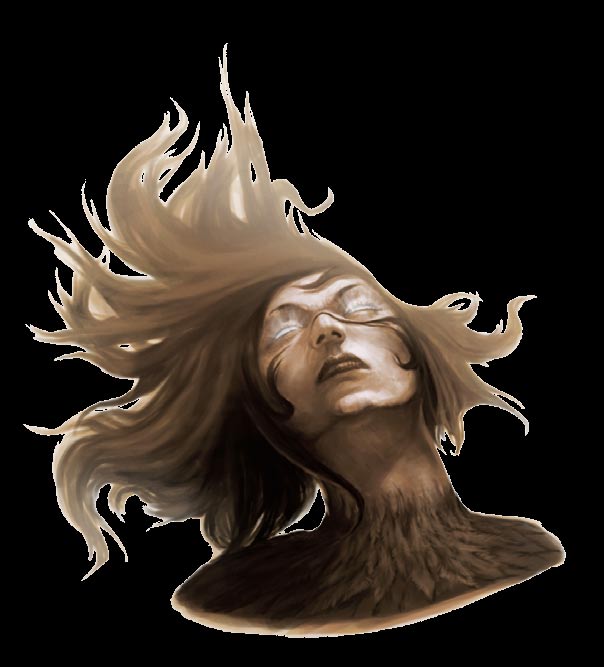
Oh, you’re not done yet.  A lot of the extracted images have black backgrounds.  Don’t know why.  I use the granddaddy of all free graphics programs, GIMP, to fix that.  It’s like Photoshop but free (available on Windows and Linux).  Anyway, you pull in an image that looks like this:

Void Images-500

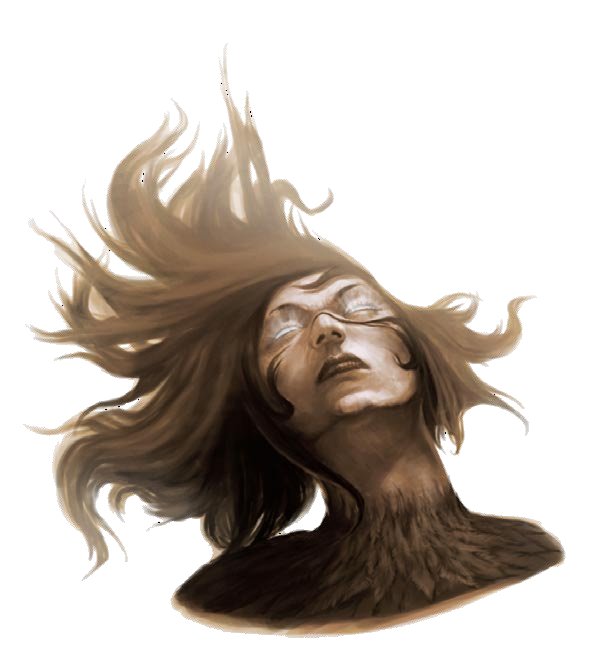
And then you use the fuzzy select tool (magic wand) to select all the black and hit delete.  Play with the threshold to get as much of the black without getting any of the main image.  You may have to go select other black subregions (like the ones between clumps of hair in this case).  Clean up stray black pixels with the eraser.  Quickly you get:

Void Images-500Perfect.  I then slap them into Word, add a caption, and print.  I like to put it in landscape and use multiple columns, so I get 2-3 vertical strips when cut.

It’s a bit of work but generally you only have to do it once per adventure, and you get to reuse the NPCs a lot. Heck, once the Bestiary is out I’ll make one for each monster and those will get loads of use.

Sometimes you can do a quicker capture of one or two things simply by alt-print screening the Acrobat window, tossing into Microsoft Paint, and cleaning it up. You can also use the same general approach to make paper minis.

Anyway, power tips from the rogue’s gallery are welcome… This process is a bit involved and I bet there’s ways to do it in a more streamlined way.

I wish companies would provide galleries – a zip of jpegs, or at least an easy to consume PDF appendix.  All the beautiful art is getting seen only by the GM 90% of the time.  And having the image handouts, paper minis, etc. adds so much to the usefulness of the product.  And it’s not like there’s a reason to protect the stuff; you can get it if you want it but of course you’d expect to get in trouble if you reused it illegally in a product or whatever.

Using Images As Visual Aids In Your Game

I buy a lot of PDFs, especially the Paizo Adventure Paths where I get the PDF free with the book for being a subscriber.  I have taken to making a lot of printouts as props for my game.

It’s a shame for the players never to see the beautiful character art for the NPCs.  Or else you have to fold the book over, hand it around, and tell them “Don’t look at the stats on the same page!”  We’ve done that, and it’s time-consuming, sometimes hard to see when the DM just waves the picture around…

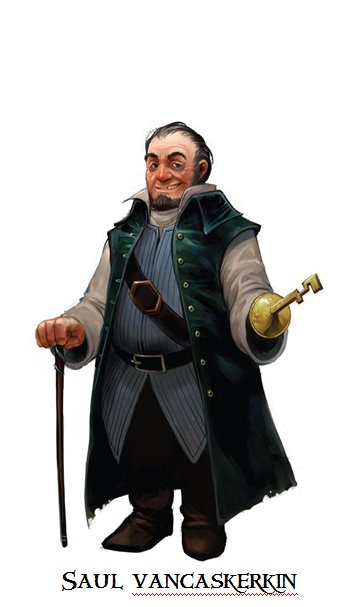
Also, I get a lot of “How do you spell that weird character name?!?”  So I’ve cut to the chase, and before a game session I create a bunch of printed strips that I can fasten to the outside of my GM screen with binder clips (bulldog clips to you Brits).  It’s sweet – when the party meets their new buddy Saul from the Second Darkness adventure Shadow in the Sky, and I whip this out and clip it to the screen:

Saul

Then in later scenes, I clip whoever’s present to the screen.  It provides great visual cues of who they are talking to and what their name is, cutting down on the “Tell…  Sully, or Slim or whatever… that we accept!” And too often PCs forget NPCs that are even in their party.  Have you ever had a PC group say, two combats later, “Oh yeah, what about your follower Gerald?  I guess he’s been tending the horses or something.”  Out of sight, out of mind.  Even if you don’t have images, at least print out the names and post them up.  (As an aside, we find ourselves doing this at work for people on conference calls – it makes it easier to remember them and incorporate them into the meeting.)

In many published adventures, there’s images for the vast majority of the important NPCs, and when there’s not, Google Image Search comes to the rescue.  “I need a half-0rc wizard.   Hmmm… <types “half-orc wizard” into Google Image Search>  There we go, the first result!”

Now, there aren’t *that* many easily findable images online.  So this may not work forever, but certainly is enough for important NPCs.  And if you make a habit of ripping them you can have a library of ready-for-home-use images.  You can probably reuse them judiciously in other campaigns.

Extracting and preparing them for use isn’t as easy as it could be.  Next time, tips and tools for preparing these little beauties.

I Like Random Generators

As I prepare to unleash my PCs on a new city tomorrow, I am prepping up a storm.  I hate being caught short without NPC names and descriptions.  Luckily, there’s a lot of nice random generators out there that can provide you with an invaluable list of a dozen or so ready to go people.  Then, you just pull the one out of the top five or so that seems most applicable to the situation, whenever the PCs grab some random bar patron/messenger/guild thief/whatnot aside and you want them to be more than a stock nameless/faceless prop.

I’m using the Seventh Sanctum description generator and a Yet Another Fantasy Name Generator, freely mixing and matching for first and last names.  In short order, I have a list of potential NPCs like:

Angborn D’Evrona

This serious gentleman has large eyes the color of blue tropical waters. His luxurious, straight, brown hair is worn in a style that reminds you of a fluttering flag. He has a slender build. His skin is china-white. He has small hands. His wardrobe is sexy, and is completely gray.

Now, they do start sounding weirdly the same, so you have to finesse them in use, but it’s a great starting point that saves me thirty seconds of trying to remember some guy I ran into at the grocery yesterday to use as a good NPC description starting point (though that’s also a good exercise; over a week note down your first impressions of people you run across for later use…).

As a second pass, I use Chris Pound’s name generator to get some epithets to sprinkle in, and edit the descriptions to include styles it clearly doesn’t have (e.g. people have hair or are bald, but there’s no balding/thinning people, so I edit one of the bald guys to be partway…)  But what if a couple of these guys end up needing stats?  Well, Myth Weavers has a random NPC stat block generator.  I throw in a second level male rogue, and get:

Tahir, male human Rog2:  CR 2; Size M (5 ft., 10 in. tall);
HD 2d6+4; hp 16; Init +2; Spd 30 ft.; AC 12; Attack +2
melee, or +3 ranged; SV Fort +2, Ref +5, Will +2; AL LE; Str
12, Dex 15, Con 14, Int 10, Wis 15, Cha 8.

Languages Spoken:  Common.

Skills and feats:  Appraise +2, Decipher Script +3, Disable
Device +2, Disguise +4, Gather Information +4, Hide +6,
Intimidate +3, Knowledge (Local) +3, Listen +4, Move
Silently +7, Sense Motive +6, Spot +9, Use Magic Device +2;
Alertness, [Evasion], Weapon Finesse.

Possessions:  2,000 gp  in gear.

Primary motivation: Boredom. The character has no other
reason than their life is otherwise uninteresting.

Secondary motivation: A deep hatred of the Evil. The
character's hate runs deep, and dominates their personality.

Recent Past: The character has been visting a friend in
Verbobonc.

Helpful!  Obviously there are little bits to change.  But there are great bits too; sometimes random generation is awesomely wise.  This guy is LE but is motivated by a hatred of evil!  That’s a great character hook, an interesting “I’m not evil, I just use these harsh methods to combat true evil” thing.

I want the perfect Pathfinder random generator.  Pathfinder, and Golarion, are so new there’s not really good generators tuned for their ethnicities and suchlike – specifically Chelaxian names and descriptions, specifically Varisian, et al.  And all these generators do one thing and not the other – some do good names, some do good stats, some do good descriptions, some do good personalities – but none do more than 1-2 of those at a time.

My wish list:

  • Support Golarion (and other) ethnicity naming schemes.
  • Support Golarion (and other) ethnically tuned descriptions.
  • Support Golarion (and other) locations – for example, we know the general racial/ethnic makeup in Taldor, so let me roll a random Taldan!
  • Support Pathfinder (and other) stats
  • Do name (including epithets), stats, description, and personality.
  • Let me fix anything I want and then randomize anything I want.  If I don’t want to pick race, roll it for me.  If I just know I need a redhead, or a female rogue, or someone named “Bart,” pull the rest.
  • Let me do a little multiple choice – often a randomly generated NPC has bits of “bleah” in them.  Gen maybe 5 choices for each field into a popdown, and if I don’t like something I have a quick-pick to modify.

Eighth Alternity “The Lighthouse” Session Summary Posted

Eighth Session (14 page pdf) – We return from a six-week hiatus to our Alternity-based campaign aboard the space station Lighthouse!  First, half the players were gone, then the GM was, but now we’re back on track.

Back on the Lighthouse, a gambling scam leads into a mystery.  The hot naked chick from Session 1 is back, and is accused of murder and sabotage!  Needless to say, we all vie to prove her innocence.  Cops!  Aliens!  Spies!  Massage parlors!  All we’re missing is Lennie Briscoe.  WE MISS YOU JERRY!!!

The gambling tournament was run by the GM completely off the cuff.  It was fun, though a bit anticlimactic when we all washed out.

I want to brag on myself about our escape plan after robbing the gamblers.  I read the Lighthouse supplement way back when.  So were in this massage parlor playing cards, and the pirate captain lady came up and started talking about stealing the money – and I totally had this flash from the past and asked, “Wasn’t there some massage parlor on the Lighthouse that has a hidden airlock in it?  Is this the one?”  Well, it was.  “Hey, baby, how about you get someone from your ship to bring some spacesuits over to this airlock.”  Ding, automatic escape plan!  All the other players looked at me like “Where the hell did you pull that out from?!?”  Setting details FTW!

Then the murder mystery was fun.  Though when Chris (Rokk Tressor) theorized that someone had just incinerated a piece of the alien chick to put her DNA at the scene and was really rendering her, Paul (the GM) replied, “No, but that would be a better plot than this one!”  We’re happy Angela Quinn is back, we really enjoyed that first adventure where we were motorboating around Bluefall with her.

Oh, and we’ve levelled up – check out my warlion at level 5 and the Captain at level 4!

Reavers on the Seas of Fate – Third Session Summary

Our aspiring pirates get their first taste of honest ship-to-ship combat in the third installment of our Pathfinder campaign, Reavers on the Seas of Fate – “Water Stop.”

Third Session (12 page pdf) – The crew of the Albers goes foraging on an island to replenish their stores, and comes across some escaped slaves.  Of course, the Chelaxian naval frigate bearing their former owner arrives shortly thereafter.  Just as they discover a goblin pirate ship!  It’s hot three-way action in a naval boarding action.  And then it’s off to Riddleport!

This was a stretch session.  I had planned for them to get to Riddleport and get into that this session, but the character who has lived in Riddleport and has most of the hooks for them wasn’t going to be there.  So I figured I could expand the travel part enough to fill a session.

Leafing through some random supplements, I found a couple things that struck a chord.  In WotC’s Stormwrack, there is an adventure called “The Sable Drake,” basically an encounter with a goblin pirate ship.  I had thrown some canoes full of goblins at the PCs last time, supposing they came from a village on the nearby island.  By converting those to goblins on two ship’s boats from the Sable Drake, it was a lead-in.  Then in Atlas Games’ En Route II: By Land Or By Sea, there’s an encounter called “Water Stop” detailing some escaped slaves hiding on an island; the PCs meet them and then their old master shows up looking for them.  This was perfect; I wanted to start pulling in elements from PCs’ backgrounds, and most of them have a beef against the Chelaxians.  Ox had been the slave of Captain Marcellano, a Chelish seafarer.  Thus I mixed the two together.

It wasn’t too hard to convince them to go onto the island and poke around; they thought maybe the goblins came from there and they’d get to kick some more ass.  They came across the slaves and managed not to kill them (the way the encounter’s written is that the poorly armed commoner-type slaves surround the PCs and try to get them to surrender to figure out if they’re likely to rat them out; somewhat dangerous in that often PCs take any manner of threat as an invitation to maximum overkill).  The slaves tell them about a “weird black ship” in a hidden cove and then the Chelaxian Navy ship Raptor appears and approaches the Albers to see if they have seen some missing slaves.  Soon, they’re both going after the goblin ship, who the PCs finger as having drug off a bunch of escaped-slave looking people.

Really, the tough part about all this was that in Golarion, goblins are all total meatheads.  It was hard to believe they could pilot a ship, even with a wererat captain and a handful of adepts.  But hey, you work with what you’re given.  I changed them substantially from the “leet ship” in Stormwrack to a barely actionable converted fishing ship.

In the end, everything worked out for the PCs and the slaves.  The PCs hoped that the goblins would whittle down the Chelaxian marines enough that they could take them; they were quickly disabused of that – one of the things I wanted to get across before they took  up their future life of piracy is that the Chelaxian navy is no one to screw with. They were pretty sober as the goblin ship took three massive broadsides and sank to the bottom.

The noble was Marcello Marcellano, the son of the guy who owned Ox.  I expected him to go to greater lengths to try to kill him, but he played it cool.  A shame, I built a pretty good 4th level swashbuckler using the new class from Tome of Secrets (Adamant Entertainment) and the duelist feats etc. from Way of the Duel (Sinister Adventures).

They went back and started diving the goblin ship for loot…  It was funny, they encountered a reefclaw and after beating it all borked their Knowledge: Nature checks so that they were “sure those things live in large colonies!”  (They’re solitary).  They made the checks in the open and came up with the alternate interpretation themselves.

Selene, Vincenz, and Thalios Dondrel son of Mordekai are now at large in Riddleport as well, so I’ll have some good NPCs the PCs are very familiar with to use.  Next session’s based on Pulp Fiction!

Request for Comment: Hero Points

Or whatever you want to call them  – Action Points, Fate Points, Karma Points, Plot Points, et cetera.  For reference here’s a good but somewhat dated summary of a bunch of hero point mechanics by John H. Kim.

Here’s the deal.  I want to use something like this for my new Pathfinder campaign.  We’ve been pretty constantly using the Eberron “Action Point” mechanic (Eberron Campaign Setting, p.45) in all our group’s campaigns since we saw it.  You get 5 + 1/2 character levels of them, and they let you add 1d6 (or best of multiple d6 at high levels) to a roll before you know whether it’s successful or not.  They work pretty well.  But I’ve begun to be dissatisfied with them.

I noticed it some in Rise of the Runelords and even more in Curse of the Crimson Throne that we’d end a level with a lot of action points left over.  There were a couple reasons.

1.  You would hoard them “just in case.”  This was somewhat mitigated by them refreshing every level, but you didn’t know when you were going to level.

2.  They didn’t do all that much – you wouldn’t use them unless you were ultra desperate or thought you were within 3 points of the DC you needed.  As levels get higher and numbers range more widely, a lot of the time you knew there was no point in using the action point on a given miss.

3.  Because of the inconsistency of the core D&D mechanic in terms of what is a d20 roll you are making and what isn’t, you could use them to make a save but not to not get hit in combat, so their utility in saving your bacon was reduced.  Though you can use an action point to stabilize when at negative hit points, again as levels get high it’s rarer a shot lands you in that magic 10 point range; it’s more likely to overkill you by like 30 points when it comes.  D&D 3.5e number scaling past level 10 is a cruel mistress.

4.  The APs tried to give hero points of their own, like Crimson Throne had Harrow Points that gave bonuses to a different stat with each chapter.  This was frustrating in and of itself when the stat was a poor match – as a priest, fighter, and ranger was the party most of the time, I was the only one to use the Wis and Cha boosts.  But it also created a “too many different boost points” problem and they got totally forgotten most of the time.

5.  It was a buzzkill when you used one and still didn’t make the roll.

We’re also playing Alternity, which has Last Resort Points.  These points are better in some ways.  They’re worse in that you get from 0-2 of them and they don’t regenerate with level, you have to buy more with XP, which means they’re too scarce.  They’re much better in that they just flat turn a failure into a success (or boost a success to a higher level of success).

Also, some systems (like PDQ Sharp’s Style Dice) let you use such points to make actual narrative plot changes with points.  “A Chelish warship appears on the horizon!”  “Our old ally Vincenz shows up!”  “The dungeon passage collapses!”

So there’s a couple different axes that a hero point mechanic can work on.

  • How do you get them/how do they regenerate?  (Buy with XP, when you roll a crit, when you roll a fumble, when you do something cool, when you act according to some character trait, when you level, every game session, per adventure)
  • What can they do?  (Reroll, small fixed bonus to roll, small variable bonus to roll, large fixed or variable bonus, automatic success level upgrade, change plot/world, activate powerz, make a save/get missed/soak damage, get init or an extra action)
  • When can you use them?  (Before you roll, after you roll but before you determine the result, after you determine the result)
  • How many does someone get and how often can they use them (anytime, once per scene, once per session, something else)

Here’s what I’m thinking about doing.

First, I want the points to “do more” – ideally fully turn a miss into a hit or whatnot, not add on a small bonus.  Seems to me that the mechanic’s not worth having unless it does this much; otherwise it’s a lot of fiddliness (and worse, a breaking out of immersion) without enough punch to justify it.  So one option is that the points are fairly rare, but can:

  • Turn a miss into a hit
  • Turn a hit into a crit
  • Turn a hit into a miss (usually, if you’re the one getting hit)
  • Turn a crit into a hit (same)
  • Make a save
  • Make a target fail their save (maybe…  but maybe not.  With save-or-dies seems too powerful.  Maybe make a target reroll their save.)
  • Bypass SR
  • Override a bad condition (possessed, feared, paralyzed, etc.) for a round
  • Otherwise “save your damn life” somehow

However, one of our group has an interesting alternate proposal – that the points go up in efficacy as you use them.  First point you use is a +1 (or -1 on an opponent’s roll).  Second point, +2.  And so on.  This is a clever way to both ramp up effectiveness over time (I’m neutral there) and to discourage hoarding (I’m very on board with that).  It does mean that eventually the points become worth +20 or more, at worst that reduces to auto fail/success but in higher level 3.5e play it may still not be enough sometimes. It is a little more fiddly though, they have to be strongly paced at about two per level.

I’d also like them to be usable to make narrative changes, with DM oversight.  Any kind of hero point is already stepping outside the simulation for an explicitly narrative concern, so in for a penny, in for a pound, I figure.

In general you should give them for behavior you want to promote.  I don’t really like giving them for crits or whatnot, that seems too random and also generates undesirable interactions with crit feats.  I’m doing slow advancement in this campaign, so there’ll probably be a couple adventures per level.  I plan to call them “Infamy Points” to match the pirate theme.  Perhaps give one per level and one per adventure, to semi-reflect the character becoming more bad ass and feared and… infamous.  Maybe bonus points whenever anyone does something spectacular that could rightfully be said to raise their infamy level.

I’m also considering having the Infamy Point total be used as a bonus to certain Intimidate/Bluff/Diplomacy rolls as a kind of raw fame and deadliness bonus, though the problem is that if you get 2-3 per level that bonus gets out of control.  Maybe a bonus equal to unused Infamy Points?

What do all of you think?  Do you use any kind of hero point mechanic?  Do you like lots of them with wimpy bonuses, or fewer with more guaranteed results?  Have any clever ideas for me?