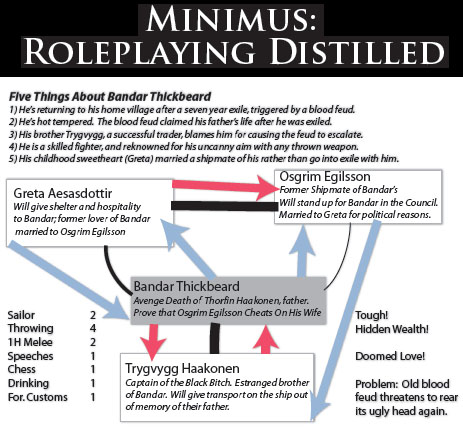
 I was asking for better ways to track PC/NPC relationships in my game on RPG Stack Exchange and Brian brought up the free game Minimus, which is basically an example of social network mapping for an RPG. This reminded me of the person-to-person tracking diagrams I’ve seen in books on intelligence work, it’s a common HUMINT technique. But then I started looking for good tools to do it and started coming up short..
 There’s super complicated open source BS like graphviz – not something I want to deal with as part of my hobby. “Do it in R,” suggested someone who clearly wanted a punch in the nose. Then I thought maybe I could use a virtual corkboard like corkboard.me or Spaaze but those don’t even have basic “pins and yarn” kind of ways to represent relations. Then I looked at online graphing tools like yED and diagram.ly, which are fine but I already own Visio. That has a lot of fiddling around with layout for the desired use. I’m hoping for something a little more purpose built (like a HUMINT tool) that could be used with maximal ease by a GM.
Such things are also called sociograms, and are used in social media (all examples I could find sucked) and sometimes to map out character relationships in fiction, which is very much where I’m going with it.

I envision just entering names to create cards/whatnot and then create positive/negative relationships (color?) of various intensity (thickness?) connecting them, with some explanatory labels. Perhaps being able to assign them to a location (like the village they live in) and assigning other affiliation (guild, organization, etc. where you could perhaps get the aggregate opinion of “those guildmembers to that PC” or “that person to the party in general” ) would be nice. In a simple UI that is editable while also trying to run a darn game, and lets me quickly look up what this person thinks about the PCs (or if maybe they know someone that knows the PCs…).
I know this has to exist, it’s what intelligence folks do all day… I’m happy to pay a consumer amount of money for something if it hits my needs exactly. Anyone seen anything that would do the trick?
Seems like a simple enough “yarn and cards” solution would be a nice virtual replacement for all those wall-covering “find the serial killer” big boards in crime movies… And on the other hand, to construct lovely virtual stalker shrines to Justin Bieber or whoever… WHY DOES THIS NOT EXIST?!?!?!?
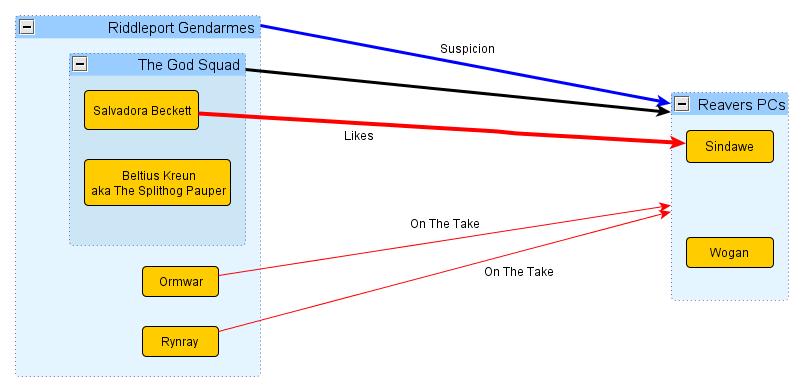
Here’s an example of what one small part of a relationship diagram for our Reavers campaign might look like… The Gendarmes in general are quite suspicious of the group, but they have a better relationship with the God Squad and Salvadora is specifically fond of Sindawe… I did it in yED, and had to spend 75% of the time fooling with layout.
Edit: Based on recommendations in the comments, I tried out The Brain. Here’s my results:
 It’s OK – it does let me do color/width of the lines – but the automatic layout is pretty bad, it’s really hard to even see who all is linked to the ship (the alternate outline view is even worse). Everything I click on, it gives me a weird curvy-lined mess where it’s hard to even see what all is linked to the central thought; the line routing is Godawful. I used to work for the company that makes LabVIEW, which has to do a similar task, and I know it’s quite hard, but… It somewhat hits my requirements, but in the end, I’m not sure it’s compelling and easy enough that I’ll use it for this purpose.