Category Archives: talk

Pathfinder MMO Sounding Not Too Thrilling

More info is coming out on the new Pathfinder MMO being worked on by Goblinworks, an outfit with Ryan Dancey, Lisa Stevens, and Mark Kalmes.

Sadly, it’s not thrilling me.  I’d like to like it, I like those people and Paizo and Golarion and Pathfinder but it doesn’t seem compelling.  Connect the dots with me.

They are fanatically against making a “themepark” MMO, which sounds to me like a code word for “a MMO we have to make content for.” Eh, OK.

It’s set in Golarion, in the River Kingdoms, which is good.  But they contend that the normal levelling mechanic that Pathfinder (and most MMOs) use is no good and they want to use the EVE Online model.  For those unfamiliar with EVE, you get better at skills in realtime (not game time), meaning that those who got into the game first end up being the best.

This is combined with their plan to not let many people into the game, to dribble it in stages, 4500 players a month. So those first people are guaranteed to always be better, have better skills, etc. than anyone who comes later, no matter how much they play or kill or earn or whatever.

This sucks and it’s why none of my friends played EVE Online for more than a month. In their first blog post they say they want to avoid the spike and crash pattern, but the fix to that is to make sure anyone joining after start gets a progressively worse deal? Sounds to me like the “little bump then whimper” pattern.

So then also, it’s a PVP game, and when someone kills you they can loot your corpse.  They don’t get everything, but what they don’t get is destroyed so you still lose everything except what you had equipped.

So goody, you get to act out a paranoid fantasy, fanatically avoiding other people because it’s likely that they are part of a huge roving Lord Humongous band out to kill you and loot your corpse. That’s some bullshit right there. There’s a bounty system and guards in towns to slightly mitigate this but it’s really pretty awful.

Dancey came onto the Paizo forums to defend this as “not being theme parkey” and “well you just have to be in a party all the time, soloing is for WoW lovers” and some of the fanboys are behind them “catering to the niche” and “not selling out” but… really? Great, I can only do things rolling 12 deep for self defense and then also competing with everyone I’m with for resources.  Forget it, let’s just hunt PCs!

They claim to be against griefing but this basically sounds like a custom recipe for a big non-fun game.
D&D 5e Coming Along… Nicely?

I think it’s no surprise to anyone that WotC has burned every bit of their credibility with me over 4e. And I am a little dubious about the “multiple coexisting levels of complexity” plan they have espoused for 5e.

But so far what I’m hearing about the specific for 5e are really positive. At DDXP they had some seminars, let’s evaluate what they’re saying!

Class Design

The Good

  • Taking Vancian magic back to casters from everyone – in other words, removing “dailies” and crap from fighters
  • Not using so much “jargon” like the power keywords in favor of natural language (thank you!!!)
  • Quick chargen
  • Power not escalating as quickly, for example the fighter BAB not going up so fast, instead just getting more other options, so iconic monsters like ogres are interesting longer
  • No mandatory magic item economy!!!  YAY!
  • Including all the PHB1 classes from all editions, 1-4
  • Easy 3e style multiclassing, which obviates the need for too many variant classes that should just be multiclassing (like every gish ever).

The Questionable

  • Although they are talking about balancing classes not strictly on DPS, which is great – like if the bard does 70% of the damage of a fighter, they get charm and stuff as compensation – but those sample percentages still seem to say that everyone needs to be a combat guy.  That’s not very 1e.

The Bad

  • Nothing? I have to admit except for me being dubious about the true effectiveness of mixing various complexity levels in one game I don’t see anything here that makes me crap myself in rage, which is more than any 2 pages of the 4e PHB can say.

Skills & Ability Scores

The Good

  • Removing rolls in favor of “yeah, your stat is high enough, you’re good”
  • Use of stat checks for saves
  • 4d6 drop lowest as basic stat gen method
  • skills as smaller tweaks to ability scores
  • interaction first, checks come second
  • No set skill list, something can give you +2 to opening jars
  • non-adventuring skills sound like they work kinda like 2e NWPs, which is good
  • Bringing the Great Wheel cosmology back
  • Maybe stat boosting magic, but with caps
  • Silver standard
  • Wider categories of weapon specialization (e.g. axes, not “battleaxe”)
  • Less scaling while leveling
  • Quick prep
  • More power to the DM
  • grittier low levels (not quite 1e, but not superheroes like 4e)
  • skill challenges should “die in a fire” because they mess up the narrative
  • grid-based combat optional in core books

The Questionable

  • Both race and class give you a stat bump, which is fine in the abstract but I worry about it feeding the bad, below.
  • Themes.  They seem to be focusing a lot on these new themes, which is fine, kinda like 2e kits which I liked – but I worry they’re going to put too much power in them (some 2e kits were quite unbalanced too). But later they talk about them limiting class sprawl which is nice.

The Bad

  • I’m worried about the intense stat dependency.  Stat min-maxing wasn’t so important in 1e but it’s all super important in 3e and that sucks. It makes people cry about rolling stats and makes them too min-maxable as they stack their race/class/point buy/etc on top to give themselves +5 to hit and 20 dps at first level.
  • NPCs not being built like PCs. That’s 4e-ism and it sucks.
  • Still talking about their “virtual table” and hedging about PDFs.  Sigh. They’ll never write good software but they need to wake up and join the 2000’s in terms of digital content.

Summary

So… Awesome? Bringing simulation back to the game? Making sure you can do iconic 1e things? I have to admit, I am not convinced they can wean themselves off rules-heavy and take it to more of a 2e-ish approach. But I like 90% of what they’re saying!  If they can restrain their impulse to write 500 pages of fucking rules, and keep the stat dependency in check so there’s not the big hassle of min-maxing and stat dumping, this has potential. Maybe even potential to be better than Pathfinder – I love Pathfinder, their flavor and art and everything is nice, but  it suffers from its 3.5e legacy of being so rules heavy – people try “cap at level six” variants like E6 to try to avoid the worst of the power inflation and craziness.  Will 5e be the best yet? I still am not to the point where I’d bet money on it, but it seems like WotC has learned the lesson that Microsoft learned with Windows Vista – giving people what you want them to have instead of what they want never works out well for you.

Jade Regent Character Creation Rules

Here’s the rules we are using for our Jade Regent campaign from our GM Paul, with some explanations from me.

Allowed Rulebooks

APG is in, the Ultimate books are out (although during the campaign you will have the chance to pick up Japanese-style weapons and maybe even to get trained for levels in ninja or samurai).  [Ed: Paizo has been overwhelming us with new rules over the last  year, and frankly a lot of it isn’t well balanced.  We haven’t been allowing Ultimate Magic or Ultimate Combat in any of our games so far. In my Reavers campaign it’s core only, anything else by specific GM inclusion or asking me.]

Chargen Methods

Stats are 4d6 drop the lowest, arrange as you will. If your stat block sucks you may use the point-buy method, this time around I’m setting point-buy at High Fantasy, 20 points. Standard races are all in, but if you want something other than that let me know and we’ll talk about it. No evil races or monster races will be allowed though.
Evil characters are not a good fit for this particular campaign.

FATE Aspects and FATE Points

Aspects! Please write 3 aspects for your character before you reach the gaming table, we will create 2 more for each character when we get together for the first session. The first three should be as follows:The first aspect should be a description of your character’s archetype, such as “Half-orc sorcerer in tune with nature’s fury”, “Physically perfectionist elven wizard”, or “Charming Sunderer”. Try to make sure your character’s core competency makes it into your first aspect.

The second aspect should describe your character’s trouble, the main weakness or stumbling block that keeps causing trouble for the character. It can be a personality trait that causes trouble for the character, or it can be something bad that just keeps happening to him for some inexplicable reason. Examples: “Why did it have to be fairies?”, “Vengeful over hurt pride”, “Family Man”.

For the third aspect, think about what motivates your character, what shaped him to become who he is, and what pushed him to the life of an adventurer. The best aspects are ones that can be used both for or against your character. ex. “Must protect my friends at all costs”, “People are not always what they seem”, “I Heart Forbidden Lore”, “There must be some way I can find a profit from this…”

Each character will get 3 fate points. When you level up, they will be refreshed. You can get more fate points whenever your character suffers due to one of his aspects (depending on the situation, this could result in failed skill rolls, damage, or just social humiliation). Spending a fate point allows you to either reroll the d20 roll you just made, or add +4 to it, your choice, but you can only spend a fate point when one of your aspects applies to the roll you’re making. For instance, “I Heart Forbidden Lore” could help you if you’re doing research or trying to recall facts about some kind of demonic monster, but it wouldn’t help you on a to-hit roll against a goblin. Regardless of aspects, a fate point can always be spent to stabilize you if you’re dying.

Character Advancement

There will be no XP awarded or spent.  Level advancement will be declared by the GM when it needs to happen. [Ed: XP are frankly one of the most annoying things to deal with – useless bookkeeping that promotes uninteresting behavior. None of our campaigns use them.]

Multiclassed Spellcasters

We will use our usual multiclassing house rule for spellcasters.

Badges

We’re not using experience points, but I wanted a mechanism that allowed me to give rewards for completing side-missions. Thus I created the badges; each one can be earned by completing one of the side-missions in the adventure path.

As soon as I introduced them the players started plotting to find a way to collect them all! Besides the pleasure of collecting, they each also get one fate point when the group gets a badge.

Pathfinder Spellcaster Multiclassing House Rule

Our GM Paul’s multiclassing house rule for spellcasters in Pathfinder, in case you find it of use.

The problem: Multiclassing in D&D works fine for the martial characters and skill-based characters, the abilities of the various classes stack together well to make a stronger character. The rules are very punitive for primary spellcasters. None of the spellcasting classes build on each other and none of them stack well with the abilities of any other class. Various fixes have been attempted for this in the game (prestige classes like Mystic Theurge and Eldritch Knight etc., Practiced Spellcaster feat, variant class features, and so on), but they all seem kind of specific and kludgy to me. Why can’t I just make a fighter/sorcerer and have it be effective? These rules are intended to address that.

The rule: To take advantage of this rule, you must have at least one level in a primary spellcasting class (bard, cleric, druid, sorcerer, wizard). For every two class levels you possess that are not in that class, you advance your spells per day, effective caster level, and spells known as if you had advanced one level in the primary class. You do not gain any other benefits (like channel energy, wild shape, extra feats, class powers, etc). However, you may not take your total caster level higher than double what it would otherwise be.

You may use multiple caster classes to feed into each other (a Cleric5/Sorcerer4 would cast as a 7th level cleric and a 6th level sorcerer, but would only have channel energy and domain powers of a 5th level cleric, and bloodline arcana and bloodline powers of a 4th level sorcerer).

Any prestige class that adds caster levels to a primary spellcasting class (such as Arcane Archer or Dragon Disciple) only adds the caster levels specifically listed, you can’t count it (for the class it adds to) for the purposes of this rule.

This rule replaces hybrid classes like Mystic Theurge and feats like Practiced Spellcaster, so those are no longer available.

Examples:
A Fighter2/Cleric3 would cast spells as a 4th level cleric (but channel energy and have the domain powers of a 3rd level cleric).

A Ranger4/Wizard2 would cast spells as a 4th level wizard (but have school powers of a 2nd level wizard). Ranger is not a primary spellcasting class, so ranger spells would be unaffected.

A Fighter6/Druid1 would cast spells as a 2nd level druid (but have class features as a 1st level druid), because you can only double caster level at most.

A Paladin4/Sorcerer1/DragonDisciple2 (Dragon Disciple adds +1 caster level to Sorcerer) would cast as a 4th level sorcerer (1 for the sorcerer level + 1 for Dragon Disciple + 2 for the 4 paladin levels). Because Dragon Disciple adds to the bloodline abilities, the character would have bloodline powers as a 3rd level sorcerer. The paladin spells would still be cast as a 4th level paladin.

A Rogue3/Sorcerer1/Wizard2/ArcaneTrickster2 (Arcane Trickster adds +2 caster levels to sorcerer) casts as a Sorcerer5 (1 from sorcerer + 2 from Arcane Trickster +2 from the other 5 levels) and as a Wizard4 (2 from wizard + 3 from the other 6 levels, but maxes out at 4 because you can only double the caster level).

I Need A Relationship Mapping Tool

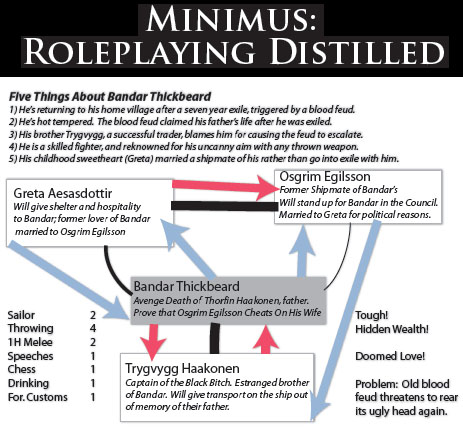
I was asking for better ways to track PC/NPC relationships in my game on RPG Stack Exchange and Brian brought up the free game Minimus, which is basically an example of social network mapping for an RPG.  This reminded me of the person-to-person tracking diagrams I’ve seen in books on intelligence work, it’s a common HUMINT technique. But then I started looking for good tools to do it and started coming up short..

There’s super complicated open source BS like graphviz – not something I want to deal with as part of my hobby. “Do it in R,” suggested someone who clearly wanted a punch in the nose. Then I thought maybe I could use a virtual corkboard like corkboard.me or  Spaaze but those don’t even have basic “pins and yarn” kind of ways to represent relations. Then I looked at online graphing tools like yED and diagram.ly, which are fine but I already own Visio. That has a lot of fiddling around with layout for the desired use. I’m hoping for something a little more purpose built (like a HUMINT tool) that could be used with maximal ease by a GM.

Such things are also called sociograms, and are used in social media (all examples I could find sucked) and sometimes to map out character relationships in fiction, which is very much where I’m going with it.

I envision just entering names to create cards/whatnot and then create positive/negative relationships (color?) of various intensity (thickness?) connecting them, with some explanatory labels.  Perhaps being able to assign them to a location (like the village they live in) and assigning other affiliation (guild, organization, etc. where you could perhaps get the aggregate opinion of “those guildmembers to that PC” or “that person to the party in general” ) would be nice.  In a simple UI that is editable while also trying to run a darn game, and lets me quickly look up what this person thinks about the PCs (or if maybe they know someone that knows the PCs…).

I know this has to exist, it’s what intelligence folks do all day… I’m happy to pay a consumer amount of money for something if it hits my needs exactly. Anyone seen anything that would do the trick?

Seems like a simple enough “yarn and cards” solution would be a nice virtual replacement for all those wall-covering “find the serial killer” big boards in crime movies… And on the other hand, to construct lovely virtual stalker shrines to Justin Bieber or whoever… WHY DOES THIS NOT EXIST?!?!?!?

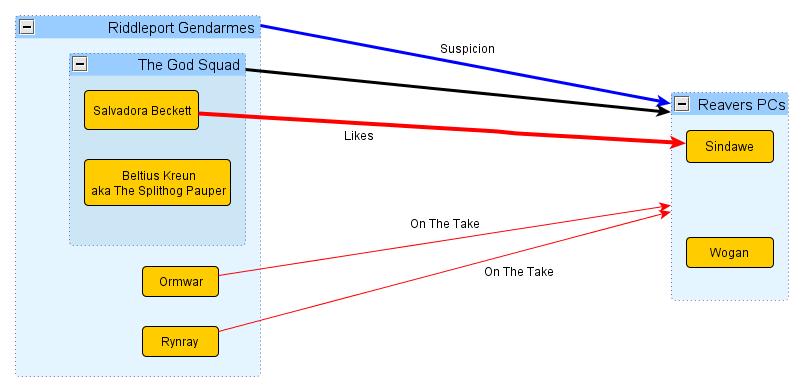
Here’s an example of what one small part of a relationship diagram for our Reavers campaign might look like… The Gendarmes in general are quite suspicious of the group, but they have a better relationship with the God Squad and Salvadora is specifically fond of Sindawe… I did it in yED, and had to spend 75% of the time fooling with layout.

Edit: Based on recommendations in the comments, I tried out The Brain.  Here’s my results:

It’s OK – it does let me do color/width of the lines – but the automatic layout is pretty bad, it’s really hard to even see who all is linked to the ship (the alternate outline view is even worse). Everything I click on, it gives me a weird curvy-lined mess where it’s hard to even see what all is linked to the central thought; the line routing is Godawful. I used to work for the company that makes LabVIEW, which has to do a similar task, and I know it’s quite hard, but… It somewhat hits my requirements, but in the end, I’m not sure it’s compelling and easy enough that I’ll use it for this purpose.

Jade Regent

Our group finished off the epic three-year Alternity campaign, The Lighthouse, that Paul was running for us and then discussed what to do next. The result is more Pathfinder – we are taking on the Jade Regent Adventure Path! Paul ran Rise of the Runelords and Curse of the Crimson Throne APs for us and they were excellent so we’re happy to get back into another.

Here’s our Jade Regent page, I’ll post characters and session summaries and whatnot there.

The upshot is that we are novice adventurers in Sandpoint (the same town Rise of the Runelords started in) and, because of our relationships with some important NPCs, end up taking a caravan north, through Ulfen (Viking) lands and across the Crown of the World (North Pole) to end up in Tian Xia (Asia)! Sounds like fun.

More later, I’m off to the game!

Wizards to Reprint 1e AD&D

Interesting!   I logged on to RPG Stack Exchange chat this morning and people were talking about this WotC release indicating that they’ll be reprinting and selling copies of the AD&D 1e books, on sale as of April 17.

That’s cool but surprising. The clarifications coming out of Seattle on the “multiple edition support” of D&D 5e have started to make it clear they won’t really support old versions per se, just let you craft your game to be kinda like them. Is it to judge interest in 1e/old school gaming? That’s hard – I mean, I still have my 1e books, and not to mention all the retroclones are mostly-free.

Now this reminds me of a more inspired idea Zak had which was to reprint all the 1e adventures in big coffee table books, which I would throw money at with no questions. (Adventure content is really more valuable than old rules content – something which WotC needs to wrap its head around; it’s why Paizo is beating them like red-headed stepchildren.)

Also, the money from this sale goes to the Gygax statue? I reckon that’s a good mix of being nice and sucking up to the community… It’s interesting that Hasbro signed off on that. It made me think this was fake until I could find the original on the Wizards site.

Well, let’s see what this means! I am I think understandably skeptical of any step from Wizards that seems beneficial and philanthropic, but I’m happy to be proven wrong.

State of the RPG Union: Green Ronin

Chris Pramas from Green Ronin has posted about their 2012 plans.

He doesn’t really say how they’re doing, but I guess it’s fine as they are forging forward with their licensed properties, doing Set 3 for Dragon Age and a bunch of stuff for A Song Of Ice And Fire, including a revised core rulebook to take advantage of the hype from Book 5 and the HBO series. Then besides two more DC Adventures books, they’ll put out some non-licensed Mutants & Masterminds things. That’s the long and short.

Here’s the real problem with all this…

With all of our licensed material, the thing to remember is that we don’t control the approvals process and this can affect our release dates. We do our best and so do our partners but sometimes patience is required.

My perceptions may be colored because I’m not interested in any of those licenses, but it just seems like being tied down 90% to licensed properties is risky – and somewhat less original, content-wise, than my fond remembrances of Green Ronin from the Freeport/M&M 1e days.

Well, good luck to GR anyway, they seem to be thriving.

Taking a Break from the GM Chair

Sometimes you have to take a break from the GM chair to recharge.  Here’s our new interim GM.

All Inclusive D&D 5e?

Well, as you heard recently, D&D 5e (or “D&D Next,” as they are styling it) has been announced. There were hints about how it would be some kind of “includes every version everywhere RPG toolkit!” and Monte Cook confirms both that he’s been working on 5e and that that’s their intent.

The thing is, there’s ways in which I think that’s possible and ways in which I think it’s not. On the one hand, if they return to publishing real content in setting books and adventures, that is somewhat “cross editions” – one of the main weaknesses of the 4e products was that they were useless for anyone not playing 4e, whereas editions 1-3 tend to freely exchange adventures, setting info books, etc.

It is also possible to have different levels of complexity of the same rules.  I actually played around with a game system with three levels of granularity called “The Third Degree” a while back, it was inspired actually by the action movie RPG Feng Shui.  There you had cascaded stats – like you might have Body 5, but below that Str, Con, Mov, and Tgh of varying amounts. For mooks their stat blocks would just say “Bod 5,” and you would use 5 for any sub-stats that came up.  I realized you could maybe please everyone if you had three degrees of complexity of each mechanic. Where it fell down is that you essentially needed technology to be able to print a custom RPG book for each player in the game so that they’d know what level of everything a given campaign was using!

I mean, earlier D&Ds had all kinds of optional rules and also rules not marked as optional but that were so fiddly everyone ignored them (weapon speeds, weapon types vs. armor, declaring actions, and other such lameness). So that sounds difficult but not impossible.

What is impossible is actually unifying 1e, 2e, 3e, PF, and 4e as they stand into a single rules framework.  It just won’t work. There’s too much crufty little crap that is not just “levels of complexity” but “different.” And I think they know this; in Monte’s article he uses circumlocutions like “your 3E-style game”. In fact, he says a 1e-loving player can play in your 3e-style game and ignore the options they don’t like – I think that’s probably overreaching; just having the level of granularity be the campaign is probably about as much that’s achievable. And the GM is going to have to have control.  “You are all starving!” “I ignore the starvation rules, they don’t come in till 3e!” But the real question is, will this really bring the players back in?  “Here, you can play at this level that’s 1e…ish?”

I also worry that their attempt to pander to all versions will make them not really innovate with this game. If all they do is try to glue all the old versions together in some demented Multiverser kind of way, in the end is that compelling? Shouldn’t such a game include a new “5e” as well which is an actual improvement on the game?

Here’s a secret.  We grognards don’t love Pathfinder, and 2e, and 1e (in my preferred order) because they are perfect. There’s a lot of BS and cruft in them. Except for the total nostalgia whores who demand everything be as Gygax originally spit it out because they are into that, the reason we like those old games is the level of hassle they give or don’t give us and the mode of gameplay they promote.

Here’s what I like and dislike about all the editions, let’s see if they can include all the good and remove all the bad.

  • Basic D&D – low hassle, low rules, low character customization (side note – comparing this new toolkit plan to BECMI is largely incorrect;  in BECMI you got newer higher levels added on and a couple rules, but the ruleset didn’t transform or anything.) Lightly handled all styles of play really. I just lump 0e into here because I can’t understand how anyone actually does still like 0e. Very rules light and dungeon/exploration focused.
    I love this edition because it gives you the basics and then gets out of your way and lets you go adventuring.
    I hate this edition because once you’ve played it a while you tend to “want more” though.
  • 1e AD&D – somewhat crufty and arcane, but usually not during combat itself. Low powered, you had to fight hard to stay alive, no level appropriate kid gloves. Exploration focus still. Not much character customization supported by the rules, mainly by personality plus whatever mutation White Plume Mountain inflicted on you. The golden age of the adventure module.
    I love this edition because it is very easy to write a diverse set of adventures for and to house rule.
    I hate this edition because there’s a charming level of wonkiness to the rules, but it’s underlaid by a not charming at all level of cruftiness you need to house rule away.
  • 2e AD&D – not all that different, more of a streamlined 1e (I like it better than 1e), but the supplements and adventures that came out for it promoted more of a storytelling and roleplaying experience. Not as much focus on the dungeon, but kinda like Basic had nods to wilderness, dungeon, city, planar, etc. You were a fraction tougher than in 1e but still weren’t a superhero. Lots more character customization via kits etc. (Those who say kits were unbalanced haven’t played subsequent games – “Oh lordy he gets a +1 to something!” was a big deal back then, but nowadays they all seem like short bus prestige classes.) NWPs provide a very, very loose skill system. (I actually added Perception and Luck stats to my 2e games.) The golden age of the boxed set. TSR adventures were not that good and were often retreads.
    I love this edition because it hits a great midpoint of rules complexity – it has the more rules content of 1e but via THAC0 and other streamlining, makes it less work than 1e to play, but more satisfying over a long time than Basic.
    I hate this edition – well, mainly for historical reasons.  Death of TSR, Lorraine Williams, giant space hamsters, Castle Greyhawk, bad adventures.
  • 3e AD&D – you start off a Billy Badass. 3.5e and Pathfinder cranked that up even more. Lots of character customization, arguably too much. Lots of helpful slash painful rules for everything.  3.0 core I actually really love, but am more ambivalent when you say 3.5 or PF with all the splatbooks. You stopped being able to house rule as much in this version because of how many rules they were and how much they interacted – you kinda had to just allow/disallow things and maybe if you spent a lot of time balancing it, introduce a new prestige class or whatever. Balance became a lot more of a concern in this edition, mainly because with the customization you could have wildly varying power levels at the same character level. More of a combat focus than 2e, especially with all the minis-requiring flanking/AoO/etc rules. The golden age of the adventure module come again, but from all those third party OGL folks. WotC adventures were not that good and often retreads.
    I love this edition because it lets you craft much more detailed and realistic characters, with the multiclassing and feats and all.
    I hate this edition because there are all these damn rules, and your players think it’s their place to grouse when you don’t use them or change them.
  • 4e AD&D – purely tactical combat. Less character customization choice but highly balanced. “I just like moving minis around and playing a board game.” There are actual good changes to the core ruleset in there, but then they layer goofy stuff all over it so that combats are a four hour long exercise in marking tokens with other tokens.
    I hate this edition because it removes nearly everything I enjoy in roleplaying.
    I love this edition because its flat reception has caused Wizards to pull their heads out of their asses and reassess what it is people liked out of D&D in the first place.

Insomniac Monkeys On Crack

Another issue came up in the last session of my Pathfinder campaign – chronic PC impatience.

It happens especially when they go to cities and between adventures. They go into a frenzy of trying to buy and sell and talk to everyone and do everything to the point where I have to start enforcing fatigue rules to get them to stop pounding on people’s doors at 3 AM demanding magic item sales.  Sometimes there is plot related time pressure but often there’s not.

In this campaign, I knew it was happening a lot. Heck, the last huge multisession fight they got into was initiated with Serpent going to visit the Cypher Lodge in the middle of the night and waking people up to demand magic item sales (with no idea that it had been taken over by the forces of evil… He found out quick though). So I tried to give them an out, a friendly (as such things go) local crime figure they’re aligned with (Saul Vancaskerkin from the Second Darkness Adventure Path) offered to take care of buying and selling and whatnot for them.  I reckoned that would get it off our play session plates and let us get to adventure. “Sure!” they said. And then they immediately went out to do it some more! They literally made that deal with Saul at 3 AM, went to bed, woke up, and then demanded of him immediately whether he’d gotten everything on their wishlists yet. When he hadn’t, it was out to kick down doors.

Serpent, and his player really, was getting frustrated. He keeps wanting to sell and or buy his stuff NOW.  Well, I run a fairly realistic game world.  If you want to sell something like that in a four hour span, then like in the real world you’re going to get pawn shop prices. And if you want some specific magic item, you’re not going to be able to find it in that span – especially if you have shitty Diplomacy/Knowledge: Local skills.  I also run fairly low magic so there’s not “magic shops”. I try to reward their persistence with some randomly generated magic stuff that some decent scavenging lets them find some gypsy selling or whatever, but this doesn’t sate their desire for to-spec items. It’s not just buying and selling, it’s anything they end up wanting to do in a city (Get information! Build a criminal empire!), but that’s a handy example I have that shows the syndrome. PC impatience vs. the realistic pace of the world.

Am I being hard-headed? I guess I feel like a lot of this, and I’ve said this out loud to the players, can be elided easily.  Say you are looking for X, let’s all say you loiter around in town for a week, and it’ll probably show up. It doesn’t have to take GAME time, it can be over with in one sentence. But for whatever reason, they don’t want to “let time pass” – every waking hour is spent in high activity mode. And in cases like this, it ends up making things take a lot more game time than a more relaxed approach would.

I understand that’s easy to do in a game – it’s why in many computer games we set our character to “run” by default, why would you want to go somewhere slowly? But it does stretch my (and NPCs’, in my world) patience when the group is a nonstop tornado – trouble in any 24 hour period is practically guaranteed.

It’s not just this group either.  I always laugh when I see con game adventures that are time-based – the PCs arrive at the inn at 5:00, then dinner is at 6:00, the body is discovered at 6:30, and then this big list of things that are supposed to happen after the next 24 hours.  Here’s what really happens: from 6:30 to 7:00 the PCs (insisting on being in combat round time the whole time so that they get the most out of their buff spells) beat, intimidate, interrogate, tie up and/or kill everyone in the whole inn. That’s if they’re good characters and a murder is needed to provoke them of course; otherwise that happens from 5:00 to 5:30 instead.

Of course maybe I’m worrying about it too much – if they didn’t want to waste game screen time on it, they wouldn’t; they’re adults and I’ve explained all the above to them explicitly. And heck, I can’t really claim it’s unrealistic – adventurers in town is just like sailors or cowboys or whatnot; they have a short time to play hard before they head back out on the sea/trail/etc. But it seems to frustrate the players (well, especially the one) because he seems to think it’s unreasonable that he can’t get what he wants quickly.

Comments or ideas? I also posted this as a question on RPG Stack Exchange to see if it garners any good answers.

D&D 5e is Coming!

It’s official! It was obvious from all the Mearls/Cook noise from over there in WotC land, but now the New York Times is reporting that Dungeons & Dragons 5th Edition is planned to be announced by WotC today! They cite the MMO pressure and the split to Pathfinder and muse – as do we all – about whether WotC can bring D&D back together again.

If nothing else, despite its “dwindling market” it’s good news that the NYT considers this part of all the news that’s fit to print!

For those who consider this to be dubious news and part of the Great Media Conspiracy, Mike Mearls has responded on wizards.com to say it’s true and that they’re going to take a big hint from Paizo and do an open playtest of the new rules! You can sign up at that link.

This isn’t really surprising for those who have been watching. The Escapist recently published three articles on D&D’s past, present, & future that inform the landscape behind it very well.

Well, this is good news I think.  I’m one of the many who told WotC from the first steps of 4e that they were about to really mess up and fragment the hobby, and look, that’s exactly what happened. This is a big chance, and Mike Mearls and Monte Cook might be the right people, to un-screw up Wizards and D&D.  This is a hard task  given their corporate setup; here’s an interesting article on ENWorld from insider Ryan Dancey about how the Hasbro financial reporting structure and internal politics has really smacked D&D down hard and basically drove them to their ill-considered “let’s make it all depend on DDI and then not deliver” strategy.

Also, I like the open playtest idea.  Now, there are problems with open playtests – with Pathfinder, they got a lot of flack from some folks from not being willing to change too much despite fan feedback. D&D could fall into this trap too, and consider 4e (or 3e, depending how much they’re willing to admit their mistakes) too much of a must-have baseline. But if they take too much “fan input,” you get something designed by committee, which always sucks more than something designed by a small set of skilled artists. But the open playtest is no longer a rarity – Paizo has made sure of that; Goodman Games is using it for their Dungeon Crawl Classics, 6d6 does it routinely, and even those not doing truly open playtests seem to be doing more closed playtests (if the number of invites I get for such things is any guide).

ENWorld has three articles on the new edition: WotC Seeks Unity With a New Edition, The Day Wizards Showed Me 5th Edition, and Bet You Wish Your Workplace Looked Like Wizards of the Coast (this last is the most unlikely, unless you love being laid off). They are also keeping up a 5e Info Page with all reveals to date. Best quote so far is from former D&D Brand Manager Scott Rouse – “4e is broken as a game and business and it needs to go away.” The weirdest thing is all the news coverage it’s getting- from the Huffington Post to PerezHilton.com to HispanicBusiness.com.

Also, there’s an article on Forbes from a playtester – he got to play in an early draft of 5e and liked it.

The blogosphere results are in and there’s a lot of dubiousness.  GeekDad from Wired’s article on the new edition is probably a good representative response. I have to admit I’m dubious but hopeful.  If they could carry off Pathfinder compatibility, that would be a coup. WotC needs to realize they’re not the 900 lb gorilla any more, Paizo’s been eating their lunch in sales for a year now and is expanding into novels, comics, minis, MMOs… If they could come up with some plan to merge the two instead of leaving them divided, then BOOM goes the dynamite! If they don’t… 5e would have to be super amazingly good to sway me from Pathfinder, and I don’t just mean the rules – all the good content people have (usually after being laid off my Wizards) gone to Paizo, which is why the 4e adventures have reportedly been largely tripe. We’ll see if they can really swallow their pride and unify…

Many people are chiming in with what they want 5e to be like but frankly most strike me as confused and sucky. I really like Zak’s (before the announcement!) ideas on what 5e should be like though…