Category Archives: talk

D&D 5e PHB Readthrough, Chapter 1-2, Character Creation and Races

Welcome to the second part of my Dungeons & Dragons Fifth Edition readthrough and review of the Player’s Handbook.  Last time, we dispensed with the introduction, and now it’s character generation time!

Chapter 1: Step-by-step Characters

This chapter walks you through the process.  Choose a race, choose a class, determine ability scores, describe your character, choose equipment, come together, you’re ready to rock.

You get proficiencies from your class and other sources, and those proficiencies all share your class proficiency bonus. That’s an interesting streamlining – in 3e, you got a wide array of “your bonus to everything is different.” In 4e you got “+1/2 your level to like, everything.” This threads between those extremes; providing a more simplified general number you add to things you can do while differentiating between things you are skilled at vs not – weapons, nonweapon skills, spellcasting, whatever.  They list the proficiency bonus in each class table but that’s weird because it looks like it’s the same for all of them – it’s +2 and goes up by 1 at levels 5, 9, 13, 17. What is that, ceiling(level/4)+1?

Besides your hit points you actually record your Hit Dice because you’ll use them for healing too. This has confused a lot of 5e newbies online already.  I remember reading Dragon Magazine when I had just started gaming and was playing Star Frontiers, I bought it for the Ares section and would look at the rest with interest – I could figure out what a lot of the D&D part meant except “what the heck is a Hit Dice?!?”

It’s the standard six ability scores – Strength, Dexterity, Constitution, Intelligence, Wisdom, and Charisma, in their new-as-of-3e ordering. Ability modifiers work like 3e and are +1 for every 2 points (=(score/2)-5). I hope their other changes rein in the min-maxing enough; I would have been tempted to take this back to the lower-scaled bonuses and penalties of Red Box Basic (BECMI).

The primary method of generating stats?  ROLLING THEM LIKE A REAL MAN. 4d6 drop lowest, arrange how you like.  Or if you are weak, they do allow for a standard array or point buy (“If your DM approves”!). At least they say rolling is the primary method. A la carte point buy, along with unrestricted magic purchase, is one of the biggest cause of the problems with Third Edition (including 3.5e and Pathfinder) as it allows high precision min-maxing.

Armor Class (AC) is 10 + Dex + armor as it’s been in every version since 3e.

One notable change is that they just simplify and say Strength is + to hit and damage for melee weapons (and thrown weapons) and Dexterity is + to hit and damage for ranged weapons (and finesse weapons). That’s kinda how it worked in 4e, though layered under their arcane power lingo.

And then, there’s a single XP table for all characters.  The fact that there’s just one doesn’t surprise anyone who’s played the game since 3e but FYI if you’re a pure old schooler. The numbers seem scary low – 300 xp for level 2? I haven’t gotten to how they’re awarded, so it may even out, but that’s an order of magnitude reduction from the standard Pathfinder table.

They do define “tiers” of play and tell you what you might expect, but unlike in 4e they refrain from giving them names and note that “the tiers don’t have any rules associated with them,” which is good.

Chapter 2: Races
chuckThey don’t want to leave out anyone’s favorite. There’s nine races, Dwarf, Elf, Halfling, Human, Dragonborn, Gnome, Half-elf, Half-orc, Tiefling, and most have sub-races.  This is a maximal set of races from the various PHBs.

Some of the fiddliness of 3e is removed here. For example, instead of age modifiers to your stats, you are told you could “use your age to explain a particularly” low or high stat.

Each race gets 2-3 pages for a core writeup then a page or so of subraces, representing the various traditional ones – like elves have high elf, wood elf, and dark elf. You tend to get a +2 to a stat from the base race and then a +1 or +2 to another from the subrace (picking a subrace is mandatory). They also go to lengths to point out what these subraces map to in various campaign worlds – “the shield dwarves of northern Faerun are mountain dwarves,” for example.

They mention that races do vary per campaign world, and mention kender and cannibal halflings of Dark Sun as examples.

Dwarves are what it says on the tin. Female dwarves do not have beards (I bet the newbies wonder why I’m saying some of these seemingly totally random things… Suffice to say that any weird statement I make like this is because there’s some major historical debate among gamers on it.) They get +2 to Con, darkvision (low-light and darkvision have been merged), poison resistance plus advantage on poison saves, and some proficiencies.  Hill dwarves get +1 Wis and more hit points; shield dwarves get +2 to Str and armor proficiency.

Elves are the slightly-shorter type, not the slightly-taller Pathfinder type. They get a +2 to Dex, darkvision , proficiency in Perception, and charm/sleep resistance.  I like that they state these abilities directly but without having to resort to too much gamespeak. “You have advantage on saving throws against being charmed, and magic can’t put you to sleep.” High elves get +1 Int, proficiencies, and a cantrip, wood elves get +1 Wis, proficiencies, +5′ move, and can hide in the wild. Drow get +1 Cha, longer darkvision, some magical abilities, and are sensitive to sunlight (plus they dress super sexy). I’m happy that the made-up-sounding “eladrin” has been demoted to a froofy name for a high elf.

Halflings are the Hobbit type not the murder-thief adrenaline junkie type. They get a +2 Dex, -5′ move, are small (which isn’t as big a deal in 5e), are lucky (reroll 1’s!), brave (advantage against being frightened), and nimble (can move through spaces of larger opponents). Lightfoots get +1 Cha and can stealth behind someone and Stouts get +1 Con and advantage/resistance against poison.

Humans are, you know, us.  They can even be black now, which wasn’t OK pre-3e.  (OK, I’m kidding… Mostly…) Humans get +1 on all their ability scores, an interesting interpretation of the “they’re the polymaths of the races” vibe they have. In a sidebar they basically say “or you could play third edition!” and take +2 to two stats, a skill, and a feat. Humans don’t have subraces in the same sense of the other races, but they do list a bunch of Forgotten Realms ethnicities as examples (no abilities or stat changes are tied to them).

Everyone knows these are the “big 4” – in fact, the PHB goes on to say that the other races are “Uncommon” and may not appear in all worlds and even when they do, they are rarer – they even describe what commoners might think of them if they haven’t encountered them before.

Dragonborn are dragon guys of a vaguely Klingon ilk. They get a +2 Str and +1 Cha, resistance to a given damage type linked to their color, and a breath weapon – at will, 2d6 +1d6 every 5 levels after 1!  a 30′ line or a 15′ cone. That’s nothing to sneeze at. (Get it?!?) But you have to rest to recharge it. They don’t have subraces per se, just color bloodlines. (The [rather silly] issue of whether female dragonborn have breasts is not addressed.)

Gnomes are tinkers and adrenaline junkies. And into nature, and illusions.  For most of the races it didn’t hurt too much that they decided to combine up every other edition’s concepts of them into one, but since gnomes have varied so much, it makes this description a little schizophrenic. They get +1 Int, are small, -5′ move, darkvision, and advantage on all Int/Wis/Cha magic saves. Forest gnomes get +1 Dex and illusions and speak with critters; rock gnomes get +1 Con, knowledge, and tinker (make a couple doodads – not very interesting out of the box but I assume the list of possible devices will grow without bound in splatbooks).

Half-elves are diplomatic outcasts (squint real hard and it makes sense) and get +2 Cha, +1 to 2 scores of your choice, darkvision, charm/sleep resist, and a couple skills.

Half-orcs are, you know, half orcy. +2 Str, +1 Con, darkvision, proficiency with Intimidate, one free “pop up to 1 hp when reduced to 0 hp” reimplementation of ferocity, and an extra damage die on crits.

Tieflings are devil people. Well, anywhere less than half devil. Horns, tails, the whole deal. They get +1 Int, +2 Cha (what is this, a Lords of Acid album cover?), darkvision, fire resistance, and some minor spells.

Overall a good spread, and described decently. I don’t disagree with any of the implementations, except that there seems to be a weird lot of charisma boosts for races that could fairly be described in lore as “feared uggos.”

The thing I thought was the most impressive was how the game terms took the background.  They were still there somewhat – Small size, advantage, resistance – but when they could describe something without resorting to sounding like a lawyer, they did, and I think the rules are more robust for it.  “Magic can’t put you to sleep” is way more definitive than “immune to things with the sleep keyword” or whatever – over time you get these things that “are exactly like that but don’t have just the right keyword” – plus it sounds more like natural freaking English.

By this point in 4e I was starting to get pinpricked by weird stuff – movement in squares, super magical racial abilities like eladrin teleporting, rules being keyword-driven to the point of incoherence… But so far, so good here. Part of me wants to gripe about there being no racial stat penalties, as an obvious sop to the helicopter-parented self-entitled kids of today, but… eh. 5e, where all the children are above average.

Next time – 112 pages of classes (gulp)!
Reavers on the Seas of Fate – Season Four

Time to start in the fourth season of our epic Reavers on the Seas of Fate campaign!  A Pathfinder piracy campaign based in Golarion, Reavers has seen our protagonists – currently Sindawe the Mwangi monk (captain of the Teeth of Araska), Serpent the albino Ulfen druid/ranger/barbarian, and Wogan the portly gun-wielding Chelish priest of Gozreh – range far and wide in their depredations. Tommy Blacktoes the halfling and Ox the Garundi both were PCs, but their players dropped out eventually.

In Season One they got their start on the mean streets of Riddleport in northern Varisia. They went as far as the ancient serpentfolk ruins of Viperwall to thwart plans to use the recently-completed Riddleport Light to open the Cyphergate and bring madness and/or death to the populace. They also met a lot of our major recurring characters – Saul Vancaskerkin the friendly Riddleport crime lord, Clegg Zincher the less friendly one, Samaritha the half-elven Cyphermage, Lavender Lil the well-endowed tiefling prostitute, Elias Tammerhawk the head Cyphermage and upcoming crime boss, Jaren the Jinx, unlucky pirate, and Hatshepsut the priestess of a lost civilization. And many others, who mostly got killed. Before it was all over, Tammerhawk was revealed and thwarted as an evil serpentfolk trying to bring ruin to Riddleport, Samaritha was revealed as a benign serpentfolk and Serpent’s love interest, Lavender Lil was spirited away from Clegg Zincher’s vengeance by an enamored Tommy, and Hatshepsut was freed from time-stasis in Viperwall and joined the group. And Sindawe gains the favor(s) of Wendo spirit Mama Watanna, Sadly the thwarting of Tammerhawk still resulted in his escape and in a tsunami that wrecked Riddleport – and the insertion of weird orichalcum glyphs in each player!

In Season Two they deal with the aftermath of the tsunami and head out to the Devil’s Elbow, where they discover an odd link between their new glyphs and threats from the Shadow Plane. They kill a pirate captain and take his ship, and finally are promoted from “hired muscle” to “independent contractors!” They wavecrawl around and meet many aquatic terrors, and bring some themselves. More horror in Riddleport also results, but in the end they take a trip to go find Jaren the Jinx and end up on an Azlanti island fighting Deep Ones. In other news, Tommy and Lavender Lil end up becoming thralls of the succubus lord Nocticula.  And Serpent and Samaritha get married! Sindawe cheats on Mama Watanna with Hatshepsut, but manages to talk his way out of the worst of it…

Season Three is all about heading across the Azlant Ocean to the sunken spires of lost Azlant to follow both pirate captain Morgan Baumann and collect a bounty on her, but also to follow a treasure map entrusted to Sindawe by his father. There’s aquatic exploration and survival horror and skirmishes with the elves of the Mordant Spire who consider Azlant their purview, until they finally reach the lost Sun Temple Colony and delve into its bizarre legacy and inhuman masters. Flying Azlanti death rays, flame-slug puppetmasters, vampire strippers… But in the end they confront both their goals and head back to Riddleport! Sindawe and Wogan try to keep their mind on their money and their money on their mind this season,but not so Serpent – Samaritha comes up pregnant!

Now, Season Four.  In realtime this season is almost complete so I can tease you on its contents!  They haven’t heard the last of the serpent man posing as Elias Tammerhawk, or of the shadow demon Chmetugo. Wogan wants to go save his sister, who now lives in the depths of Nidal, from a local plague. Sindawe wants to prey upon the ships of the Chelish coast like a wolf. Serpent wants to keep his new egg safe. They team up with some old friends, Captain Clap and Thalios Dondrel, son of Mordekai, for some pirating. But as one might expect, Cheliax is not a soft target. There will be blood! And, two new PCs join the group.

So stay tuned for the continued exploits of the fearsome Reavers on the Seas of Fate!

ENnie Winners Announced

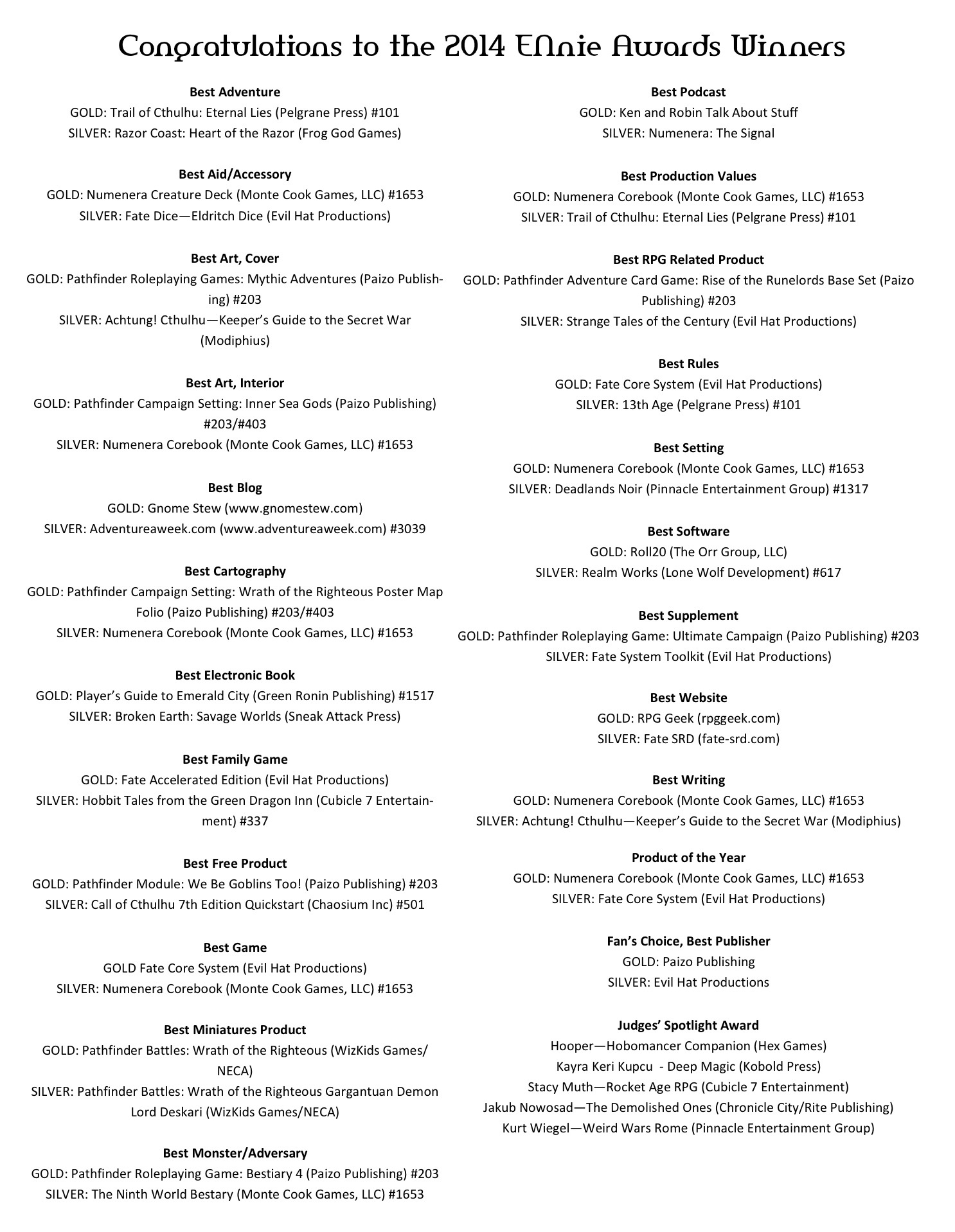
Here’s the list of ENnie winners from ENWorld announced at Gen Con.  Let’s see how I did on my predictions

ennies

My Best Adventure pick, Razor Coast, got Silver. For Cover Art I had Mythic Adventures but then Razor Coast again, which got snubbed for Achtung Cthulhu. I had Numenera and Inner Sea Gods tied for Interior Art, they got Gold and Silver. I nailed the Best E-Book, Emerald City followed by Broken Earth. I got the order reversed on Best Free Product, We Be Goblins and CoC 7th. Best minis, Wrath of the Righteous (twice?), same on Best Monster/Adversary, Bestiary 4 and Ninth World Bestiary. 

I picked Numenera for Best Production Values and Numenera as second for Setting (along with Razor Coast, which should have gotten more than one ENnie). Best Supplement – Ultimate Campaign, and I tagged Realm Works and roll20 for Best Software and FATE/Numenera for Product Of The Year. Of course Paizo gets fan favorite, that goes without saying.

So except for the categories where I deliberately didn’t pick, I was pretty darn accurate! I do think RC should have gotten a little more and Numenera a little less – I mean, there was a big buzz around it and yay, Monte Cook, but it’s one of those where I know a batch of people who own it, but no one who’s played it… But in any event, congrats to all the winners! 

Link

ORE Bundle of Holding

This week’s Bundle of Holding is all ORE all the time – for one low price get Wild Talents, GODLIKE, Better Angels, and a bunch of other stuff.

2014 ENnie Nominees Are Here

The “Gamer Oscars,” the ENnie awards, are given out each year at Gen Con. And the nominees for this year are… Well, go read the link for all of them, I’m just going to chime in with the parts I have an opinion on. My picks are…

Best Adventure

  • Razor Coast: Heart of the Razor – Frog God Games. Because I helped proof it, because it’s good, because I’m running it in my pirate campaign, because it had an epic journey to finally come to life.  Though I really like that there’s a Dreamlands campaign (The Sense of the Sleight-of-Hand Man) in the running.

Best Aid/Accessory

  • I’m not big into trinkets. I’m also not sure how to reasonably judge some dice against cards against an advice book. Pass.

Best Art, Interior

Best Art, Cover

  • Razor Coast – Frog God Games immediately over Pathfinder Roleplaying Game: Mythic Adventures – Paizo Publishing. For my money Wayne Reynolds is the Larry Elmore of the 2010’s. He’s basically competing against himself here and the Mythic cover is a little too busy; the Razor Coast cover is classic.

Best Blog

  • Haven’t read any of them except for Gnome Stew which I don’t get a lot out of.  After a quick read I like the feel of The Other Side the best.

Best Cartography

  • Hmm, no opinion.  The fact that there is a Map of the Flanaess is bad ass but it’s not the quality of some of these others. And I love Razor Coast but its maps are not its high point (they tend to be pretty but have some problems in play).

Best Electronic Book

Best Family Game

  • I have no context on any of these.

Best Free Product

Best Game

  • I don’t know.  I mean, it was originally the battle of titans – 13th Age vs Fate Core System vs Numenera. Huge sales, huge buzz. But I have to say, after getting 13th Age and Numenera – I read them, and that was it.  If someone was running a Numenera game I might play.  Not sure about 13th Age. And I have very much not enjoyed the FATE games I’ve played in.  So none?  Sad I know, and it’s not because they are small or bad games. Just none of them interest me. I’ll give Numenera the edge just because I’d play it if asked and might not play the other two if asked.

Best Miniatures Product

  • Pathfinder Battles: Wrath of the Righteous – WizKids Games/NECA. The Pathfinder minis are just beautiful.  I really don’t need any more but I can’t resist buying a brick every time they have a new set because they push the bar forward on sculpts, paints, and weird materials each time.

Best Monster/Adversary

Best Podcast

  • Hmm, I listen to a lot of podcasts but haven’t heard of these.  No RPPR or Fear the Boot?  Come on now! I’ll try out All Games Considered and Ken and Robin Talk About Stuff.

Best Production Values

  • Numenera Corebook – Monte Cook Games, LLC. Can’t say anything against the production here, it’s first-rate.

Best RPG Related Product

  • As opposed to “Aids and Accessories?” Trinket category 2, pass.

Best Rules

  • I’m not in love with any of these. 13th Age and Fate Core System leave me mostly cold. Hillfolk is supposed to be all groundbreaking but I found Hamlet’s Hit Points to be pedantic and plodding as hell so I haven’t ventured it.  Shaintar: Legends Arise – “more stuff for Savage Worlds” is fine but I have a hard time pegging a “Best Rules” on it.  Makes me wish I’ve read tremulus because maybe I could vote for it here.

Best Setting

  • Razor Coast – Frog God Games, because I love pirates, followed by Numenera Corebook – Monte Cook Games, LLC, because it’s artsy and unusual if a little less accessible.

Best Supplement

Best Software

  • Realm Works – Lone Wolf Development and Roll20 – The Orr Group LLC. Gaming software’s come a long way since back in the day! I’m more likely to use Realm Works than Roll20 just because I’m a in-real-life guy.

Best Writing

  • Hmm, Numenera is the only one of these I’ve read so I can’t really judge.

Best Website

  • Why the hell is The Escapist nominated every year? It’s infrequently updated, a mass of 404s and “this is shut down now” – I go look at it every year when it’s nominated and try to figure out what I’m missing. Blog? No post in 3 months.  Forum? Shut down. Podcast? Dead 5 years. Escapist Interviews? 404.  What am I missing, because a casual survey indicates this is an old ass abandoned site?
  • Tabletop Audio is pretty and a cool idea. RPG Geek is a good reference site.  See Page XX is engaging, I read it once every 6 months or so, but it’s pretty tightly scoped so one every 6 months is enough.

Product of the Year

  • I assume Fate Core System is going to win just because squee, FATE. Or maybe Numenera on the basis of being the only game that’s not retreading well-trod ground.  Another Cthulhu game? We have enough, seriously. Razor Coast is the one out of all of them I plan to play…

All in all, not a year I’m super excited about. I got a couple fun things, which are mostly not on this list… I do like looking at the lists to see what I may have overlooked that could be good. I need to read tremulus sometime and see if it overcomes the “storygame effect” (entertaining to play – once). How about you, were any of these super winners in your mind?

Awesome Ship Kickstarter

Since I am running a long pirate campaign that’s headed to the Razor Coast, I was jazzed to come across this ship and terrain Kickstarter – with various ships including a 60′ barque (La Belle), 90′ sloop-of-war (HMS Drake), and a 130′ frigate (HMS Surprise).  It’s a chunk of change but… I had to do it! Go check it out if you plan on some naval action in your game.

Link

D&D Basic Rules Are Out

If you didn’t know, the free D&D Basic rules are out today and can be downloaded from Wizards’ site.

Mastodon and Pathfinder

So this new Mastodon video has a bunch of gaming – larping mostly, but also the Pathfinder Beginner Boxed Set (which the titular nerd plays with his super old grandma, entertainingly – he is a level 10 CN Barbarian named “Usurper of Death” and she is an eighth level CE mermaid who wears a thong). I find it bizarre but entertaining. Two devil signs up! Courtesy ENWorld.

Geek Related Back In The Swing Of Things

Hey all, it’s been a while since I was posting regularly here – I kinda dropped off the face of the Earth earlier this year. You’ll be happy to know that I’m back and there’s a lot of content coming (you’ve seen it start over the last week).

We are finishing up playing the Carrion Crown adventure path and I’m still running my Reavers on the Seas of Fate campaign, which will be headed to the Razor Coast soon.  Once Carrion Crown is done we’ll be playing the Wrath of the Righteous mythic level AP. Other parts of the group are running/playing the Savage Tide AP, Deadlands, and the Serpent’s Skull AP.

Plus, with D&D 5e coming, it’s going to be a lively summer! So stay tuned.

Upkeep and Lifestyle

The Downtime rules in Pathfinder from Ultimate Campaign kinda whiffed on the Upkeep section of the rules, which basically say “uh, nothing needs upkeep, move along.” But wouldn’t it be more interesting if it did?  “No!,” the people shout, no one likes being taxed. But what if there were options and possible advantages to be had?

Let’s talk about PCs who want to live high on the hog, as opposed to paying their bare minimum for food while in town. There’s nothing in Pathfinder RAW about this. However, in D&D 3.5 there were optional rules on Upkeep (DMG p.130) with costs per month for various levels of lifestyle. We used a variant of these rules in Living Greyhawk:

The GP required to support PCs between adventures is called upkeep.

For 12 GP per TU* your PC gets adventurer’s standard upkeep. This pays for common room and board, replenishes rations, mends clothing and equipment, refills healing and disguise kits, restocks up to twenty normal steel arrows and bolts, and heals hit point and temporary ability damage between adventures.

You may also pay more GP to live better than the average adventurer. For 50 GP per TU, rich upkeep gives the same 5 benefits as standard upkeep and a +2 Circumstance bonus on Bluff, Diplomacy, Gather Information, Intimidate, Perform, Profession, and Sense Motive checks when your GM determines that your increased social status would grant you a benefit. For 100 GP per TU, luxury upkeep increases this bonus to +4.

You may choose not to pay for your PC’s upkeep for an adventure. If you do so, the PC retains any damage into the next adventure and does not gain any of the benefits of standard upkeep. The PC may gain other penalties or benefits at the discretion of your GM. At the beginning of the adventure, if your PC possesses at least five ranks in Survival and succeed on a DC 20 Survival check, he gains the benefits for standard upkeep. He may still gain penalties or benefits at the discretion of your GM. If you fail this check, you may not then choose to pay for upkeep for that adventure.

Time Unit: Abstraction of time spent not adventuring, about 1 week.

To incorporate something similar into the Downtime rules, it’s easy – determine the relevant cost tiers and benefits, then tie it into the Capital system as usual.  Let’s say you decide on monthly levels of 5 gp (Subsistence, has penalties), 20 gp (Basic, default), 50 gp (Nice), 100 gp (Rich), and 200 gp (Wealthy) is the maximum ultra luxurious lifestyle. The higher levels get you social bonuses, faster recovery, maybe faction points or other bennies from other rulesets you’re using…  Then it can be paid for using the currencies in the system, with some flavor as to whether it’s goods, influence, labor, or magic fueling your super-luxe life. You can pay for it in all of the usual ways, from money found adventuring to working for a living… Someone unskilled only makes 3 gp/month, so they get the Middle Ages Mostly Starving lifestyle unless they moonlight. Any Craft or Profession skill would let you afford Basic with a little spending money left over. A super skilled artisan with a +20 Profession check is only making 15 gp/week, so could pull Nice, but it’s not enough even for a 100 gp/month lifestyle – but that’s why those folks are the 1% (as Chris Rock would say, it’s the difference between being rich and having wealth!).

Theater of the Mind

With D&D Next coming out soon, I’ve seen some questions from newer gamers who only have experience with 4e and maybe 3.5e about how to make combat work without using a tactical map or grid and miniatures, sometimes referred to as “Theater of the Mind” combat because all the description and positioning is happening in the participants’ imagination and not on a game board.  So I thought I’d take a moment to explain Theater of the Mind combat and how to make it a successful technique.

 I run theater of the mind combat preferentially. I can’t always get away with it in 3.5/Pathfinder, but in Basic and 2e days I did this exclusively, and most other RPGs assume it as the default and only option. We are even doing this more in Pathfinder nowadays as we grow increasingly bored with tactical tabletop combat and how long it takes. D&D Next/5e is fairly similar to 2e in metaphor so I believe most of these techniques will port well.

Theater of the mind provides quicker and, frankly, more interesting combat scenes – but the primary risk that comes with it is players feeling hosed, that too much of the power is in the GM’s hands, and that they keep getting told “No” arbitrarily when they want to reach someone in combat or whatever. This is why D&D had been moving more and more to minis and defined rules in the name of “player empowerment.” And of course with more feats and powers that have ranges on them, it’s unclear how to adjudicate flanking, range, etc. without a tactical map to rely on. Here’s how to do theater of the mind combat without reducing player agency.

Put information in your players’ hands.

Be clear with your descriptions. For this to work, you have to be clear and the players have to pay attention, or else you get a lot of “Well I wouldn’t have charged if I had heard there was a chasm between us and then…” Describe the most important elements (obstacles, opponents, how those opponents are armed) and don’t be afraid to reiterate it each round. Similarly, players should be detailed and repeat themselves – “And then I use my move action to move 30′ away from the rest of the group so that if they decide to area effect us I’m farther away, right, you heard me right GM?”

Even if not using a tactical map, putting a quickie room sketch on a whiteboard or whatever can help a lot – in our Pathfinder games nowadays, “mapping” is just the GM continuing to draw the map on the whiteboard, and rather than use a tactical map we just refer to that and say “I run over near that altar thing…” If pressed we add some X’s and O’s, football play board style, to show relative force dispositions.

In general, give the players the benefit of the doubt. Be generous in your interpretations; they are badass adventurers and you can fairly assume they’re making badass decisions. You’ll want to be fair and have a clear “take-back” policy for the table in case of mishearing – but it’s OK to not be too generous there, as it will encourage people to pay attention.

Put decisions in your players’ hands.

Firstly, let the players have some discretionary input into the narration. I learned my lesson on this playing Feng Shui, where I learned if the PCs are fighting in a pizza parlor and someone wants to pick up a pizza cutter and slash someone, getting out of the way of that as the GM and letting them declare there’s a pizza cutter nearby and use it without getting all up in their business has a lot of upsides – players who add to the environment are invested in the environment. After playing Feng Shui I was so much better as a D&D DM. Let them riff off the environment, only vetoing clear abuse.

You also want to encourage players to explain both what they want to do and “why” – their intent and stakes. “I want to move 15 feet” tells no one anything. “I want to get into flanking around the orc leader with Jethro, and I’m willing to risk an AoO to get there,” for example. Similarly, you as the GM want to state options and stakes to them – “You can do that, but there’s a chance that you’ll fall in that pit.” Some quick negotiation and being very specific help here. “I want to swing on the chandelier, and I’m willing to risk a fall,” says the player, envisioning a max of 2d6 damage based on the room description they heard, but the GM is thinking 10d6… If you wait till after the slip and fall to have that discussion the player gets irate; if you set the stakes up front everyone’s on the same page.

Put outcomes in your players’ hands.

Put the outcome in the PC’s hands, ideally via a die roll from some attribute of their character. So if they want to know how many creatures they can catch in their Burning Hands spell, you could respond “Two, but you can roll Spellcraft (or Int, or whatever) to try to get three, with the downside that if you fumble you’ll burn one of your buddies in melee with them.” I use this in naval combat in our current Pathfinder game – when a PC fireballs the other ship, how the heck do I know where every one of the 30 enemy crewmen are? I say “Roll Spellcraft,” and based on the result is how many pirates got fried. We have generalized the assist mechanic to be “success at 10, and then +1 for every 5 above that,” and it’s easy to quickly map effects onto success margins in that manner.

Same thing with movement. I have all my players convert their movement into an actual “Move bonus”, +2 per 5′ of movement, so a 30′ move is a +12, for example. (Side rant, the conception of movement as fixed when everything else in the system is a variable is one of the greatest missed opportunities in D&D design and all the other games that blindly inherit their metaphor from it.) “I want to get around that orc and flank him with Billy!” “OK, roll Move. You’re not even inside the door yet and there’s a bunch of other orcs, so I’ll call that DC 20, fail means you get to melee but not in flank, fail by 5 means someone AoOs you on the way.”

I also used a house ruled Luck stat in 2e to help determine other elements like “Who’s standing on the trapdoor?” Because if a player is rolling for it and/or making risk/reward decisions, then they feel that the outcome is in their hands and not yours.

One last thought – make character options that a PC has paid for worth it. Some options are hard to quantify if not on a battlemat (like the Lunge feat from Pathfinder). As the GM, you basically want to keep stuff like that in mind and give them a benefit for it from time to time. If, for example, you’re telling people they can’t reach opponents a good bit in battle, and someone has the Lunge feat, turn it into “you reached them!” automatically once every combat when they plead “but… Lunge!” Basically whatever the option is allegedly for, let it do that.

The Time For Experience Points Has Come And Gone

The WotC designers have just presented some polls about how XP progression should work in D&D Next and there’s a lively discussion on ENWorld about it.  I have mentioned in passing that none of our group’s Pathfinder campaigns use XP any more, but I thought this was a good time to unpack that a little and discuss why XP are an outmoded solution to a problem that doesn’t really exist.

Accounting Work

Some of the drawbacks of XP are obvious. It adds a significant amount of non-fun accounting to the game. Most of that burden is on the GM, who has to look up charts and add numbers like it’s tax time for the last 15 minutes of the session, and then all the players get to do some too. This is Dungeons & Dragons, not Accountants & Ledgers. The justification is usually that it’s a “necessary evil” as the only sound way to conduct character advancement; we’ll examine the falseness of this claim below.

It Makes Adventures Suck More

I was just listening to a Know Direction podcast where Amber Scott was talking about the process of working on an Adventure Path chapter lately, and discussed that some of the challenge was the changing/padding required to generate the ‘right XP budget’ and that the actual theme/story of the adventure had to be compromised somewhat to make that work. That sucks, and it illustrates how any published adventure has to make a lot of Hobson’s choices just to get the ‘correct amount’ of XP generated. I had a discussion with James Jacobs about a number of questionable, from the story and GM standpoint, decisions in the Dragon’s Demand module – it was giving out “story awards” to the tune of 200 XP for climbing a DC10 mount of rubble to enter the dungeon. He justified it by saying “Yes but we need people to get from first to sixth level over the course of this one module to fight our end dragon so we padded the shit out of it” (I’m paraphrasing :-).

RPGA/Organized Play adventures, from my experience there, suffer horribly from this problem.  I was a Living Greyhawk Triad and most attempts to innovate in adventures were squashed by the ever-dominant need to have “N encounters that generate X XP for levels Y-Z in H hours.” Of course the other layers of homogeneity required of OP on top of that make the problem even worse, but that’s a big part of it. And in the end, if there is a “correct amount” of XP to give, then why are you spending the effort to micromanage it?

So basically the adventures we play are not as good as they could be from other perspectives because of this unnecessary constraint.

It Makes Players Suck More

Here’s the deal – I like open-ended, in character roleplay, and the ability for PCs to innovate to reach their goals (often referred to as Combat As War in online discussions). XP for monsters (I’m not sure adding “for gp” really helps that) drives a playstyle where you confront everything head-on, grinding like it’s WoW.  If the goal is “save the princess from a castle full of bad guys,” you can’t just do that, because the ugly head of metagaming rises up and says “If you just scry and teleport in and grab her you won’t get as many XP as if you do a room-to-room fight with every orc…” Therefore you start making decisions based on metagame concerns instead of in-game factors. Of course as the GM you can try to give compensating story awards for solving it with different approaches – but then why are you tracking XP again, if there’s a “right number” to give?

I was in a team that took Silver in the D&D Open at Gen Con back in… Uh, the 1990s sometime. We didn’t get Gold, we were told, because we bypassed the penultimate encounter (a nuisance encounter of some humanoids) by flying over it to beard the BBEG directly. So even though our judge said we rocked the adventure and did it better/faster/cheaper (no character loss)  than everyone else, you know, we didn’t harvest enough souls. Lesson learned, we’ll shout our battle cry of “No Witnesses!” in the future.

The Theory

Obviously, the theory behind XP is that they are a needed reward system. Pavlov, Gygax, and Ayn Rand have worked together to come up with the ultimate system of motivating PCs to go out there and adventure, and it is both that and a semi-realistic way to reflect people getting better at what they do.

The problem is, these motivations are a thin lie to begin with, and don’t accomplish their desired ends in practice either.

First alleged reason to have XP, motivation.  Without XP  you don’t incentivize desired behavior in the game. I’m pretty sure we all play D&D to have fun, and adventuring is fun. If there weren’t XP, would our characters not go out and defeat the invading orc hordes? What degree of player and GM sucking must be required for such a low rung on Maslow’s Hierarchy of Needs to kick in?

Second alleged reason to have XP, realism.  It models the growth of your character by getting better through experience and shepherds them through their Campbellian arc. OK, so the more goblins I murder, I get better at playing my lute? Ridiculous.  You could make this claim for a system like BRP where you “tick” skills you use and those skills advance, but the dull blade of XP as implemented in D&D and its derivatives can make no such virtuous claim to simulation.

Let’s look at XP in practice.  First, let’s assume you are running a story-oriented game, or using an Adventure Path or series of modules (that’s not a new idea, ahem, T1-4, A-14, GDQ1-7). To not have that go badly awry, you need the PCs to be at a certain level at certain times. So unless they successfully tread the primrose path on the adventure you’ve set up for them, you as the GM end up needing to accommodate that.  Throw in some random encounters, some story awards, role-playing awards, some side adventures, because you know you can’t send them to the Demonweb unless they’re at least approaching the right level.

But if you are trying to generate a ‘correct amount’ of XP then having XP is of no value, as it loses its lovely alleged Randian properties. It can’t motivate behavior if you’re trying to get them to the right number by any means necessary. You could argue that it provides the illusion of player agency, if your players are dumb, but in the end you have a predetermined outcome and are forcing yourself and your players to jump through more and more  hoops to realize it. Boo.

But XP also hurts sandbox gaming.  Why? It’s the Gygax Way, right, he wouldn’t have written it if it wasn’t the right thing to do? Don’t tell me about “OSR” like I’m a noob; I’ve been playing D&D since the original Red Box.

D&D is still a game full of murderous cretins, and the XP system is a lot of the reason for that. I find it hard to say that the behaviors XP drive are actually the desired ones. Even the D&D Next article I link discusses XP in terms of “how many goblins you need to kill to level.” As discussed above, actual innovative goal-achievement, one of the pillars of the OSR, is quite specifically countermanded by XP (unless, again, you adopt the “give them anyway” rubric, and get to do extra math to justify a predetermined outcome). A decent GM should be able to reward desired behavior in the game.  Do you get nothing for saving the princess or completing a quest besides XP, really? And if you get loot, isn’t that its own reward?

The Alternatives

Well, what we do is “level when the GM says.” Pretty simple.  Sure, this might be a problem in those first spazzy 12-year-old games we all had, where the  GM’s trying to screw the players and all – but how many pages of rules have been written trying to fix that lowest-common-denominator problem, and has it actually succeeded?  No, those who are playing “level 30 silver dragons!” or “being killed by cats!” type games continue to do so. This approach requires zero math and is very easy for the GM – pulling out a level 7 adventure you want to run?  You don’t have to throw weeks of grind at the PCs, just tell them “you level!” In my Reavers campaign, the PCs are like 7th level after four years of play, because I have plenty of piratey adventures appropriate for those levels to bring them!

Or… Now, this is super hippy-dippy, and I know that before I say it, but you could even just level by consensus, in a more sandbox game. If the GM cares about what level they’re prepping for, then the GM should level.  If the GM is just “whatever, I’m a judge OD&D style, hexcrawl yourselves into a coma” then maybe players should spend more time at the levels they enjoy.  I personally would usually vote not to level, as I enjoy the low/mid-levels best and over about 12 starts to suck.

Or, you could level by IRL time.  This is interesting because it allows you to set a goal as to how long a campaign should take, and since levels will vary it will vary the speed at which the PCs progress to naturally keep them on track.  Let’s say our gaming group says “OK, Paul is going to run Wrath of the Righteous next, and we want it to last a year and then go on to something else.” Then you set out a schedule – to finish out, PCs have to be level 16, so they need to get more than a level per month, say one every 3 weeks, to make that happen. So then level on schedule. This is kinda brilliant, because as you level up, earlier parts of the adventure get easier, and you accelerate – more encounters/day, more adventure/IRL week. If you get ahead, it’s harder, and you are slowed down accordingly.

You can somewhat mitigate the cost vs benefit equation here by using a simpler rubric, like “you level after X adventures/sessions/whatever”, where X = character level or a constant. This loses some GM control (especially if it’s “sessions”) but it’s a good compromise for, say, Organized Play setups where you need a way to track character leveling outside the bounds of a traditional campaign.

A very simulation-minded GM could derive their own way of character advancement – in-game time, whatever – easily on top of this framework.

XP As An Option?

Sure, but so, in D&D Next or whatever, can’t we just have XP as an option and “GM levels whenever” as an option?

As described above, XP forces compromise from both the adventure author and GM in terms of adventure design and the players in terms of in-character play. Having “the option” not to XP doesn’t help that all that much – we already have that option, but our adventures and players are still tainted by the XP-oriented mindset. So even those deciding not to use XP will get compromise adventures that had to be designed with that stricture in mind. Kill it with fire.

XP Should Be Buried Now

I know that it’s so “traditional” that it’s hard to accept, but after 30 years of gaming and some careful analysis I really can’t say that the many man-hours spent calculating XP (or worse, gerrymandering it as a GM) have had anywhere near a positive return on investment in terms of game quality or fun.