Tag Archives: 4e

4e PHB Readthrough – Chapter 10: Rituals

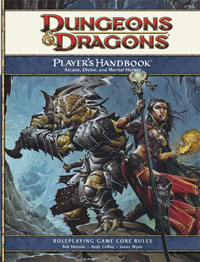
Finally we reach the last chapter in our Dungeons & Dragons Fourth Edition Player’s Handbook readthrough with rituals.

Rituals is a new thing for 4e.  Because the old spellcasting system has been retired and what are called “spells” now are really just powers like any other class’ powers, a lot of old effects didn’t really fit in the powers system.  These range from the more-utility-than-utility like Arcane Lock to the old favorite Raise Dead, to magic item crafting.

Rituals are found in books or scrolls, like spells in older editions.  But you don’t have to be a spellcaster per se to use them, you just need the Ritual Caster feat (and that’s only to do them from books; anyone can cast one from a scroll).  In general they take a while to cast and use up some kind of expensive component.  Rituals are lightly skill linked – some use a skill check to gain a better result, but many don’t really use or require the listed skill.  They have a minimum level needed to perform them.

I think rituals are pretty neat; they have the potential to make memorable effects (like Raise Dead) more memorable.
Continue reading

D&D 4e PHB FAQ, Updates, Etc.

To help you through the reorganization, here’s the new 4e PHB FAQ, oddly squirreled away in the Help section of the Wizards site, NOT in the main Products… FAQ section, which only has the old 3/3.5 FAQs.  Then, there’s a separate place where they’re posting PDF “Updates” to the books (a more positive way of saying “Errata.”   There’s 3 pages of PHB errata already!

4e PHB Readthrough – Chapter 9: Combat

We’re closing in on the end of our chapter by chapter dissection of the Dungeons & Dragons Fourth Edition Player’s Handbook. This time – combat!

Much of this chapter is familiar to players of any edition of D&D; I’ll stress the differences (being an intro to D&D for noobs is beyond the scope of this readthrough). Most of it is familiar, only different in the fine implementation details. As we get started, everything sounds familiar:

  • Six second rounds.
  • Roll init once per combat. It’s d10 + 1/2 level + Dex mod.
  • Surprise round starts us off, and those surprised grant combat advantage.
  • Use miniatures! Especially D&D Minis!

Much of the meat here is in the definitions. 4e isn’t’ quite as “definition based” as Spycraft 2.0, which went from a good game to an exercise in tedium in one version, but it makes a stab at it – your old Magic: The Gathering playing skills will serve you well in terms of strict interpretation.

Continue reading

4e PHB Readthrough – Chapter 8: Adventuring

After the awfulness that was the magic item section, we resume our readthrough of the new Dungeons & Dragons Fourth Edition Player’s Handbook.

The first section is “Quests.” These are the new way they’re factoring adventures, into multiple “quests,” where a quest has a goal and a reward. It refers to the DMG for more, but I don’t really like the MMORPGey feel – a player can propose a quest for the DM to vet to get a “stake in the campaigns’ unfolding story.” Maybe it’s grumpy grognard-itis, but I don’t recall my characters needing specific rewards offered to “find my mother’s remains in the Fortress of the Iron Ring.” I’ll withhold judgment till DMG readthrough time.

Next, they discuss encounters, artificially separating them into combat and noncombat types. This seems like an odd artificial distinction to me, but is apparently because the DMG has separate rules for “skill challenges”.

Experience points. They cap out at 1 million (30th level). Same deal as in all previous editions otherwise. Except that when you level you go “ding”, glow with yellow light, and immediately go to max hit points. (No, not really.)

Continue reading

D&D 4e’s Out… And It’s Awful. Here’s Why

Dungeons & Dragons Fourth Edition has hit stores, but as my readthrough review shows, you probably shouldn’t bother with it (see the “4e PHB Readthrough” posts on this blog for the nitty gritty). It’s a World of Warcraft-inspired tactical combat game, very unlike (and incompatible with) previous editions of D&D.

Many people love to attack the bearer of bad news, so let me be clear about my background. I’m not one of those D&D-haters, or someone who has only played Third Edition and therefore can’t believe anything might be an improvement. I’ve gamed since the early 1980s, starting with Star Frontiers and quickly moving to the D&D Basic set, and happily migrating to AD&D first edition, AD&D second edition, and D&D third edition. Each time, the new version of D&D, with its improved elegance and increased options, easily sold me on being an improvement on the previous version, and I was happy to upgrade! My bookcases still bear the weight of more Second Edition gear than anything else, just because they published the most product ever in that generation – but except for repurposing adventures those books lay fallow after the upgrade. I view players of “1e derivative” products like Castles & Crusades and OSRIC with pity; I enjoyed my First Edition days but I don’t find that I want to go back there.

I’m also not a D&D-only guy – I’ve played everything from Deadlands to Feng Shui to Call of Cthulhu – I have several Cthulhu Master’s tourneys under my belt and have playtest credits in things as farflung as “Wraith: The Great War.” Check out my RPG reviews – they’re pretty widespread. I also can’t be accused of being just a “collector”, I play all the time. So I think I know RPGs in general, and D&D in particular. I don’t have a (previous) bone to pick with WotC. I helped launch 3e as one of the original Living Greyhawk Triads at Gen Con 2000. OK, so enough about my credentials.

4e is the first time I thought of D&D, “Whoa – this isn’t going in the right direction.”

Continue reading

4e PHB Readthrough – Chapter 7: Equipment

In this installment of our read through of the Dungeons & Dragons Fourth Edition Player’s Handbook, we take a look at equipment. Every class starts with 100 gold to equip themselves, a welcome reduction in complexity from the class-based random roll that still persisted in 3e.

Armor has the first big changes. It’s divided into light or heavy. With light armor, you add your Int or Dex modifier, whichever’s higher, to your AC. With heavy armor, you don’t.

Even mages are proficient with cloth armor, which though it doesn’t give an armor bonus, can be made of special materials or gain enchantments that do. That’s pretty elegant.

Continue reading

4e PHB Readthrough – Chapter 6: Feats

Another day, another twenty pages of the D&D Fourth Edition Players Handbook, read and broken down for your deviant pleasures. This time, it’s Chapter 5: Feats.

Feats were the “big addition” in the Third Edition rules. Other games had done them, but this was the first time D&D had done anything like it.

As expected, you get many more feats in 4e. One at every other level, and one at 11th and 21st to boot. They break feats down into Class, Divinity, Multiclass, and Racial. There are also general feats, but that’s not officially a category. They are also broken up into Heroic, Paragon, and Epic levelled feats – you can’t take feats from a higher tier.

Continue reading

4e PHB Readthrough – Chapter 5: Skills

Welcome to the latest installment in my blow-by-blow readthrough of the new Dungeons & Dragons Fourth Edition Player’s Handbook. Or as those of us “in the know” (read: geeks) call it, the D&D 4e PHB.

Chapters 1-3 started out promising enough, until the classes section in Chapter 4 took a far left turn for World of Warcraft territory. Let’s see how skills work now in 4e.

For those of you who are “utes,” back in the day D&D didn’t have anything like skills. They were introduced in rudimentary fashion in Second Edition and became a full-fledged system in Third Edition.

Continue reading

Green Ronin/Paizo Podcast on Open Gaming

Chris Pramas, Nicole Lindroos, and Erik Mona talk about open gaming – OGL, GSL, 4e, Pathfinder, True20, and more in this podcast! Get a free 1 1/2 hours (maybe from not going to see the new Indiana Jones movie) and listen to it! Yes, Wizards is still sitting on the new GSL, so much is speculation, but it’s a good overview.

Kill the Wizard First!

The excellent blog Kill the Wizard First is wrestling with a lot of the same 4e shortcomings I am; he’s even trying to come up with fixes.   I’m not sure it’s worth the trouble, but check it out!

4e PHB Readthrough – Chapter 4: Classes

Welcome to the second installment in my read-through of the new Dungeons & Dragons Fourth Edition Player’s Handbook. This time, we’ll go through Chapter 4: Character Classes.

“Just one chapter!?!” you cry? Well, this one chapter is 125 pages long; the first three chapters combined were only 49 pages. It’s more than a third of the total book, and by far the meatiest. So buckle up, buttercup!

The classes in 4e are: cleric, fighter, paladin, ranger, rogue, warlock, warlord, and wizard. The venerable barbarian, druid, monk, and bard have been jettisoned and the warlock and warlord (was: marshal) have been imported from the 3e splatbooks. The sorcerer is gone too – or really, as we’ll see later, the new wizard is a sorcerer and the old wizard is dead.

Continue reading

4e PHB Readthrough – Chapters 1-3

As I read through the 4e PHB, I bring to you a play by play commentary. I’m trying to wipe what I already think I know and just take the book as it comes.

First Impressions. The layout is decent, though unexceptional – you’d think the RPG with the most money thrown at it would look the best. I am not sure I like the art style – it’s too “busy” for me, and all the characters look stiff or stilted, not natural. But for the record I didn’t really groove on the 3e “spiky partial pencil sketch” model either. So that’s a wash.

Chapter 1 – How to Play. Part of this chapter is the usual intro to roleplaying for newbies complete with the de rigeur “children’s game of make-believe” comparison. The couple interesting bits are “A Fantastic World,” where they set the stage for their “points of light” setting. I don’t really think D&D needed a default setting more hardcoded into its pages, but I reckon it’s not too hard to ignore it and swap it out. The other interesting part is in the description of the DM, where they’re careful not to say that the DM sets the rules. He builds the adventures, plays the monsters, and “referees” how to apply the rules when it’s unclear. That concerns me a little, the “DM is at the mercy of the rules” thing was previously limited to the pages of Knights of the Dinner Table.

Continue reading