Tag Archives: review

D&D 5e PHB Readthrough, Chapter 3, Classes

Welcome to the third part of my Dungeons & Dragons Fifth Edition readthrough and review of the Player’s Handbook.  Last time, we got through the race section, and now it’s time for 112 pages of character classes!
LowClassAncientEgyptianStatuettes

Chapter 3: Classes

Well, they sure don’t want to repeat what they did in 4e and make you wait till a later supplement for your favorite class to appear. They pack in twelve of them – barbarian, bard, cleric, druid, fighter, monk, paladin, ranger, rogue, sorcerer, warlock, and wizard. It lacks only the marshal from 4e.

Here’s the general format.  Each class gets saving throw proficiency in two saves (which means you add your proficiency bonus to those but not the third). It gets proficiencies in some armor, weapons, and tools and some number of skills (usually 2-3).  Hit dice and hit points are as in previous editions, though they list the average hit point roll and say you can just take that instead of rolling.

In a manner parallel to the subraces, every class has several paths or specializations under it which are mandatory to take at (usually) level 3. For many classes it’s a couple different paths; for wizards it’s school specializations, etc. This is one of the major expansion-content points in the game. There are 20 levels and you get something at most of them – a core class ability, a path feature, or at every fourth level an ability score improvement (which can be swapped out for a feat, if you’re using the optional feats rules).

Let’s dig into the classes, and I’ll point out interesting approaches as we go.

The barbarian is a raging wild fighter with d12 Ht Dice; their abilities are things like rage, reckless attack, and brutal critical – getting better attacks while taking risks. Rage is really boss – damage bonus but also melee damage resistance. “Resistance” (they wait to define this way later in the book, I’m not sure why they didn’t put it next to advantage) means half damage, period! You get a limited number of 1 minute rounds until you take a short rest. They have the Unarmored Defense feature (you’ll see it more later) that gives you CON bonus to AC when unarmored. At fifth level they get an extra attack, but this doesn’t also go up at 10th and 15th like it did in 3e – you get that one extra, and that’s the dealio. That’ll keep it cleaner at high level.

The barbarian’s paths are Berserker (rage is better) and Totem Warrior (choose a totem spirit, get some related buffs).

The bard is as usual a magical singy person with d8 Hit Dice. They get spells to cast off a custom spell list and have limited spells known. They have Bardic Inspiration, which is a bit of a disappointment from e.g. 3e; they can play at you and then you get a d6 bonus “inspiration die” to use. But instead of being able to buff the whole party, you can only do this a number of times equal to your Charisma mod until a long rest.  So… You get to give out 3-4 d6’s a day? Boo.

The paths are College of Valor (add the sucky inspiration d6’s to damage instead) and College of Lore (subtract an inspiration die from an enemy).  Maybe I’m missing something, but the extreme hobbling of how many times you can use Inspiration make it kinda terrible.  Instead, the bard becomes just a gishy “can fight OK and also has enchantment spells” person. I remember in Second Edition people would always try to give up the musical part of the bard with kits (e.g. gypsy bard) because it was so pointless and awful.

Aside: Spellcasting

Spells in 5e for all classes are “not quite Vancian” – you still have spells known and slots and levels, but you can use a slot to cast any spell you know of that level or lower on the fly instead of having to tightly specify “2 Cure Lights, 2 Bless…” This comes in two flavors; the “limited spells known, but you can cast any of them with those slots” model (the bard, sorcerer) or “you have access to a large set of spells, but for the day you have to choose a (level + stat mod) number you can cast using those slots” (the cleric, druid).  Save DCs are now 8 + proficiency bonus + stat modifier.

The cleric is a warrior healer with d8 Hit Dice. They only get up through Medium armor by default. They have spells off a custom list too. Unlike most other classes you have to pick your variant, in this case a deity, from level 1. You get a domain with powers and spells from that, and your ability to channel divinity to turn undead and/or do other stuff varies based on it. In a very First Edition callback, at 10th level the cleric starts to be able to use Divine Inspiration to call on their god for aid once a week by rolling percentile dice under their level. Make it and sha ZA something good happens. There’s only like 7 domains (Knowledge, Life, Light, Nature, Tempest, Trickery, War) but it almost says “insert splatbook here” under the entry. Hint, Life is what turns your channel into Pathfinder style channeled healing. You can only use the channeling once between short rests though.

The druid is a nature-loving, spell-casting person who can turn into an animal, with d8 Hit Dice. They get spells of the “choose what you can cast today off the full list” type. Wild shaping into an animal starts at level 2 so the fun kicks in early. You can’t cast spells in beast form till like 18th level though. Oddly, there is no animal companion for the druid (despite what both pieces of art would have you believe). They don’t get many specials besides this – the wild shape is kinda cool because it loses its own hp till you turn back to yourself, but overall this still seems like it’s the third “d8 HD, can do a little fight, and casts spells” class in a row.

They have two path choices, Circle of the Land (recover some spell slots with a short rest, some extra spell choices based on terrain) and Circle of the Moon (faster, more violent wild shaping).

The fighter fights. And has d10 Hit Dice. At first level you pick a fighting style (archery/defense/dueling/great weapon/protection/two-weapon). He gets some nice little once-between-rests boosts (1 HD hp regain; 1 extra action). The fighter does extra attacks at levels 5/11/20.

The martial archetypes are Champion, Battle Master, and Eldritch Knight.  Champions get an extra fighting style and better crits and Battle Masters get combat maneuvers (trip, parry, disarm, there’s a page full of them) that use “superiority dice” – 4 of them, replenished at a rest. Eldritch Knights get spellcasting! It’s limited, basically going up a spell level every 6 levels (no fireball till level 13!) but there you go. Armor doesn’t inhibit spellcasting in 5e so no need for powers around that.

The monk is a ki-powered martial artist with d8 Hit Dice. They get a nice Dex+Wis unarmored AC. They can also use Dex for attack and damage, so Strength need not apply. They can make another attack as a bonus action, can make another 2 by spending a ki point (flurry of blows)  and have unarmed damage that goes up some over time (just d4 to d10 at 17th level). They get all the traditional monk stuff – deflect arrows, slow fall. Their stunning fist just uses ki points, only comes at level 5, and stuns for a round if they fail a save.

Their two path options are Way of the Open Hand, Way of Shadow, and Way of the Four Elements.  Way of the Open Hand is pretty hardcore, whenever you hit with a flurry you can trip or push 15′ or deny reactions. Eventually you get Quivering Palm, which no one has ever failed a save against in 30 years at my gaming tables – maybe this’ll break the streak?

One complaint, instead of instant death it does “10d10 necrotic damage.” They kept some of the 4e damage keywords and they sound just as out of place in 5e as they do anywhere.  “Necrotic?” “Radiant?” “Psychic?” What are we, in a CSI lab now? They seem to have worked hard to make most of the rest of the rules non-jarring English, but this bit fails that test.

Way of Shadow is ninja/shadowdancer-ey, spend ki to do darkness or silence or stuff, jump from one shadow to another, eventually become invisible in shadows. Way of the Four Elements gets you a big long list of Dragonball Z/Book of Nine Swords style special moves you can spend your ki on.

The paladin is a holy warrior with d10 Hit Dice and limited-level spellcasting (like the Eldritch Knight). They get spellcasting like the EK, some fighter maneuvers, “divine sense” which is detect evil just for fiends and undead and such, and lay on hands for healing. You can burn spells to add damage as a “divine smite.” It’s pretty similar in concept to earlier paladins.

The paths are Sacred Oaths which come with a code of conduct – Oath of Devotion gives you power to make your weapon holy and turn fiends, Oath of the Ancients is weirdly druidy, and Oath of Vengeance is like Solmon Kane LG murderhobo style.

The ranger is a wilderness fighter with d10 Hit Dice. You get a favored enemy type (dragons, elementals, etc etc), you have advantage on checks against – but not combat, knowledge and survival and stuff. You can choose from a handful of the fighter fighting styles and get limited spellcasting. Senses and movement are a big thing.

The archetypes for the ranger are the Hunter and the Beast Master. The Hunter gets special moves against certain form factors of foes – like Giant Killer is for foes bigger for you. Beast Master gets an animal companion.  It doesn’t get more hit points as you level up which is odd, but it does get your proficiency bonus to attack and damage. Seems like it’s going to die a lot.

This, unfortunately, is where a bad bit of 4e-ism creeps in. Apparently, you have to use your action to command the animal to “take the Attack, Dash, Disengage, Dodge, or Help action.” But, like, every turn.  This is a clear “but we’re worried about the action economy” gamist move – I can see using an action to sic Rover on someone but then he’s damn well going to attack each round without me “spending an action to power him.” House rule time.

The rogue is like a thief and has d8 Hit Dice, but hews to the new post-2e world where of course it has to get sneak attacks all the time. It is limited to once a turn, but can happen basically if the person is in melee with anyone (or you have advantage from any other source). There’s also some skill boosts with a couple skills (double proficiency bonus) and various escape/evasion themed abilities.

Rogue archetypes include the Thief (no really 1e players we love you too!) which has some pocket-picking and second-story work, the Assassin which kills, mildly – advantage in surprise rounds and auto-crit on surprised folks, and the Arcane Trickster, which is mainly just low level spellcasting – there is a “spell thief” feature but it’s not till level 17.

The sorcerer is a self empowered magic machine with d6 Hit Dice. I was interested to read this; given the hybridization of spellcasting there’s not as wide a gap between the “kinda prepared” and “kinda not” spellcasting now – wizard vs sorcerer was frankly a somewhat arguable distinction in 3e and here it becomes quite the same unless they zazz it up somehow. This has the same standard 5e limited-spell-list model as the bard. But they go back and add extra flexibility with some “sorcery points” you can spend for spell slots (cost: level+2) or put metamagic on spells to make them longer, larger, badder, quieter, etc.

The archetypes are Draconic Bloodline and Wild Magic.  Draconic makes you a little tougher and boosts damage for your related element, and eventually sprout dragon wings.  Wild magic has a full page wild magic table.  This is a little weird because the way it’s stated is “Immediately after you cast a sorcerer spell of 1st level or higher, the DM can have you roll a d20. If you roll a 1, roll on the Wild Magic Surge table…” So that’s not “roll it all the time,” I guess the intent is for the DM to dial it back when it would be annoying or force the issue (well, 5% force at least) for critical things?

The warlock is some dark force’s butt puppet (not saying that’s a bad thing), and has d8 Hit Dice. Limited-list Charisma-based spellcasting but super limited, like “here’s 2 spell slots.” And then the star is Eldritch Invocations, which you choose from a big list of supernatural abilities that you can use either at will, or sometimes need to recharge with a rest.  Most are just spells, which is disappointing, but some are cooler.

The splat factor here is your otherworldly patron – the Archfey, the Fiend, the Great Old One. The abilities are themed predictably.

And finally, the wizard, the spell-chucking bookwork with d6 Hit Dice. Lots of Int-based spellcasting, learn spells and put them in a book, traditional 1e-3e flavor. You can recover some spells once used – which seems strangely exactly the same in effect, if different in implementation, than the sorcerer extra-spell-slot thing. They don’t get much in the way of specials, “let the casting do the talking” is the plan.

The paths are arcane traditions, in this case schools – abjuration, evocation, etc. (the full 8 from earlier editions are represented). Each one makes it cheaper and faster to get those spells, and then gives you a couple minor related superpowers.

Analysis

Well, that was quite a slog!  Going through this chapter in depth, I feel a little ambivalent about the overall feel.  The classes are fine, I guess.  Not many of them gave me any wow factor of “OMG I have to play that now!” The barbarian with their damage resistance did tempt me, though. Of course they are specifically trying to not innovate too much but bring back “what you all remember” in the classes, so that might be expected.

At times I felt like they strayed over the line to 4e-style “dang these classes feel all the same a little too much,” but after thinking about it I think that might just be a 1e and 2e thing as well – classes had less variation then (“You leveled?  Have a couple  hit points.  Move along!”), and the more extreme variation in 3e had its own problems (see Some Thoughts On 2e and 3e’s Legacy for more). The special abilities are nice, and often aren’t just a dinky “+1 to something,” so they really matter.

But many of the powers that aren’t just “get a proficiency” are very, very limited in number of uses. That’s very much not 1e/2e – you didn’t get cool new powers with each level, but the abilities you had you could use all day long. With spells it’s one thing, but I don’t like feeling like “sorry, you’ve used all your powers today” when that power seems like something you could do, you know, anytime. “Sorry, you already disarmed someone today, no more for you!”  A couple classes (ahem, bard) really suffer from this badly. And again, one of the problems with 4e was that suddenly it became a resource management game for everyone, instead of the more traditional approach of people that like resource management self-selecting into wizards and people that didn’t self-selecting into fighters.

But, I don’t know.  Am I just too used to 3e/3.5e/PF and so am jumping at shadows? I’ll withhold judgement for now. There’s only a couple things I specifically and acutely found objectionable in the writeups and they’re easily house-ruled; I hear happily that we’re “allowed” to do that again.
D&D 5e PHB Readthrough, Chapter 1-2, Character Creation and Races

Welcome to the second part of my Dungeons & Dragons Fifth Edition readthrough and review of the Player’s Handbook.  Last time, we dispensed with the introduction, and now it’s character generation time!

Chapter 1: Step-by-step Characters

This chapter walks you through the process.  Choose a race, choose a class, determine ability scores, describe your character, choose equipment, come together, you’re ready to rock.

You get proficiencies from your class and other sources, and those proficiencies all share your class proficiency bonus. That’s an interesting streamlining – in 3e, you got a wide array of “your bonus to everything is different.” In 4e you got “+1/2 your level to like, everything.” This threads between those extremes; providing a more simplified general number you add to things you can do while differentiating between things you are skilled at vs not – weapons, nonweapon skills, spellcasting, whatever.  They list the proficiency bonus in each class table but that’s weird because it looks like it’s the same for all of them – it’s +2 and goes up by 1 at levels 5, 9, 13, 17. What is that, ceiling(level/4)+1?

Besides your hit points you actually record your Hit Dice because you’ll use them for healing too. This has confused a lot of 5e newbies online already.  I remember reading Dragon Magazine when I had just started gaming and was playing Star Frontiers, I bought it for the Ares section and would look at the rest with interest – I could figure out what a lot of the D&D part meant except “what the heck is a Hit Dice?!?”

It’s the standard six ability scores – Strength, Dexterity, Constitution, Intelligence, Wisdom, and Charisma, in their new-as-of-3e ordering. Ability modifiers work like 3e and are +1 for every 2 points (=(score/2)-5). I hope their other changes rein in the min-maxing enough; I would have been tempted to take this back to the lower-scaled bonuses and penalties of Red Box Basic (BECMI).

The primary method of generating stats?  ROLLING THEM LIKE A REAL MAN. 4d6 drop lowest, arrange how you like.  Or if you are weak, they do allow for a standard array or point buy (“If your DM approves”!). At least they say rolling is the primary method. A la carte point buy, along with unrestricted magic purchase, is one of the biggest cause of the problems with Third Edition (including 3.5e and Pathfinder) as it allows high precision min-maxing.

Armor Class (AC) is 10 + Dex + armor as it’s been in every version since 3e.

One notable change is that they just simplify and say Strength is + to hit and damage for melee weapons (and thrown weapons) and Dexterity is + to hit and damage for ranged weapons (and finesse weapons). That’s kinda how it worked in 4e, though layered under their arcane power lingo.

And then, there’s a single XP table for all characters.  The fact that there’s just one doesn’t surprise anyone who’s played the game since 3e but FYI if you’re a pure old schooler. The numbers seem scary low – 300 xp for level 2? I haven’t gotten to how they’re awarded, so it may even out, but that’s an order of magnitude reduction from the standard Pathfinder table.

They do define “tiers” of play and tell you what you might expect, but unlike in 4e they refrain from giving them names and note that “the tiers don’t have any rules associated with them,” which is good.

Chapter 2: Races

chuckThey don’t want to leave out anyone’s favorite. There’s nine races, Dwarf, Elf, Halfling, Human, Dragonborn, Gnome, Half-elf, Half-orc, Tiefling, and most have sub-races.  This is a maximal set of races from the various PHBs.

Some of the fiddliness of 3e is removed here. For example, instead of age modifiers to your stats, you are told you could “use your age to explain a particularly” low or high stat.

Each race gets 2-3 pages for a core writeup then a page or so of subraces, representing the various traditional ones – like elves have high elf, wood elf, and dark elf. You tend to get a +2 to a stat from the base race and then a +1 or +2 to another from the subrace (picking a subrace is mandatory). They also go to lengths to point out what these subraces map to in various campaign worlds – “the shield dwarves of northern Faerun are mountain dwarves,” for example.

They mention that races do vary per campaign world, and mention kender and cannibal halflings of Dark Sun as examples.

Dwarves are what it says on the tin. Female dwarves do not have beards (I bet the newbies wonder why I’m saying some of these seemingly totally random things… Suffice to say that any weird statement I make like this is because there’s some major historical debate among gamers on it.) They get +2 to Con, darkvision (low-light and darkvision have been merged), poison resistance plus advantage on poison saves, and some proficiencies.  Hill dwarves get +1 Wis and more hit points; shield dwarves get +2 to Str and armor proficiency.

Elves are the slightly-shorter type, not the slightly-taller Pathfinder type. They get a +2 to Dex, darkvision , proficiency in Perception, and charm/sleep resistance.  I like that they state these abilities directly but without having to resort to too much gamespeak. “You have advantage on saving throws against being charmed, and magic can’t put you to sleep.” High elves get +1 Int, proficiencies, and a cantrip, wood elves get +1 Wis, proficiencies, +5′ move, and can hide in the wild. Drow get +1 Cha, longer darkvision, some magical abilities, and are sensitive to sunlight (plus they dress super sexy). I’m happy that the made-up-sounding “eladrin” has been demoted to a froofy name for a high elf.

Halflings are the Hobbit type not the murder-thief adrenaline junkie type. They get a +2 Dex, -5′ move, are small (which isn’t as big a deal in 5e), are lucky (reroll 1’s!), brave (advantage against being frightened), and nimble (can move through spaces of larger opponents). Lightfoots get +1 Cha and can stealth behind someone and Stouts get +1 Con and advantage/resistance against poison.

Humans are, you know, us.  They can even be black now, which wasn’t OK pre-3e.  (OK, I’m kidding… Mostly…) Humans get +1 on all their ability scores, an interesting interpretation of the “they’re the polymaths of the races” vibe they have. In a sidebar they basically say “or you could play third edition!” and take +2 to two stats, a skill, and a feat. Humans don’t have subraces in the same sense of the other races, but they do list a bunch of Forgotten Realms ethnicities as examples (no abilities or stat changes are tied to them).

Everyone knows these are the “big 4” – in fact, the PHB goes on to say that the other races are “Uncommon” and may not appear in all worlds and even when they do, they are rarer – they even describe what commoners might think of them if they haven’t encountered them before.

Dragonborn are dragon guys of a vaguely Klingon ilk. They get a +2 Str and +1 Cha, resistance to a given damage type linked to their color, and a breath weapon – at will, 2d6 +1d6 every 5 levels after 1!  a 30′ line or a 15′ cone. That’s nothing to sneeze at. (Get it?!?) But you have to rest to recharge it. They don’t have subraces per se, just color bloodlines. (The [rather silly] issue of whether female dragonborn have breasts is not addressed.)

Gnomes are tinkers and adrenaline junkies. And into nature, and illusions.  For most of the races it didn’t hurt too much that they decided to combine up every other edition’s concepts of them into one, but since gnomes have varied so much, it makes this description a little schizophrenic. They get +1 Int, are small, -5′ move, darkvision, and advantage on all Int/Wis/Cha magic saves. Forest gnomes get +1 Dex and illusions and speak with critters; rock gnomes get +1 Con, knowledge, and tinker (make a couple doodads – not very interesting out of the box but I assume the list of possible devices will grow without bound in splatbooks).

Half-elves are diplomatic outcasts (squint real hard and it makes sense) and get +2 Cha, +1 to 2 scores of your choice, darkvision, charm/sleep resist, and a couple skills.

Half-orcs are, you know, half orcy. +2 Str, +1 Con, darkvision, proficiency with Intimidate, one free “pop up to 1 hp when reduced to 0 hp” reimplementation of ferocity, and an extra damage die on crits.

Tieflings are devil people. Well, anywhere less than half devil. Horns, tails, the whole deal. They get +1 Int, +2 Cha (what is this, a Lords of Acid album cover?), darkvision, fire resistance, and some minor spells.

Overall a good spread, and described decently. I don’t disagree with any of the implementations, except that there seems to be a weird lot of charisma boosts for races that could fairly be described in lore as “feared uggos.”

The thing I thought was the most impressive was how the game terms took the background.  They were still there somewhat – Small size, advantage, resistance – but when they could describe something without resorting to sounding like a lawyer, they did, and I think the rules are more robust for it.  “Magic can’t put you to sleep” is way more definitive than “immune to things with the sleep keyword” or whatever – over time you get these things that “are exactly like that but don’t have just the right keyword” – plus it sounds more like natural freaking English.

By this point in 4e I was starting to get pinpricked by weird stuff – movement in squares, super magical racial abilities like eladrin teleporting, rules being keyword-driven to the point of incoherence… But so far, so good here. Part of me wants to gripe about there being no racial stat penalties, as an obvious sop to the helicopter-parented self-entitled kids of today, but… eh. 5e, where all the children are above average.

Next time – 112 pages of classes (gulp)!

D&D 5e PHB Readthrough, The Beginning

Buckle up as we start our review and readthrough of the Fifth Edition PHB!

Design

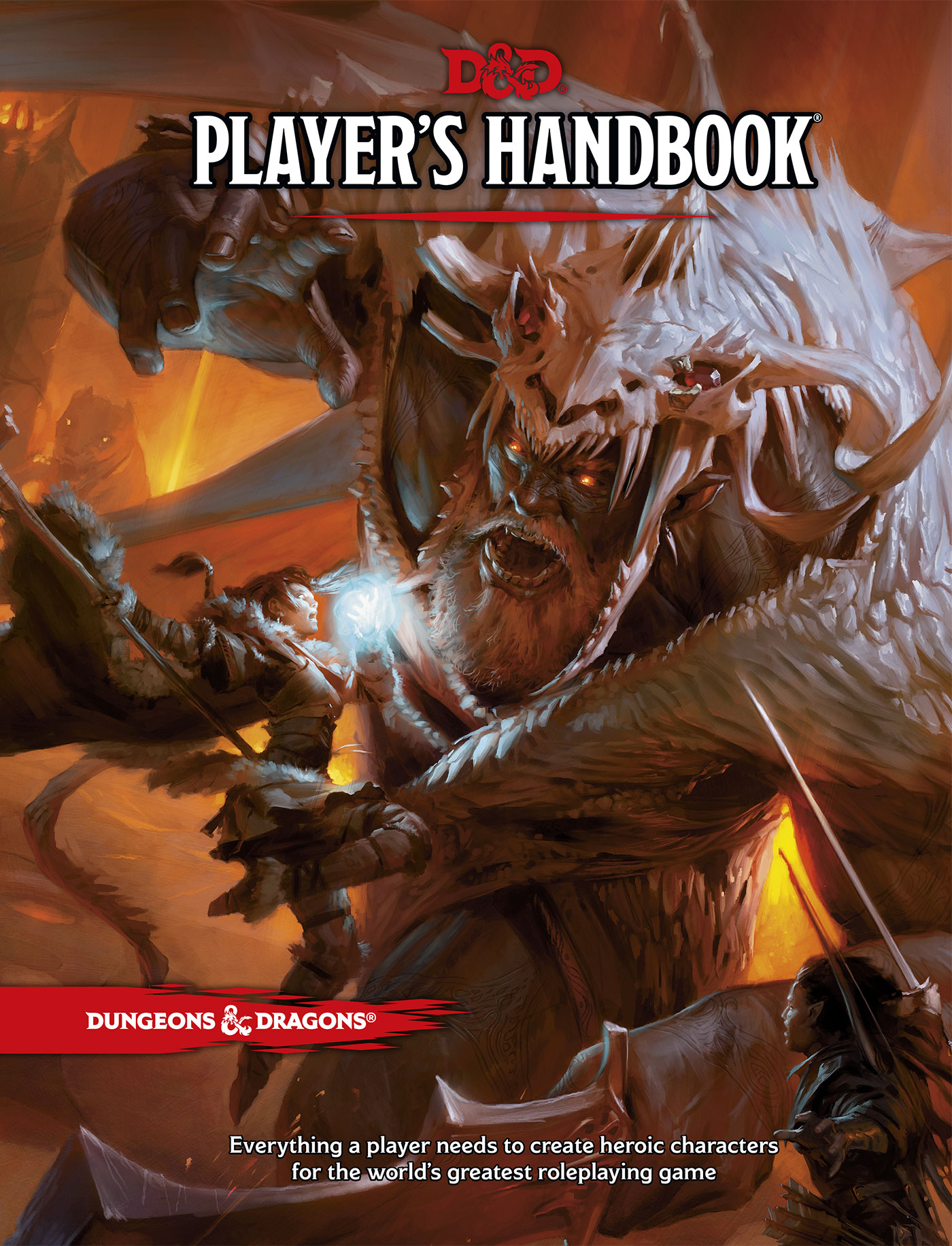
5ephbThe Dungeons & Dragons Player’s Handbook is 350 pages, hardback, and full color. It is clearly noted as “fifth edition” on the rear cover, which is much preferable to the confusing “we’ll just say it’s D&D, for I’m sure this is timeless!” approach that was teased. The vivid cover art depicts fire giant King Snurre fighting some lady. Not as clearly iconic as the Elmore Basic set dragon painting or as arcane as the 1e AD&D PHB “big idol” cover art, but better than the 2e, 3e, and 4e PHB cover art for sure. I’d say it ties with the Pathfinder Core Rulebook at #3 of all-time D&D PHB cover art.

The interior art is varied and attractive – a lot of the pieces really strongly remind me of the aesthetics of the Second Edition PHB interior art. There’s a lot of full page color plates of PCs doing things. It’s definitely not the line art of 1e, the sketch art of 3e, or the “Corporate said these pictures all have to look the same” of 4e.

The two-column graphic design is legible; fonts,  headers, and sidebars are attractive and functional.

Preface

Normally I skim Prefaces and Introductions and that sort of thing, but these were worth it because they try to explain the approach this edition is taking to the game. The preface stresses that this is a game of collaborative creation – you mainly need friends and a lively imagination, and that the players are what makes D&D come to life. All sounds good, nothing terrifyingly groundbreaking. I’ve gamed for too long to put myself properly into the “I am a complete noob what does this do to my fragile little mind” mindset to understand how this’ll start out new players but it seems like a good setting of expectations.

Introduction

The introduction does some introduction of basic terms. They kick off with a super short “what is roleplaying” example, and go on to mention terms  – though a little inconsistently; they bold “campaign” and “multiverse” so you pick them out as meaningful nouns of the game but not “player” or “Dungeon Master” or “adventure?” Odd. Anyway, it gives the basic 411 and notes that having fun and making a memorable story is how you “win.”

They move away from the 4e “points of light” default setting and go back to the “multiverse” concept, and specifically shout-out to the Forgotten Realms, Dragonlance, Greyhawk, Eberron, etc. This section starts a nice theme, which is that they put some of the control back in the DM’s hands – e.g. “Ultimately, the Dungeon Master is the authority on the campaign world and its setting, even if the setting is a published world.” Empowerment of the group to make the game theirs and the DM to rule on the setting, rules, etc. as theirs is echoed many times. This hearkens back to the attitude written into B/X D&D and Second Edition AD&D (see Rule Zero Over The Years for an exploration of the textual attitudes to the relative primacy of rules, players, and DM in various D&D editions).

Then they lay down the basics of how to play.  “The DM describes the environment, the players describe what they want to do, the DM narrates the results of the adventurers’ actions.” Simple explanation of the ‘trad game’ process, though it has some subtle guidance in it (note that players describe what their characters try to do, but the DM decides what happens – yes, no, or what to roll; as opposed to “players make random checks against the stuff on their sheet and tell the DM”).

They explain polyhedral dice, and that usually d20 + modifier vs target number is the core resolution mechanic. Then they mention “advantage and disadvantage,” which is new in this edition – basically rolling 2d20 and taking the best (advantage) or worst (disadvantage). From the designer chatter previous to the release, this is supposed to be used in conjunction with fewer/lower bonuses to provide “bounded accuracy” – if you’re really good, you can hit what you can hit more reliably, but you’re not getting a huge +8 bonus to your rolls that starts to play into the balance, optimization, and encounter tuning issues that plagued Third Edition. They then clarify how specific rules supersede general rules, something that everyone understood but didn’t need spelled out prior to 3e. And, you round down. Simple enough.

Then they describe adventures, and make an important statement – the Three Pillars of Adventure are exploration, social interaction, and combat. This is important to note; especially in 3e/4e, for many people combat had become the sole defining characteristic of the game, reigning in either primacy or solitude, and people would seriously argue that “D&D is only about combat it’s unsuitable for those other things.” A statement explaining the role of all three will hopefully balance expectations of players and DMs of the future.

Magic is described as core to the D&D experience – they do note that “practitioners are rare” and “common people see it on a regular basis, but minor stuff” which helps set some core setting expectations that I’ve seen argued on the Internet far too much.

It’s all good stuff and I don’t have problems with any of it. But the Introduction is a little laundry-listy, though not as bad as 4e’s was. I personally would have pulled the dice and advantage and stuff part back into the rules section and made this a more coherent, punchier statement about adventure and what you could expect D&D play to be like. “You should expect imagination, rounding down, and magic!” isn’t, like, a super coherent message for new players. For grognards like me – OK, got it, on to character generation!

Next time – Chargen and Races!

Dungeons & Dragons 5th Edition Breakdown

D&D on WhiteAs regular readers of this blog know, I’m a long time RPG player and have played every version of D&D since Basic in the 1980s. I was not a big fan of what Fourth Edition did with the game, along with what turned out to be the majority of the market, and have been playing Pathfinder for my D&D fix for the last 6 years. 

I’ve been following the news of the upcoming Fifth Edition with interest.  I read the free Basic rules and shared some initial impressions, but waited until the Player’s Handbook came out to really go into the rules in depth and see what I make of them.

So stand by – you’ll get a PHB readthrough and review (probably in several parts like the 4e one), a Hoard of the Dragon Queen review, and a comparison to all the previous versions of D&D! Will 5e get a passing grade, and will WotC do right by D&D’s deceased creators’ legacy? Stand by to find out!


Geek Book Review: Liar’s Blade

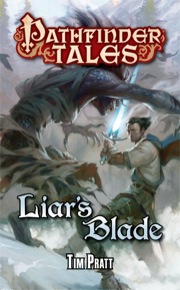
liarsbladeI just finished reading Liar’s Blade, one of a batch of Pathfinder Tales novels I got recently. This is a line of novels set in Pathfinder’s Golarion game world.

This is a well-crafted novel, not standard tie-in fiction fare by any means. It’s a story of a scoundrel named Rodrick and his magical intelligent sword, Hrym. They get hired by some weirdos to go across the River Kingdoms and Brevoy to get some mystery artifact.

The writing is good, with less of the tortured translation of game rules into prose than is customary (I hate that…). The banter between Rodrick and Hrym (and to a lesser extent with their other traveling companions) is really fun.  The two people who hire them, the dour priest Obed and his freaky companion Zaqen, remind me of the tag-along bad guys from the Curse of the Crimson Throne adventure path, who we affectionately referred to as “The Boner Squad” – Shadow Count Sial was the dour one, and then if you kinda combine the perky Laori Vaus and the chain devil into one person, you get a bit of the same dynamic.

Rodrick as a rogue was a well-realized character.  He wasn’t uber competent or a hopeless schlep, and he was avaricious but not vicious, scheming but occasionally letting his emotions get away with him. And Hrym is pretty funny, he’s a sword made of living ice who can’t really remember all of his millennia of life; he’s fond of sleeping on piles of gold coins and of Rodrick’s “twisty little mind.”  In the afterword Pratt credits Fafhrd and the Grey Mouser as the inspiration for his two characters’ adventures, and the main characters’ bromance in Liar’s Blade definitely puts one in mind of Leiber’s characters.

The travelogue through the River Kingdoms and Brevoy is also nice. The fight scenes aren’t anything to write home about, but since Hrym is super-magical many of the fights end quickly with a blast of ice magic, so we don’t have to dwell on many of them.

I’ve read a half dozen of these novels and this is definitely the best-written. Liar’s Blade is very entertaining, I give it 8 goblins out of 10!

Geek Book Review: The Big Book Of Adventure Stories

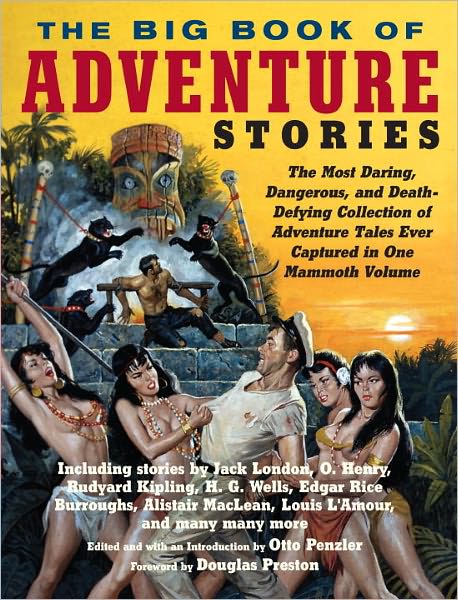
Big Book of Adventure StoriesI was in the library and saw the lurid cover to the left and figured what the heck, there might be something in there good for a laugh.

What I found was awesome.  It’s like a Penguin book of pulp classics, if Penguin wasn’t so stuck up that they didn’t have such a thing!  This massive 874-page tome contains everything from stories I read in high school English like “The Most Dangerous Game,” “The Soul of a Regiment,” “To Serve Man,” Jack London’s “The White Silence,” and Rudyard Kipling’s “The Man Who Would Be King” to representative stories from just about every pulp property you’ve ever heard of, from Tarzan to Zorro to Sheena to Buck Rogers! It’s a complete canon of pulp adventure fiction.

I’m not well versed in the pulps and so had never read the original stories for many of these – some yes, but others I know know through movies or general cultural osmosis. You have in one volume Lady Fulvia, Conan the Barbarian, Khlit the Cossack, Fafhrd and the Grey Mouser, Peter the Brazen, The Spider, the Scarlet Pimpernel, Wandering Smith, Singapore Sammy, Beau Geste, Zorro, Hopalong Cassidy, Buck Rogers, The Cisco Kid, Sheena Queen of the Jungle, King Kong, Bulldog Drummond, Aubrey St. John Major, Allan Quartermain, and more! Plus stories by Clark Ashton Smith, H.G. Wells, O’Henry, Philip Jose Farmer, Sax Rohmer, and various other luminaries. Great, great stuff.

This is an awesome collection.  I may have to find and buy a copy; I already have recommended it to friends who have bought copies. I owe my library so much in fines now, it took me a good while to churn through this – it’s big and in small print.

It’s funny, the presentation is really over-lurid – the cover above, and it’s broken up into internal sections like “Future Shock,” “Yellow Peril,” and “Megalomania Rules”… I mean, perhaps it’s against their spirit to take pulps too seriously and present it like it’s a Penguin book but I really didn’t expect the sheer amount of truly great writing this book was going to contain from its cover. Otto Penzler did a great job with this too – it’s not all the “most famous” of each author’s works; there’s a generous selection of “never published before” in here too.  I am going to have to check out more anthologies this guy’s edited because he knows what the hell he’s doing for sure.

Ten Year Old Girls Review Rise of the Runelords Miniatures

I had my new minis out from yesterday’s post-purchase initial review of the new Wizkids Pathfinder Battles Rise of the Runelords minis. (My that’s a long name.)  Go there to see the pictures for context. My daughter and one of her little friends saw them and decided to give me their opinions on them.  It was hilarious. Here’s as much as I could capture from stream of consciousness 10 year old girlspeak…

Storm Giantess: “She looks like she’s about to do something to me.”
“Cut you into pieces?”
“Yeah.”

Ogre Brute: “Looks like trollface meme guy.” <brief interruption where they tell me I’m so uncool and not up with the hip new things and we have to Google trollface. He does.>

Mash-fell-knocker (their pronunciation of Malfeshnekor):  <in a high voice> “Who’s a good doggie, who’s a good doggie, who’s a good doggie?” <in a harsh voice> “I kill you!”
“He looks like a monkey with elf ears.”
“He looks like a mix between a bat, a dog, and the ‘My precious’ guy from Lord of the Rings.”

Lucretia: “Her hair and eyes look evil.  She’s kinda bald but pretty. She must be the queen of something.”
<imitating Lucretia>  “You must obey me or be cut into pieces!”

Lyrie Akenja: “For Pete’s sake woman, put on a shirt!”
“Put on a shirt!  Put on a shirt!  Put on a shirt!” <chanting together>
“She has a wand, what is this, Harry Potter?”
“Oh look she has a kitty!”
<a long discussion on the pros and cons of kitties ensues>

Ogrekin: “Looks like Invader Zim with a muscly body and something on his head.”
“Looks like a bodybuilder with a messed up face.”
“Yeah, his face is jacked up.”
“Is that a baby rattle he has?”
<i do have to admit the ogrekin’s weapon is underwhelming, needs more meat on it>

Faceless Stalker:  “It looks like a beast that paints itself.”
“Put on some clothes!”
“His weapon looks like a spoon.”
<reading the base> “6 of 65!  Wow!  Good job for nothin’, guy!”
<this is a pretty weak mini, I agree with the girls>

Wraith: “Tornado man!”
“He kinda reminds me of the Statue of Liberty!”
“I know!”
“He’s not the Statue of Liberty, he’s the Statue of Liberty’s torch.”
“Yeah.”

Goblin Commando on Goblin Dog: “Oh look it’s a gremlin!  It’s a gremlin riding a puppy.”
“He looks like the guy from that book… Origami Yoda!” <I feel pain and regret that apparently kids nowadays don’t know Yoda except via derivative media.>
“He looks like the gremlins from that movie where the girl’s little brother gets taken and she has to marry someone and they attack her face!”
<a long Q&A ensues where I try to figure out what movie she’s talking about>
“Yeah, Labyrinth!”
“I’m bored, can we go play Littlest Pet Shops now?”

RPG Movie Review: The Wild Hunt

I was bored and looking through Netflix for something to watch, and it recommended to me The Wild Hunt – an independent movie where Canadian LARPers go a little mental. It had won a couple film festival awards, so I figured what the heck.

The setup is that Erik, an Icelander in Canada, heads out to a big ol’ LARP weekend in the woods to try to get his worthless girlfriend back. He’s not a LARPer but his brother is really big into it; Viking heritage, Norse sagas, the whole bit. The whole batch of LARPers are very, very, very serious about it – it almost converts over into cool, actually. You have other movies like Role Models where the people are into LARP but it’s still very cheesy and you’re like “whatever, diversity yay, ponce around all you want,’there’s nothing wrong with that’, but eek.” But here they are all so into it and put a lot of work into it – if you can make LARP seem cool, this movie comes closest to doing it.

It’s a pretty interesting  movie. It starts out weak mainly because of the unsympathetic main characters – Erik is a certifiable wuss, his girlfriend is a bitchy whore, and the initial crop of LARPers you meet are reasonably insane – but evens out its keel once you get to know more of the (better, and more interesting, frankly) secondary characters and they quicken the pace. It’s a low budget thriller set in an isolated setting where romantic hassles etc. end up cascading into Lord of the Flies. The ending is a lot more dark and brutal than I would have expected from the first act. About a third of the way through, I wasn’t sold and wondered if I should bail, but after seeing the whole thing I’d give it a 5/10, decent.

Of course some roleplayers are worried that this will “demonize the hobby.”  To that I say bah, many of the movies/TV shows with killers, they are doctors and lawyers and cops and moviemakers and other such. It should just be a rush to see your own niche thing breeding killers for a change. And it’s not like anyone will actually be afraid of this happening for real; they’re Canadians for God’s sake.  Everyone knows Canadians can’t kill anyone; they don’t have the constitution for it. (Not that there’s anything wrong with that.)

Fantastic Fest 2010 Day Eight

One week isn’t enough for Fantastic Fest!  No, it’s a week and a bonus day.  And good thing; I saw my favorite two movies of the fest on this last day.

After a week of being in a movie theater, and often getting about 3 hours sleep between the late showing and getting in the early morning ticket line, I started to get sick.  A fistful of meds kept my sinuses in line till afterwards (I’m still suffering even now…)

14 Blades (8/10) – Donnie Yen stars in this period HK martial arts movie.  It’s well done and showcases some of the Mongol type areas.  Nothing too new and unique, but it was solidly executed – which made it better than the higher profile movies of the fest, True Legend and Legend of the Fist.  Duty!  Honor!  Kung fu!  All that good stuff.  It has light supernatural elements; occasional wire-fu and one baddie has a cool “evade death blows and leave a garment hovering behind” ninja trick kind of thing.

Red Hill (8/10) – Ryan Kwanten from True Blood stars in an Aussie film by Patrick Hughes.  It’s a constable’s first day on the job in a small outback town, Red Hill, when there’s a prison break and an infamous criminal from the town gets loose.  The locals freak, and are sure he’s coming back…  What could have been a straightforward slasher movie instead has a big twist, and the movie keeps tension without dragging.  We were all pleasantly surprised by this one – it’s not great, but it’s quite good.  [Side note – my gay friends that lust after Kwanten in his Jason Stackhouse role are concerned that he is not as dumb, and therefore not as adorable, in this part.  Fair warning.]

13 Assassins (9/10) – Now that’s a movie!  Takashi Miike gives us a samurai movie in the vein of Seven Samurai.  There’s a bad noble who has the favor of the Shogun, and a bunch of samurai are recruited to take him out before he goes and plunges the entire country into chaos.  The bad guy is Caligula bad, and the 13 samurai are cool – it’s hard to take a large cast like that and make them all distinct but they did a good job of that.  The entire latter part of the film is the 13 taking on like 200 guys in a town they’ve turned into a kill zone.  It is awesome.

Sound of Noise (9/10) – I didn’t know what to expect from this movie, but I heard from people that really liked it so I gave it a go.  It’s a Swedish film about guerrilla musicians and the tone deaf cop from a famously musical family who’s after them.  That description doesn’t really do it justice, but it’s quirky, fun, musical, dramatic, and more.  I hope more people get a chance to see it.  It gets my nod for best of the fest.

And that’s Fantastic Fest 2010!  I’ll do a recap next, but there were a lot of movies and the vast majority were very good.  I’ll be there next year, and since I managed to score a VIP badge I’ll be able to get some sleep!

Fantastic Fest 2010 Day Seven

Son of a bitch.  I just wrote up a huge long post and WordPress ate it.  Sorry, I’m not going to do it all again, here’s the highlights though.

Legend of the Fist: The Return of Chen Zhen (7/10)

  • HK movie starring Andrew Lau
  • Sequel to Fist of Fury (Bruce Lee) or its remake Fist of Legend (Jet Li)
  • Starts off strong with kung fu WWII action scene
  • Then goes noir with a lot of hanging around a nightclub unsubtly called “Casablanca”
  • Masked avenger subplot a la Black Mask, but should have either been cut or gone into more, it was an odd thing to be a small sideline
  • End fight scene in Japanese dojo a shout-out to earlier Fists movies, but wasn’t nearly as good
  • Starts strong, then goes downhill

Bedevilled (8/10)

  • S. Korean movie, didn’t know what to expect based on blurb and pic
  • Self absorbed bitch Hae-won living in Seoul goes back to the island she grew up on, which has only about 9 souls living on it, eking out a 12th century subsistence lifestyle
  • The men abuse, the old ladies enable, and the one woman friend of Hae-Won, Bok-Nam, and her daughter are the ones to take the brunt of it
  • Hae-won keeps to her “not my problem” policy as bad things happen
  • Slow build and then in the last act the payback begins
  • Very well done movie, not a typical slasher/revenge movie, great indictment of those who stand by and won’t speak up when others are doing bad things

Red (8/10)

  • Based on Warren Ellis graphic novel
  • Bruce Willis, Morgan Freeman, John Malkovich, Helen Mirren are retired secret agents who get provoked by Karl Wagner et al. and have to swing back into action
  • A straightforward but well done comedy actioner, much better than the “Expendables”/”A-Team” kind of crap we’ve gotten lately
  • In theaters soon – heck, I may go see it again when it comes out

The Last Circus: Balada Triste (3/10)

  • Strongly hyped by Harry Knowles (AICN founder, FF co-founder) in slavering terms
  • Balada Triste = Sad Trumpet
  • Spanish film by Alex de la Iglesia about a kid whose clown dad is killed in a battle during Spanish Civil War, which is fun
  • Forget that and skip forward, now he’s a sad clown and working for a circus, he falls in love with a circus performer who has a violent happy clown boyfriend
  • He gets his ass beat
  • Both he and the other clown get all deformed and have Joker transformations
  • They fight over the “sad strumpet” a lot and are all surreal
  • I want to cut myself
  • Some people justified the movie’s weaknesses because of its “compelling imagery” but just because you’re Spanish doesn’t mean you’re Guillermo del Toro
  • Q&A indicates that Knowles loves this because of the comic book references
  • Worst film I saw at the fest, agreement on that assessment from the people I was attending with

Fantastic Fest 2010 Day Six

Day 6, I wasn’t going to mess around – I put down five movies like they were unruly hookers.

First up, the awesome Rare Exports (8/10).  Scandinavians have weird myths, and this one delves into the early Swedish myths of Santa Claus – think less “jolly old Nick” and more “demented goat-beast.”   It’s the tale of a boy and his (modern day) reindeer-ranching village as Christmas approaches.  Some Americans (those goddamn Americans are always behind it) are blasting up on a nearby mountain, and it appears wolves have eaten all the reindeer…  But then you find out that the mountain may be where the natives froze and buried Santa because he was so nasty….  And next thing you know there’s fifty naked old guys running through the snow chasing a little boy.  This was a very enjoyable movie, it never goes over the line to slasher horror but you really think that any minute it’s going to…

There was a cool short before it, Unholy Night,  that similarly deals with the Icelandic Santa myths, in which there are 13 Santas, one of which is named “Meathook.”  You can imagine how that ends up.  They want to parlay the short into a film with all 13 Santas.  Sounds like a winning idea for a one-season Showtime special to me!

Then it was time for Mutant Girls Squad (6/10), the newest from the three Japanese psychos behind Tokyo Gore Police, Robogeisha, and Be A Man! Samurai School.  It’s Troma-esque schlocky gore.  I didn’t find it too engaging.  It was better than last year’s Vampire Girl vs Frankenstein Girl at least, but there’s only so far the sophomoric imagery takes you – “Girl with a chainsaw coming out her ass” and “Girl with katanas coming out of her breasts” were two of the characters in this flick.  It was enjoyable in a middle school kind of way for the first hour, and then I got sleepy.

Next was a real high point, Drones (9/10) – like Office Space, but with aliens!  Kinda.  A true low budget success, we get a tale of intergalactic domination told only with office workers in cubicles.  The writing is the real star here, and the film is clever and engaging.  The protagonist, “Brian”, discovers in short order that both his best friend and his girlfriend are alien infiltrators, but from different races that oppose each other…  But it doesn’t go all “Bros vs Hoes,” it’s a good-hearted film where the characters pull together.  Very, very funny.  We all came out of that showing reinvigorated and chatty.

Then we watched The Dead (7/10).  Fair warning, the people I was with liked this film less than I did.  They shot a zombie outbreak movie in Africa, on the border of Sierra Leone and Burkina Faso.  An American military man involved in some brushfire war there gets stranded when a zombie outbreak happens.  He travels across the country, teaming up with a local military man for much of the journey.

This film just didn’t have the bite it should have.  First of all, “zombie outbreak” is only about a 6 on the 1-10 scale of fucked up shit that happens in that part of Africa every day.  The filmmaker shied away from showing any of that, possibly out of ultra sensitivity to the inevitable charges of racism that would follow.  (They talked about some of the Internet nimrods that are already tooting that horn; there is absolutely no reason for it but people like to bring themselves some measure of fame by crapping on other stuff.)  Second of all, they talked about the transformation of the main character from selfish to altruistic over the course of the film, but the movie I saw doesn’t support that one bit (that he was that selfish, or that he changed).  I did like how the people in the movie weren’t all “turn on each other and be more dangerous than the zombies,” that’s such a cliche now; seeing even disparate people band together despite their differences (besides black/white, they were on opposite sides in a war a day ago) in the face of such a threat.

A side note, they started this movie way before Resident Evil decided to have its newest incarnation in Africa, so no copycat charges please.  I think some of the problem may be that they just couldn’t get some of the scenes they wanted in the can; between customs delays and bribery and being held at gunpoint and knifepoint and suffering from dysentery, they really had a hellish time trying to make a movie in Africa.  There’s a scene where he finds a baby and gives it away to some soldiers about one minute after; the director expressed his frustration that they wanted to do more with that but just ran up against the limits of their time in country.

Finally, we had Rammbock (9/10), a German zombie outbreak movie.  A sad sack going to bug his ex-girlfriend gets caught up in an outbreak and he and several other residents of the townhouse barricade themselves in and have to help each other.  This film also had a fairly positive view of human nature post-zombie, though there was the one “Mr. Twitchy” who endangers everyone by being a big selfish tool.

I thought their take on the zombie outbreak was a very compelling one. It’s a disease, and the result is 28 Days Later style fast-zombies, but you find out that being bitten isn’t 100% fatal, and that an infected’s immune system might fight it off if they stay calm and avoid adrenaline rush.  So you have a reason to not just kill anyone bitten, and a reason to be seeking after sedatives and other McGuffins.  It opens up a lot of interesting avenues that the now-traditional zombie disease closes, and I’d be interested in seeing more riffs on it.

It was also clever in that all their attempts for random townspeople to confront zombies with violence end badly – they really have to use their brains, they don’t all go Ash like so many movies depict.

This was one of the best days of the fest!  But even better is yet to come…

Fantastic Fest 2010 Day Five

Day five, and the second week of Fantastic Fest.  All the weekend partiers have left, and Fantastic Arcade rolls up its mat.  Now it’s just the hardcore movie watchers.

First, I saw The Man From Nowhere (7/10).  Somewhat of a South Korean riff on The Professional, starring Won Bin, which according to the movie blurb on the FF site I guess I would know if I were a teenaged South Korean girl.  I’m not, so I could give a crap.  But the movie was decent.  It starts out with some reclusive guy running a crappy pawnshop in an apartment building; his junkie neighbor has a little kid and then the bad men come and it turns out he’s ex-special forces and then he becomes the KILLDOZER!  The bad guys basically snatch kids, use them for various criminal schemes, and then harvest them for their organs.  I enjoyed the movie but can’t help but feel like since they had Korean pop star Rain in the bloody Ninja Assassin last year at FF this was a deliberate attempt to duplicate that.

Next, I watched a movie about a cannibal family in Mexico called We Are What We Are (7/10).  It was interesting, not a slasher flick, but a serious movie about a family that is – well, it sounds weird to call them “normally” dysfunctional, with the crazy mom and the brothers both wanting to bang their sister, but they’re not all Texas Chainsaw Massacre crazy.  They are cannibals, and seem to believe strongly that they have to, from time to time, eat someone in a ritual manner.  Interestingly, the corrupt cops and locals seem to treat cannibalism as a pretty common thing there – when a would-be victim escapes and finds a cop, the cop radios in a “code 17 in progress,” which one would think is a pretty low number for “cannibals on a rampage.”  I liked that they left a lot unexplained, like the exact nature of the ritual and what exactly happened to the father (he dies in the first 30 seconds of the film, but it’s never clear who did it and how).  The main thing that seemed off was that in the end when the cops are on their trail, they somehow home in unerringly in packs to their one apartment in a whole barrio.  As a bonus, thanks to the Alamo’s extensive menu I ate a big bowl of puerco guisada while watching it, and my cackling discomfited my neighbors.

The high point of the day was Stake Land (8/10), a post-apocalyptic vampire movie like unto I Am Legend, or The Road with vampires.  These are more feral vampires only slightly differentiated from fast zombies, not “sexy prince of the night” vampires.  A guy named “Mister” and a kid named Martin travel across the mostly-wasted American countryside, where only small enclaves of humans still hold out against the hostile world.  They slay vampires in roughneck style, and directory Jim Mickle must be making John Carpenter jealous, since he knows how to make it look good.  It has rednecks throwing vampires out of helicopters as a terror weapon.  And nun raping, lots of nun raping.  (All the men seem to be all over the old nun, played by Kelly Gillis, as opposed to the oddly fresh-faced young women for whatever reason.  Maybe it’s because they all touched themselves to Top Gun too.)  More dangerous than the vampires are the psycho fundie militia that’s taken over swaths of the area.  Dark and violent, Stake Land is a really good vampire movie.

I finished out the day with the disappointing Bunraku (6/10). It seemed really interesting at the start – Josh Hartnett, Woody Harrelson, Demi Moore, Ron Perlman, and some Japanese chick (I really did think he was a woman for his first two scenes – really it’s some pop star named “Gackt”) star in a Sin City meets Moulin Rouge, cowboys-and-samurai action romp!  But after the initial imagery wore off, the plot really started to lag.  They have to kill the “top ten killers” and I started napping towards the end of them.  Although it had loads of visual style, it definitely needed some tighter pacing and editing in the last third of the film.