Tag Archives: RPGs

Some Thoughts On 2e and 3e’s Legacy

I was following the thread on SOB about the various editions of D&D over the years, and my white-hot hatred of 4e has caused me to reflect some on the good and bad things about 3e.

I played and enjoyed a lot of 2e.  When 3e came out, I was really impressed at the improvements and uptook it.  Improved and streamlined basic mechanics, better multiclassing, more interesting monster builds, more flexibility.  With many years of retrospective, however, I do think that there are some directions it took the game that ended up with (to me) undesired and probably unintended results.  So here’s some bad things that 3e introduced or exacerbated.

Rules vs Rulings

I think there were and are two kinds of players/GMs/groups. Those who felt limited by the rules and those that didn’t.  This was true in every edition back to 1e – the “old school D&D is about rulings, not rules” statement is revisionist.  I played in plenty of “the rules as written are sacred” 1e games.  Anyway, let’s say a fighter decides he needs to throw his two-handed sword at someone.  There were definitely people in earlier eds. that would say “no, there’s no rules for that” and also people that would say “Uhhh…  -4 to hit and don’t try doing this all the time.  Roll!”  3e codified a lot of that, which for some folks was helpful.  Here’s a feat allowing you to throw a melee weapon and a standard rule for if you do it without any special ability to do so.  Which is nice.  But with all the huge amount of rules, though, they varied from this optimal formula, and you got a lot of “you can’t do this without the feat” stuff.  Or with things like skills, at higher levels (and DCs) you suck *so* bad at doing things untrained that it’s about the same thing.  So it helped the “I need rules” crowd while limiting the “I am comfortable making it up and my players don’t spend all night arguing about my calls” crowd.

Scaling

In general I don’t believe that “having rules for something is bad,” which old schoolers sometimes use to say any skill system etc. is bad (with no answer for why combat rules should not be similarly abstract – they certainly are in some games and it works there).    But the implementation has implications.  The problem with 3e skills is the same as with 3e combat – the scaling.  With the raw numbers and also the various feats and whatnot, levels mean a lot more.  It used to be that a fifth level versus a tenth level fighter wasn’t that huge of a functional gap.  You hit more, and maybe did a couple more points of damage.  Now, damage scaling is to the point where our 13th level 3.5e fighters easily dump out 100 points of damage a round.  In 1e or 2e, you’d expect more like 30.  That degree of scaling ends up requiring min-maxing so that you are competitive at a given level.

The corollary to this is the difficulty/prep in creating high level PCs or opponents, but it’s more wide reaching than that.  A small amount of randomness has huge effects. Some randomness is desirable – the people who wanted all save-or-dies removed are clearly pussies – but too much them makes people force standardization (and 4e’s the epitome of this) in order to compensate.  Hence the new slavish adherence to “appropriate CR/ELs”.  A necessary obsession with balance also spawned more focus on game-breaking and the rules as a good unto themselves in general.

Magic Items

The new approach to magic item crafting was also problematic.  It was nice to have one; the “it’s pretty much impossible – but they’re everywhere!” approach of 1e/2e damaged immersion.  The ability to fine tune your loadout instead of largely being constrained to a couple things you’ve found was a huge game changer.  This leads to the “Christmas tree syndrome” and the virtual elimination of many non-boost items from the game.

Tactical Combat

Then, of course, the minis focus was harmful.  With the maneuver/AoO rules they are pretty much necessary, and you can’t help but spend more and more time on that part of the game than the others.  I can’t help but recall the GM advice in the cinematic game Feng Shui  by Robin Laws – “Don’t use a map!  At most do a rough sketch of an area if it’s unclear but for God’s sake don’t use a tactical setup.”  And the game was mainly all about combat, not an Amber-esque RP-fest, its’ just that Laws saw correctly the effects that tactical combat have on an RPG.

2e Today

I recently had a friend want me to run her on an adventure with her old 2e character she loved.  I had done that before with a 3e-updated version, but I couldn’t find it and so just pulled the 2e stuff and ran with it.  And it was refreshing.  The lack of minis promoted face-to-face interaction.  Less rule complexity made things run faster. She innovated more in combat.

It’s funny – when we played 3e initially, with our older ed assumptions firmly in place, and before the many splatbooks offered all the abusive choices, it *was* a better system.  Our first 3e campaigns were some of the most fun we’d had.  But over time, as these effects started to manipulate our default expectation, it got worse.  I’ve noticed a tendency in our groups now to play other games “like we play 3.5e”.  Mini-heavy combat in particular, which naturally tends to damage RP (the more time you spend on one part of the game, the less you spend on others).   I’ve noticed that when our gaming group runs other games, we seem to add a lot more lame ass minis combat in than they necessarily prescribe.

Responses – 4e, Pathfinder, Old School

Ironically, 4e, which I hate, tries to address these issues while Pathfinder, which I strongly prefer, ignores them.

4e addresses the scaling with the huge hit point boost and class standardization.   Unfortunately this is the lamer “balance solution” to the problem and turns combat into slogs.  It addresses magic items semi-successfully by removing the usual boost items, but is left with really lame and underpowered items.   On the tactical combat issue – no, it embraces tactical combat and gives it tongue kisses.  And on rulings vs rules, it’s still clearly rules based.  Confused people count removing a meaningful skill system as “more ruling based because then you can make it up.”  But with the overall rules-are-God emphasis, it’ll just end up promoting the “you can’t do that” camp.  There’s other things I dislike about 4e, but on this topic at least, it makes an effort to address some of these issues.

Pathfinder pretty much ignores these four problems, which is a shame.  I’ve already played one Pathfinder campaign, and though it’s definitely a better, more fun version of 3.5, and IMO better than 4e, it does nothing about these, which are at the core of the problems with 3.5e play.

I’m not ready to go back to 2e either, 3e definitely on the balance had great innovations.  But the real Holy Grail is to keep those while fixing these four issues.  Maybe with a second version of Pathfinder they’ll feel more comfortable in deviating from the 3.5e core enough to address them.  So for my D&D fix I’m going with Pathfinder – but it’s definitely an “in the meantime” kind of thing.

I’ve played some of the old school games – like Castles & Crusades, which makes the wise decision to update the core mechanics to be more civilized than 1e’s.  But they just aren’t enough for me.  I do want some character flexibility and cool powers – sure, I can write all the backstory I want with a 1e/Basic/OD&D character but the “they’re all so damn the same” factor is still there for me.  If I want totally rules light, then I want something like Spirit of th Century where I can define my own abilities without as much constraint.  But if I’m going to hassle with classes and levels, I want some “zazz” to them.

I haven’t done much houseruling in a while – something 3.5e,. with its huge rules setup, kinda works against – but maybe I’ll take a cut at what a new ed should look like.  I like feats and skills and multiclassing and prestige classes, so this wouldn’t be a retro-clone, but there are things that if cut or significantly changed from 3e would make a big different while still retaining that “D&D feel” 4e lost for me.
Origins Award Finalists Announced

Per ICv2, the Origins Award finalists have been announced – the winners are announced at Origins in June.

As I don’t give a crap about all that stuff other than RPGs, here’ s the RPG finalists excerpted!

RPGs:

  • CthulhuTech by Catalyst Game Labs
  • D&D 4e Player’s Handbook by Retardation Studios
  • Mouse Guard RPG by Archaia Studios Press
  • Star Wars Saga Edition..  What?   I call shenanigans on this.  It was released in June 2007, even the WotC product page says so.
  • The Trail of Cthulhu, Pelgrane Press

RPG Supplements:

  • Buccaneers of Freeport by Green Ronin Publishing
  • Forgotten Realms Campaign Guide, by Mary Sue Productions
  • Hero Lab, by Lone Wolf Development
  • Serenity Adventures, by Margaret Weis Productions
  • Star Wars: Knights of the Old Republic by Wizards of the Coast

I have no vote for the RPG finalists – haven’t played any of them except 4e (sucks) and SW: Saga (good but from two years ago).  I definitely vote Buccaneers of Freeport for the supplements though.  I so love Freeport.

In fact – not only was SW: Saga from 2007, but CthulhuTech was a finalist last year as well!  What the hell?!?  Is this year’s crop of RPGs so shitty we have to pull last year’s in to make a solid spread of nominees?  Hmmm.  Well, it looks like CT was published through Mongoose initially but then switched publishers to Catalyst so it could come out as a full color hardcover…  I guess that’s enough of a change to merit resubmission.  What’s SW:Saga’s excuse?  Did Lucas issue a new version where Han doesn’t shoot first?

Nominate Now For the Indie RPG Awards

John Kim has opened the nominations for the 2008 Indie RPG Awards.  If you enjoyed an indie game published in 2008, go nominate it.  Voting is not by the public, but by some cabal of small press and indie RPG designers.  Registration’s through May and voting is in August, and winners are announced at Gen Con!

Second Curse of the Crimson Throne “Skeletons of Scarwall” Session Summary Posted

We continue to clear Castle Scarwall in Part II of Skeletons of Scarwall (8 page .pdf).  Two more of the four sub-bosses, a devil bat lady (who really reminds me of an enemy from some video game I can’t place) and a shadow dragon, fall to our swords and sorcery, leaving only one sub-boss to go and then the main boss – who we already killed once before, so no worries there.  Our party is only three strong, but we are mighty!

The main challenge is keeping enough spells held back to take care of Shadow Count Sial when he finally decides to turn on us.  He’s acting even twitchier than usual and it’s clearly only a matter of time.  I hope Laori sides with us and not him when it all goes down.  Though Annata’s not quite sold on the hot girl-on-girl Laori proposed last session, she’s been a good friend so far.

We hit level 13 at the end of the session.  For Annata, I’m thinking adding a level of Crusader (a holy martial artist from Tome of Battle: The Book of Nine Swords) to get more combat prowess.  She’s supposed to be a holy warrior but her damage sucks (1d6+2 whether you need it or not!).  She’s finally worked through the feat chains to add one of the Pathfinder beta crit feats, which will help…  She could make her crits fatigue, stagger, sicken, or bleed an opponent, I’m still deciding which.  But with Crusader she’d get all kinds of nice boosts.  Paul’s letting me swap out Stone Dragon school for Desert Wind school to match Sarenrae’s sun focus, though counting the powers as one level higher.  I’m thinking Death Mark, Fan the Flames, Flashing Sun, Foehammer, Divine Surge, and Thicket of Blades stance.  Although Iron Guard’s Glare is also attractive, and if combined with Fire Riposte and Holocaust Cloak, and potentially the various fire shield magics Annata has available to her, could be compelling.

It’s a shame to lose a level of spellcasting, but truth be told, seventh level cleric spells suck.  First of all, there’s not enough of them.  And four of those, really the only good ones, are basically the same spell (dictum/holy word/blasphemy/word of chaos).  Spells like Holy Word and Disrupting Weapon suck because they specify that they only affect creatures of less than your caster level.  So they’re no use on big bads, they are only mook-mowers, and we have plenty of other mook-mowing options. The symbol spells which also take up several spots on the spell list suffer from the same issue.  She’ll miss the level bump to Channel Energy way more.

Hot Girl On Girl Action In Our D&D Campaign?

In our last Curse of the Crimson Throne episode, my character Annata had a surprise sexual proposition from her friend Laori.  I was faced with the decision of whether or not to give in to the frenzied cries of “We want slashfic!” from my fellow party members.  I made my decision, but as I reflected on the thought process I went through to arrive at it, I started to consider the nature of that process.

For some reason, there is very little talk out there about how people actually conduct character immersion in role-playing games.  I suspect it’s the minority that do it at all; many people deliberately reject it and even those who talk about in-character play seem to equate it to things like “using funny voices” or other trivia that reveal that they don’t really understand what immersion, in my opinion, really is.  I wanted to share the method behind how I run “in character” and hopefully get some insights from others out there who do the same.

Here’s some background on the situation in the game to provide a shared context.  My character, Annata, is a priestess of Sarenrae, sun goddess of redemption.  She grew up on the streets as part of a Fagin-style child crime group.  She escaped to the church and grew up there.  She was in the big city of Korvosa and worked as a physician, so she wasn’t cloistered and isn’t ignorant of the world, but her semi-isolation in living arrangements  and total devotion to her duties kept her from “dating” per se.  And long story short, now she’s an adventurer.

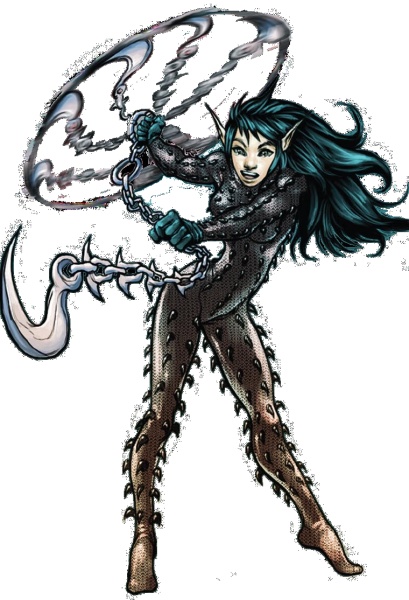
Our group met an odd woman, a “Forsaken” elf (Annata’s not 100% sure what that means) named Laori, and have adventured with her on and off.  She’s a cleric of Zon-Kuthon (think the Cenobites from Hellraiser).  Normally that would be “bad,” but her and her organization’s goals align with our heroes’.  And more than that, she’s likable.  She’s a happy, peppy, and perky (if evil) S&M Gothchick.  Sarenrae’s faith is very ecumenical, and her personality is a lot like Annata’s, so they took to each other quickly and became friends.  All the guys think (from a distance) that she’s hot; here’s the somewhat anime-looking artist’s conception of Laori in her spiked chainmail catsuit:

Laori

Anyway, last session Annata and Laori were chattering away and kinda out of nowhere, she lets me know that she wouldn’t mind getting more intimate with me.  Annata does like Laori; she’s a peppy chirpy cleric too and she definitely saw her as (platonic) girl-friend material, but this was a surprise twist she didn’t see coming.

Interesting! So here’s a peek into how my thought process went. I admit it’s a mix of true immersion and metagame thinking about my character’s personality, but I find that necessary because you seldom have enough information about the fictional world to avoid the “meta” totally.

First, my immediate reaction was intuitive, a quick reaction based on my conceptualization of Annata’s personality. Is it completely out of the question?  No.  Is it a slam dunk? No.  I could see it going either way.

I made a quick roll.   I like to use dice in these kinds of situations. Some people object to this and think any kind of personality mechanic, even an informal appeal to  fate like this one, is “roll-playing” and not immersion.  But in my opinion, the only way to truly simulate real feelings in game is to add some randomization. In the real world, attraction and the like don’t follow any automatic rules. You don’t control who YOU are attracted to.  You may have a “type” but the factors that go into it are too many to be deterministic.  If she had been propositioned by some random person she didn’t know or didn’t like, then I wouldn’t make a roll. If it was some guy she was totally into, then probably I wouldn’t roll either – unless in my opinion the situation was off enough that she might react poorly. In this case, I did what I usually do – a d20 roll, higher means more positive, with vague modifiers applied mentally. Think of it as the other person making a Charisma check. She’s made a handful of checks like this over the course of the campaign, when she’s met someone and I want to know “is chemistry kicking in.” So I made the roll. My gut was “if this isn’t real high, there’s no way.”  I don’t set hard thresholds and results (too much work!  The whole intuition plus roll happens in 5 seconds total), but in this case my gut said 1-5: Disgust, rejection, breaking off friendship; 6-10: Rejection, no explicit breaking off of the friendship but she won’t trust her afterwards; 11-15: Rejection but with friendship not severely affected; 16-20 Maybe, intrigued – not “Yes,” but “She’d think about it.”

Roll result – 18. That’s pretty high. Certainly not high enough for a good girl who has always thought of herself as straight to drop trou on the spot, but enough that after politely extricating herself, she found the idea unexpectedly intriguing and churned over it in her mind afterward in traditional woman-hashing-over-a-relationship fashion.

Here’s the mental path I went through.  Annata has been pretty staunchly straight so far; she was interested in two guys back in Korvosa (Grau, who was a bit of a project for her, and Vencarlo, a sophisticated older gentleman who ended up being the local equivalent of Zorro). Now, she is in love with Vencarlo, or thinks she is (it’s her first time in love). But he hasn’t reciprocated much, and since they both blew town she’s not sure if they’ll ever meet again. And she feels emotionally vulnerable, being away from Korvosa and all.  She’s heard of such things (woman on woman) but never thought about it herself.  What would Sarenrae do?

Meta-thinking comes in here.  I’m not sure if Sarenrae is for or against that kind of thing. One of the problems with fantasy religions is that there’s usually a lot undefined in terms of expected behavior of parishioners.   Is premarital sex OK at all?  Is homosexuality?  This is hard because these should be game “facts” and not subjective, which means I have to engage in metagame thinking. I decide that Sarenrae’s faith is probably not strictly against either, though general societal conservatism that would look down on both would be present.

Back to fully in-character.  Annata has often meditated upon the beauty of the goddess as part of her religion, though (it was the beauty of a statue of the Dawnflower that drew her when she was a street urchin).  Annata has gone through several emotional states in the campaign; when the group left Korvosa for the wilderness she transitioned from her current gig as somewhat strident wound-tight freedom fighter into a bit of a depressed martyr complex, but recently their time with the Shoanti barbarians ended up being kinda “Spring Break”-ey and she got to relax and party and open her mind, so she is in an experimental and confident kind of mood generally.  Laori is clearly a little S&Mey, which isn’t something Annata conceives herself as into, but she is pretty submissive and I can see the dynamics of a top/bottom relationship working there.  And finally, Annata is worried she might be embarrassed if the other guys found out – it might diminish her stature as a spirital leader in the party, generate jealousy, or just get her razzed more.  In the end, a lot of mixed feelings that don’t call for clear action one way or the other.

She thought over it long enough that the sheer weight of the analysis took some of the edge off – she’s not going to act on it (and probably won’t mention it happened). But she took it well enough that it won’t affect her friendship with Laori, and that means she might try again, and if it does it’s got a chance of going farther. I’m pretty comfortable that this is a realistic reaction – I’ve known a couple people over time who have been tempted (sometimes successfully, sometimes unsuccessfully) by a daring and insistent gay friend.

I haven’t gone into my method for how I play female characters; that’s a big topic and only peripherally relevant.  (Nor do I feel like I need to justify it; the people who are “against” crossgender play are wrestling with deep-seated emotional problems IMO.)  But suffice it to say the thinking through the various pros and cons I go through above is my attempt at a female approach to analyzing relationship issues, as opposed to the more… elemental typical male response.  (In this case, I am guessing the other two male PCs’ reaction would be “Hell yeah!” tempered only by explicit or implict fear that Laori would be the “top”.)  I wish I could do it more completely “in character,” but I find myself having to pepper the thought process with little meta-thoughts a lot.

I’m interested in how other people work through in-character issues. (I know some of you don’t, and think this is all weird, and say D&D is just for combat-n-fun… Feel free to not respond then.)  Do you use pure immersion (“I am Annata, and I think this…”), metagame evaluation of your character’s personality (“Annata has this in her background so she’d probably react this way…”) , randomization (“I roll d20 and… Annata likes it!”), something else I haven’t thought of, or a mix of these? And if a mix, in what proportions?

Probably one missing element is metagame group dynamics. “Would the other people at the table feel weird about this?” I almost totally omit that. Either I’m a role-playing purist, or I’m just a narcissist that doesn’t give a good goddamn what other people think, but there it is. Another is the narrativist approach, determining if this would make for a good story or not and deciding on those grounds. I do keep that in the back of my mind a little I guess… If I think it would generate a shit story I’d steer away from it out of fear of “ruining the game for everyone”.   I also try to remove “What I the player think about this” as much as possible.  Do I the player think Annata-on-Laori action would be hot; do I believe homosexuality is right, etc – I deliberately firewall that away (as much as is possible) in favor of my character’s personality and beliefs.  Or worse, what someone else thinks – I have little tolerance for people who interject with “Well, a good character/cleric/woman/etc. would…”  I politely encourage folks like that to close their filthy gobs.  And lastly, “acting.”  Immersion is akin to method acting, but in my mind the more commonly defined RPG actor stance – “using voices” and dramatic turns and flourishes – have jack crap to do with real in character play.

Thus after thinking about it, I’d have to say my pet “in character” thought process mix is:

  • As much immersion as I can (50%)
  • Metagame evaluation to fill in the gaps where I can’t fully immerse (35%)
  • Randomness where I think that human feelings should not be deterministic (10%)
  • A shade of “will this derail the story” in the back of my mind (5%)

I’m really interested in hearing other people’s method for “deep IC” play!

First Curse of the Crimson Throne “Skeletons of Scarwall” Session Summary Posted

We head out to haunted Castle Scarwall in Part I of Skeletons of Scarwall (8 page .pdf), the fifth and penultimate chapter of the Curse of the Crimson Throne adventure path.  Fighting undead is where Annata is a Viking, so we’re kicking bony ass and taking ghoulish names.  We were tickled to be fighting orcs and skeletons, it’s like we’re first level all over again.

I know it’s hard for a DM to run NPCs in a party, but these three Brotherhood of Bones hangers-on we have are worthless with a capital LESS!  Well, except for our favorite, Laori, who is always entertaining.  This session, she let Annata know she’d like to sleep with her!  I’m writing a separate blog post about how she dealt with that.  Will it violate the Paizo fansite license morals clause?  Find out, read the full summary!

At the end, we fought and slew what we think is the “main boss” but it didn’t lift the evil aura around the place; Paul was impressed that I then intuited we’d need to kill all the sub-bosses and then kill the main boss else he’d just respawn.   I’ve been playing RPGs and computer games for 25 years, I know how game designers think.

Let me say again for the record how sweet the Channel Energy power is for clerics in Pathfinder.  For those not familiar with it, Pathfinder replaced turning undead with “channeling energy.”  It heals people in short range and harms AND turns undead.  You can augment it with feats as Annata has – her channeling damages (but doesn’t turn) evil outsiders, she can make it heal only her allies (by default it heals everyone in range), and she’s quickened it to a free action with Quicken Turning.  It means that:

  • If you have a day where you’re not fighting undead, one of your major class powers isn’t worthless.
  • You can heal at range rather than always having to incur attacks of opportunity to go heal a comrade.
  • You can heal multiple party members at once.
  • You have loads of dice of healing that don’t eat up  your spell slots.  Thus you get to use spells for useful proactive things.
  • With the quicken, you aren’t wasting your time every round of combat with only healing.

Face it, as damage dealing has grown, Cure spells have not kept pace.  Even low level characters dish out or take like 20 points of damage a round – at our level, 80 points in a round isn’t uncommon and I’ve seen more than 100.  The usual 1d, 2d, 3d, 4d Cure spells are pretty much worthless in the face of that; I’d need ten minutes and my entire spell loadout to take care of just a couple rounds of combat.  So the channeling steps in to fill the gap and let the cleric do something in a round other than heal.  Neat!

Dread, Spite, and Spankings

Dread: The First Book of Pandemonium is a modern horror game reminiscient of Hunter: The Reckoning, Esoterrorists/Fear Itself from Pelgrane, or playing mortals in In Nomine.  It’s by Rafael Chandler of Neoplastic Press, and has been reviewed like ten times on RPG.net.  It’s pretty cool, and if you want to look into it, the entire player section (141 pages of it!) is available for free download.  The design and art is really nice and gritty demon hunting is one of the three primary gaming joys (killing zombies and Nazis being the other two).

Now he’s released Spite: The Second Book of Pandemonium.  It’s a standalone game, same system slightly refined, and this time you’re fighting angels!  Well, naughty angels, whose depredations are not much better than the demons’.  And again, you can download and read the entire 182-page player’s section!  I’ve been reading through it and it looks pretty bad ass.  The game line seems well supported with both products and free downloads.   You buy them in PDF or Lulu POD – which is a shame, I think it’s more than good enough to get into stores and all.

So check them out!

What, you want to know about the spankings too?  You dirty little monkey!

TV for Gaming: Krod Mandoon and the Flaming Sword of Fire

I’m catching up on my DVRing, and finally got to watch last week’s premiere of Krod Mandoon and the Flaming Sword of Fire, a fantasy show satire on Comedy Central.

I was unsure if it would be decent going in, but I enjoyed it.  It wasn’t hilarious, but it was funnier than all the usual Scary Movie etc. satire movies and I got a laugh out of a lot of the dialogue; the slapstick was weaker.  The fight scenes were even better than the standard Hercules/Xena/various knockoff trash (nice effect when he sticks his flaming sword through an assassin and withdraws it!).  And the pole dance from the female lead sealed the deal.

And boy, they left no sexual stone unturned for the jokes.  Homosexuality, gangbangs, bestiality, rape…  Only necrophilia and watersports are left for the rest of the series!

I guess that’s my real concern – the premiere was good enough, but I wonder how they’re going to carry the gag for a whole series.  We’ll see – I didn’t expect the live action Tick to be any good either and I was surprised.

It was notable for its poking fun at all the generic tropes – the bad guy who kills everyone around at the drop of a hat, the hero who always jacks it up whenever he’s doing something badass, the worthless henchman.  Would it hurt to run a real game like this sometime?  Frankly, some of our campaigns sounds like an episode of Krod Mandoon at the table; we try to keep the joking “out of character” but it might be fun to play a parody from time to time.  Humor in gaming’s hard to carry out though.  Toon and Paranoia always delivered, but efforts at D&D style humor often sucked – WG7 Castle Greyhawk, I’m looking at you.

So if nothing else, it’s a good laugh for those who find themselves in similar situations to Krod frequently – you know, fighting an oppressive empire, liberating slaves, and hacking evil minions.  And don’t we all?

Wil Wheaton on Dungeon Mastering

Wil Wheaton, former Ensign Crusher and geek celeb extraordinaire, posts about his recent experiences DMing for his son and friends.

We’ll forgive him for running 4e.  He has some good observations on DMing style, including improvisation and catering to your players and having fun.  You know, all that stuff old schoolers hate.

TV for Gaming: Deadliest Warrior

I read about this new show, Deadliest Warrior, earlier today on Topless Robot and then watched it this evening.  It’s on Spike TV, and it’s like Mythbusters meets the Military Channel.  They take some historical warriors, do a bunch of tests on the weapons and moves they use, feed it into a computer, and run a simulation 1000 times to determine who would win.

This first episode was “Viking vs. Samurai.”  They get both Viking combat experts and samurai guys to whack on sweet ballistics dummies (with skeletons and all, a step up from Mythbusters) with greataxes and katanas and all. Biggest revelation?  The katana’s kind of a bitch weapon.  I say this because it’s an RPG tradition to give katanas the biggest damage bonus because they’re so uber.  But here, the longsword is the one that totally decapitated the dummy.  They could cut through two pigs with the katana, but when pitted against a similar pig carcass in chainmail it did exactly jack crap.

There’s a lot of simulationist love to get out of their weapon trials [Obligatory 4e jab: unless you’re playing 4e, which has deliberately rejected all that historical trivia like real world weapons and armor (no really, they say that in Worlds & Monsters p.15)].  And just watching them cleanly shear off a thin segment of hair flesh, skull, and brain gave me a lot of new combat-description fodder.

It’s not perfect, they set up a kinda artificial round-by-round thing where the combatants exercise their long range weapons, then medium, then short.  The Viking doesn’t employ his shield against the samurai’s yumi (bow), instead just sucking up a couple shots and leaving his shield for the “special weapons round,” but eh, it’s good fun.

The samurai won by a slight margin (522/1000 trials) but I think the Vikings got ripped off!  They have a complete episode, “Apache vs. Gladiator,” up on their Web site.  Check it out!

WotC President Explains: “We Are Retarded”

ENWorld scores a interview with WotC president Greg Leeds in which he says nothing we didn’t already know about their recent move to yank all WotC/TSR products from electronic publishing via PDF from all channels without warning.  Except that PDFs are never coming back because of “them pirates.”  Why even do an interview if you’re not going to say anything?  Man, the marketdroids have really raped D&D’s corpse.  Alas.

I don’t know if they realize that before PDFs, enterprising pirates just scanned and OCRed the docs anyway.  This will change nothing in terms of piracy, and will only jack their customers.  But, after all their other moves, it’s clear they don’t really care about that.  They have the attitude that “all you little vermin need our product like it’s your drug, so we can be as exploitative as we want and you’ll still come crawling to us.”  (And frankly from reading ENWorld, there is a good subset of people for whom this is true.)

Wizards of the Coast’s Latest Dick Move

Wanted to buy a PDF of any Wizards of the Coast/TSR product ever?  TOO LATE!!!

It started with an email I got from Paizo:

Date: Mon, 6 Apr 2009 19:28:09 -0700 (PDT)

Dear XXXXXX,

Wizards of the Coast has notified us that we may no longer sell or distribute their PDF products. Accordingly, after April 6 at 11:59 PM Pacific time, Wizards of the Coast PDFs will no longer be available for purchase on paizo.com; after noon on April 7, you will no longer be able to download Wizards of the Coast PDFs that you have already purchased, so please make sure you have downloaded all purchased PDFs by that time.

We thank you for your patronage of paizo.com. Please check out our other downloads at paizo.com/store/downloads.

Sincerely yours,
The Paizo Customer Service Team

But it turns out it’s not just Wizards hating on Paizo, it’s everywhere.  They pulled all their product from DriveThruRPG etc. as well.  With LESS THAN ONE DAY OF NOTICE to download even things you’d already bought.

Read the threads on RPG.net and ENWorld for more.

Wizards chimed in on this with a:

“Hey all. I wanted to step in and shine a mote of light on the subject. First off, this cesation of PDF sales has absolutely nothing to do with the Internet Sales Policy. I know it’s the 6th of April and I can definitely see how the two would appear linked, but the truth is, this is a completely seperate matter.

Unfortunately, due to recent findings of illegal copying and online distribution (piracy) of our products, Wizards of the Coast has decided to cease the sales of online PDFs. We are exploring other options for digitial distribution of our content and as soon as we have any more information I’ll get it to you.”

He’s referring to the new Wizards Internet  Sales Policy they announced today.  Yes, these moves are unrelated.  Surrrrrrrre they are.

So in other words, there are naughty pirates out there!  Don’t sell PDFs!  At the same time, WotC has announced they are suing eight individuals for infringement based on torrenting the PHB2.  You don’t bother announcing stuff like that unless you are trying a “My penis is so big” offensive against the evil forces of teh Intarwebs.

Well you know what?  Fuck you, Wizards.  May I direct everyone who is interested to The Pirate Bay, where the D&D 4e PHB2 is available.  (Not that I’d personally download any of that 4e crap.)

Are they really serious?  What does removing all your PDFs from legitimate outlets do except encourage people to pirate it?  And pulling this with such short notice undermines faith in the entire PDF market – re-downloadability is one of the selling points.

Paizo’s running a “PDF Love” sale on their stuff to try to make it up to their customers (use promo code “PDFLove” for 35% off!).  Of course this sudden yank screws all the companies who were reselling their stuff.  But since when did Wizards give one little damn about any of their supposed parters in the RPG industry?