Interesting Zak Smith piece on Vice.com, Why I Still Love ‘Dungeons & Dragons’ in the Age of Video Games…
Geek Speak

Interesting Zak Smith piece on Vice.com, Why I Still Love ‘Dungeons & Dragons’ in the Age of Video Games…
The winners of the 2015 ENnie awards were announced at Gen Con this weekend. Let’s see who won and who I wanted to win! Here’s the full list of nominees for comparison.
I’m a sucker for the East Texas University setting and adventures, but my picks this year were also the winners, Zak S.’ Red and Pleasant Land (Silver) and the Call of Cthulhu Horror on the Orient Express (Gold), reissued as a big ass boxed set. Red and Pleasant Land is a significant step forward for RPGs as an art form and I voted it for Gold, just because Orient is a re-issue of an older adventure and that docks it a bit in my estimation. The Tyranny of Dragons 5e adventure was just kinda poor, and it looks like the voting reflected that.
I find it really hard to vote for these “random junk” categories. Is this dice set better than this CD of sounds? What does that even mean? But I know the Paizo Harrow Deck is good quality. It didn’t win, the CoC dice set got Silver (how good can dice be?) and the 5e DM screen got Gold.
Not a great year for cover art, I thought a couple of these were pretty generic. I love the Wayne Reynolds Freeport cover, but it didn’t win. Rise of Tiamat got Gold (that art style does nothing for me) and Achtung! Cthulhu: Rise of the Secret War got a deserved Silver.
Dreamhounds of Paris not winning Silver at least is a miscarriage of justice! The Strange’s very cool and profuse art got Gold and the D&D MM (Silver) is decent if workmanlike, but Dreamhounds is about impressionism and surrealism in art…
I’ll be honest, I don’t read any of these. I have tried year after year to get into Gnome Stew (Silver) because it always wins, but I never can. I don’t really like the “aggregator site” blog metaphor, it makes a lot of content but much of it of indifferent quality IMO (several of the others have the same metaphor). ConTessa got Gold, which is nice,well designed, and promotes women in gaming. It’s the only one that looks like a Web site from this decade. From checking out the nominees I also like DMDavid, as it’s a simple but consistent blog with good articles.
Hm. My picks were the period maps in Horror on the Orient Express and the “pretty modern computer game” maps of Ninth World (Gold). The Glorantha book got the Silver instead; it’s a good book but I don’t know about the cartography per se, they seem pretty… Simple? Lots of indistinguishable green expanses?
The D&D 5e free Basic rules are certainly notable and deserve the Gold. Ken Writes About Stuff vol. 2 got Silver which is also deserved, though his writing is often not my cup of tea (Suppressed Transmission just gave me a headache… “What if the local WAL-MART is staffed by SNAKE PEOPLE who serve CHUPACABRA SANDWICHES to the MORLOCKS in the loading dock…”), often coming across to me like crypto-conspiracy Mad Libs. I like his actual games though.
I voted Doctor Who, since it’s the one that I got my 12 year old daughter and she actually tried to run for her friends. Atomic Robo, which I hear great things about, got Silver and the D&D Starter Set got Gold.
Well of course the Basic D&D rules get Gold here. Silver went to the 13th Age Archmage’s Orrery but I liked the Doctor Who Arrowdown adventure, a 15 page pro-quality adventure. Orrery is 64 pages but not pro quality layout.
No surprise, we all knew D&D 5e was getting Gold and The Strange was getting Silver.
I agree with this – the WizKids D&D prepaints got Gold and the innovative Paizo Pawn set (real module art, hundreds of pawns for $40) got Silver.
Achtung! Cthulhu’s Terrors of the Secret War got a deserved Silver and the D&D 5e MM got Gold. The Strange’s bestiary really did deserve something too, but it was a tight race. I’m not sure if the 5e MM is really as good or just got the “D&D 5e bump,” it’s a fine MM but it’s much like MMs of years past – not that that’s bad, but is it award-winning?
I didn’t like how most of these podcasts were very narrowly focused. I voted Ken and Robin Talk About Stuff for Gold (the one of these I listen to regularly) and it won, the Miskatonic U podcast got Silver. Since I’m not hip deep into CoC or The Strange or whatever I probably won’t be starting in on any of these others, except maybe NPC Cast, I’ll check that out.
The D&D Starter Set got Gold and Horror on the Orient Express got Silver, which is bizarre if you open up both and compare them (Horror is like a chest full of cool shit).
Usually I give this category a big “bah” because it’s an even weirder grab bag than Best Aid/Accessory, but this year’s Designers and Dragons books that are a history of RPGs are certainly notable and deserve their Gold. The Temple of Elemental Evil board game got Silver.
D&D 5e got Gold and it’s pretty well deserved IMO. Mutant: Year Zero got Silver, a game which was nominated in lots of categories and I have never heard mentioned until these awards (and I’m pretty active online).
Red and Pleasant Land got Gold here, and The Strange got Silver, which is all well and as it should be, both of these were true innovators. Dreamhounds of Paris was also good and my friend Bruce is doubtless cutting on himself right now since the Glorantha book didn’t get anything here (though it did get the Diana Jones award, so he’s actually pretty gloaty about it).
Gold to Roll20, Silver to Hero Lab – finally we have truly outstanding pieces of software in the RPG space. I use Hero Lab all the time and would use Roll20 all the time if I did much online gaming.
Gold to the 5e DMG and Silver to Pathfinder Unchained. (Is the DMG really a supplement and not core rules? Most games have that in their core rules nowadays). Anyway, taxonomic complaints aside, good picks. Paizo continues to innovate inside the 3.x realm with Unchained.
Look can someone explain this to me. Every year The Escapist gets nominated and usually wins, this time getting Gold. Go click on that link. It’s a dead Goddamned site. Forums, closed down. Features, not in a decade. Archives, end in 2011. Blog, exactly three posts this year. WHAT THE FUCK? Am I missing some large and active part of this site amidst all the dead links? I have to be missing something because as best as I can tell it’s a DEAD GODDAMN SITE GETTING GOLD EVERY YEAR. Politics? Money? Sex? How is this happening? I mean, they do tweet I guess, is it just because of their Twitter stream? Then be honest and link to that! (And maybe they should put a tweet-stream on their front page if that’s the real draw!)
Tabletop Audio, on the other hand, is a proper Web site that got a deserved Silver.
Red and Pleasant Land took Gold and the D&D 5e PHB took Silver. I’m not sure I think “Writing” when I read the D&D PHB. Best Rules yes, but Writing, I mean, technically it is writing, but I expect “Best Writing” to be like, good and not just rules explanation (like in Red and Pleasant Land). Or Designers & Dragons, which is also nominated here despite only being “RPG Related” in category (?)
The D&D PHB in Gold – I mean, it’s a new D&D release, you gotta expect that. What’s more surprising is the dark horse indie Red & Pleasant Land getting Silver, bringing it to 4 ENnies and one of them being in the most prestigious category! I hope this means less business as usual and more innovation – even a lot of Kickstartered stuff is “here’s just another FATE game” and more real out of the box stuff (which to be fair Numenera and The Strange also are, as well as adventures like Dreamhounds of Paris).
Gold for WotC and Silver for Paizo! Quite an upset because Paizo is very beloved by all their fans. Mearls and Crawford did a yeoman job in dragging D&D/WotC’s reputation out of the shitter this year (come on, I think that’s fair to say) by being accessible even while not delivering on some things fans care about (like licenses). Increased transparency has helped a lot here – I’m not sure WotC has gotten better than Paizo in an absolute sense but they sure get a gold star for “most improved,” that’s for sure!
How about you, what did you want to win that did (or didn’t)?
Hey, many of you remember the Chase Rules I’ve been using for years now. We still have chases all the time in my games. Well, I finally got around to updating them and making them more full-featured. Check out my new Geek Related Chase Rules – I’d like to get comments before I lock it down and call them done! Let’s say in two weeks I’ll do a final edit.
Thanks to DaddyDM for expanding on these rules himself, and John Reyst for putting the original version on the d20PFSRD.
It’s that time again, vote for your favorite products in this year’s ENnie RPG awards!
Ah, killing people and taking their stuff. It’s great fun, but in this era of Christmas Tree Syndrome it’s hard to keep up with all that loot!
The GM tells you about some stuff when you loot your dead opponents – and a lot of details are held till later (magic, street value). Sometimes no one writes it down, and that item is lost forever. Sometimes multiple people write it down and you have a conflict later on. Sometimes when you go back and ask the GM “OK so was that morningstar magic?” he responds “what morningstar? You mean two or three sessions ago? I have no idea.”
For our Pathfinder games, I developed a solution. (It’ll work for any game though.) It’s an easy to use Excel spreadsheet that you use to log treasure, distribute treasure, and handle selloffs and money splitting. So I’m sharing it with you! (cc-attribution-sharealike).
The Geek Related Treasure Distribution Spreadsheet
It has an instructions tab, but here’s how it works. When you get loot you log it on the Party Treasure tab with who you got it from and when thus:

Then any time someone claims an item, you cut and paste it to the Distributed Treasure tab and add who got it and when thus:

And you never have to worry again! It makes organizing distributions easy, and selling off unwanted loot and splitting the profits. Money is handled slightly differently on the Coinage tab thus:

It has a couple formulas but it’s not fancy, mainly it’s just a well thought out format that is a) really fast to enter when you’re in the middle of a game and b) efficient to do distributions and sell-offs. Now the GM has some context to help him remember that maybe-magic morningstar (Oh, the dead cultists right after the temple to Torag, right…), you know who got a piece of loot, and most importantly no valuable treasure just goes missing. We often do a big selloff at the end of a session when someone’s had to hurry off – now they can just go look and see how much money they got out of it.
And it’s entertaining to review late in a campaign. It’s like a historical record of things that happened. (We gave two snake corpses to a mole-man? Oh yeah, I remember that…). It’s amazing how big the spreadsheet gets, when we get finished with an Adventure Path we look back and there’s four-hundred-odd entries… Add extra tabs for other stuff you need to track (like I added a tab to track army food and stores for Wrath of the Righteous, or caravan food and stores for Jade Regent). Your party will love you for it! Once we started doing this we got hooked and now every single campaign has a big ol’ treasure spreadsheet at the end of it.
It works best if you put it in a Dropbox so everyone in the group can view/edit it from their computers and phones and stuff. Enjoy! Feel free and ask questions about its use after you’ve given it a look.
Dungeons & Dragons Fifth Edition is out – and it’s pretty good! I hated Fourth Edition and, like many folks, defected to Paizo’s 3e-derived branch called Pathfinder and Paizo rose to the top of the sales charts for a long period. But now with a viable product, good community engagement, and the nostalgia factor (Drizzle the elf! Space hamsters!) WotC is back in the game. Will Paizo just fade away, only beloved by a fringe of the old guard? No, and here’s why.
Let me preface this by saying these are “big boy” reasons, not game system details – how many hit points a bard gets is very meaningful to some ultrageeks but is not relevant to market position. If you wanted to hear something about 5e gnomes vs Pathfinder gnomes, please go play and let the grownups talk for a minute. With that preamble, here are the three major edges Paizo has over WotC and why those will help them maintain their market position.
1. The subscription model. Paizo’s subscription model of selling is like printing money. You’ve heard how comics subscriptions are basically the single largest factor in keeping comics and comic stores afloat right? Well, same effect applies with Pathfinder subscriptions. The convenience wrenches the money right out of me and many other customers automatically without requiring us to re-make purchasing decisions each month (and to be at the mercy of stores just happening to stock products we want). It’s the same reason why WoW always made huge bank and that model became very compelling to video game producers. Paizo keeps quiet about how much of a big deal this is, probably deliberately so folks like WotC don’t get the memo. But from a business point of view, this is probably the single biggest innovation and leverage point they have from a revenue model perspective. And it’s a big one. I work in software, where we desperately try to get people into subscription models – maintenance, SaaS, etc. because it’s so financially productive.
2. The iconics. With their iconic characters – an idea enhanced from 3e D&D – Paizo doesn’t just have a game system, they have intellectual property. They have then used those iconics to fuel their comics, audio dramas, card games, mini-figs – and I wouldn’t be surprised to see movies or TV in the future. I thought it would be a no-brainer for WotC to have a strong stable of iconic characters in 5e but they completely didn’t for reasons that elude me. Sure, they have some older recognizable characters from their campaign settings – Elminster, Drizz’t, the Dragonlance characters – but they’re not capitalizing on them. One big reason why the D&D movies sucked was that both the good guys and the bad guys were just new made-up generic folks. “I have purple lips and am evil!” Screw you. Call me when you make Strahd or Bargle or Vecna or someone the bad guy. Hasbro is supposed to be “branding” geniuses, but even Paizo’s unique visual take on goblins generates stuffed animals and cute comic spinoffs and miniatures while with the 5e launch WotC’s critter of choice, kobolds, has pretty much zero sizzle and visual styling. [Normal] People relate to characters way more than setting way more than rules. Companies work very hard to get good commonalities to use to push customers across product boundaries inside brands, and that’s a great way to do it that WotC doesn’t seem to have an answer for, making it much harder to really capitalize on cross-media opportunities.
3. The adventures. “It’s the adventures, stupid.” Why do people have such nostalgia-love for the old days of Basic D&D/1e AD&D? Do they go back and talk about their love for weapon speed factors and to-hit tables? No, they talk about THE ADVENTURES. Temple of Elemental Evil, Ravenloft, Scourge of the Slavelords, Isle of Dread… These were the shared experiences people had and what they find compelling about the hobby. Adventuring is the entire point of all the rules and setting content, it’s the actual activity of the game. WotC gets this enough to keep revisiting those classic adventures every edition (Now – Return to the Return to the Keep of the Elemental Hill Giants!) but not enough to actually put out frequent and compelling adventure content themselves except for a smattering of mostly indifferent products. In 3e, the Open Gaming License covered this gap and new adventures are what propelled third party companies like Green Ronin and Atlas Games into the larger businesses they are today. In 4e, they kicked off with a couple and then slid into nowhere and now with 5e, they managed to get two out – but frankly, they’re not all that good, and again, it’s a matter of amount. Paizo gets out an Adventure Path chapter per month, every 6 months it’s a new one, there’s previous ones where if you want to do gothic horror or Arabian Nights or whatever there’s something to scratch that itch – WotC’s just planning to retread the same old properties, at a plodding pace. And as they are still farting around on licensing, third parties aren’t filling that gap as avidly as they could be. That is leaving player engagement on the table and providing fewer shared experiences to build the nostalgia that’d drive their sales in the future, especially in other media.
So though 5e is a fine game – I’m not sure that as part of the overall package, Paizo has a lot to worry about. Sure, Hasbro can pump in marketing dollars and get things into bookstores, but a) do they care enough about a small line to do so, as opposed to making more Iron Man doodads, and b) can they really successfully capitalize on multiple product lines and the D&D IP? You’d think that’s where they would be Vikings, but so far early results don’t show a lot of spark there. Anyone that’s listened to Paizo employees talk about behind-the-scenes stuff at Gen Con/PaizoCon seminars (all available on various podcasts) know that they are very smart, squared away professionals who tightly manage their own work, freelancers, licensed products, everything. They’re a well-tuned machine producing huge amounts of product across various channels and product types – Hasbro/WotC could probably do the same – but they don’t seem to be. So sure, brand recognition and deep pockets and being a decent game product will help push 5e into the limelight, but their execution isn’t crisp enough to push Paizo out, is my prediction.
We’re getting set to run through Razor Coast in our Reavers campaign. This Kickstarted gem from Nick Logue was in limbo for a long time and finally came to fruition. If you didn’t get a copy, you are in luck – the PDFs are in this week’s Bundle of Holding and you can get the whole set of books cheap!
Thought I’d share a little tidbit from a Paizo forum thread I started asking about Hispanic or Latino analogues in Golarion. I’ve run through most of the other Golarion ethnicities and I’m hankering to play a member of La Raza Cósmica! James Jacobs says there’s not really anything now, but there will be – “That’s the plan.” Most speculation as to where that’ll come from is on Arcadia, though he doesn’t say that out loud.
Why, I think I’ll get one of these Han Cholo rings in preparation!
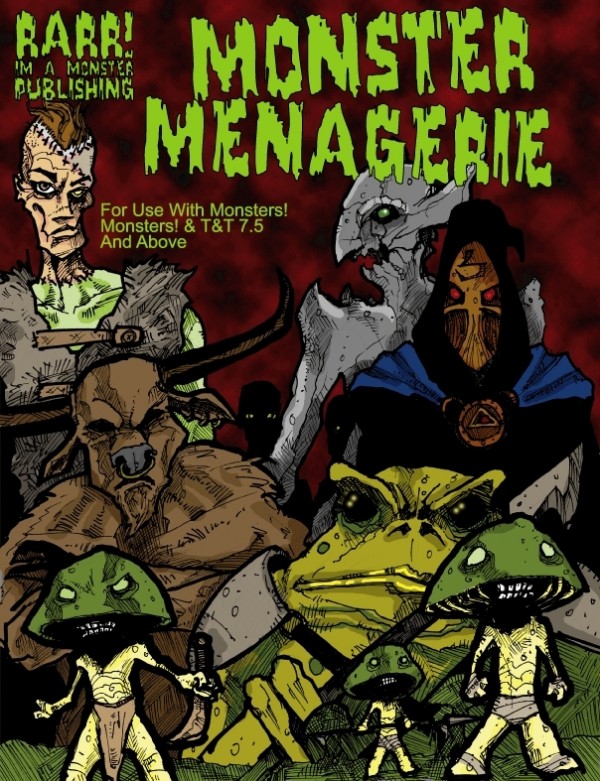 Well, our old friend James (Jim) Shipman of Outlaw Press, who happily steals other publishers’ products, art, etc. is back with yet another scam. You can read about all his Tunnels & Trolls thievery in these old articles. And he’s back at it, as seen in Bleeding Cool News, stealing someone’s products again, a “Monster Menagerie” product from a small publisher, and he boldly states there’s more to come in an email to the artist that complained.
Our lovely IP laws only exist to protect Disney and other large corporate interests. Everyone talks about “class action lawsuits!” and the like but you’re talking about huge money and mobilization to try to get whatever $200 is in the accounts of some scumbag in Lawrenceville, IL. You can rip off the little guy blatantly and mercilessly. Resign yourselves to it. This has been going on for 5 years now.
The only real defense is for all of you to go after his Internet footprint – if you’re an affected publisher or artist send a DMCA takedown notice to his ISP/Web hosts; everyone is welcome to complain to the abuse line at anywhere he uses for email, Web, DNS, etc. At least that could drive him to prefer whatever other petty crime he commits back in Illinois. See the back issues for various emails (currently Jimship2@frontier.com), eBay seller IDs, and IP addresses he uses (4.59.106.0-255 is popular, which is Level3 in the Little Egypt region of Illinois) – and be aware he likes to post fake comments to sites claiming to be from other companies, vandalize Wikipedia entries, etc. He currently conducts his online sales from http://www.outlawpressinc.com via PayPal as op_publishing@yahoo.com. A WHOIS gives what appears to be his parents’ address in Lawrenceville, IL.
Feng Shui, by Robin Laws, one of the coolest games in RPG history. Well, it’s coming back, and you can get in on the Kickstarter! Which is like 300% funded after being live for an hour. Give up on collecting boots from goblins and be a real action movie hero, Chow Yun Fat style (or someone else for you kids nowadays).
Here on Geek Related, I dish out the shame when it’s due but also the props when they are due. In D&D 4e, the “kid-proofed” version of the Rust Monster prompted me to write the ever-popular article Mike Mearls Strangles Realism In D&D Like It’s An Unruly Hooker. Go read it to find out why.
But today in Forbes, there’s a preview of the new fifth edition rust monster. And you’ll be happy to know it’s 100% hooker safe.
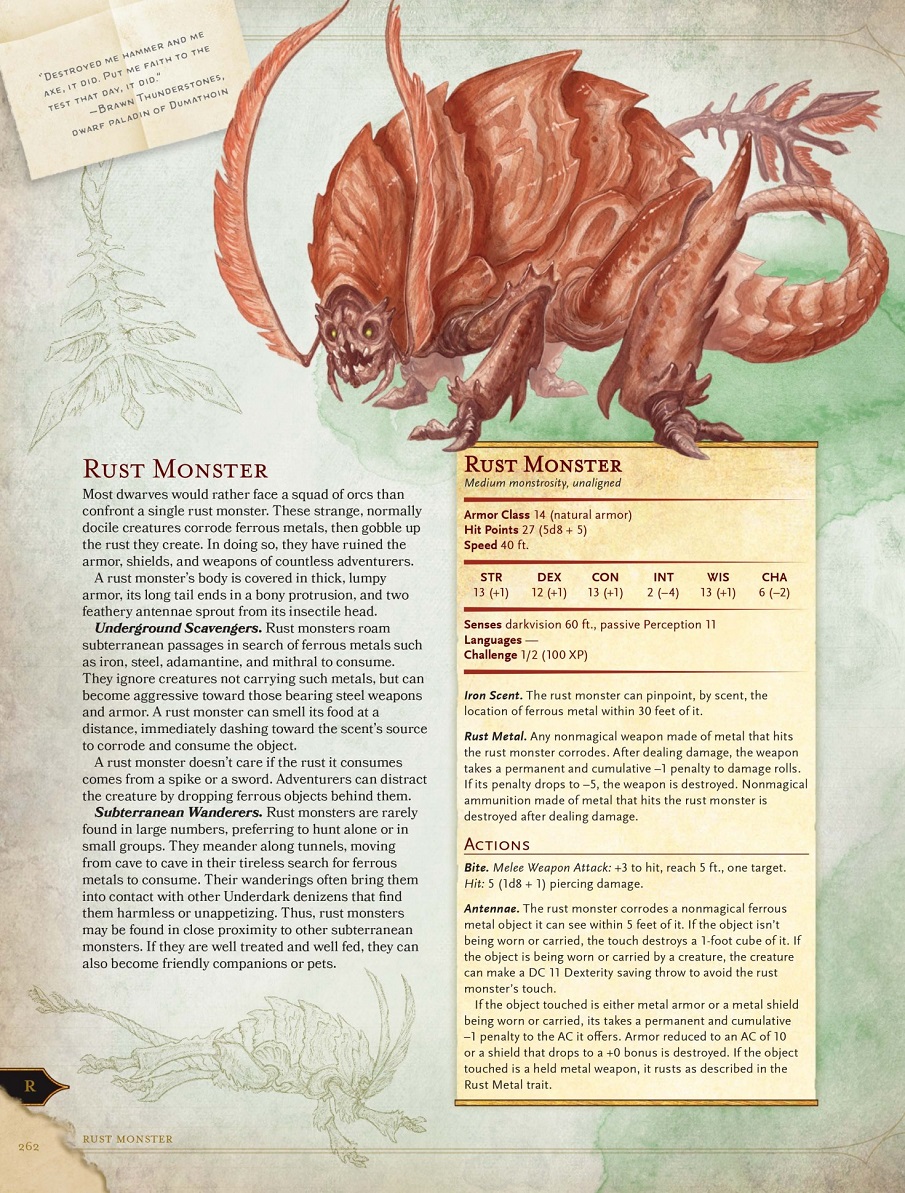 Well, OK, maybe 90% hooker safe. In earlier editions, if the weapon rusted, bam, that was it. Your +5 Holy Avenger is so much brown dust. Here you get the progressive -1’s before it’s destroyed. So it’s definitely nerfed from some other incarnations of the Rust Monster. But that’s still a far sight better than 4e’s “oh, you can always just get it back afterwards” approach. I imagine there will be some way to fix a rusted weapon – there’s not a spell for it yet, but I imagine the second level make whole spell will return eventually. But that’s fair enough.
I’m not quite done with digesting 5e yet, but it’s clear the game has at least come back into the general design space we expect from Dungeons & Dragons. So let me clearly say “Thanks, Mike Mearls!” I, and I think I speak for a good batch of other gamers here, appreciate that you could see that a good portion of the critique of 4e wasn’t just “grognards that hate change” or “trolling for kicks on the Internet” but was the thoughts of real gamers who honestly wanted to help improve the game. Well done, and thanks for listening.
[Edit: Well, I missed the fact it was “nonmagical weapons” only. 5 shots to get rid of nonmagical only is still pretty crappy and nerfed. It’s not as psychotically anti-simulation as the 4e version but – sorry Mike, demoted to “beating” (still better than “strangling”).]


 Geek Related