Game Geeks has a comprehensive, albeit negative, review of D&D 4e. He echoes my concerns about back compatibility, role pigeonholing, etc. There will be a Part 2 next week.

Game Geeks has a comprehensive, albeit negative, review of D&D 4e. He echoes my concerns about back compatibility, role pigeonholing, etc. There will be a Part 2 next week.
I read a lot of RPG reviews from many good sources – RPG.net is my favorite, but there’s a lot of places hosting them out there. I’ve written a fair number of RPG reviews myself over the years.
Roger Ebert has issued a blog post called “Roger’s little rule book” for film critics, describing ways in which he feels film reviewers should write and behave in order to best serve the public who reads their reviews. I think many of his points are equally valid for RPG reviews! Except that no one’s flying RPG reviewers anywhere first class, sadly. Anyway, if you write reviews, give it a read.
I came across a link to this today and have promptly lost track of where that was, so first, props to the unknown blogger or columnist who brought this to my attention.
Anyway, it’s a free e-book on Lulu called “A Quick Primer For Old School Gaming.” I’m not normally into the retro-gaming movement, but I think this is important because it focuses not on the specific “recapture exactly how old D&D felt in my youth” aspect of it, but instead very incisively points out four things – conceits, if you will – that distinguished gaming back in the day and that perhaps we are starting to miss more and more.
The author, Matthew Finch, calls them “Four Zen Moments.” They are:
I agree with all of them, but the first is the most important. I really saw it when I ran some AD&D 2e recently. Without rules for micromanaging how many fricking inches you can jump, the game flowed faster and I as the DM had a lot more flexibility to make judgement calls – and to also use those to nudge the story. And we didn’t use a battlemat, which made combat alive again.
Some of these aren’t universal goods, like “Heroic, not Superhero.” Superhero games are fun too – Feng Shui was liberating to me because all the PCs start as ultra powerful badasses, so you are freed from the level grind mindset that too much D&D inculcates. But I do like some low level stuff in my D&D – heck, I remember fondly the “zero level PC” rules that came out from time to time (Greyhawk Adventures, IIRC, was my favorite). I do think that’s a weakness in D&D now. If you want to start as studs, then start at level 5 or whatever. But the approach of making level 1 superheroic denies an entire play style an opportunity.
Anyway, good stuff, and worth mulling over.
It’s a simple question. Where do you go to find good reviews of RPG products, so you know where to spend your hard earned dollars?
The answer, however, isn’t so simple. But as a guide, here’s some of the key places to go read RPG reviews, with some reviews of their reviews! (Oh, I can be so meta).
RPG.net. RPG.net is the site I prefer to submit my reviews to. They print reviews of anything – a given week may have reviews of super mainstream D&D products, other established products like HERO, independent games, super old games, totally fringe PDF games… Their volume isn’t huge but is larger than most, maybe 2-5 RPG reviews on every Monday and Friday, but they are notable for having the most complete reviews. The average RPG.net review is long, steps through each chapter of a work, gives summaries and analysis and opinions – there’s not a formal standard, but the understood bar of review quality is the highest of all the review sites. They also do board game reviews and occasional “other” (book, game) reviews. Annoying in that you can’t edit your reviews once you submit them, but nicer than average in that the reviews section isn’t just a forum, it’s real pages.
TheRPGSite. This site has fewer reviews, maybe a couple a week, just put into a forum. The reviews are also in depth, and lean more towards non-mainstream games but non-“indie” in terms of the formalized FORGE/Indie Press Revolution crowd. Reviews are pretty much all RPG. A larger percentage are by a core set of people, especially RPGPundit, so you may agree or disagree with the reviews in bulk based on your philosophical leanings.
ENWorld. Higher volume (a fistful every day), in a customized forum. Some are comprehensive but some are shorter. This part of ENWorld was dead a while and has just relaunched so I’m unsure about the sustain rate on it, and the historical review database is offline. They also have sections for lots of non-RPG stuff. Much more d20-oriented than the other review sites.
RPGNow. Loads of volume; most products in their catalog have a couple reviews at least. The down side is that most are a short paragraph at best. Here’s a representative example. But the star rating and number of readers is surfaced on the product page, so you can quickly see the popularity and average opinion of the game.
I had heard that the new Clone Wars animated Star Wars movie was “the suxxorz” via Ain’t It Cool News (no link because the review was taken down due to studio embargo) and other such sites. Even Ebert ripped the movie a new one. I was ready to believe it; I think Lucas somehow went crazy in the long intermission between the two trilogies, and I hated the second trilogy with a passion, especially Phantom Menace. In fact, I bet you didn’t know this, but your friendly Geek created the Death to Jar Jar Binks Home Page, which gained some popular and media note following the release of Phantom Menace. So I was quite prepared to stick it in and break it off Lucas with Clone Wars. I hadn’t planned on seeing it at all, but I took a father-daughter day with my six year old today and she wanted to see it; it’s the only new kids release out. “I saw Space Chimps for her, I guess I may as well see Clone Wars,” I thought.
“This is more betterer than the real people ones,” she whispered to me halfway through. And I have to say, I agree. Clone Wars wasn’t bad at all. In fact, it was kinda good.
Finally we reach the last chapter in our Dungeons & Dragons Fourth Edition Player’s Handbook readthrough with rituals.
Rituals is a new thing for 4e. Because the old spellcasting system has been retired and what are called “spells” now are really just powers like any other class’ powers, a lot of old effects didn’t really fit in the powers system. These range from the more-utility-than-utility like Arcane Lock to the old favorite Raise Dead, to magic item crafting.
Rituals are found in books or scrolls, like spells in older editions. But you don’t have to be a spellcaster per se to use them, you just need the Ritual Caster feat (and that’s only to do them from books; anyone can cast one from a scroll). In general they take a while to cast and use up some kind of expensive component. Rituals are lightly skill linked – some use a skill check to gain a better result, but many don’t really use or require the listed skill. They have a minimum level needed to perform them.
I think rituals are pretty neat; they have the potential to make memorable effects (like Raise Dead) more memorable.
We’re closing in on the end of our chapter by chapter dissection of the Dungeons & Dragons Fourth Edition Player’s Handbook. This time – combat!
Much of this chapter is familiar to players of any edition of D&D; I’ll stress the differences (being an intro to D&D for noobs is beyond the scope of this readthrough). Most of it is familiar, only different in the fine implementation details. As we get started, everything sounds familiar:
Much of the meat here is in the definitions. 4e isn’t’ quite as “definition based” as Spycraft 2.0, which went from a good game to an exercise in tedium in one version, but it makes a stab at it – your old Magic: The Gathering playing skills will serve you well in terms of strict interpretation.
After the awfulness that was the magic item section, we resume our readthrough of the new Dungeons & Dragons Fourth Edition Player’s Handbook.
The first section is “Quests.” These are the new way they’re factoring adventures, into multiple “quests,” where a quest has a goal and a reward. It refers to the DMG for more, but I don’t really like the MMORPGey feel – a player can propose a quest for the DM to vet to get a “stake in the campaigns’ unfolding story.” Maybe it’s grumpy grognard-itis, but I don’t recall my characters needing specific rewards offered to “find my mother’s remains in the Fortress of the Iron Ring.” I’ll withhold judgment till DMG readthrough time.
Next, they discuss encounters, artificially separating them into combat and noncombat types. This seems like an odd artificial distinction to me, but is apparently because the DMG has separate rules for “skill challenges”.
Experience points. They cap out at 1 million (30th level). Same deal as in all previous editions otherwise. Except that when you level you go “ding”, glow with yellow light, and immediately go to max hit points. (No, not really.)
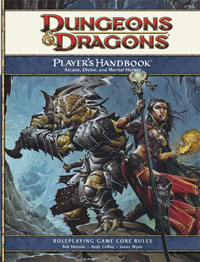 Dungeons & Dragons Fourth Edition has hit stores, but as my readthrough review shows, you probably shouldn’t bother with it (see the “4e PHB Readthrough” posts on this blog for the nitty gritty). It’s a World of Warcraft-inspired tactical combat game, very unlike (and incompatible with) previous editions of D&D.
Many people love to attack the bearer of bad news, so let me be clear about my background. I’m not one of those D&D-haters, or someone who has only played Third Edition and therefore can’t believe anything might be an improvement. I’ve gamed since the early 1980s, starting with Star Frontiers and quickly moving to the D&D Basic set, and happily migrating to AD&D first edition, AD&D second edition, and D&D third edition. Each time, the new version of D&D, with its improved elegance and increased options, easily sold me on being an improvement on the previous version, and I was happy to upgrade! My bookcases still bear the weight of more Second Edition gear than anything else, just because they published the most product ever in that generation – but except for repurposing adventures those books lay fallow after the upgrade. I view players of “1e derivative” products like Castles & Crusades and OSRIC with pity; I enjoyed my First Edition days but I don’t find that I want to go back there.
I’m also not a D&D-only guy – I’ve played everything from Deadlands to Feng Shui to Call of Cthulhu – I have several Cthulhu Master’s tourneys under my belt and have playtest credits in things as farflung as “Wraith: The Great War.” Check out my RPG reviews – they’re pretty widespread. I also can’t be accused of being just a “collector”, I play all the time. So I think I know RPGs in general, and D&D in particular. I don’t have a (previous) bone to pick with WotC. I helped launch 3e as one of the original Living Greyhawk Triads at Gen Con 2000. OK, so enough about my credentials.
4e is the first time I thought of D&D, “Whoa – this isn’t going in the right direction.”
In this installment of our read through of the Dungeons & Dragons Fourth Edition Player’s Handbook, we take a look at equipment. Every class starts with 100 gold to equip themselves, a welcome reduction in complexity from the class-based random roll that still persisted in 3e.
Armor has the first big changes. It’s divided into light or heavy. With light armor, you add your Int or Dex modifier, whichever’s higher, to your AC. With heavy armor, you don’t.
Even mages are proficient with cloth armor, which though it doesn’t give an armor bonus, can be made of special materials or gain enchantments that do. That’s pretty elegant.
Another day, another twenty pages of the D&D Fourth Edition Players Handbook, read and broken down for your deviant pleasures. This time, it’s Chapter 5: Feats.
Feats were the “big addition” in the Third Edition rules. Other games had done them, but this was the first time D&D had done anything like it.
As expected, you get many more feats in 4e. One at every other level, and one at 11th and 21st to boot. They break feats down into Class, Divinity, Multiclass, and Racial. There are also general feats, but that’s not officially a category. They are also broken up into Heroic, Paragon, and Epic levelled feats – you can’t take feats from a higher tier.
Welcome to the latest installment in my blow-by-blow readthrough of the new Dungeons & Dragons Fourth Edition Player’s Handbook. Or as those of us “in the know” (read: geeks) call it, the D&D 4e PHB.
Chapters 1-3 started out promising enough, until the classes section in Chapter 4 took a far left turn for World of Warcraft territory. Let’s see how skills work now in 4e.
For those of you who are “utes,” back in the day D&D didn’t have anything like skills. They were introduced in rudimentary fashion in Second Edition and became a full-fledged system in Third Edition.
 | mxyzplk on Frog God Hero Lab Files |
 | screamindave on Frog God Hero Lab Files |
| mxyzplk on Dungeon Crawl Classics –… |
 | Dieter Zimmerman on Dungeon Crawl Classics –… |
 | sopantooth on Dungeon Crawl Classics –… |
| mxyzplk on Dungeon Crawl Classics –… |


