Tag Archives: RPGs

Using Images As Visual Aids In Your Game

I buy a lot of PDFs, especially the Paizo Adventure Paths where I get the PDF free with the book for being a subscriber.  I have taken to making a lot of printouts as props for my game.

It’s a shame for the players never to see the beautiful character art for the NPCs.  Or else you have to fold the book over, hand it around, and tell them “Don’t look at the stats on the same page!”  We’ve done that, and it’s time-consuming, sometimes hard to see when the DM just waves the picture around…

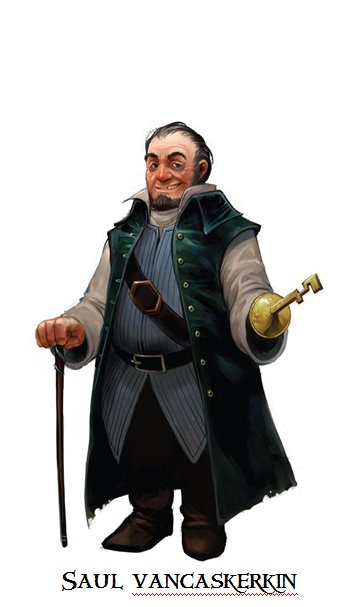
Also, I get a lot of “How do you spell that weird character name?!?”  So I’ve cut to the chase, and before a game session I create a bunch of printed strips that I can fasten to the outside of my GM screen with binder clips (bulldog clips to you Brits).  It’s sweet – when the party meets their new buddy Saul from the Second Darkness adventure Shadow in the Sky, and I whip this out and clip it to the screen:

Saul

Then in later scenes, I clip whoever’s present to the screen.  It provides great visual cues of who they are talking to and what their name is, cutting down on the “Tell…  Sully, or Slim or whatever… that we accept!” And too often PCs forget NPCs that are even in their party.  Have you ever had a PC group say, two combats later, “Oh yeah, what about your follower Gerald?  I guess he’s been tending the horses or something.”  Out of sight, out of mind.  Even if you don’t have images, at least print out the names and post them up.  (As an aside, we find ourselves doing this at work for people on conference calls – it makes it easier to remember them and incorporate them into the meeting.)

In many published adventures, there’s images for the vast majority of the important NPCs, and when there’s not, Google Image Search comes to the rescue.  “I need a half-0rc wizard.   Hmmm… <types “half-orc wizard” into Google Image Search>  There we go, the first result!”

Now, there aren’t *that* many easily findable images online.  So this may not work forever, but certainly is enough for important NPCs.  And if you make a habit of ripping them you can have a library of ready-for-home-use images.  You can probably reuse them judiciously in other campaigns.

Extracting and preparing them for use isn’t as easy as it could be.  Next time, tips and tools for preparing these little beauties.

I Like Random Generators

As I prepare to unleash my PCs on a new city tomorrow, I am prepping up a storm.  I hate being caught short without NPC names and descriptions.  Luckily, there’s a lot of nice random generators out there that can provide you with an invaluable list of a dozen or so ready to go people.  Then, you just pull the one out of the top five or so that seems most applicable to the situation, whenever the PCs grab some random bar patron/messenger/guild thief/whatnot aside and you want them to be more than a stock nameless/faceless prop.

I’m using the Seventh Sanctum description generator and a Yet Another Fantasy Name Generator, freely mixing and matching for first and last names.  In short order, I have a list of potential NPCs like:

Angborn D’Evrona

This serious gentleman has large eyes the color of blue tropical waters. His luxurious, straight, brown hair is worn in a style that reminds you of a fluttering flag. He has a slender build. His skin is china-white. He has small hands. His wardrobe is sexy, and is completely gray.

Now, they do start sounding weirdly the same, so you have to finesse them in use, but it’s a great starting point that saves me thirty seconds of trying to remember some guy I ran into at the grocery yesterday to use as a good NPC description starting point (though that’s also a good exercise; over a week note down your first impressions of people you run across for later use…).

As a second pass, I use Chris Pound’s name generator to get some epithets to sprinkle in, and edit the descriptions to include styles it clearly doesn’t have (e.g. people have hair or are bald, but there’s no balding/thinning people, so I edit one of the bald guys to be partway…)  But what if a couple of these guys end up needing stats?  Well, Myth Weavers has a random NPC stat block generator.  I throw in a second level male rogue, and get:

Tahir, male human Rog2:  CR 2; Size M (5 ft., 10 in. tall);
HD 2d6+4; hp 16; Init +2; Spd 30 ft.; AC 12; Attack +2
melee, or +3 ranged; SV Fort +2, Ref +5, Will +2; AL LE; Str
12, Dex 15, Con 14, Int 10, Wis 15, Cha 8.

Languages Spoken:  Common.

Skills and feats:  Appraise +2, Decipher Script +3, Disable
Device +2, Disguise +4, Gather Information +4, Hide +6,
Intimidate +3, Knowledge (Local) +3, Listen +4, Move
Silently +7, Sense Motive +6, Spot +9, Use Magic Device +2;
Alertness, [Evasion], Weapon Finesse.

Possessions:  2,000 gp  in gear.

Primary motivation: Boredom. The character has no other
reason than their life is otherwise uninteresting.

Secondary motivation: A deep hatred of the Evil. The
character's hate runs deep, and dominates their personality.

Recent Past: The character has been visting a friend in
Verbobonc.

Helpful!  Obviously there are little bits to change.  But there are great bits too; sometimes random generation is awesomely wise.  This guy is LE but is motivated by a hatred of evil!  That’s a great character hook, an interesting “I’m not evil, I just use these harsh methods to combat true evil” thing.

I want the perfect Pathfinder random generator.  Pathfinder, and Golarion, are so new there’s not really good generators tuned for their ethnicities and suchlike – specifically Chelaxian names and descriptions, specifically Varisian, et al.  And all these generators do one thing and not the other – some do good names, some do good stats, some do good descriptions, some do good personalities – but none do more than 1-2 of those at a time.

My wish list:

  • Support Golarion (and other) ethnicity naming schemes.
  • Support Golarion (and other) ethnically tuned descriptions.
  • Support Golarion (and other) locations – for example, we know the general racial/ethnic makeup in Taldor, so let me roll a random Taldan!
  • Support Pathfinder (and other) stats
  • Do name (including epithets), stats, description, and personality.
  • Let me fix anything I want and then randomize anything I want.  If I don’t want to pick race, roll it for me.  If I just know I need a redhead, or a female rogue, or someone named “Bart,” pull the rest.
  • Let me do a little multiple choice – often a randomly generated NPC has bits of “bleah” in them.  Gen maybe 5 choices for each field into a popdown, and if I don’t like something I have a quick-pick to modify.

Eighth Alternity “The Lighthouse” Session Summary Posted

Eighth Session (14 page pdf) – We return from a six-week hiatus to our Alternity-based campaign aboard the space station Lighthouse!  First, half the players were gone, then the GM was, but now we’re back on track.

Back on the Lighthouse, a gambling scam leads into a mystery.  The hot naked chick from Session 1 is back, and is accused of murder and sabotage!  Needless to say, we all vie to prove her innocence.  Cops!  Aliens!  Spies!  Massage parlors!  All we’re missing is Lennie Briscoe.  WE MISS YOU JERRY!!!

The gambling tournament was run by the GM completely off the cuff.  It was fun, though a bit anticlimactic when we all washed out.

I want to brag on myself about our escape plan after robbing the gamblers.  I read the Lighthouse supplement way back when.  So were in this massage parlor playing cards, and the pirate captain lady came up and started talking about stealing the money – and I totally had this flash from the past and asked, “Wasn’t there some massage parlor on the Lighthouse that has a hidden airlock in it?  Is this the one?”  Well, it was.  “Hey, baby, how about you get someone from your ship to bring some spacesuits over to this airlock.”  Ding, automatic escape plan!  All the other players looked at me like “Where the hell did you pull that out from?!?”  Setting details FTW!

Then the murder mystery was fun.  Though when Chris (Rokk Tressor) theorized that someone had just incinerated a piece of the alien chick to put her DNA at the scene and was really rendering her, Paul (the GM) replied, “No, but that would be a better plot than this one!”  We’re happy Angela Quinn is back, we really enjoyed that first adventure where we were motorboating around Bluefall with her.

Oh, and we’ve levelled up – check out my warlion at level 5 and the Captain at level 4!

Reavers on the Seas of Fate – Third Session Summary

Our aspiring pirates get their first taste of honest ship-to-ship combat in the third installment of our Pathfinder campaign, Reavers on the Seas of Fate – “Water Stop.”

Third Session (12 page pdf) – The crew of the Albers goes foraging on an island to replenish their stores, and comes across some escaped slaves.  Of course, the Chelaxian naval frigate bearing their former owner arrives shortly thereafter.  Just as they discover a goblin pirate ship!  It’s hot three-way action in a naval boarding action.  And then it’s off to Riddleport!

This was a stretch session.  I had planned for them to get to Riddleport and get into that this session, but the character who has lived in Riddleport and has most of the hooks for them wasn’t going to be there.  So I figured I could expand the travel part enough to fill a session.

Leafing through some random supplements, I found a couple things that struck a chord.  In WotC’s Stormwrack, there is an adventure called “The Sable Drake,” basically an encounter with a goblin pirate ship.  I had thrown some canoes full of goblins at the PCs last time, supposing they came from a village on the nearby island.  By converting those to goblins on two ship’s boats from the Sable Drake, it was a lead-in.  Then in Atlas Games’ En Route II: By Land Or By Sea, there’s an encounter called “Water Stop” detailing some escaped slaves hiding on an island; the PCs meet them and then their old master shows up looking for them.  This was perfect; I wanted to start pulling in elements from PCs’ backgrounds, and most of them have a beef against the Chelaxians.  Ox had been the slave of Captain Marcellano, a Chelish seafarer.  Thus I mixed the two together.

It wasn’t too hard to convince them to go onto the island and poke around; they thought maybe the goblins came from there and they’d get to kick some more ass.  They came across the slaves and managed not to kill them (the way the encounter’s written is that the poorly armed commoner-type slaves surround the PCs and try to get them to surrender to figure out if they’re likely to rat them out; somewhat dangerous in that often PCs take any manner of threat as an invitation to maximum overkill).  The slaves tell them about a “weird black ship” in a hidden cove and then the Chelaxian Navy ship Raptor appears and approaches the Albers to see if they have seen some missing slaves.  Soon, they’re both going after the goblin ship, who the PCs finger as having drug off a bunch of escaped-slave looking people.

Really, the tough part about all this was that in Golarion, goblins are all total meatheads.  It was hard to believe they could pilot a ship, even with a wererat captain and a handful of adepts.  But hey, you work with what you’re given.  I changed them substantially from the “leet ship” in Stormwrack to a barely actionable converted fishing ship.

In the end, everything worked out for the PCs and the slaves.  The PCs hoped that the goblins would whittle down the Chelaxian marines enough that they could take them; they were quickly disabused of that – one of the things I wanted to get across before they took  up their future life of piracy is that the Chelaxian navy is no one to screw with. They were pretty sober as the goblin ship took three massive broadsides and sank to the bottom.

The noble was Marcello Marcellano, the son of the guy who owned Ox.  I expected him to go to greater lengths to try to kill him, but he played it cool.  A shame, I built a pretty good 4th level swashbuckler using the new class from Tome of Secrets (Adamant Entertainment) and the duelist feats etc. from Way of the Duel (Sinister Adventures).

They went back and started diving the goblin ship for loot…  It was funny, they encountered a reefclaw and after beating it all borked their Knowledge: Nature checks so that they were “sure those things live in large colonies!”  (They’re solitary).  They made the checks in the open and came up with the alternate interpretation themselves.

Selene, Vincenz, and Thalios Dondrel son of Mordekai are now at large in Riddleport as well, so I’ll have some good NPCs the PCs are very familiar with to use.  Next session’s based on Pulp Fiction!

Request for Comment: Hero Points

Or whatever you want to call them  – Action Points, Fate Points, Karma Points, Plot Points, et cetera.  For reference here’s a good but somewhat dated summary of a bunch of hero point mechanics by John H. Kim.

Here’s the deal.  I want to use something like this for my new Pathfinder campaign.  We’ve been pretty constantly using the Eberron “Action Point” mechanic (Eberron Campaign Setting, p.45) in all our group’s campaigns since we saw it.  You get 5 + 1/2 character levels of them, and they let you add 1d6 (or best of multiple d6 at high levels) to a roll before you know whether it’s successful or not.  They work pretty well.  But I’ve begun to be dissatisfied with them.

I noticed it some in Rise of the Runelords and even more in Curse of the Crimson Throne that we’d end a level with a lot of action points left over.  There were a couple reasons.

1.  You would hoard them “just in case.”  This was somewhat mitigated by them refreshing every level, but you didn’t know when you were going to level.

2.  They didn’t do all that much – you wouldn’t use them unless you were ultra desperate or thought you were within 3 points of the DC you needed.  As levels get higher and numbers range more widely, a lot of the time you knew there was no point in using the action point on a given miss.

3.  Because of the inconsistency of the core D&D mechanic in terms of what is a d20 roll you are making and what isn’t, you could use them to make a save but not to not get hit in combat, so their utility in saving your bacon was reduced.  Though you can use an action point to stabilize when at negative hit points, again as levels get high it’s rarer a shot lands you in that magic 10 point range; it’s more likely to overkill you by like 30 points when it comes.  D&D 3.5e number scaling past level 10 is a cruel mistress.

4.  The APs tried to give hero points of their own, like Crimson Throne had Harrow Points that gave bonuses to a different stat with each chapter.  This was frustrating in and of itself when the stat was a poor match – as a priest, fighter, and ranger was the party most of the time, I was the only one to use the Wis and Cha boosts.  But it also created a “too many different boost points” problem and they got totally forgotten most of the time.

5.  It was a buzzkill when you used one and still didn’t make the roll.

We’re also playing Alternity, which has Last Resort Points.  These points are better in some ways.  They’re worse in that you get from 0-2 of them and they don’t regenerate with level, you have to buy more with XP, which means they’re too scarce.  They’re much better in that they just flat turn a failure into a success (or boost a success to a higher level of success).

Also, some systems (like PDQ Sharp’s Style Dice) let you use such points to make actual narrative plot changes with points.  “A Chelish warship appears on the horizon!”  “Our old ally Vincenz shows up!”  “The dungeon passage collapses!”

So there’s a couple different axes that a hero point mechanic can work on.

  • How do you get them/how do they regenerate?  (Buy with XP, when you roll a crit, when you roll a fumble, when you do something cool, when you act according to some character trait, when you level, every game session, per adventure)
  • What can they do?  (Reroll, small fixed bonus to roll, small variable bonus to roll, large fixed or variable bonus, automatic success level upgrade, change plot/world, activate powerz, make a save/get missed/soak damage, get init or an extra action)
  • When can you use them?  (Before you roll, after you roll but before you determine the result, after you determine the result)
  • How many does someone get and how often can they use them (anytime, once per scene, once per session, something else)

Here’s what I’m thinking about doing.

First, I want the points to “do more” – ideally fully turn a miss into a hit or whatnot, not add on a small bonus.  Seems to me that the mechanic’s not worth having unless it does this much; otherwise it’s a lot of fiddliness (and worse, a breaking out of immersion) without enough punch to justify it.  So one option is that the points are fairly rare, but can:

  • Turn a miss into a hit
  • Turn a hit into a crit
  • Turn a hit into a miss (usually, if you’re the one getting hit)
  • Turn a crit into a hit (same)
  • Make a save
  • Make a target fail their save (maybe…  but maybe not.  With save-or-dies seems too powerful.  Maybe make a target reroll their save.)
  • Bypass SR
  • Override a bad condition (possessed, feared, paralyzed, etc.) for a round
  • Otherwise “save your damn life” somehow

However, one of our group has an interesting alternate proposal – that the points go up in efficacy as you use them.  First point you use is a +1 (or -1 on an opponent’s roll).  Second point, +2.  And so on.  This is a clever way to both ramp up effectiveness over time (I’m neutral there) and to discourage hoarding (I’m very on board with that).  It does mean that eventually the points become worth +20 or more, at worst that reduces to auto fail/success but in higher level 3.5e play it may still not be enough sometimes. It is a little more fiddly though, they have to be strongly paced at about two per level.

I’d also like them to be usable to make narrative changes, with DM oversight.  Any kind of hero point is already stepping outside the simulation for an explicitly narrative concern, so in for a penny, in for a pound, I figure.

In general you should give them for behavior you want to promote.  I don’t really like giving them for crits or whatnot, that seems too random and also generates undesirable interactions with crit feats.  I’m doing slow advancement in this campaign, so there’ll probably be a couple adventures per level.  I plan to call them “Infamy Points” to match the pirate theme.  Perhaps give one per level and one per adventure, to semi-reflect the character becoming more bad ass and feared and… infamous.  Maybe bonus points whenever anyone does something spectacular that could rightfully be said to raise their infamy level.

I’m also considering having the Infamy Point total be used as a bonus to certain Intimidate/Bluff/Diplomacy rolls as a kind of raw fame and deadliness bonus, though the problem is that if you get 2-3 per level that bonus gets out of control.  Maybe a bonus equal to unused Infamy Points?

What do all of you think?  Do you use any kind of hero point mechanic?  Do you like lots of them with wimpy bonuses, or fewer with more guaranteed results?  Have any clever ideas for me?

Reavers on the Seas of Fate – Second Session Summary

The second session of our new Pathfinder campaign, Reavers on the Seas of Fate, went off like gangbusters.  Hearken to “The Tale of the Sea Bear.”

Second Session (15 page pdf) – Insanity and chaos reigns as the crew of the Albers investigates the derelict Sea Bear.  Soon, they are turning their suspicions against each other.  And then, things get out of hand.
Later, the survivors struggle against the uncaring sea and the fury of random encounters!

This is the second part of the intro adventure I was running as a heavily modded combo of Maiden Voyage (3e, Atlas Games) and the new Mysteries of the Razor Sea (3.5e, Sinister Adventures).  In this episode, the PCs board a ghost ship that had its mainmast replaced with a native totem pole.  As you might expect, things started getting weird fast.  I was impressed with how much the players went with it – I started passing them notes about “You think person X is acting suspicious” and they just up and started stabbing one another.

Fun scene – Ellis went running down into the hold to stop Ox and Bull, and Ox failed a Perception check so he got “a figure suddenly looms behind you in the hold!”  He stuck his pike right through the poor sea dog’s chest.

The biggest DM dilemma I faced was when the PCs had the good idea of tossing the skeletons overboard.  The skeletons, incidentally, were the new Pathfinder “bloody skeletons” that have fast healing.  I had the totem pole raise them back to full unlife with two rounds of its drumming (it couldn’t attack with animated objects during those rounds).  So Chris, quite innovatively, dumped them overboard when killed.  The big question – can a skeleton swim?  I ruled yes just to keep the heat on, but await the rogues’ gallery’s dissection of the physics involved.

I’m really happy with how the NPCs are working out.  Thalios Dondrell and Vincenz especially are being treated like “real people.”  In find that by portraying NPCs as competent, but not infallible Mary Sues, PCs respect them – it’s just that most NPCs you meet in games are such one-dimensional chumps, they don’t get that.

After the ghost ship, a pretty large percentage of the crew was dead, including the navigator.  I am using a combination of the Stormwrack (WotC) and Broadsides! (Living Imagination) sea/shipfaring rules, so as they wandered the seas they exercised their skills trying to follow the charts and keep safe and on course as storms hit.  They weathered a big one, but got blown somewhat off course and got their rigging fairly jacked up.  They’ve come up on some islands they think delimit the Gulf of Varisia and stopped in a cove to refit, and had a more lighthearted combat with a dozen demented goblins.

I love the Paizo take on goblins; they are well and truly insane.  Dangerous in their way, but spend half their combat actions running around like butt monkeys instead of actually fighting.  One clambered up to the crow’s nest and was doing the Pantsless Goblin Victory Dance over the shrieking Old Pete when Ox finally got to it.

Seems like everyone enjoyed themselves!  Wogan was happy to get a wheellock pistol off the dead captain of the Sea Bear, Serpent was happy that his snake had the biggest kill count in the goblin fight, Ox liked being able to go nuts and kill allies, Sindawe liked the massive combat, and Blacktoes… liked fleeing a lot, I think.

As a final bonus – it turns our our group played Maiden Voyage once before!  I didn’t remember because I was a player then and GMing now, and it was like four years ago.  Here’s the session summary of our Eberron party going through Maiden Voyage! I think you’ll see some similarities and some differences…

Meet the Reavers – Wogan, Chelish Sea-Priest

Wogan, Patrick’s character, is a hearty priest of Gozreh.  Everyone especially loves his illustration and it causes Chris to imitate Yosemite Sam-style pistol firing anytime Wogan makes a pronouncement.

Wogan

woganWogan is a Chelish man of average height and a bit more than average weight.  Intense black eyes and a full beard braided into tendrils tied with small white bows are his main features.  He usually wears a vest and blue and white vertically striped pantaloons.  When expecting trouble he dons his blue-green studded leather armor, a pair of pistols, boots and his trusty trident.

He was born in a small fishing village near the southern end of the Arch of Aroden.  His father died when Wogan was young, lost to the sea.  His mother lived with his elder brother’s family.  He has a younger sister whom he hasn’t seen in years as she was married to a man from the Chelaxian interior.  After his mother died, there was nothing holding Wogan to his small village so he signed up with the first passing ship as a healer and sea-priest.  It’s easy enough for him to find work; every ship wants a Gozran priest if they can get one.

Wogan’s hobbies include fishing, drinking, and placating the fickle god Gozreh.

Meet the Reavers – “Serpent” Ref Jorenson, Ulfen Druid

Paul was our GM for the last couple Adventure Paths, but he gets to play this time!  He decided to go with an Ulfen character, the Viking analogue in the world of Golarion.  This somewhat-crazed druid is definitely pirate material.

Serpent Jorenson

serpent“Serpent” Ref Jorenson is an Ulfen man with pale skin that never tans or burns, pale blue eyes, and dark hair.  He is very tall and long of limb and tends to hunch over, making him seem very spiderlike when he moves.  His combat gear is a scimitar and  hide armor.  He has a very large pet constrictor snake called Saluthra.

His father, a man from the Lands of the Linnorm Kings, seduced his mother,a beautiful traveller, when he was young; a year later a baby was deposited on his doorstep.  Rumors tell that the woman is a witch or fey from Irrisen.

Ref felt a strong pull towards the sea all his life.  The song of Gozreh compels him to wander the land and sea.  He loves to spin tall tales.

Reavers on the Seas of Fate – First Session Summary

We’ve already had our first session of Reavers on the Seas of Fate, entitled “Maiden Voyage.”

First Session (12 page pdf) – The characters, still lowly seamen, meet for the first time upon a poorly-disciplined ship, the Albers, bound to Riddleport from Kintargo.  With women on board and gambling and fighting allowed, it’s only a matter of time till the captain turns up dead, filling the crew with mutual suspicion, and then a mysterious ship comes out of the fog…

For this first adventure, I combined the old Atlas Games 3e scenario Maiden Voyage and the new Sinister Adventures pdf Mysteries of the Razor Sea.  Both are first level ghost ship scenarios; Maiden Voyage focussed more on the ship and crew the players were travelling with.  Mysteries of the Razor Sea was totally about the ghost ship – it had more horror and is tougher.  So I felt they complemented each other well; basically I am using the ghost ship from Razor and everything else from Maiden Voyage, with some changes to lead in to the next part of the adventure, which will be in Riddleport.  Entertainingly, the crewman “Bull” was actually named “Ox” in the adventure.  I considered letting him keep it and having him and the PC “Ox” really hate each other in the same way chicks wearing the same dress to a party would, but even with the minor name change they’re both bald Garundi and I got a lot of the same dynamic.

As a side note, lots of the Atlas Games stuff is on clearance sale at paizo.com and it’s good material.  Besides this adventure, I may use some of their other scenarios like Three Days to Kill, and I’m using Nyambe: African Adventures to flesh out the Mwangi Expanse.  Heck, if I decide to cross the sea to Arcadia I may use Northern Crown: New World Adventures.  Stock up while it’s cheap and still available!

I felt the first session went well – I thought we’d get a lot farther, but the players got into the interaction with each other and the NPCs; we played three hands of the card game Skulls, investigated the death of the captain…  There were only two very minor combats, a boxing match between Bull and then the PCs helping to subdue Bull when he attacked the first mate, convinced he had murdered the captain.  The rest was all roleplaying fun!

And it’ll be a great object lesson for when later in the campaign the characters sign on to a pirate charter and read “no women, no gambling, no fighting…”  They will nod sagely to themselves about the wisdom of all these strictures.

Meet the Reavers – Sindawe H’Kilata Narra, Mwangi Monk

Chris is known for his ass-kicking characters.  I mentioned the campaign would probably move south along the coast to the pirate kingdoms of the Shackles and venture into the Mwangi Expanse, Golarion’s Africa analogue.  The Mwangi are thus the world’s Africans.  As in the real world, that’s a meaninglessly general and imprecise term that’s only useful to white people an ocean away; Sindawe is specifically a Bonuwat, a seafaring people who live mainly along the coast of the Fever Sea.  He’s a monk, but not a “kung fu” type of monk; he’s using the Sinister Adventures “Way of the Warrior” pdf rules for a more Polynesian/Samoan inspired type of hand to hand combat.

Sindawe

sindaweSindawe H’Kilata Narra has an exotic appearance – green eyes, bald, jet black Fu Manchu-style moustache, Mwangi, scar tattoos (right arm – beating anatomical heart, left arm – a tiger’s paw raking, various tribal markings on chest and face). Wears a vest stylized to look like a tiger’s head and britches adorned with colorful shells, pieces of glass, and coins (yes, there are streaks of rust). He has a quiver of javelins across his back and many knives in his belt and vest. His feet are bare.  His hobbies are scrimshaw and collecting maps.

Due to a blood feud with the Okeke clan, most of the adult males of Sindawe’s family are dead, presumed dead, fled, or in hiding. The women folk have fled or are living with other families.  His father, Mogaba, was an infamous pirate widely feared for his brutality and cunning and supposedly was slain by the crew of a Chelaxian Q-ship. Mogaba left his family when his sons were still young. His sister and brother-in-law stepped in to help raise them. His mother, Manyara, was slain during the blood feud with Okeke family.  His uncle, Samanya, a reasonably honest merchant, was slain by business rivals from the Okeke family. He taught the brothers sailing during an extended multi-year merchant expedition.

Three members of the Okeke clan slew Samanya and Manyara for reasons unclear even today; some have speculated “ruthless commercial rivalry” or revenge for various acts of piracy by Mogaba.  The feud ended immediately after the Okeke extracted promises of peace from Bolade, Sindawe’s aunt.  Bolade, a famous and honored monk, fled to a remote area of Mwangi interior where she maintains an extended family enclave.

Over the next 8 years Sindawe and his brothers, Mosi and Ochiba, learned martial skills from various sources, sometimes far from home. They re-united on the anniversary and hunted down the 3 Okeke directly responsible for murdering Samanya and Manyara. In the process they slew 2 other members of the Okeke family. Then they hunted down 4 more that were likely to carry on the blood feud.  None of these fights were remotely fair.  Mosi was killed during the final fight. Ochiba and Sindawe and most of the remaining family fled to avoid reprisals.

Sindawe owns a treasure map and pages from a journal showing the secret location of an El Dorado island in the far most western oceans. One of Mogaba’s men delivered the map to Sindawe shortly after Mogaba’s death. To Sindawe this island represents wealth enough to restore his family and a connection to his estranged, dead father. However, he doesn’t fully understand the depths of Mogaba’s evil for the island’s full wealth can only be truly realized if its inhabitants are slain or enslaved.

Meet the Reavers – Tommy “Blacktoes” Burrowbank, Halfling Rogue

I’ve known Kevin for years and gamed with him occasionally, but this is his first time joining our gaming group.  Like many older gamers with jobs, families, etc., he sometimes goes for years without really being able to swing regular campaign participation, but then gets fed up with it and makes the time.  Welcome aboard, Kevin!  Here’s his character, the halfling rogue Tommy Blacktoes.

Tommy Blacktoes

tommyThomas Burrowbank (aka Tommy Blacktoes for his penchant for painting his toenails with black polish) was born to a small family indentured as cooking servants to one of the minor noble houses in Cheliax.  Accused of theft, Tommy’s father was executed and he, his mother (Tish Burrowbank) and his twin sister (Sara Burrowbank) were exiled to survive in the streets of unforgiving Cheliax.  At the tender age of 9, Tommy slipped away from his mother and sister and gained passage on a small trading vessel that ultimately put in at Riddleport.

Tommy has spent the last 4 years of his life living by his wits on the streets of the debauched city.  He is driven by his lust for adventure (fueled by the natural curiosity of his race) as well as a passion for things material.  Tommy also has a burning desire to one day return to Cheliax and exact his revenge against the noble house that destroyed his father.  He envisions finding his mother and sister and taking them away from their poverty, but secretly fears how they will view him (if indeed they still live) for his desertion 4 years ago.

In Riddleport Tommy has made a bit of a name for himself as a jack-of-all-trades.  He earns coin as a crewman to various trading ships that put in at Riddleport, and has developed a love for the open sea.  He is also for hire as a spy for rival merchants of the River District looking to gain a competitive edge, an appropriator of goods (typically lifted from their owner), and a person who knows the latest information – for a price.  His activities over the last couple of years and (his ability to seemingly disappear like a ghost) have unknowingly earned the attention of several of the “crime lords” of Riddleport.  Whether this is a good or bad thing remains to be seen…

Tommy is a rogue’s rogue and has few “true” friends, and only one person with whom he has a genuine, yet reluctant trust: Saul Vancaskerkin, the proprietor of the gaming establishment The Golden Goblin.  He is quite charming and attractive, but uses this to strategically position himself for his own advantage and personal gain.  He is however quite bright and smart enough to know whom to cross and whom to not…usually.

Tommy is 3’2” tall and weighs 32 pounds.  He has long, dirty blonde hair that he wears braided and drawn into a ponytail.  He has striking green eyes that flash when laughing or angry.  Tommy is usually seen wearing a dark blue, silken shirt under a black leather vest, black leather, knee-length pants with leather calf-wraps and spats (another curious fashion statement) over the tops of his feet.  Tommy wears a scarf to match the blue silk shirt wrapped about his head.  He is a fan of gaudy jewelry and trinkets, and his pointed ears sport many studs around their outer edges.  His favorite is a plain gold hoop (the only piece of jewelry with any real or sentimental value as it is the mate for the one his sister wears – or wore).  Tommy is very skilled with his sling staff and prefers to use this from a distance when forced into combat. If pressed, he does not hesitate to defend himself with his sword or dagger (which he keeps hidden in his right calf wrap).

Meet the Reavers – Melako “Ox” Chaalu, Garundi Barbarian

I thought I’d introduce you all to the characters of Reavers on the Seas of Fate.  Here’s the first, “Ox.”  Ox is Bruce’s character.  It’s a bit of an in-joke among the group that Bruce likes to build useless characters – very low powered, and ideally crippled and insane.  Everyone was surprised when he came out with a Power Attacking barbarian!  Well, he is a slave, in a nod to Bruce’s masochist sensibilities.  Without further ado, here’s Ox!

Ox

oxMelako “Ox” Chaalu had the misfortune of being born to a desperately poor family of tenant farmers from the Gamadu clan.  The clan’s holdings are deep in the Rahadoum hinterlands, far up a tributary of the Uta River.  After the rains failed again the clan elders decided that ten of the clan’s children must be sold to a traveling merchant so the rest of the clan could survive.  His parents had no money and no standing with the clan, so he was among those selected.  From there he was trafficked through the slave-markets of Manaket into the hands of Captain Marcellano, a Chelaxian merchant captain and master of the Aroden’s Hand.

Captain Marcellano was cruel and relentless in both his business dealings and his attitude towards his crew.  Under his tutelage, Ox developed both the skills of a sailor and a persistent dislike for life as Chelaxian chattel.  But his time with Captain Marcellano had an ending; as the Captain gained wealth and power he retired to his estates in Westcrown and hired others to run his ships.  As part of these changes, Ox was traded to the crew of the Albers.

Ox very much lives up to his name.  He is dark-skinned with the sharp features typical of most Garundi, but he is built like a brick wall.  He keeps his head shaved, though under the harsh sun he may wear a keffiyeh wrap.  He normally wears a pair of canvas pants belted with wide leather and a red sash, though he also has light armor for when the occasion demands.  He will only carry his boarding pike and cutlass when they have been issued to the crew, but always has a utility knife and marlinspike handy.  On shipboard he never wears shoes, as he is often called to climb into the rigging.

Ox has always had an interest in rope-splicing, though his talents are clearly more functional than artistic.  Never one for unnecessary conversation, Ox has recently developed an interest in religion: it is obvious to him that Rahadoum’s decision to turn its back upon the gods has been instrumental in converting a once-bountiful nation into a sand-blasted wasteland.  He has yet to find one that really appeals to him.