Tag Archives: D&D

D&D 5e PHB Readthrough, Chapter 8: Adventuring

adventureAnd now we get to the Adventure!  Welcome to this installment in my D&D Fifth Edition PHB readthrough and review. This time, Chapter 8: Adventuring.

First they reiterate the D&D Decision Loop (DDDL) from earlier:

  1. The DM describes the environment
  2. The players describe what they want to do
  3. The DM narrates the result of their actions

Firmly establishing the trad playstyle.  I’m actually a little ambivalent about this, I like some player participation in limited environment narration and especially action narration but I can see they’re setting the baseline here.

Then we get the usual sections that have been in every PHB since time immemorial. Time, Movement, Vision and Light… It’s all pretty straightforward.  6 second rounds like the kids use nowadays. Crawling and swimming and stuff are simplified to just use 2 feet of movement to go 1 foot. Skill checks are described as being binary – you might make Strength (Athletics) checks to be able to climb or swim, but then the speed is invariant.

I like the “Interacting with Objects” section, instead of a big chart of substance hardness and hit points like in 3e it just says “DM will decide, and if he says you can’t cut a rope with a club, then that’s the way it is.”  I could see a DM advice book with things like the 3e hardness chart as “Here’s some guidance, if you don’t happen to personally know where bone fits vis-a-vis wood and stone in the hardness follies” but I like it being kept out of the core rules for simplicity.

But wait… Then a section on Social Interaction and Roleplaying?  What’s the world coming to? Isn’t D&D just torches and swords and orcs and Cheetos? They describe third person (“Descriptive”) roleplaying and first person (“Active”) roleplaying, and correctly note the second is more immersive. Affecting NPCs is a mix of roleplaying with the possibility of Charisma checks.  This is great, like a lot of things it moves the dial back to Basic/1e/2e times before affecting NPC attitudes was a completely rules exercise where “Diplomancers” could min-max happily enslaving anyone they could talk to with their +50 Diplomacy skills.

Next resting. Like 4e there is a “short rest” (1 hour, and you can roll up to your level in Hit Dice to heal) and a “long rest” (8 hours, and you regain all your hit points and 1/2 your Hit Dice).  This is the primary healing mechanic, which is pretty – perhaps overly – generous (on average, you can heal 2x your entire hit points in the first day). So don’t expect much in the way of lingering wounds.

Then there’s a between adventures section involving lifestyle expenses (from Chapter 5) and downtime.  This is very similar to the Pathfinder downtime system – options include making money from crafting or professions or doing research or training or recuperating from diseases or other effects.

This chapter’s a bit of a laundry list but it is a necessary laundry list of how you do what you do when you’re not murdering.
Wrath of the Righteous Chapter Three, Demon’s Heresy – Sixth Session

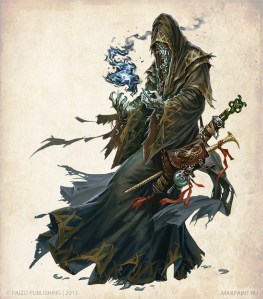
Xanthir Vang

Xanthir Vang

Sixth Session (11 page pdf) – We slay Xanthir Vang, and then it’s mostly all over but the looting.  The extensive, extensive looting.

A spellcaster I can’t grapple?  Well that’s a corker.  I use my mythic maneuver power to Dirty Trick him while everyone else tries to figure out how to hurt him.  Sadly, “area effect spells” are what we don’t use, though apparently they would have been great.  After an epic fight, we kill him anyway.

End of battle quote, courtesy Bruce our session scribe, who often lives in a parallel plane of existence:

Calanthe looks at the mass of disintegrating worms. She says, “And thus I am avenged for the deaths of my parents. This is how we treat assassins who have no respect for life.” In saying this, of course, she does not know that she is channeling the only known words of Argrath the Liberator, who uttered a sacred oath to tear the Red Moon from the Middle Air.

An insider note – Xanthir offered a question-for-question info exchange.  We agreed, as long as Tabregon answered the questions.  This is a bit of an inside joke; Bruce, Tabregon’s player, both attends via Skype (and sometimes gets a warped impression of what’s going on as a result) and is somewhat notorious for not being able to explain things in a concise and coherent way.  We all giggled at the thought of this being put to good use against our enemies for once. Xanthir got frustrated fast and just went to combat. Heh heh.

The rest of the time we piled up loot. Next, we’re on to The Midnight Isles!

D&D 5e PHB Readthrough, Chapter 7: Using Ability Scores

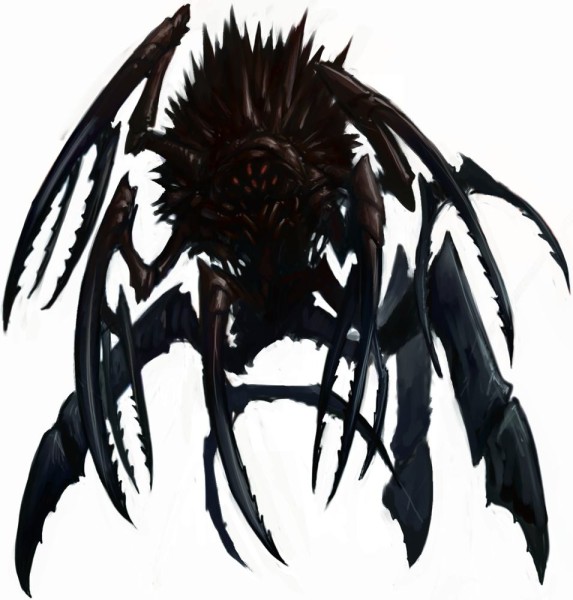
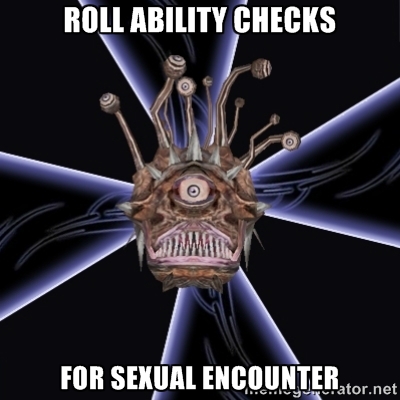
beholderWelcome to this installment in my D&D Fifth Edition PHB readthrough and review. We are entering “Part 2: Playing the Game” with a chapter on using ability scores.

First they reprint the Ability Scores and Modifiers section from earlier, in penance for their questionable organizational skills. They explain advantage and disadvantage, one of the big new mechanics in 5e – in many cases, instead of an additional bonus or penalty to a d20 roll,  you roll twice and take the best or worst die result instead. Advantage and disadvantage cancel each other. Simpler and elegant, though they’ve retained enough bonuses/penalties and other stuff to track that it doesn’t hugely simplify the system.

Finally they kinda explain skills.  They try to keep skills on the down-low in this version, basically you generally use ability checks but you can add your proficiency bonus to skills you have. Since proficiency bonuses really only range from +2 to +6 that means that, barring other abilities, there’s not a huge difference between having a skill and not having it.

They also describe passive checks, which is just taking 10 on the die, done when you’re doing it repeatedly or the GM wants to do it in secret (different from 3e’s taking 10 and 20). And working together, which provides advantage.

Group checks have an interesting mechanic – everyone makes the check and if half or more succeed, the group succeeds.  This removes the shitty “everyone makes a roll and one person is going to fail/succeed because probability” problem in earlier editions, very elegant.

Next they just go into what you use Strength, Dexterity, etc. for.  None of this is all that new and surprising, except DEX gives you bonuses to both attack and damage with ranged and finesse weapons, 4e-style. A sidebar on hiding sweeps away hundreds of pages of rules lawyering from previous editions, just saying “you can’t hide if someone can see you – but if you’re hidden you can sneak up on someone if they’re distracted, at the DM’s discretion.” You know, like all sane people have done it. (Google “The Rules Of Hidden Club” if you want to see how pathetically insane rules lawyers have gotten on this topic.)

And then saving throws are just ability checks (plus proficiency if applicable).

So the general message is… Ability checks! Roll them!

D&D 5e PHB Readthrough, Chapter 6: Customization Options

customWelcome to this installment in my D&D Fifth Edition PHB readthrough and review. We’ve reached the end of the Character Creation section.  Now it’s time to customize.

By customize, I guess we really mean “some more spare rules.”  We start with multiclassing. It works like 3e where you can add levels ad hoc in whatever classes.  It has the additional twist of having ability score minimums, which is an interesting and IMO satisfying middle ground between the 1e “you need this much ability to be this class” and 3e-style “minmax however you want.”

Then there are feats. Feats are optional in 5e, you take them in place of an ability score advance (every fourth level). Since you have fewer of them than in 3e, each one is pretty buff.  In fact, oddly, some give you one point of ability advance anyway. Even the “skill” ones are good – let’s take “Actor,” which would be +2 to 2 skills in 3e (yawn).  Here, it gives you +1 Charisma, advantage on deception and performance checks, and an ability to mimic someone’s speech. Many are of course combat focused, like Dual Wielder gives you +1 AC and the ability to 2-handed fight with non-light weapons, and the ability to draw or stow 2 weapons at once.  I like how many of them add those little details (like the draw/stow) that show they’ve thought through the little details. A couple are boring (Skilled – Gain proficiency in 3 skills!) but that’s the minority, and they’re designed to help you push in some character direction you can’t get by class min-maxing in the new regime. And, they’re not strictly better than the +2 to a stat (though since the limit is 20, if you put a high number in your primary stat, a couple advances probably cap you out and you are looking to diversify anyway).

There’s only 42 feats, but each one is meaty, and you’re only going to get a fistful with any character, and I’m sure more will come (whenever they decide to publish anything else…).

And we’re done with character generation!  Solid all in all. Streamlined and not as fiddly as 3e, but more consistent and customizable than 2e. And a real role-playing game and not a pure tactical boardgame like… Uh… Some editions.

Wrath of the Righteous Chapter Three, Demon’s Heresy – Fifth Session

Jerribeth

Jerribeth

Fifth Session (11 page pdf) – After a brief regrouping, we head out to the Ivory Labyrinth where we fight Jerribeth, a fetching looking mythic glabrezu demon, and send her down the dark road to the black mountain from which none ever return. Then we come face to… something squirmy with the worm-man sorcerer Xanthir Vang and, one can only assume, his magical pan flute!

First, though, Trystan convinces Arushalae to give him her magical bow as, you know, part of her repentance. This gives Antonius a very, very poor impression of Trystan. Avarice is non-good in general but Irori teaches separation from all earthly entanglements, so this is double grody to him. If this were a real good story, people’s sins would get used against them at some point during the AP but I’m sure that won’t happen.  It would be boss though.

We get to the Ivory Sanctum and find Jerribeth, who looks fair but is really just a glabrezu.  I grapple her anyway, which hurts a lot but I’m trying to become the ultimate mythic grapple monster so it’s good practice. It doesn’t stop her attacks but it sure stops her spells. I repeat my mocking schtick about “redeeming everyone!” when we defeat Jerribeth…

“OK, now let’s lead her on the road to redemption!” he declares, pausing long enough to see the horrified expressions on his comrades’ faces before snapping the demon’s neck.

Then we kick in a lot of buffs and just rampage through the complex. “Don’t stop to loot – there’s more kill to be had!” we cry as we sprint past our downed foes to the next room. We only halt once we get to Ol’ Wormy himself… Next time!

Wrath of the Righteous Chapter Three, Demon’s Heresy – Fourth Session

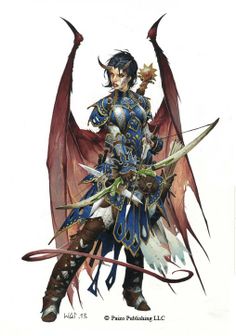
Arushalae, Reformed Succubus

Arushalae, Reformed Succubus

Fourth Session (9 page pdf) – We find an allegedly reformed succubus and fight a sea of enemies on her behalf, just like with a normal succubus.

So this reformed succubus sends Tabregon a dream and we go get her and kill her enemies and she’s good and we of course believe her and want her to come join the Crusade because those guys are just poopy-head racists whenever they don’t like anyone with horns.

As you can tell from the tone there I started to get a bad attitude about this time and I’ll explain why.

Here’s the problem I have – it’s partly with this adventure path, and partly with how some of our party is acting around these “redemption” plotlines. We’re just eating the plot-points like so much pablum without any real roleplaying or interesting conflict about what’s supposed to be difficult moral decisions.  I’m not dumb, I’m sure she really is supposed to be good and there’s no “game success” repercussions to blindly trusting her.  That’s par for the course for these Paizo storylines, they usually only have one layer of complexity to them and don’t require you to really think or make hard decisions to succeed. What I do object to is not having any realistic push-back at all.  Succubi, what with the telepathy and dominate person? So we should all automatically back her?  I’m sure the crusaders won’t just throw us in the hole and execute her when we return, but they *should*, or at least there should be the threat of that.  “Detect evil” and metagaming shouldn’t settle every argument and some of these attempted redemptions (we’ve hauled a half dozen high level evil folks back to camp and dumped them there as possible proteges) should bite us in the ass.

I like the idea of a good campaign, and of the possibility of redeeming some foes – I’m usually the only one in most of our games suggesting we don’t just kill all our enemies out of hand. Everyone shouldn’t be unremittingly evil or there’s never any hope or changing people. But the way this is playing out, it just makes it… Cheap. There’s just no drama about it.  So it makes me bored.  As an Irori-ite I find Chaos just about as objectionable as Evil, but I’m sure no one in the group is interested in talking about that philosophical point so bah.

I understand some people like their games like this, but to me this kind of thing is the interesting crux of roleplaying so when it gets short shrift it drains most of the enjoyment for me – I could give a shit about killing more monzterz for their XPz. Story shouldn’t be video game cutscenes inflicted on you… I am trying to push more real in-character discussion on this stuff but we don’t have all of the group IC at the same moment pretty much ever so it’s hard to get going.

Wrath of the Righteous Chapter Three, Demon’s Heresy – Third Session

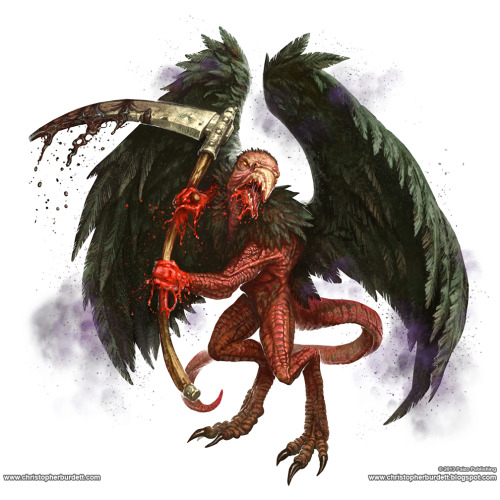
Vrock

Vrock

Third Session (7 page pdf) – a Woundwyrm and mythic vrocks decide to challenge our Mythic Bullshit ™ but are thwarted! And we thaw out some new friends.

We prepped heavily for the fight with the Woundwyrm and it ended up being quite mobile and complex. Tsuguri’s aura of madness ability is the real star here, causing the beast to lose several rational moves.

“I know, let’s redeem it!” exclaims Antonius! Before everyone is done with their expressions of shock and horror,  he finishes it a swat from his weapon.

After we kill it we bust out some guys who got turned into statues, and one, Trevor, is Sosiel’s lost brother and has written a long sad letter to him.  We joke about delivering the letter and then trotting his brother out 30 seconds later. He’s pretty buff, so I try flirting with Trevor but to little effect.

Then we go to my Place of Destiny ™ and kill the mythic vrock that engineered the evil ritual that set me on my path to mythic notability.

This was a pretty tactical session but I was punchy so I got in a lot of little quips.

Wrath of the Righteous Chapter Three, Demon’s Heresy – Second Session

Second Session (14 page pdf) – Our heroes continue to investigate the Worldwound and slay various beasties found therein.

First up: The Shrine of the Fallen. Interesting note, we were having fun with playing explorer and naming all the terrain features we came across regardless of whether anyone else had named them (natives, what do they know) and I declared this place the Shrine of the Fallen.  And later we found out that was totally its name and the undead that haunt it are called “fallen.” Noice!

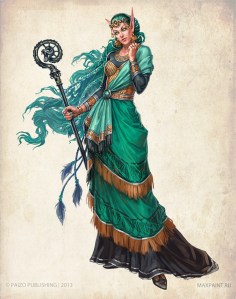
Zanedra

Zanedra

Next up: Some half elf chick named Zanedra and some Baphomet cultists. She has a monster with her that turns out to be her eidolon, she’s a summoner! Its name is something like “Spinnarabeth,” which is weird because the suffix -beth is used for a lot of villain names in this AP. I immediately develop a conspiracy theory that this is usual among evil people and resolve to keep a better eye on Irabeth back in Drezen. We take Zanedra captive and send her back for justice, which might be dangerous (won’t her eidolon just come back? Eh, who knows.).

Then it’s bodaks… Shawanda, Trystan, and I pretty much kill whatever we get to hit so it’s just a race to see who goes first.

Antonius steps into the bodak and smites it three times with his three-section staff. He destroys it utterly. Shawanda puts her sacred blade back into the scabbard with an irritated sigh.

But then I fail to kill Skullgrim the nabassu in one attack routine and she gets to kill him, so balance is restored to the force.

Wrath of the Righteous Chapter Three, Demon’s Heresy – First Session

Jesker Helton

Jesker Helton

First Session (11 page pdf) – We fight some random wildlife and then have a brotherly encounter with some barbarians.  Not really.

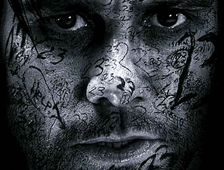
We are on a quest to find some demented priest of Erastil who has gone all Number 23. We find him and kill the demon he vomits up.  He’s still evil, but then again so is everyone we take on as minons in this AP. The dead Erastilian hero whose tomb we find him in is interred with some super magic bow that Trystan covets.

Trystan recovers his commune spell to ask the burning question, “Would Erastil want us (me) to have Delamar’s bow?”
Shelyn’s reply, “No.”
“What’s that Shelyn? I can’t quite make you out… zzzzCRACKLE,” says Trystan.
The rest of the group stares sternly at him and he sighs.

Retriever

Retriever

Then, we go on patrol with Jestak our evil barbarian captive.

Trystan raises the alarm, “Evildoers are afoot!” Antonius and Jestak leap to their feet.
Jestak yells, “Evildoers? I have been told we hate evildoers!”
Shawanda stares sternly at Jestak.

I got to try to grapple a retriever, which actually posed a grappling challenge for me which was nice. I talk everyone into bringing the jewel-eyed spider skulls back to complete our dance club in Drezen.

I had to leave before the next part, where the group got to Winter Sun Hall and met up with a barbarian leader who is connected to Shawanda (he calls her “Sister,”), they both were exposed to the same awfulness that started her down her mythic path. He attacks, and Trystan just kills him with an arrow of human slaying. Apparently the keeping everyone evil alive stuff only applies in some cases, when it won’t cause a huge buzzkill for someone else’s plotline. Sad trombone.

Wrath of the Righteous Chapter Two, Sword of Valor – Sixth Session

Sixth Session (12 page pdf) – And finally we liberate Drezen and retake the Sword of Valor! We relax by going to kill some grandmas.

Deeper in the dungeon, a bunch of Deskari statues do a phantasmal killer on the NPC Sosiel; he lives but is driven insane. I have to choke him out too (I choke out about one person per game session). Then, it’s a Grimtooth’s Traps moment with a pit of green slime that nearly devours Shawanda totally.

Then we find Aron Kir (Sam Winchester) under the thrall of a shadow demon. I KO him, the demon comes out and it gets frisky. It tosses Shawanda all the way back into the green slime pit, which is entertaining in a morbid way. It turns into a festival of me and Shawanda tanking it, the healers pouring healing into us, and Calanthe magic missiling away (sovereign against incorporeal foes!).

We come away with the Sword of Valor.  Huzzah!

Then we get Drezen in order and try to redeem/heal our various evil and/or insane posse.

  • Joran Vhane – evil dwarf
  • Chaleb – evil homicidal cavalier
  • Uziel – evil tiefling rogue
  • Sosiel – insane cleric
  • Aron – formerly possessed drug addict
  • Jestak – evil homicidal barbarian

Yes, these are the understudies for our party of paladins.

Octoeagle

Octoeagle

We go out on patrol and find three crazy grandmas who are actually hag cultists of Lamashtu conducting Island of Dr. Moreau experiments and have created a largely-useless “octoeagle” (octopus/eagle hybrid) and “clawyote” (coyote with crab claws). We kill them for crimes against nature. We loot their country-clutter decor with abandon and take the two animals back to be mascots for our two army units.


Track Your Treasure

Ah, killing people and taking their stuff.  It’s great fun, but in this era of Christmas Tree Syndrome it’s hard to keep up with all that loot!

The GM tells you about some stuff when you loot your dead opponents – and a lot of details are held till later (magic, street value). Sometimes no one writes it down, and that item is lost forever.  Sometimes multiple people write it down and you have a conflict later on. Sometimes when you go back and ask the GM “OK so was that morningstar magic?” he responds “what morningstar? You mean two or three sessions ago? I have no idea.”

For our Pathfinder games, I developed a solution.  (It’ll work for any game though.) It’s an easy to use Excel spreadsheet that you use to log treasure, distribute treasure, and handle selloffs and money splitting. So I’m sharing it with you! (cc-attribution-sharealike).

The Geek Related Treasure Distribution Spreadsheet

It has an instructions tab, but here’s how it works.  When you get loot you log it on the Party Treasure tab with who you got it from and when thus:

partytreasure

Then any time someone claims an item, you cut and paste it to the Distributed Treasure tab and add who got it and when thus:

distributedtreasure


And you never have to worry again! It makes organizing distributions easy, and selling off unwanted loot and splitting the profits. Money is handled slightly differently on the Coinage tab thus:

coinage

It has a couple formulas but it’s not fancy, mainly it’s just a well thought out format that is a) really fast to enter when you’re in the middle of a game and b) efficient to do distributions and sell-offs. Now the GM has some context to help him remember that maybe-magic morningstar (Oh, the dead cultists right after the temple to Torag, right…), you know who got a piece of loot, and most importantly no valuable treasure just goes missing. We often do a big selloff at the end of a session when someone’s had to hurry off – now they can just go look and see how much money they got out of it.

And it’s entertaining to review late in a campaign. It’s like a historical record of things that happened.  (We gave two snake corpses to a mole-man?  Oh yeah, I remember that…).  It’s amazing how big the spreadsheet gets, when we get finished with an Adventure Path we look back and there’s four-hundred-odd entries… Add extra tabs for other stuff you need to track (like I added a tab to track army food and stores for Wrath of the Righteous, or caravan food and stores for Jade Regent). Your party will love you for it! Once we started doing this we got hooked and now every single campaign has a big ol’ treasure spreadsheet at the end of it.

It works best if you put it in a Dropbox so everyone in the group can view/edit it from their computers and phones and stuff. Enjoy!  Feel free and ask questions about its use after you’ve given it a look.


Wrath of the Righteous Chapter Two, Sword of Valor – Fifth Session

Fifth Session (13 page pdf) –  Though we’ve killed Staunton Vhane, there’s a lower level that still needs clearing in Drezen. “Someone’s in my root cellar. Someone with a fresh soul!”

First we do loot distribution.  I should do a separate post with our 3l33t loot tracking and distribution spreadsheet format, it makes it easy to keep up with it all. You find literally 100 different things per AP volume and tracking it needs some rigor.

The dumb demonblood addict has run off again. We head into the dungeons of Drezen to find him and the Sword of Valor (really a banner, in a case of false advertising). Vampires and demons and such annoy us until we’re finally at a loss as to where to go, we have to bring in Staunton Vhane’s brother Joran to do the dwarf thing and show us the secret door we can’t find.

Salamander

Salamander

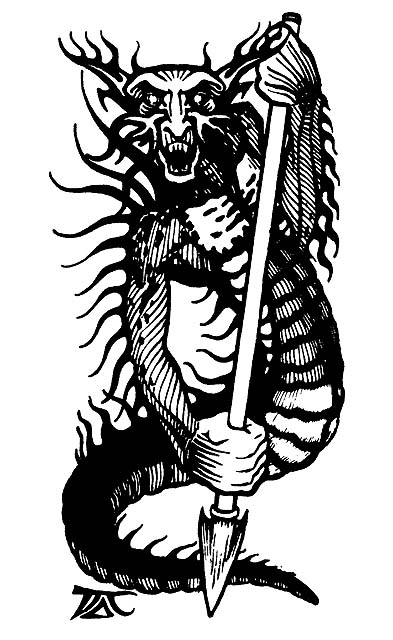
Inside, we find the Corruption Forge and a bunch of salamanders.  I love salamanders, I don’t know why. Probably the super boss AD&D MM art. Everyone else starts taking the slow way down and I just swashbuckler-swing down there, get in the middle of ’em and start whaling away. It hurts, but a lot of my Iron Mountain and Champion of Irori powers have to do with staying in one place and being surrounded…

Then it’s a priestess and schir demons and crystal widgets. Calathe actually has shatter for some reason (well, there have been a lot of demonic crystals in this campaign) and she brings it down while we destroy them in detail.